

Image 01 Image 03

BDS Tag

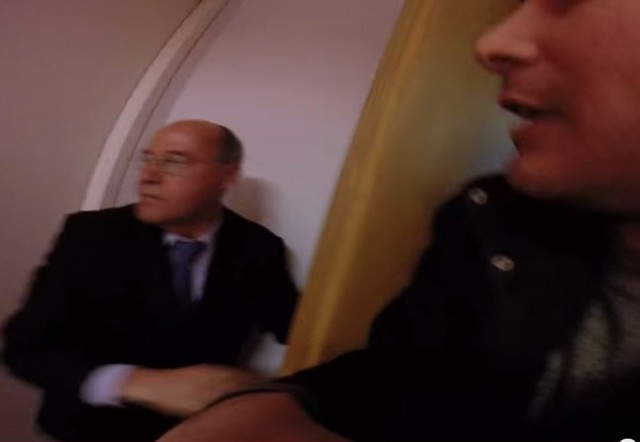
David Sheen is a name you probably haven't heard before, at least not the David Sheen who is a leading anti-Israel propagandist. Sheen, along with Max Blumenthal, travels the globe presenting a gross negative caricature of Israel worthy of 1930's cartoons. Sheen and Blumenthal were to present their anti-Israel campaign in the German Bundestag (parliament) until a left-wing German lawmaker, Gregor Gysi, objected (allegedly) on the grounds that the two were anti-Semitic. That objection reportedly almost got Sheen and Blumenthal disinvited, although they did end up giving their presentation. Sheen and Blumenthal then chased the lawmaker down the hallway. Both men got in Gysi's face, and Sheen tried to push his way into a bathroom as the lawmaker tried to shut the door. Sheen, writing at the anti-Israel, anti-Zionist Mondoweiss website, explained how it developed:
At the end of our presentations, Max called upon those assembled to join us and confront Gregor Gysi, and this call was applauded by many in the audience. A group of us then walked to his office, prepared to talk to him politely and explain the consequences of his cavalier political ploy. However, he refused to come out of his office and meet with us, even for a minute. When he finally emerged, he strode right past us at a brisk pace, and – well, you probably saw the rest – I followed him and demanded that he acknowledge responsibility for the repercussions that I would have to face as a result of his actions.
Sheen shot this video: Someone else filmed from a different angle, starting with an initial confrontation (which appears to be outside Gysi's office):
The American Studies Association annual meeting, which started yesterday, had a panel of faculty opposed to the ASA's anti-Israel academic boycott. That panel came against the backdrop of ASA being forced to abandon its previous written policy of excluding representatives of Israeli academic institutions under threat of legal action against the hosting hotel. Apparently, the anti-BDS panel's mere existence was upsetting to some boycott supporters, including Micki McGee of Fordham, who was in the spotlight when she filed a university religious discrimination complaint against a fellow professor who objected to the boycott. Fordham rejected the charge. Inside Higher Ed reports:
It was just the first day of the American Studies Association’s annual meeting here Thursday, but tensions surrounding the organization’s year-old academic boycott of Israel were already flaring. The flashpoint was an anti-boycott panel that sought to explore such questions as the role of political ideology in academic debate, whether the Israel-Palestine conflict is within the purview of the ASA, and whether academic boycotts are a legitimate means to political ends. But while some attendees said they appreciated the panelists' thoughts, others accused them of perpetuating a “for” or “against” line of thinking they said has done irreparable damage to the discipline.

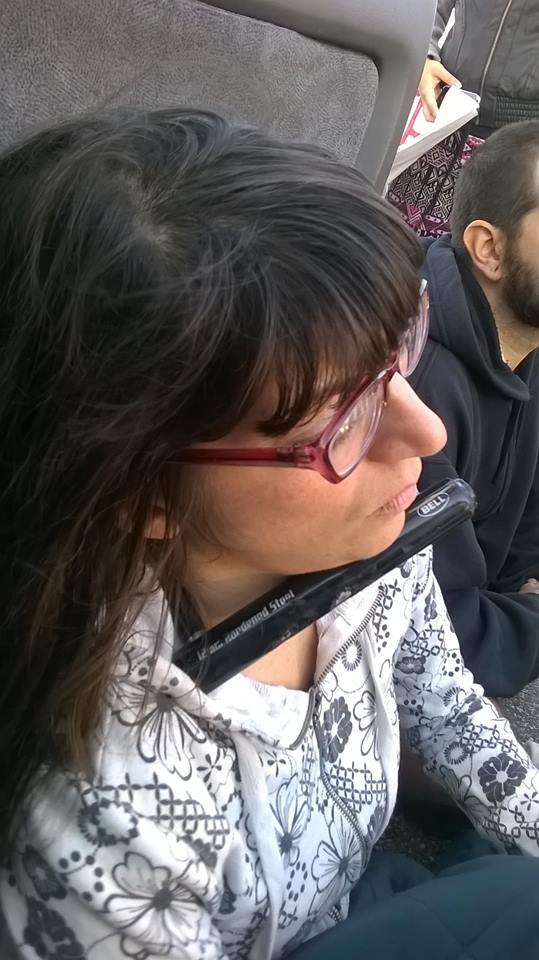
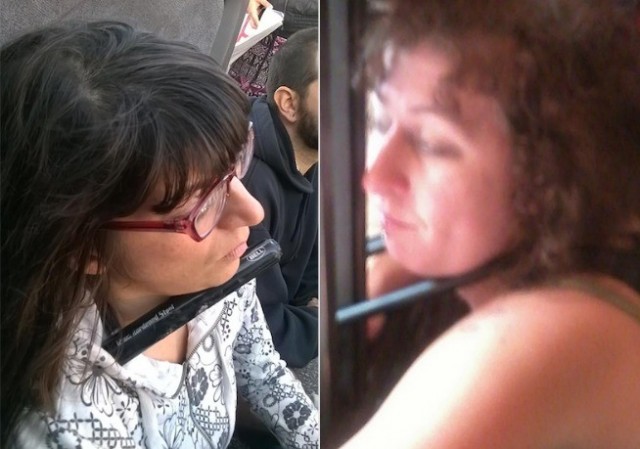
Some people. The first image is an  Anti-Scott Walker protester who, along with a friend, locked her head to State Capitol railing in June 2011 in a budget protest, via JSOnline.  The police broke the lock and released her.  At the time we noted there was a simpler solution:
Turn out the lights, lock the doors, and go home. And leave them there.
Wisconsin State Capitol head lock The second image is from the anti-Israel "Block the Boat" protest in Tampa this weekend, via Twitter account Global Revolution TV.  Presumably, she too was unlocked by police: Tampa Block the Boat Head Locked Here's the view from another angle, via Twitter user RadicalMedia_:

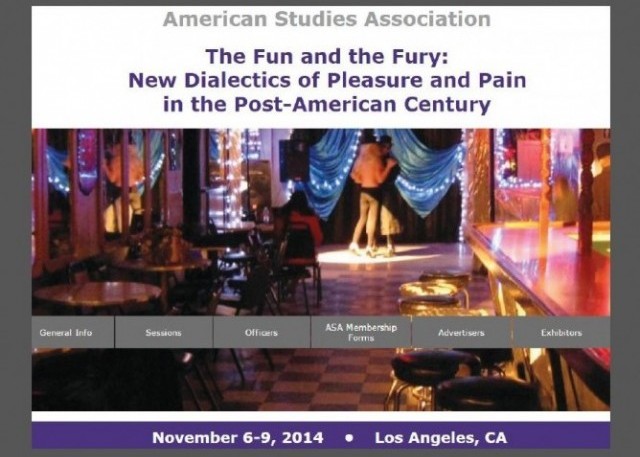
We have covered the academic boycott of Israel extensively, focusing on the American Studies Association. Recently, in connection with the ASA annual meeting this week in Los Angeles, we reported on ASA's discriminatory policy to bar attendance by representatives of Israeli Universities or any Israeli academic holding a representative title such as Dean or Rector. After a letter alerting the hotel hosting the ASA annual meeting, The Westin Bonaventure, to the hotel's legal obligations and potential liability, the ASA changed its position. The legal challenge was that hotels are bound by laws barring anti-discrimination in public accommodation, and therefore have a legal duty not to knowingly permit discrimination on the premises. In reaction, ASA denied that it ever had the discriminatory policy which ASA in fact published multiple times and had on its website. ASA even announced that it welcomed Bibi Netanyahu to the conference. In another development, as reported by Eugene Kontorovich at Volkokh Conspiracy at The Washington Post, The Times of Israel, and JNS, among others, the Rector [Dean] of the University of Haifa is taking up the challenge, and sending an official representative to the ASA conference. As part of my occasional and continuing efforts to access new audiences, I have a column about the ASA conference at the O.C. Register, Unfairly singling out Israelis. In the column, I examine how the public and the hotel would have reacted if the discrimination were directed at any national origin group other than Israelis. OC Register Unfairly Singling Out Israelis Here is an excerpt:

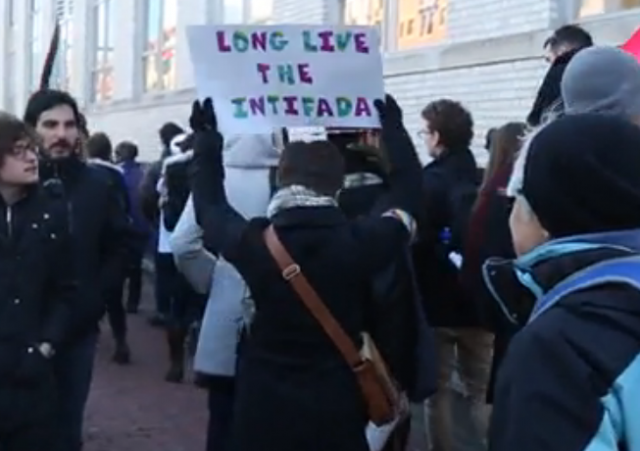
We made the Students for Justice in Palestine Zionist enemies list. I really can't imagine why. Maybe it's because we exposed in great, fully-documented detail, what SJP on campus actually represents. How SJP at Northeastern University engaged in "dorm storming" and marched to the chant of "Long Live Intifada" (the bloody suicide bombing campaign directed at Israeli civilians). And the dorm storming at New York University, in violation of university rules.

Ever since I started covering the anti-Israel academic boycott of the American Studies Association in December 2013, I have interacted with some of its members who are reasonable people concerned about the direction the ASA has taken.  But those voices have been drowned out by a shrill and vocal minority.

A little publicized fact is that less than one quarter of the membership voted in favor of the boycott (and depending on which membership numbers you use, perhaps as few as 16%), but it was enough to change the course of the organization due to low overall participation.

Once known as a somewhat obscure but well-regarded organization, ASA now is a pariah (as the NY Times described it) because of the boycott. ASA has become the poster child for how a relatively small group of anti-Israel radicals can take over key committees of a relatively small organization and leverage that power for a political agenda.

In this case, the agenda is the Boycott, Divest and Sanction movement, conceived of and scripted at the anti-Semitic 2001 Durban conference.  Part of the Durban script was to have Palestinian civil groups issue a call for a boycott.  That took place, and now groups like ASA cite the civil call for a boycott as their justification, ignoring its roots and preplanning.

At a time when the Humanities and Social Sciences are suffering and Ph.D. graduate students in fields like American Studies have few job prospects, the leadership and activists at ASA devote their energies to demonizing and delegitimizing Israel.

During this year's annual meeting, an entire day will be devoted to an offsite program run by ASA's Activism Caucus (yes, there really is such a thing) to teach faculty from around the country how to boycott Israeli universities, faculty, and scholars. ASA in a real sense has become a political activist organization.

The boycott, as applied to ASA's annual meeting, was discriminatory, and the hotel was put on notice that the hotel had potential liability.

We have covered the American Studies Association academic boycott of Israel since inception, and compiled the definitive list and accompanying statements of universities and associations rejecting the boycott.  Scroll through the ASA Tag for the full history. The short version is that the boycott targeted all Israeli academic institutions, and importantly, faculty and scholars acting on behalf of the institutions either as representatives, ambassadors or by virtue of administrative status. From the earliest days of the ASA boycott, ASA tried to make a distinction between individuals and institutions, as if boycotting an institution was not also boycotting the people who worked there. That was a critical charade, because the boycotting of individuals was too odious even for many people supporting the academic boycott.  So ASA could have a boycott of individuals while pretending it was not boycotting individuals. That ASA distinction was set forth in a December 4, 2013 statement of the ASA National Council supporting the boycott and advocating for membership approval:
Our resolution understands boycott as limited to a refusal on the part of the Association in its official capacities to enter into formal collaborations with Israeli academic institutions, or with scholars who are expressly serving as representatives or ambassadors of those institutions, or on behalf of the Israeli government ....
That is a distinction ASA made throughout its public statements and position papers -- if you were a representative of an Israeli institution, or if you had an administrative title, you were boycotted. For example, a form letter ASA distributed to members to be given to university administrators made the same distinction:

We have covered extensively the anti-Israel academic boycott passed by the American Studies Association, including yesterday when Doron Ben-Atar, a Fordham University History Professor, revealed that he had been subjected to "religious discrimination" charges by the pro-boycott head of Fordham's American Studies Department, Micki McKnee, after he called the boycott anti-Semitic. Ben-Atar was cleared of that charge but faces administrative threats for vowing to "fight" the ASA boycott. The ASA is having its annual meeting in Los Angeles in early November at the Westin Bonaventure. The ASA has stated that it will apply its boycott rules to exclude from the conference Israeli academic institutions and any individual Israeli academics who are there on behalf of their institutions or who hold administrative capacity (e.g. Dean). Only individual Israelis who pass the test of not being there in a representative capacity will be allowed to attend. These rules are unique to Israelis, and constitute national origin discrimination and potentially religious discrimination in violation of California's expansive anti-discrimination and public accommodation laws. That puts the Westin Bonaventure at legal risk, because those discriminatory rules are being applied at a conference on its premises. The American Center for Law and Justice, headed by Jay Sekulow, has sent a letter to the Westin Bonaventure, its owner and operating management, alerting them to the Westin Bonaventure's legal risk and obligations. The letter is posted on the ACLJ website and press release, and reads in part:

In December 2013, the American Studies Association passed an academic boycott of Israel, the first group of substantial size to do so. That led to a massive outpouring of outrage and rejection by over 250 university presidents and numerous university associations, not to mention the American Association of University Professors. The ASA boycott was passed with less than 20% of the membership voting for it, but so few people participated that it was enough. The anti-Israel political activists who dominated the ASA "activism" caucus and national council used their influence to the utmost, something we have detailed here repeatedly. The opposition to the boycott resulted in the ASA playing victim, claiming that criticism of the boycott and steps by university presidents to reject the boycott somehow was an infringement of the boycotters' academic freedom. As if academic freedom meant freedom from criticism and the ability to politicize an issue only when pro-boycott. But it appears that in the trenches, the attacks on those opposing the boycott have been even more vicious. One such incident involved Fordham professor Doron Ben-Atar, who writes about his experience at The Tablet today, Kafka Was the Rage:
The email arrived on the last Friday afternoon of the spring term shortly before 5:00 p.m. Anastasia Coleman, Fordham’s Director of Institutional Equity and Compliance, and its Title IX Coordinator, wanted to meet with me. “It has been alleged,” she wrote, “that you may have acted in an inappropriate way and possibly discriminated against another person at the University.” ... “Did it have anything to do with a student?” I shot back anxiously, hoping to get a sense of my predicament before the director left for the weekend. I was lucky. Coleman responded immediately. “This does not involve students and is about your behavior regarding American Studies.”

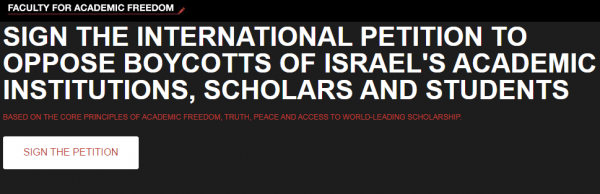
We previously mentioned that a pro-Academic Freedom Petition was circulating among faculty and researchers, specifically objecting to the academic boycott of Israel passed by a small number of groups, such as the American Studies Association. The Petition has now passed 1200 signatures, mostly from faculty at universities in the United States, but including some international faculty, researchers and scholars. This is an important development, as some anti-Israel activist groups misleadingly attempt to portray academia as stifling speech hostile to Israel. Nothing could be further from the truth. In fact, there is a pervasive campus climate of hostility to Israel led by pro-boycott faculty, concentrated in the Humanities and Social Sciences. The anti-Israel academic boycott covers  Israeli institutions of higher education, and demands termination of exchange programs, terms abroad programs in Israel,  academic cooperation, and any attempt at normalization of relations among scholars.  The comprehensive boycott of these institutions by its nature includes a boycott of the faculty and staff at such institutions. In practice, the boycott such as that of the ASA, includes refusing attendance at conferences by the individuals representing such institutions or who carry administrative titles.  It is a boycott of individuals. The faculty supporting the academic boycott of Israel disregard calls by over 250 university presidents, numerous university associations, and the American Association of University Professors, that such systematic academic boycotts threaten the academic freedom of all of us. The anti-Israel boycotters have taken over some professional organizations, where a relatively small number of activists can manipulate key committees and national councils. But the academic boycotters do not represent the majority. This Petition is just a first step in the silent majority in the academic community speaking up -- not to take sides in the Middle East dispute, but to speak out against those who bring the war into the classrooms and hallways regardless of the consequences.  Enough already. The Petition remains open, and more signatures are anticipated as the word spreads. [caption id="attachment_100289" align="alignnone" width="600"]http://facultyforacademicfreedom.org/ (Click on Image to go to Petition page)[/caption] You don’t have to be “pro-Israel” to sign — only pro-academic freedom, pro-fairness, pro-intellectual honesty, pro-education and pro-peace. Here’s an excerpt from the Petition:

We have posted many times about how the Boycott Divestment and Sanctions movement, through faculty and Students for Justice in Palestine branches, has turned campuses and classrooms into political battlefields in the worst way. When Northeastern University SJP marches to the chant of "Long Live the Intifada," they are celebrating the bloody suicide bombing campaign. When Vassar College SJP pickets a class and forces a professor to walk the guantlet just because the course involved a trip to Israel, and anti-Israel students jeer Jewish students who spoke up for Israel, they are sending a message of continued conflict -- so it was no surprise when Vassar SJP tweeted out a Nazi cartoon. When NYU SJP dorm storms and invades the privacy of students in their dorm rooms to leaflet against Israel, they bring the war into bedrooms. When the faculty members of American Studies Association bring the war to campus through an academic boycott of Israel led by people whose explicit goal is the destruction of Israel, it sends a message to students that to be pro-Israel is to be unacceptable in the classroom. When faculty are willing to destroy academic freedom for everyone in order to hurt Israel, yet play victim when their own academic freedom allegedly is impinged, the argument no longer is over principle but pure power. When conspiracy theories involving Jewish control of the media and the money are central to the arguments of BDS supporters who claim not to be anti-Semitic, anti-Semitism flourishes. When a central thesis of the student, faculty and off-campus leadership of the BDS movement on campuses is that Zionism is the cause of anti-Semitism, and even Naziism, anti-Semitism is rationalized. When stoking and exploiting racial tension is a common tactic used to increase hatred of Israel, and BDS refuses to allow Arab and Jewish students to interact for fear of "normalization," BDS tears campuses apart. When making it costly to be pro-Israel on campus is the major achievement of student BDS activists, discussion is impossible. When BDS banners and messages are at the front of Jew-baiting crowds in Europe, Boston and Miami, it's clear what BDS is about.

The fight over the academic boycott of Israel in the United States mostly is confined to professional associations in the Humanities and Social Sciences, where anti-Israel activist faculty have some ability to rig the system in their favor through control of key committees and programs. Unlike in the real world at universities, the faculty who take control of professional organizations are not counterbalanced by the faculty as a whole, students, administrators, trustees, parents and alumni.  Professional organizations are the perfect vehicle for anti-Israel activists for this reason. The activists have the ability filter the debate and tailor the information provided to membership so as to provide a one-sided view. That's what happened at the American Studies Association, which passed a boycott resolution but refused to distribute to the membership materials requested by the pro-Israel side. The resolution passed with less than 20% of the total membership voting for it, because of low overall participation.  Since then the ASA has turned into a full-time boycott entity, with its executive board calling for a complete boycott of Israel in all aspects, and an entire day of boycott organizing scheduled alongside its Annual Meeting. At the Modern Language Association debate last January on a resolution critical of supposed Israeli travel restrictions on academics, the panel discussion at the annual meeting was limited to anti-Israel activists. At the house of delegates, pro-Israel faculty did get a chance to argue against the resolution, and with that the resolution -- which had been expected to pass easily -- barely passed, and only after the language was watered down. When put to the entire membership, the resolution failed to gain the needed votes, and failed. Rigging the debate appears to be happening now at American Anthropological Association for an upcoming debate, as Haaretz reports, U.S. academics bemoan 'rigged’ fight in battle against BDS:

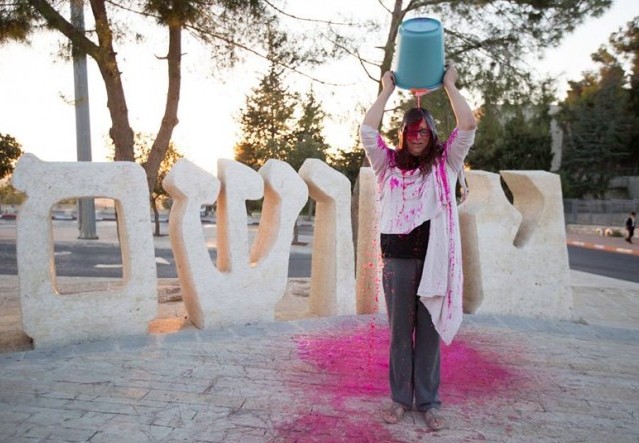
We preciously covered the "blood bucket challenge" carried out by Ohio University student senate president Megan Marzec, in which she hijacked the ALS Ice Bucket Challenge in order to bash Israel. [caption id="attachment_98557" align="alignnone" width="550"]Ohio U. Student Senate President Megan Marzed "Blood Bucket Challenge) (Ohio U. Student Senate President Megan Marzec anti-Israel "Blood Bucket Challenge")[/caption] Marzec's politicization of a charity fundraiser meant to raise research funds for an incurable disease sparked widespread outrage, and protests on campus. One of those protests was at a student senate meeting where Marzec had protesters arrested by campus police when the protesters insisted on being able to present their objections outside the allotted speaking time.  The protesters continue to face criminal charges for "disrupting a public meeting."