

Image 01 Image 03

Iran Tag

On January 21, 2015, Josh Rogin and Eli Lake at Bloomberg News reported Israeli Mossad Goes Rogue, Warns U.S. on Iran Sanctions:
The Israeli intelligence agency Mossad has broken ranks with Prime Minister Benjamin Netanyahu, telling U.S. officials and lawmakers that a new Iran sanctions bill in the U.S. Congress would tank the Iran nuclear negotiations. Already, the Barack Obama administration and some leading Republican senators are using the Israeli internal disagreement to undermine support for the bill, authored by Republican Mark Kirk and Democrat Robert Menendez, which would enact new sanctions if current negotiations falter.
In a rare move, the head of Mossad issued a statement denying the reports that he is against sanctions. Israel Matzav has the details and translation:
The above was just posted on TwitLonger by Israel Radio reporter Chico Menashe. Here's my translation: Reaction of the Mossad Chairman to the new crisis with Washington: On 19 January 2015, Mossad Chairman Tamir Pardo met with a delegation of American Senators. The meeting took place at the Senators' request, and with the Prime Minister's approval. Contrary to the report, the Mossad Chairman did not say that he opposes additional sanctions against Iran. In the meeting, the Mossad Chairman emphasized the unusual effectiveness of the sanctions imposed on Iran a number of years ago in bringing Iran to the negotiating table.

Is there anyone who gets Obama more upset than Bibi Netanyahu? It's not for nothing that unnamed senior administration officials called Netanyahu "chickenshit" and mocked Israel's failure to attack Iran. There is no love lost in that relationship. Remember when Bibi lectured Obama in front of reporters in 2011, setting off a furious reaction? And Obama left Bibi in the White House to go have dinner with the family. And on, and on. Oh, and when Bibi got more standing ovations during a speech to a joint session of Congress than Obama did in his State of the Union? The way Netanyahu dealt with a heckler was classic:

Alberto Nisman, the Argentinian prosecutor who investigated the 1994 bombing of the AMIA Jewish center in Buenos Aires and documented Iran's extensive terror ties in the western hemisphere, was found dead at his home Sunday night of a bullet wound to the head. Nisman was slated to testify today on his latest explosive accusations that the current government of Argentina, specifically President Cristina Fernández de Kirchner, purposely covered up Iran's involvement in the bombing in order to preserve a grain-for-oil deal with the Islamic Republic. The New York Times reports:
The body of the prosecutor, Alberto Nisman, 51, who had been heavily protected by police sentries because of threats, was discovered Sunday night. He had been scheduled to testify on Monday at a congressional inquiry about his accusations. The security minister, Sergio Berni, said evidence at the scene, including a .22-caliber pistol and spent cartridge found near Mr. Nisman’s body, indicated suicide. An autopsy announced later said he had died of a bullet wound to the head. But the news immediately provoked shock and outrage from the political opposition and leaders of Argentina’s Jewish population, Latin America’s largest, who demanded a transparent inquiry into his death. The timing appeared to put a skulduggerous international shadow over his accusations.

Yesterday we reported how an Israeli helicopter strike just over the Syrian Golan border killed several senior Hezbollah terrorist leaders, including Jihad Mughniyeh, the son of legendary and assassiated Hezbollah terror coordinatior Imad Mughniyeh. The elder Mughniyeh was responsible, among other things, for the Marine barracks bombing in Beirut that killed hundreds of Americans. A total of six senior Hezbollah military leaders were killed: https://twitter.com/One4Zion/status/556998160284139520/photo/1 A Hezbollah leader even more important than Jihad Mughniyeh also was killed in the attack:
Jihad does not appear to have been a key Hezbollah figure in the attack, however. One of the more central Hezbollah figures killed is Mohammad Ahmad Issa, who Raja News identified as an intelligence official, though other news agencies reported he was a top commander for Iraq and Syria.
In Beirut, Hezbollah is mourning its dead.

Iran recently boasted how it had transferred via Syria game-changing missiles to the terrorist Hezbollah, which controls much of Lebanon and is fighting alongside the Assad regime in Syria. Israel has warned about such missile transfers, and reportedly (without Israel admitting it publicly) bombed convoys and facilities in Syria to stop such transfers. It appears from news reports that Israel has acted again. Reuters has confirmed the bombing:
Israel has carried out an air strike targeting a consignment of missiles in Syria bound for Hezbollah in neighboring Lebanon, an Israeli official said on Saturday.... "There was an air strike. The target was not a chemical weapons facility. It was missiles intended for Hezbollah," the official told Reuters.
As with all such breaking events, photos and videos on Twitter are not yet verified as authentic.

Thanks to many for making this Thanksgiving so meaningful. This is not an exhaustive list, but it's a good start:
  • The Wife. We celebrated our 30th wedding anniversary earlier this year.
  • The Kids. Three great ones.
  • Health, and Mandy's recovery.
  • The U.S. of A. Still the place to be.
  • The Constitution and Bill of Rights. Beats any alternative I've seen.
  • Those who defend us against enemies, foreign and domestic.
  • Israel. The canary in freedom's coal mine.
  • The Readers. Seriously. Not joking.
  • The Authors, past and present. You helped build that.
  • The blogs and websites that link to us. The continued kindness of strangers is appreciated.
  • Fellow Ithaca conservatives, all ten of you.
  • The hope that the part of the human spirit that yearns to be free can prevail over evil, in Iran and elsewhere. (video h/t Caroline Glick)(original here)

It's interesting to see headlines that the P5+1 talks in Vienna about Iran's nuclear program were called a failure. On one very important level they were a success. No there was no agreement on a long term deal to roll back Iran's nuclear program. But there was an agreement to extend the Joint Plan of Action allowing Iran to keep its nuclear infrastructure in place and receive up to seven more months of sanctions relief. In other words for Iran, the negotiations were a tremendous success. Here's the Wall Street Journal (Google link):

An editorial in The New York Times today about the ongoing P5+1 nuclear talks with Iran warns about the dire consequences of the two sides not reaching an agreement.
The consequences of failure to reach an accord would be serious, including the weakening of President Hassan Rouhani of Iran and his foreign minister, Mohammad Javad Zarif, who count as moderates in Iran, and who, like President Obama, have taken a political risk to try to make an agreement happen.
That would be terrible. Rouhani and Zarif would be weakened!  Or would it? How much political power does Rouhini have anyway? And if they have any real political power, how moderate are they anyway? As far as the first question, well, they don't call Ayatollah Ali Khamenei the Supreme Leader for nothing. In an investigative report last year, Reuters showed that Khamenei using the organizations under his control has amassed a huge fortune by property seizures. David Daoud recently wrote:
More importantly, the Rahbar [the Supreme Leader] effectively decides who will or will not be the public face of his rule—that is, who will or will not be the president of Iran. Khamenei selects the 12 members of the Shura-ye Neghahban (“Guardian Council”), which is tasked with vetting and approving presidential candidates based on their allegiance to the ideals of the Vilayat-e Faqih. The Western media often calls Iranian leaders like ex-president Mohammad Khatami and current president Hassan Rouhani “moderates” or “reformers,” but the Guardian Council’s policies render such a characterization absurd. No genuine moderate or reformist candidate can get through the Council’s dragnet. In effect, then, the vetting process and the Rahbar’s ultimate authority negate any possibility of material change in Iran’s foreign or domestic policies.
In other words not only is Rouhani not the ultimate power in Iran, he wouldn't have achieved even his limited authority unless he was a true believer in the system. Rouhani is only a "moderate" in that he's willing to talk to the West to achieve his goals, but his goals and views are identical to those of Khamenei.

With the Senate flipping from Democratic control to Republican control, the question emerges whether the legislature, now in the hands of the opposition, will be able to rein in President Barack Obama in the event that he engineers a bad nuclear deal with Iran. In short, the Senate will almost certainly be more willing to stop a bad deal. The bad news is that it may be too late. As far as the deal itself, it is not considered a treaty and therefore not subject to Congressional approval. However, the sanctions bill passed by Congress allows the President to suspend (not permanently cancel) sanctions. A bill co-sponsored by Sens. Robert Menendez (D-NJ) and Mark Kirk (R-IL) that would impose stronger sanctions on Iran, if the Islamic Republic would either "violate the interim agreement or walk away from the negotiations," was scuttled by the White House in January. Although there was bi-partisan support in the Senate for the bill, Obama prevailed on Senate Majority Leader Harry Reid to keep the bill from coming to a vote. Obama viewed the bill as a violation of the P5+1's commitment  in last year's Joint Plan of Actions (JPA) (.pdf) to "refrain from imposing new nuclear-related sanctions." Since the Kirk-Menendez bill would only come into effect if Iran violated its commitments, Obama's concern seems baseless. With Reid no longer Majority Leader, the Kirk-Menendez bill should at least come to a vote, as incoming Majority Leader Mitch McConnell said in January, “We’re going to continue to press the majority leader to allow a vote on an issue that obviously enjoys the support of a very large bipartisan majority here in the Senate.”

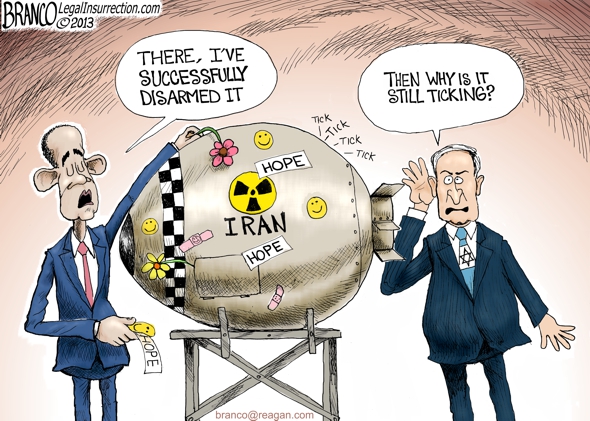
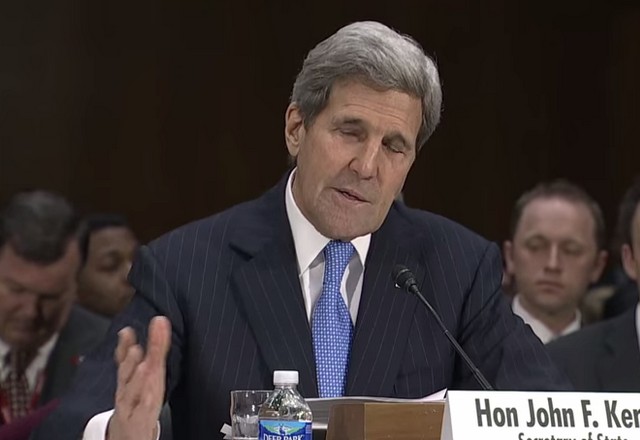
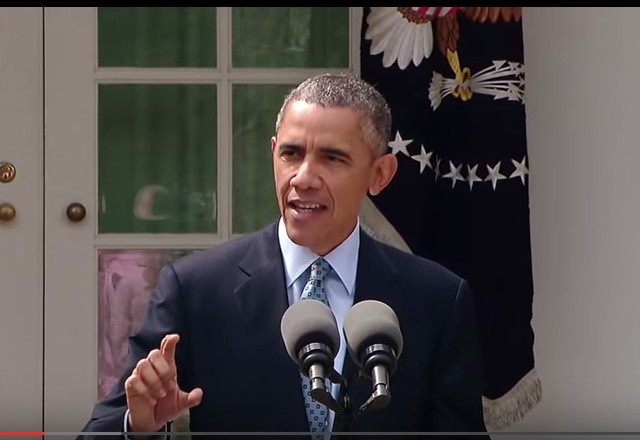
Remember when President Barack Obama said that the United States will "always have Israel's back" when it comes to Israel's security---especially in regards to Iran's nuclear program? Or when Secretary of State John Kerry said that with Iran "no deal was better than a bad deal?" They were lying. The administration's aim is to make a deal with Iran even as Israeli Prime Minister Benjamin Netanyahu warns that the emerging deal "is a threat to the entire world, and, first and foremost, this is a threat to us." Kerry's negotiation team continues to operate from a premise that "any deal is better than no deal." The Los Angeles Times is now reporting that the administration has sweetened its deal to allow Iran 4000 operational centrifuges.
The Obama administration has sweetened its offer to Iran in ongoing nuclear negotiations, saying it might accept Tehran operating 4,000 centrifuges, up from the previous 1,300, according to a semiofficial Iranian news agency. The Mehr news agency also said Monday that Iran and the six world powers seeking to negotiate a nuclear deal remained divided over how much uranium-enrichment capacity the Middle East nation should be allowed to maintain, and how to lift punitive sanctions from its economy.
Ray Tayekh, a critic of the current negotiations, observed that "the U.S. sweetener may encourage Iran to drag out negotiations to see what better offer it might receive after a few more months of talks."

At the beginning of this year, Professor Jacobson wrote an article claiming that "the most dangerous years of the Obama presidency are upon us." If the latest reports about the President's next solo move in the area of foreign policy are trustworthy, then no truer article was ever written about the Obama Administration. We've already seen President Obama take it upon himself to threaten executive action on issues like immigration and the elusive closing of U.S. detainment facilities at Guantanamo Bay. We know he wields his executive authority like a sword, and we also know he's more likely than not to start apologizing on behalf of the American people the moment we turn him loose on foreign delegations. If President Obama stays true to form, discussions about the continuation of Iran's nuclear program are about to get very, very tense. From the New York Times:
No one knows if the Obama administration will manage in the next five weeks to strike what many in the White House consider the most important foreign policy deal of his presidency: an accord with Iran that would forestall its ability to make a nuclear weapon. But the White House has made one significant decision: If agreement is reached, President Obama will do everything in his power to avoid letting Congress vote on it.

Few publications were more enthusiastic about last year's election of "moderate" Hassan Rouhani as president of Iran than The New York Times. Perhaps some of that enthusiasm stemmed from the possibility of engaging in commercial enterprises with the regime in Tehran. Ira Stoll editor of SmarterTimes noted the other day that The New York Times is promoting a tour of Iran accompanied by one of its journalists, Elaine Sciolino. After noting some of the peculiarities of the deal, Stoll writes:
There's no mention at all in the Times promotional language about the tour of Iran's status as a state supporter of terrorism, of its pursuit of nuclear weapons, or of its human rights abuses. For information about those abuses, anyone considering plunking down nearly $7,000 for the pleasure of accompanying a Times journalist on a "relaxing evening and dinner" after antique shopping in Iran may want to consider, first, browsing the State Department's latest human rights report on Iran. It reports that under Iranian law, "a woman who appears in public without an appropriate headscarf (hijab) may be sentenced to lashings and fined." It also says that "The law criminalizes consensual same-sex sexual activity, which may be punishable by death or flogging."

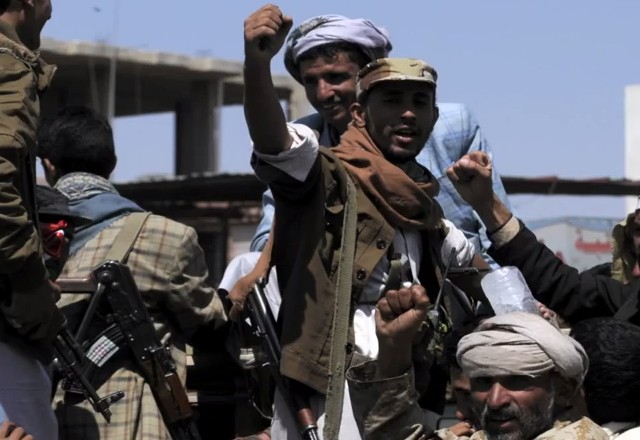
The Houthis, Iranian backed rebels have taken control of Yemen's capital, Sanaa. The Washington Post reports:
The capital of Yemen, the Arab world’s poorest and perhaps most chronically unstable nation, has new masters. Shiite rebels man checkpoints and roam the streets in pickups mounted with anti­aircraft guns. The fighters control almost all state buildings, from the airport and the central bank to the Defense Ministry. Only a few police officers and soldiers are left on the streets. Rebel fighters have plastered the city with fliers proclaiming their slogan — “Death to America, death to Israel, a curse on the Jews and victory to Islam” — a variation of a popular Iranian slogan often chanted by Shiite militants in Iraq and supporters of Lebanon’s Hezbollah.
The comparison to Hezbollah is apt as Reuters is reporting that the Houthi are blocking the appointment of Yemen's president.
Abdel-Malek al-Ejri said Hadi had suggested five names at a meeting of his advisors, who represent various political parties in Yemen. When the aides failed to agree on a candidate Hadi suggested his presidential office director, Ahmed Awad bin Mubarak, as a compromise. "But we did not agree, and the matter is still under consultation," Ejri told Reuters.
Similarly, Hezbollah has kept Lebanon's politics unsettled preventing the appointment of a President. So what's Iran's interest in Yemen? It was spelled out by Michael Segall of the Jerusalem Center for Public Affairs two and a half years ago. A couple of Segall's observations are sobering:

It is nearly a year since Iran's President Hassan Rouhani spoke before the United Nations General Assembly. Later this week he is scheduled to speak again before the General Assembly, but the enthusiasm expressed last year is nowhere to be seen. In the run up to his speech there was much excitement among the chattering classes. Take, for example, a couple of paragraphs from an editorial in The New York Times from September 22, 2013, a year ago today:
The next few weeks will be critical for capitalizing on a new sense of promise created by a recent flurry of remarkable gestures: Iran’s leadership has sent Rosh Hashana greetings to Jews worldwide via Twitter, released political prisoners, exchanged letters through the Swiss with President Obama, praised “flexibility” in negotiations and transferred responsibility for nuclear negotiations from conservatives in the military to the Foreign Ministry. Mr. Obama eased restraints on humanitarian and good-will activities, including athletic exchanges between the two countries. ... Mr. Rouhani has a sophisticated, Western-savvy team. His foreign minister, Mohammad Javad Zarif, received degrees from American universities and spent most of his adult life in the United States. Together they have raised expectations in a world eager to see Iran play a more constructive role, and the charm offensive is in full swing. Policy experts, journalists and business people are jockeying to attend a number of invitation-only breakfasts, dinners and meetings scheduled by Mr. Rouhani and Mr. Zarif while they are in New York. There’s a lot riding on their visit this week.
But the "remarkable gestures" that The New York Times cited were remarkable hollow.

This is a horribly heart-breaking story. Seven young Persians filmed their own rendition of "Happy" by Pharrell Williams, but in totalitarian regimes like Iran's, no good deed goes unpunished. A CNN Reporter tweeted the following: According to the Iran Wire, six of the accused were sentenced to six months in prison and 91 lashes, while the remaining offender was sentenced to a year in prison and 91 lashes:

Our friends over at National Review pulled this little gem. We've officially entered foreign policy bizarro world when the Department of State is absolutely refusing to work with Syria, but is open to working with Iran to fight (however they're defining that) ISIS. Blitzer asked Department of State Spokesperson Marie Harf if Syria was receiving intelligence through a third party, to which she responded, "Not at all. I can categorically reject that. We will not work with the Assad regime, we will not share intelligence with them, we will not coordinate with them. Period. Full stop. I don't want to be any clearer than that."