


Image 01 Image 03

Iran Tag

With the Senate flipping from Democratic control to Republican control, the question emerges whether the legislature, now in the hands of the opposition, will be able to rein in President Barack Obama in the event that he engineers a bad nuclear deal with Iran. In short, the Senate will almost certainly be more willing to stop a bad deal. The bad news is that it may be too late. As far as the deal itself, it is not considered a treaty and therefore not subject to Congressional approval. However, the sanctions bill passed by Congress allows the President to suspend (not permanently cancel) sanctions. A bill co-sponsored by Sens. Robert Menendez (D-NJ) and Mark Kirk (R-IL) that would impose stronger sanctions on Iran, if the Islamic Republic would either "violate the interim agreement or walk away from the negotiations," was scuttled by the White House in January. Although there was bi-partisan support in the Senate for the bill, Obama prevailed on Senate Majority Leader Harry Reid to keep the bill from coming to a vote. Obama viewed the bill as a violation of the P5+1's commitment  in last year's Joint Plan of Actions (JPA) (.pdf) to "refrain from imposing new nuclear-related sanctions." Since the Kirk-Menendez bill would only come into effect if Iran violated its commitments, Obama's concern seems baseless. With Reid no longer Majority Leader, the Kirk-Menendez bill should at least come to a vote, as incoming Majority Leader Mitch McConnell said in January, “We’re going to continue to press the majority leader to allow a vote on an issue that obviously enjoys the support of a very large bipartisan majority here in the Senate.”

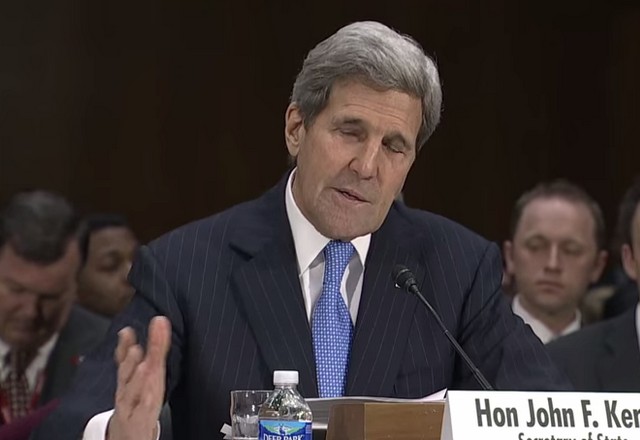
Remember when President Barack Obama said that the United States will "always have Israel's back" when it comes to Israel's security---especially in regards to Iran's nuclear program? Or when Secretary of State John Kerry said that with Iran "no deal was better than a bad deal?" They were lying. The administration's aim is to make a deal with Iran even as Israeli Prime Minister Benjamin Netanyahu warns that the emerging deal "is a threat to the entire world, and, first and foremost, this is a threat to us." Kerry's negotiation team continues to operate from a premise that "any deal is better than no deal." The Los Angeles Times is now reporting that the administration has sweetened its deal to allow Iran 4000 operational centrifuges.
The Obama administration has sweetened its offer to Iran in ongoing nuclear negotiations, saying it might accept Tehran operating 4,000 centrifuges, up from the previous 1,300, according to a semiofficial Iranian news agency. The Mehr news agency also said Monday that Iran and the six world powers seeking to negotiate a nuclear deal remained divided over how much uranium-enrichment capacity the Middle East nation should be allowed to maintain, and how to lift punitive sanctions from its economy.
Ray Tayekh, a critic of the current negotiations, observed that "the U.S. sweetener may encourage Iran to drag out negotiations to see what better offer it might receive after a few more months of talks."

At the beginning of this year, Professor Jacobson wrote an article claiming that "the most dangerous years of the Obama presidency are upon us." If the latest reports about the President's next solo move in the area of foreign policy are trustworthy, then no truer article was ever written about the Obama Administration. We've already seen President Obama take it upon himself to threaten executive action on issues like immigration and the elusive closing of U.S. detainment facilities at Guantanamo Bay. We know he wields his executive authority like a sword, and we also know he's more likely than not to start apologizing on behalf of the American people the moment we turn him loose on foreign delegations. If President Obama stays true to form, discussions about the continuation of Iran's nuclear program are about to get very, very tense. From the New York Times:
No one knows if the Obama administration will manage in the next five weeks to strike what many in the White House consider the most important foreign policy deal of his presidency: an accord with Iran that would forestall its ability to make a nuclear weapon. But the White House has made one significant decision: If agreement is reached, President Obama will do everything in his power to avoid letting Congress vote on it.

Few publications were more enthusiastic about last year's election of "moderate" Hassan Rouhani as president of Iran than The New York Times. Perhaps some of that enthusiasm stemmed from the possibility of engaging in commercial enterprises with the regime in Tehran. Ira Stoll editor of SmarterTimes noted the other day that The New York Times is promoting a tour of Iran accompanied by one of its journalists, Elaine Sciolino. After noting some of the peculiarities of the deal, Stoll writes:
There's no mention at all in the Times promotional language about the tour of Iran's status as a state supporter of terrorism, of its pursuit of nuclear weapons, or of its human rights abuses. For information about those abuses, anyone considering plunking down nearly $7,000 for the pleasure of accompanying a Times journalist on a "relaxing evening and dinner" after antique shopping in Iran may want to consider, first, browsing the State Department's latest human rights report on Iran. It reports that under Iranian law, "a woman who appears in public without an appropriate headscarf (hijab) may be sentenced to lashings and fined." It also says that "The law criminalizes consensual same-sex sexual activity, which may be punishable by death or flogging."

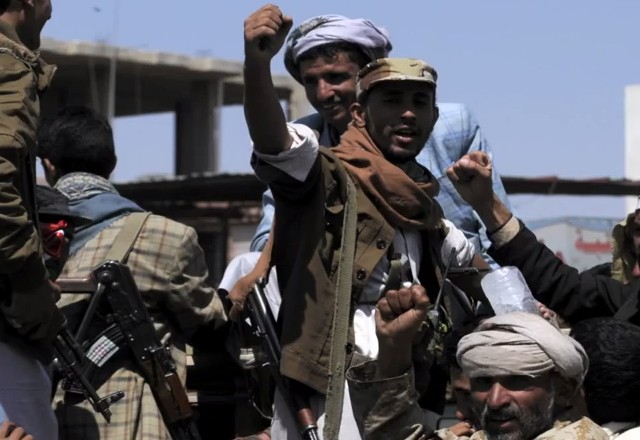
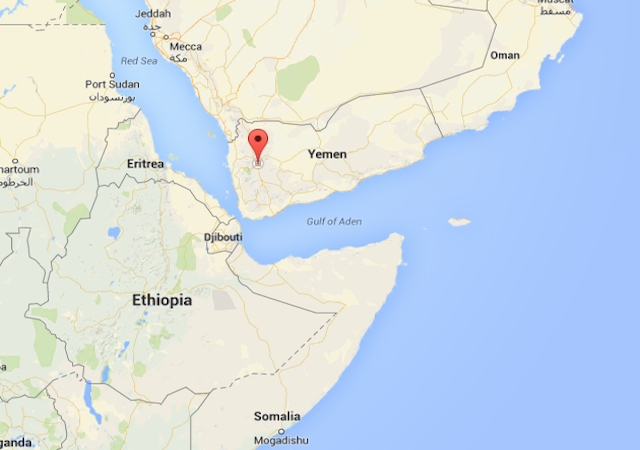
The Houthis, Iranian backed rebels have taken control of Yemen's capital, Sanaa. The Washington Post reports:
The capital of Yemen, the Arab world’s poorest and perhaps most chronically unstable nation, has new masters. Shiite rebels man checkpoints and roam the streets in pickups mounted with anti­aircraft guns. The fighters control almost all state buildings, from the airport and the central bank to the Defense Ministry. Only a few police officers and soldiers are left on the streets. Rebel fighters have plastered the city with fliers proclaiming their slogan — “Death to America, death to Israel, a curse on the Jews and victory to Islam” — a variation of a popular Iranian slogan often chanted by Shiite militants in Iraq and supporters of Lebanon’s Hezbollah.
The comparison to Hezbollah is apt as Reuters is reporting that the Houthi are blocking the appointment of Yemen's president.
Abdel-Malek al-Ejri said Hadi had suggested five names at a meeting of his advisors, who represent various political parties in Yemen. When the aides failed to agree on a candidate Hadi suggested his presidential office director, Ahmed Awad bin Mubarak, as a compromise. "But we did not agree, and the matter is still under consultation," Ejri told Reuters.
Similarly, Hezbollah has kept Lebanon's politics unsettled preventing the appointment of a President. So what's Iran's interest in Yemen? It was spelled out by Michael Segall of the Jerusalem Center for Public Affairs two and a half years ago. A couple of Segall's observations are sobering:

It is nearly a year since Iran's President Hassan Rouhani spoke before the United Nations General Assembly. Later this week he is scheduled to speak again before the General Assembly, but the enthusiasm expressed last year is nowhere to be seen. In the run up to his speech there was much excitement among the chattering classes. Take, for example, a couple of paragraphs from an editorial in The New York Times from September 22, 2013, a year ago today:
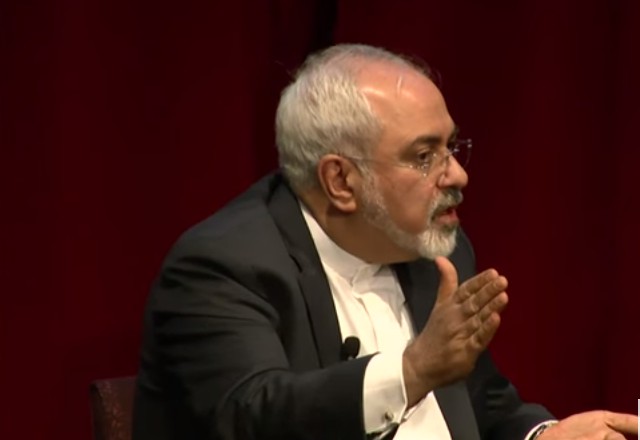
The next few weeks will be critical for capitalizing on a new sense of promise created by a recent flurry of remarkable gestures: Iran’s leadership has sent Rosh Hashana greetings to Jews worldwide via Twitter, released political prisoners, exchanged letters through the Swiss with President Obama, praised “flexibility” in negotiations and transferred responsibility for nuclear negotiations from conservatives in the military to the Foreign Ministry. Mr. Obama eased restraints on humanitarian and good-will activities, including athletic exchanges between the two countries. ... Mr. Rouhani has a sophisticated, Western-savvy team. His foreign minister, Mohammad Javad Zarif, received degrees from American universities and spent most of his adult life in the United States. Together they have raised expectations in a world eager to see Iran play a more constructive role, and the charm offensive is in full swing. Policy experts, journalists and business people are jockeying to attend a number of invitation-only breakfasts, dinners and meetings scheduled by Mr. Rouhani and Mr. Zarif while they are in New York. There’s a lot riding on their visit this week.
But the "remarkable gestures" that The New York Times cited were remarkable hollow.

This is a horribly heart-breaking story. Seven young Persians filmed their own rendition of "Happy" by Pharrell Williams, but in totalitarian regimes like Iran's, no good deed goes unpunished. A CNN Reporter tweeted the following: According to the Iran Wire, six of the accused were sentenced to six months in prison and 91 lashes, while the remaining offender was sentenced to a year in prison and 91 lashes:

Our friends over at National Review pulled this little gem. We've officially entered foreign policy bizarro world when the Department of State is absolutely refusing to work with Syria, but is open to working with Iran to fight (however they're defining that) ISIS. Blitzer asked Department of State Spokesperson Marie Harf if Syria was receiving intelligence through a third party, to which she responded, "Not at all. I can categorically reject that. We will not work with the Assad regime, we will not share intelligence with them, we will not coordinate with them. Period. Full stop. I don't want to be any clearer than that."

Numerous news organizations are reporting today that Iran's Islamic Revolution Guards Corps (IRGC) claims to have shot down an Israeli drone as the drone approached the Natanz nuclear enrichment site. Reuters reports:
The Revolutionary Guards said of the drone incursion: "This wily act further exposed the Zionist regime's adventurous temperament and added yet another black page to a record filled with crime and mischief." If confirmed, an aircraft built by Israel's state-owned Aerospace Industries known as the Heron, or the more powerful Heron TP, is likely to have been involved for such a long-range mission. Military commanders in Israel have described both as a possible means of monitoring Iran and other countries.
The Heron is also called "Eitan" in Israel and it appears to be the only Israeli drone capable of reaching Iran. The BBC reports:
Natanz is Iran's main uranium enrichment site, and contains more than 16,000 centrifuges. The statement from the Revolutionary Guards said the drone was on course to fly over the nuclear facility at Natanz.

A group of terrorism victims is seeking unsatisfied court judgements. How do they plan to obtain the cash they were awarded? By taking over Iran's internet. At the helm are Israeli civil rights attorney, Nitsana Darshan-Leitner and Robert Tolchin of New York. Darshan-Leitner has won over  $1-billion in judgments, frozen more than $600-million in terrorist assets and collected $120 million in payments, according to the National Post. She hopes to replicate her success in her latest effort. ICANN (Internet Corporation for Assigned Names and Numbers) is an agency of the US Department of Commerce in Washington, DC, which administrator the World Wide Web. ICANN licenses domain names like ".gov" ".ca" and in this case, ".ir". Countries are then able to allocate the domain names, effectively making ".ir" an asset.  Court papers have been served to ICANN and seek ownership of top-level domain names like .ir TLD, the ایران TLD and all Internet Protocol (IP) addresses being utilized by the Iranian government and its agencies. Darshan-Leitner believes these domains are worth the over $1-billion required to satisfy the outstanding debts owed by the Iranian government to the families participating in the civil suit.

We've been writing about the lack of a free and independent Kurdistan for years, It’s time for a free and independent Kurdistan. While the Palestinian agenda has dominated every international forum, the much more populous and ethnically distinct Kurds have been mostly ignored.  In part, this is because the Kurds span several nation states created by colonial powers after the implosion of the Ottomon Empire.  Turkey particularly has threatened war if a Kurdish nation emerges. In part it is because creating an independent Kurdistan does do not serve a political purpose of snuffing out the only Jewish state in the region. Developments are moving fast that could change everything. Syria lost control of its Kurd territory during the ongoing civil war, and the autonomous Iraqi Kurdistan has operated independently for years. With Iraq losing control of vast territory, and the U.S. not anxious to do anything to help, the Kurds have claimed Kirkuk for their own, as the BBC reports, Iraqi Kurds 'fully control Kirkuk' as army flees:
Iraqi Kurdish forces say they have taken full control of the northern oil city of Kirkuk as the army flees before an Islamist offensive nearby. "The whole of Kirkuk has fallen into the hands of peshmerga," Kurdish spokesman Jabbar Yawar told Reuters. "No Iraq army remains in Kirkuk now." Kurdish fighters are seen as a bulwark against Sunni Muslim insurgents.

In 1994 terrorists struck the Asociación Mutual Israelita Argentina (AMIA) in Buenos Aires, Argentina. 85 people were killed. In 2003, an Argentine judge issued arrest warrants for four Iranian officials (but denied warrants for twelve others) for their involvement in the terror attack. In 2007 INTERPOL, an international police organization, issued warrants for five Iranians and one Lebanese for the involvement in the AMIA bombing. Early last year Argentina's government reached an agreement with Iran to form a "truth commission" to investigate those who were responsible. The agreement was immediately controversy because, in the words of former Israeli Deputy Foreign Minister Danny Ayalon, it was "inviting the murderer to participate in the murder investigation.” Last week, an Argentine federal court struck down last year's "truth commission" agreement with Iran to investigate the AMIA bombing. Several senior Iranian officials and Hezbollah have been implicated in the attack that killed 85 people in that Jewish community center.
Thursday's ruling declared the agreement unconstitutional and ordered Argentina not to go ahead with it. The deal had been delayed anyway by Iranian reluctance to move forward in implementing it. ... Israel and world Jewish groups had denounced the "truth commission" deal with Iran, calling it a diplomatic win for Tehran that offered no benefit to Argentina. The deal would have let Iran review Argentina's investigation into the bombing.
Alberto Nisman, the prosecutor who took over investigation of the case, established responsibility to the highest level of Iran's government. Among those implicated were then President Ali Akbar Hashemi Rafsanjani and Iran's previous defense minister Ahmed Vahidi. Vahidi and intelligence officer Moshen Rabbani were among five Iranians who were flagged by INTERPOL for arrest in the case. (Video from March 2013) While current Iranian President was a member of the group that ordered the attack, Nisman told David Horovitz of the Times of Israel last year that Rouhani was not present at the meeting where the attack was planned. An English version Nisman's indictment is here (PDF). An op-ed in the New York Times at the time of the Argentine-Iranian agreement accused Argentina's government of doing "an about-face on terror."

Recently released commercial satellite images have revealed the Iranians are attempting to reconstruct a replica of one of the United States’ largest and most powerful warships, the USS Nimitz.
Construction on the crude model appears to be in full swing at a shipyard near Bandar Abbas, as shown in newly released commercial satellite images. 'They got this barge and threw some wood on top of it to make it look like the USS Nimitz. That's all we know for sure,' a U.S. defense official told AFP... The wooden, non-operational aircraft carrier made to look like a Nimitz-class nuclear-powered American vessel was first spotted on the Persian Gulf last summer, the New York Times reported. Besides having the shape of the 1,100-foot-long carriers, such as USS Abraham Lincoln and USS Carl Vinson, the shipbuilders also replicated the distinctive white markings on bow. A satellite flying over Gachin shipyard also photographed a fake plane parked on the deck of the equally fake carrier.