

Image 01 Image 03

Iran Tag

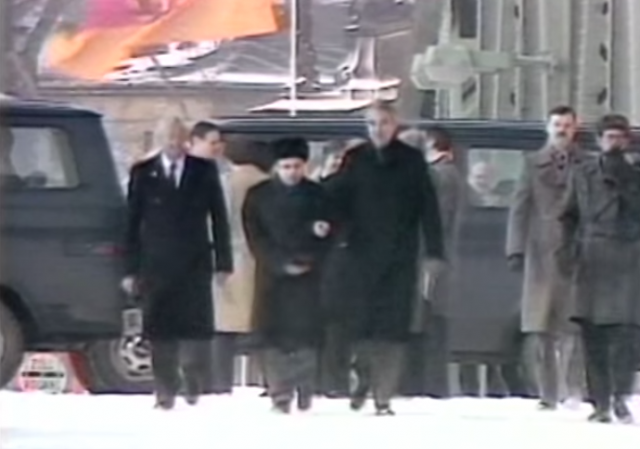
One of my early posts at Legal Insurrection, on November 11, 2008, was Is It Time For Conservatives To Sit Down In The Snow?. The post analogized what conservatives were about to experience in the aftermath of Obama's first victory to the experience of Soviet Jewish Refusenik Anatoly (Nathan) Sharansky. I related the story of Sharansky's release from the Soviet gulag, and how he resisted to the very last moment of his release:
Sharansky spend almost a decade in Soviet prison because of his activities on behalf of Jews who wanted to emigrate to Israel. Sharansky was subjected to torture and other indignities, but never lost his spirit.Sharansky notoriously refused to obey even the most mundane orders from his captors. Sharansky understood that to compromise even a little would lead to compromising a lot. Throughout his ordeal, Sharansky kept his spirits alive by reading a small book of psalms. As Sharansky was being led to the airplane that would take him from the Soviet Union to East Germany for the exchange, the Soviets confiscated his book of psalms.It would have been easy for Sharansky simply to keep walking towards the plane and freedom. But Sharansky understood that the Soviets confiscated his book of psalms not because they wanted the book, but because they wanted to show that even in this last moment, they were in control.
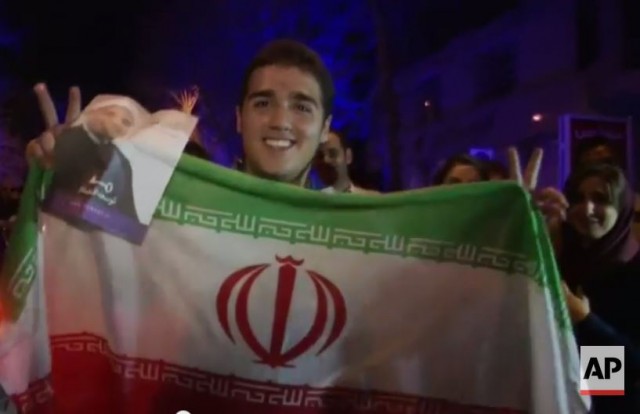
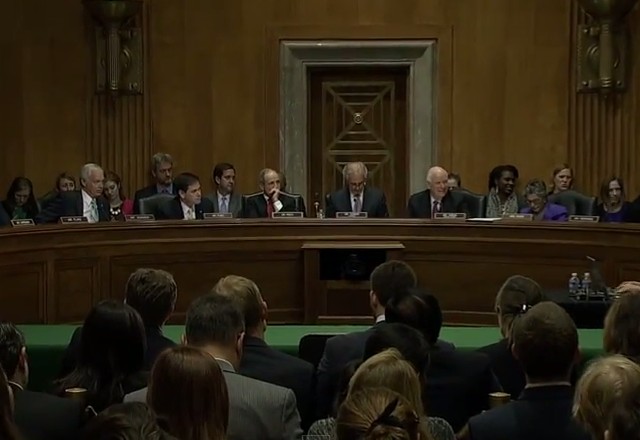
“This is the new America. We had better get used to it.” Those were the words of an Israeli TV analyst upon learning that Obama is open to negotiating an immediate lifting of sanctions on Iran as part of a nuclear deal -- the exact opposite of what he and others in the administration have been saying. https://youtu.be/CqXrW_-pzR4?t=1m17s The Times of Israel reports on the development, Obama says US open to talks with Iran on immediately lifting sanctions:
President Barack Obama on Friday left open the door to “creative negotiations” in response to Iran’s demand that punishing sanctions be immediately lifted as part of a nuclear deal, even though the initial agreement calls for the penalties to be removed over time.... “How sanctions are lessened, how we snap back sanctions if there’s a violation, there are a lot of different mechanisms and ways to do that,” Obama said. He said part of the job for Secretary of State John Kerry and the representatives of five other nations working to reach a final deal with Iran by June 30 “is to sometimes find formulas that get to our main concerns while allowing the other side to make a presentation to their body politic that is more acceptable.”

There have been a number of reactions to the Corker-Menendez bill, which provides for Congressional oversight of whatever nuclear deal the administration makes with Iran. It passed out of the Senate Foreign Relations Committee yesterday with a 19-0 vote. J. E. Dyer at Liberty Unyielding looks at the numbers and sees the bill as a loss.
If Congress rejects the Iran deal, and the president vetoes its legislation, Congress will have the balance of a 52-day period to override the veto. If the Senate finds itself unable to act, at some point in this process, Obama’s deal can be implemented without assent from the Senate. To override a veto, of course, opponents will need 67 votes. To uphold a veto, Obama just has to make sure there are 34 votes for his deal. He doesn’t have to have even 51 votes to implement it. With 34, he’s got a major win. The beauty of this for Obama is that he still gets a win if the Senate at any point can’t bring a floor vote. His deal just gets implemented because the Senate failed to act. So it won’t matter if the president has 34 votes for the Iran deal, but not enough to bring the deal to a vote. The win for Obama is merely less photogenic in that case. The effect is the same.

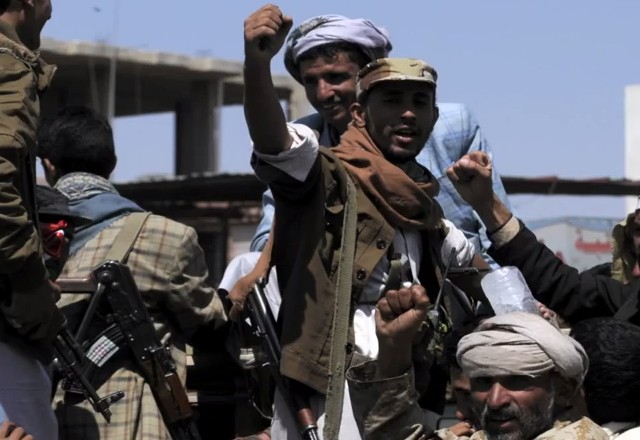
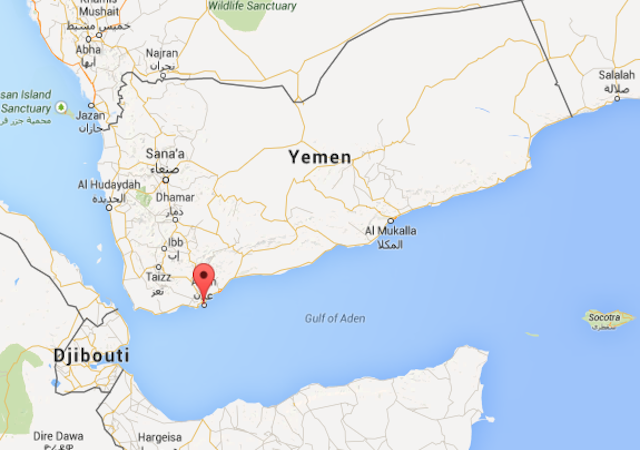
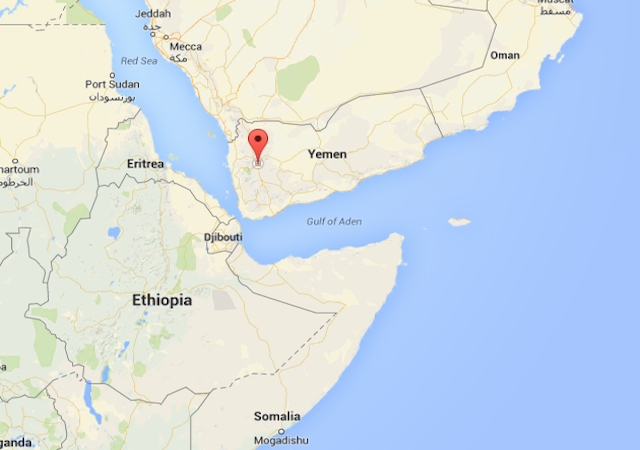
Potentially-big news out of Yemen. We've provided quite a bit of coverage on a rebel group called the Houthi. The Houthi are an Iranian-backed Shia rebel group currently gaining ground in Yemen. Earlier this year, they moved out of their territory in the north and seized control of the capital city of Sana'a, sending the President and government officials on the run to the important port city of Aden. Iran has repeatedly denied supporting the Houthi. To admit supporting the rebel group would be to admit supporting the increased threat to the shared border between Yemen and Saudi Arabia, and responsibility for upping tensions in the region. The era of denial may have come to an end this weekend. Local militiamen claim that during Friday night's fighting, they captured two Iranian military officers---a colonel and a captain, specifically---advising Houthi rebels in Aden. An initial investigation allegedly placed the two men with the Quds Force, the special forces division of Iran's Revolutionary Guard. Militia members have indicated that they will be handed over to the Saudi-led coalition.

We already know that there's a lot the White House isn't telling us when it comes to the nuclear scam deal "framework" it claims to have worked out with the Iranians. Yesterday, Professor Jacobson explained that after the "framework" was announced, it became almost immediately apparent that the US, Europe, and Iran were not on the same page about how the deal was supposed to work. Then, David Gerstman penned a great takedown of the Administration's claims that the protocols in the framework (yes, the same framework we can't explain with any consistency) strengthen those in the Nuclear Nonproliferation Treaty. Even Dick Cheney has chimed in, saying what we're all thinking: I think [Obama's] actions are constituted in my mind those of the worst president we’ve ever had. Yesterday, Senator John McCain talked with radio host Hugh Hewitt about the non-deal---and the White House is not happy about it. During the interview, McCain laid it all bare when he said that, with regards to the framework, "John Kerry is delusional.”

I visited the State Department's website earlier this week and I was greeted by an item hailing the 45th anniversary of the Nuclear Nonproliferation Treaty (NPT). After hailing the treaty the article goes on to say more explicitly, "[i]f we didn’t already have the NPT, we would desperately need it today." A couple of paragraphs later the article boasts about the latest efforts to strengthen the NPT.
The United States is committed to strengthening the nonproliferation regime and the authority of the International Atomic Energy Agency to implement nuclear safeguards -- a set of measures to verify that nuclear materials are used for peaceful purposes. The Treaty provides the foundation and context to resolve outstanding challenges to the nuclear nonproliferation regime. The ongoing negotiations with Iran provide the best diplomatic path forward for Iran to return to full compliance with the NPT. The IAEA instills confidence among all NPT parties that a state’s civil nuclear energy is not being diverted into a nefarious weapons program. In New York, the United States will promote the IAEA Additional Protocol, now recognized as the foremost international standard for safeguards that provides the IAEA with the authority to ensure that all nuclear material is used for peaceful purposes, in accordance with the NPT.

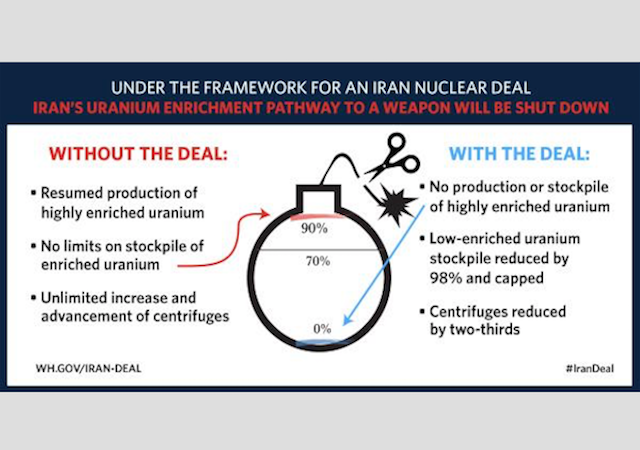
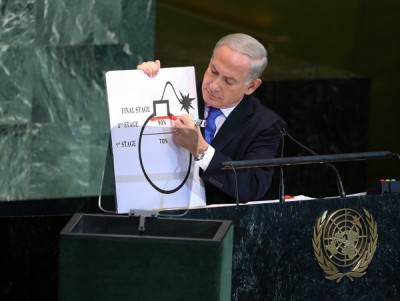
Back in 2012, Israeli Prime Minister Benjamin Netanyahu stood before the body of the United Nations with a piece of poster board and a red marker. During the two weeks prior to that moment, he had been waging a public battle with the Obama Administration over the dangerous progression of Iran's nuclear program---sound familiar---and made the decision to cut through the rhetoric in hopes that a visual aid might wake up the rest of the world. So, he picked up his marker and drew a literal red line that served as an ultimatum: “At this late hour there is only one way to peacefully prevent Iran from getting atomic bombs, and that is by placing a clear red line on Iran’s nuclear weapons program.” Remember? NATIONS-articleLarge Yesterday, the Obama paid passive-aggressive homage to Netanyahu's famous "bomb" with one of their own:

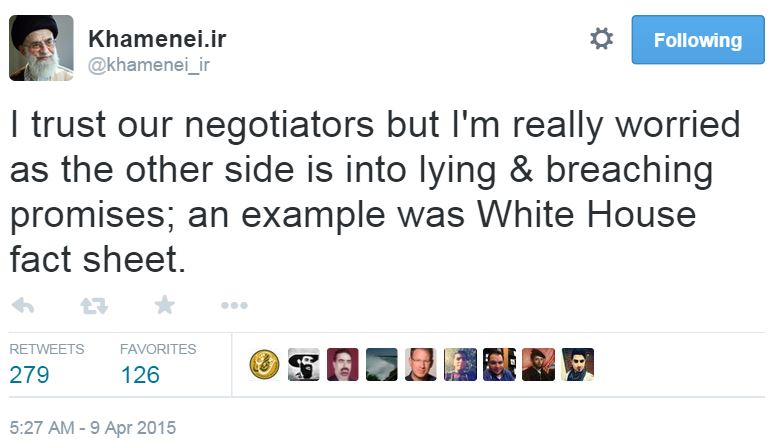
Within hours of the White House celebrating a supposed Iran nuclear framework "deal," it became apparent that the various sides -- the U.S., the Iranians and the Europeans -- had very different understandings of the deal. Those competing narratives now have moved to the stage of open declarations by senior Iranian officials that the White House is lying and that key elements in a White House Fact Sheet never were agreed upon and are unacceptable. Iran's Supreme Leader, Ayatollah Khamenei, has taken to Twitter to call the Obama administration a bunch of untrustworthy liars: https://twitter.com/khamenei_ir/status/586113075809558528

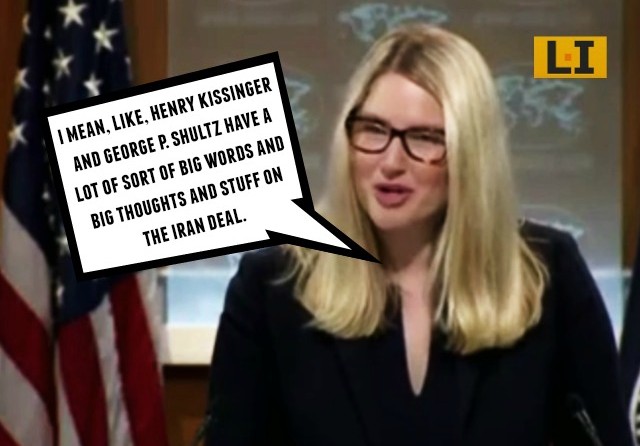
The State Department stepped in it. Again. Now infamous for her dippy soundbites, State Department spokeswoman Marie Harf might have topped her "ISIS just needs jobs" gaffe today. Henry Kissinger and George Shultz, both former Secretaries of State, wrote an op-ed that was published in the Wall Street Journal yesterday. Brutally critical of the administration's much touted Iran deal, the op-ed focused on the White House's dismissive attitude towards the danger Iran poses. Kissinger and Shultz were less than impressed by the administration's insistence on the necessity of a deal with a country whose priorities aren't remotely in the same galaxy as those of the United States, noting:
Cooperation is not an exercise in good feeling; it presupposes congruent definitions of stability. There exists no current evidence that Iran and the U.S. are remotely near such an understanding. Even while combating common enemies, such as ISIS, Iran has declined to embrace common objectives. Iran’s representatives (including its Supreme Leader) continue to profess a revolutionary anti-Western concept of international order; domestically, some senior Iranians describe nuclear negotiations as a form of jihad by other means.
In sum, the op-ed eloquently observes the Iran deal is a complete and total cluster. At a press conference held earlier today, Marie Harf was in no mood to discuss the WSJ lashing. Flustered, Harf attempted to avoid questions on the WSJ op-ed, but Associated Press reporter Matt Lee persisted. "I read it and it's far from nuanced. It's pretty damning," Lee says. "You just reject it outright? They say this is a recipe for disaster basically, but you say, no, clearly, you wouldn't be pursuing something you thought was a recipe for disaster. Is that correct?" Lee reads a few lines of the piece, and lobs them back to Harf.

There is no Iran nuke "deal," but whatever there is to the framework, even Obama now admits it paves Iran's path to the bomb, albeit on a delayed fuse, as AP reports, Obama says Iran could cut nuke time to near zero in 13 years:
Defending an emerging nuclear deal, President Barack Obama said Iran would be kept a year away from obtaining a nuclear weapon for more than a decade, but conceded Tuesday that the buffer period could shrink to almost nothing after 13 or more years. Obama, whose top priority at the moment is to sell the framework deal to critics, was pushing back on the charge that the deal fails to eliminate the risk because it allows Iran to keep enriching uranium. He told NPR News that Iran will be capped for a decade at 300 kilograms — not enough to convert to a stockpile of weapons-grade material. "What is a more relevant fear would be that in Year 13, 14, 15, they have advanced centrifuges that enrich uranium fairly rapidly, and at that point, the breakout times would have shrunk almost down to zero," Obama said.
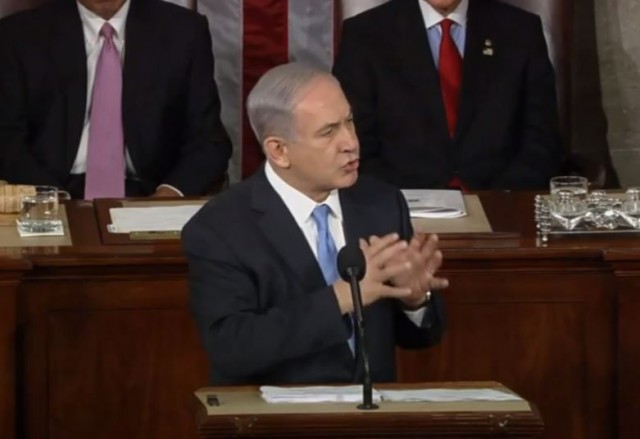
It's not at all clear that 13 years is the correct number, as opposed to 10. But regardless, the point is that at the end of this process Iran is ready to produce a bomb. Where have I heard that before? Oh yeah, Netanyahu: Nuke Deal 'Paves Iran's Path to the Bomb':

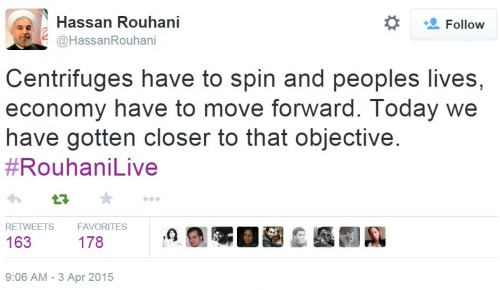
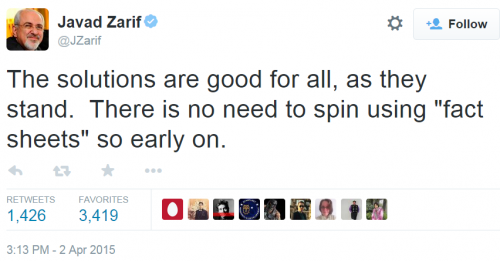
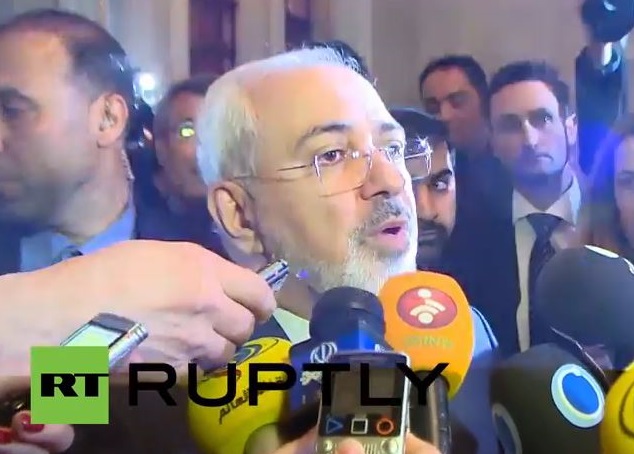
I have fallen into the trap almost everyone has, in referring to an Iran "nuke deal" and "Framework deal." Based on what the White House has revealed, the "deal" is a very bad deal, as we have explored here repeatedly: It purports to give Iran its dual goals of maintaining and improving its nuclear infrastructure while removing sanctions and ensuring the economic viability of the oppressive Mullah regime. But it's even worse. Based upon statements made after the initial announcements, it's clear that there is no deal, just enough vague verbiage to allow each side to portray the "deal" however it wants. There is no meeting of minds, not binding contract, nothing. This was revealed initially in tweets by the Iranian Foreign Minister disputed White House "spin" on the "deal," insisting that sanctions would be lifted immediately, and crowing that Iran's enrichment would continue. https://twitter.com/HassanRouhani/status/583994063512276992 https://twitter.com/JZarif/status/583723860522115072 Since then, the divergence has grown, The Times of Israel reports:

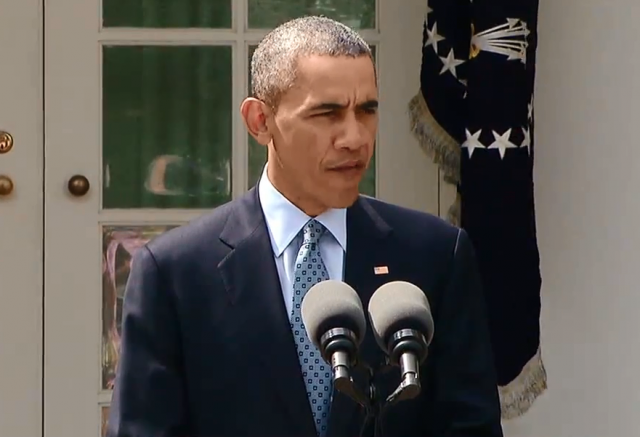
The Iran nuke Framework deal is bad for anyone other than Iran. Iran achieved its two key negotiating objectives: Keep its nuclear infrastructure in place and get sanctions relief. https://twitter.com/HassanRouhani/status/583994063512276992 As The Washington Post editorial board points out, these parameters are contrary to the bottom line Obama spelled out at the start of the negotiations: THE “KEY parameters” for an agreement on Iran’s nuclear program released Thursday fall well short of the goals originally set by the Obama administration. None of Iran’s nuclear facilities — including the Fordow center buried under a mountain — will be closed. Not one of the country’s 19,000 centrifuges will be dismantled. Tehran’s existing stockpile of enriched uranium will be “reduced” but not necessarily shipped out of the country. In effect, Iran’s nuclear infrastructure will remain intact, though some of it will be mothballed for 10 years. When the accord lapses, the Islamic republic will instantly become a threshold nuclear state. That’s a long way from the standard set by President Obama in 2012 when he declared that “the deal we’ll accept” with Iran “is that they end their nuclear program” and “abide by the U.N. resolutions that have been in place.” Those resolutions call for Iran to suspend the enrichment of uranium. Instead, under the agreement announced Thursday, enrichment will continue with 5,000 centrifuges for a decade, and all restraints on it will end in 15 years. How did Iran do it? By setting its own negotiating red line and refusing to budge. I've seen that negotiating tactic hundreds of time -- it's effective only when the opposing party is not willing to walk away from the negotiation. That's us. Obama so desperately wanted a deal that he was not willing to walk away. The Iranians didn't need to walk away, they just needed to dig in behind their red line and wait. So Obama capitulated on the key insistance of Iran keeping it's nuclear program intact, and then negotiated over the rest. Obama admitted as much in his speech after the Framework was announced:

Well that "Framework" negotiation was fun. For the Iranians, who got a great deal at least as far as a Framework goes. As this WaPo editorial points out, the Obama administration gave up on key parameters:
THE “KEY parameters” for an agreement on Iran’s nuclear program released Thursday fall well short of the goals originally set by the Obama administration. None of Iran’s nuclear facilities — including the Fordow center buried under a mountain — will be closed. Not one of the country’s 19,000 centrifuges will be dismantled. Tehran’s existing stockpile of enriched uranium will be “reduced” but not necessarily shipped out of the country. In effect, Iran’s nuclear infrastructure will remain intact, though some of it will be mothballed for 10 years. When the accord lapses, the Islamic republic will instantly become a threshold nuclear state. That’s a long way from the standard set by President Obama in 2012 when he declared that “the deal we’ll accept” with Iran “is that they end their nuclear program” and “abide by the U.N. resolutions that have been in place.” Those resolutions call for Iran to suspend the enrichment of uranium. Instead, under the agreement announced Thursday, enrichment will continue with 5,000 centrifuges for a decade, and all restraints on it will end in 15 years.
In his speech after the announcement, Obama took care not only to repeat the false rhetorical device of the only choice being between this deal and war, he blamed that choice on Israeli Prime Minister Benjamin Netanyahu. David Horvitz at The Times of Israel writes, Defeatist Obama’s deal with the devil:

While diplomats postured and preened over their hard-fought "nuclear framework" intended to usher in the era of a nuclear-but-not-nuclear Iran, Yemen continued to burn. Today, Iranian-backed Houthi rebels made major progress in their attempt to seize control of Aden, Yemen's key strategic port city and site of ousted President Hadi's last-stand. (He fled to Saudi Arabia last week.) The Houthi don't yet exercise full control over Aden, but have managed to break through barriers armed by soldiers loyal to Hadi, briefly occupy the Presidential palace, and raise the Yemeni flag before withdrawing for fear of airstrikes. This isn't an insignificant accomplishment; if the Houthi eventually oust Hadi loyalists from Aden, they will have seized control over one of the most strategically important ports in the Middle East, and upped the ante on Saudi coalition forces currently trying to regain ground.

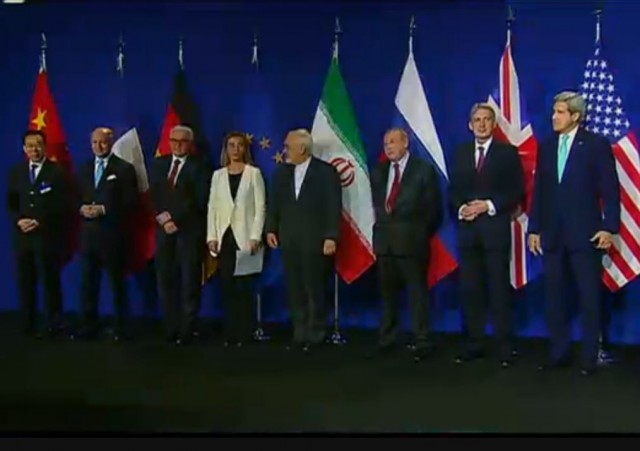
A vague agreement to agree was just announced. The precise details are somewhat vague, as it's just a statement of point, but one thing is clear: Iran is thrilled.

The arbitrary deadline to come to an agreement with Iran is today. But according to the Associated Press, that deadline might be extended to tomorrow, making this the third deadline extension.
They had set a deadline of Tuesday for a framework agreement, and later softened that wording to a framework understanding, between Iran and the so-called P5+1 nations — the United States, Britain, France, Germany, Russia and China. After intense negotiations, obstacles remained on uranium enrichment, where stockpiles of enriched uranium should be stored, limits on Iran's nuclear research and development and the timing and scope of sanctions relief among other issues. The aim has been a joint statement is to be accompanied by additional documents that outline more detailed understandings, allowing the sides to claim enough progress has been made to merit a new round, officials said. Iran has not yet signed off on the documents, one official said, meaning any understanding remains unclear. ...The softening of the language from a framework "agreement" to a framework "understanding" appeared due in part to opposition to a two-stage agreement from Iran's supreme leader, Ayatollah Ali Khamenei. Earlier this year, he demanded only one deal that nails down specifics and does not permit the other side to "make things difficult" by giving it wiggle room on interpretations.
Any deal reached would only amount to a soft framework, and likely not be particularized in writing as we reported Friday.

Last time we checked in, the White House was wallowing in a state of denial over the devolving situation in Yemen. The UN held a meeting to discuss the fall of the Western-backed Hadi government, and while the diplomats were talking, Iran executed a blatant arms dump on behalf of the Houthi rebels, who have been contributing to chaos in Yemen since late last year. America postured while the Saudis went to war, launching air strikes against Iranian-made missile launchers and destroying Houthi-controlled military barracks and air bases. Now, as coalition air strikes rage on, the Saudis have constructed a blockade as a way of preventing Iran---or anyone else---from rearming the Houthi. Via the AP:
As night fell, intense explosions could be heard throughout the rebel-held capital Sanaa, where warplanes had carried out strikes since the early morning. Military officials from both sides of the conflict said that airstrikes were targeting areas east and south of the third largest city of Taiz, as well as its airport, while naval artillery and airstrikes hit coastal areas east of Aden. "It's like an earthquake," Sanaa resident Ammar Ahmed said by telephone. "Never in my life have I heard such explosions or heard such raids."

A vague, unwritten Iran deal may soon be hammered out as talks continue this weekend in Switzerland.  Reuters reports
Iran and six major powers were exploring possible compromises to break an impasse in nuclear negotiations on Sunday, but officials cautioned they were unable to move on several sticking points. The news came as Israel said the details of a possible agreement emerging from talks in Lausanne, Switzerland were worse than it feared. In a significant development in talks aimed at securing a preliminary nuclear deal, several officials told Reuters Tehran had indicated a willingness to accept fewer than 6,000 nuclear centrifuges and to send most of its enriched uranium stockpiles for storage in Russia. Western powers, on the other hand, were considering the idea of allowing Iran to conduct limited, closely-monitored enrichment-related work for medical purposes at an underground facility called Fordow, the officials added on condition of anonymity. Iran had originally insisted on keeping in operation the nearly 10,000 centrifuges it currently uses, but said in November that Washington indicated it could accept around 6,000. Iranian officials say they had been pushing for 6,500-7,000. The officials said all parts of an emerging nuclear deal were interrelated. "Everything could still fall apart," a Western official told Reuters, adding that the talks could drag on to Tuesday, the self-imposed deadline for a framework agreement.
According to The Telegraph, a pro-Rouhani Iranian journalist covering the P5 + 1 talks has sought asylum in Switzerland following frustration that he "could only write what he is told":