


Image 01 Image 03

BDS Tag

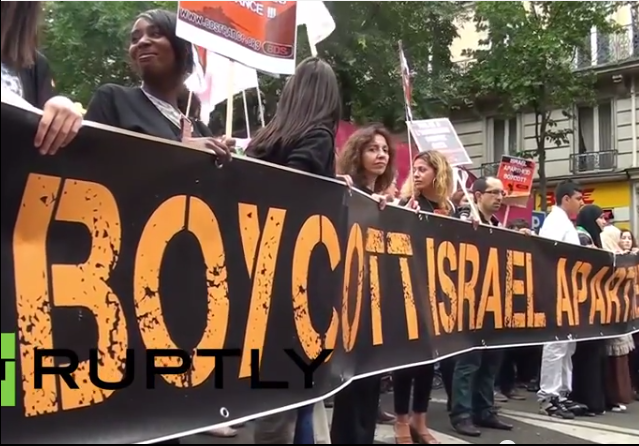
This week the Boycott, Divestment and Sanctions (BDS) movement and its supporters will be celebrating the 10th anniversary of the supposedly grassroots launch of the BDS movement by Palestinian "civil society" organizations. The Associated Press, through its writer Tia Goldenberg, has a lengthy article on the BDS movement. The article is receiving a lot of attention, including a Drudge link, and because it is AP is being reprinted (under varying titles) at numerous news website. The article starts with BDS's supposed grassroots beginnings, Boycott Israel drive gains strength, raising alarm:
Ten years ago, a small group of Palestinian activists had a novel idea: inspired by the anti-apartheid movement, they called for a global boycott movement against Israel as a nonviolent method to promote the Palestinian struggle for independence.
That narrative of how the BDS movement began is false, and demonstrably so. The boycott call issued in July 2005 was not the result of a small group of activists getting together, it was the result of a multi-year organized effort for a global boycott of Israel, most prominently in a boycott call issued at the 2001 UN Durban Conference which was so anti-Semitic the U.S. walked out. We have explored this history many times at Legal Insurrection. Here is the actual history of the BDS movement:

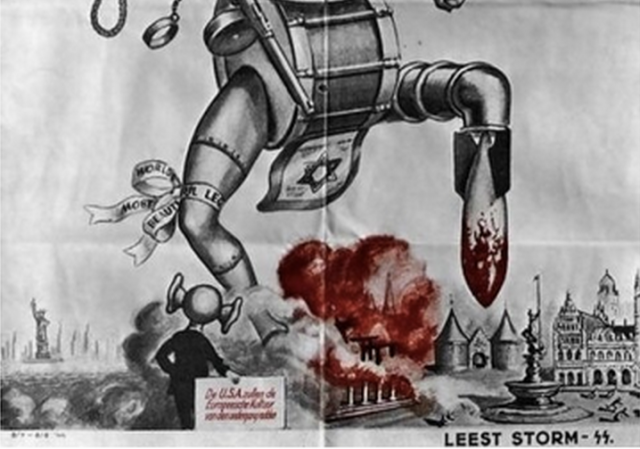
In the spring of 2014, a series of ugly incidents rocked the campus of Vassar College, a small liberal arts college just north of New York City. It started with a boycott protest against a course that involved travel to Israel and the West Bank, including forcing a professor and students to walk a gauntlet of people ululating (audio example here). It culminated in the posting on social media of a Nazi cartoon portraying Jewish control of the U.S. The group mounting the protest and posting the plainly anti-Semitic cartoon was Vassar Students for Justice in Palestine. The series of events was ignited by passage of an academic boycott of Israel by the American Studies Association, a rejection of the boycott by Vassar's president (along with 250 other university presidents), and a counter-reaction by 39 Vassar professors who defended the boycott.  SJP took it from there. It's all detailed in my post Anti-Israel academic boycott turns ugly at Vassar and a series of follow up posts, including about my debate challenge to the 39 professors (which was not accepted): With everything happening on the anti-Israel boycott front, both good and bad, Vassar had faded a little from memory, until I saw a July 3, 2015 Op-Ed in The Washington Post by Jill Schneiderman, one of the two Vassar professors teaching the boycotted course. For Schneiderman, the memories obviously haven't faded, and remain raw. The Op-Ed is How academic efforts to boycott Israel harm our students. Read the whole thing. Here is an excerpt:

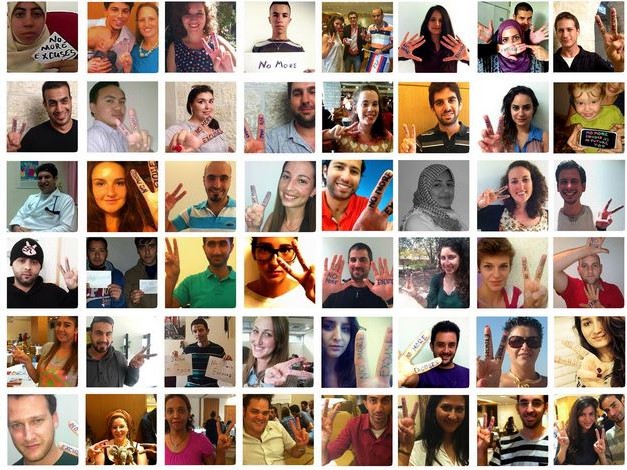
The United Church of Christ recently passed a resolution adopting part of the Boycott, Divestment and Sanctions (BDS) platform. The resolution purported to demand divestment from the "occupation," but in fact a late amendment broadened it substantially to include virtually every Israeli company, as I explained in my prior analysis. (Another resolution, declaring Israeli guilty of the Crime of Apartheid, had a split vote short of the 2/3 needed for passage.) Throughout the committee-level and annual meeting debate and presentations about divestment, aligning UCC with BDS was repeatedly stressed as part of a peaceful process of ending the conflict. The anti-Israel Jewish Voice for Peace played a central role in Jew-washing the nature of the BDS movement, allowing BDS supporters at UCC to say - hey, look, there are Jews who support what we are doing. [caption id="attachment_132637" align="alignnone" width="600"][Speaker in support of divestment says "Stand with Jewish Voice for Peace"] [Speaker in support of divestment says "Stand with Jewish Voice for Peace"][/caption]If UCC's delegates and leadership thought aligning UCC with BDS was a move towards peace, it was severely duped. Here's a perfect example of how BDS is against peaceful reconciliation. The YaLa Young Leaders conference attempts to bring Israeli youth together with Arab youth from around the world. We first wrote about the conference in 2014. Since then, it has grown to even greater success:

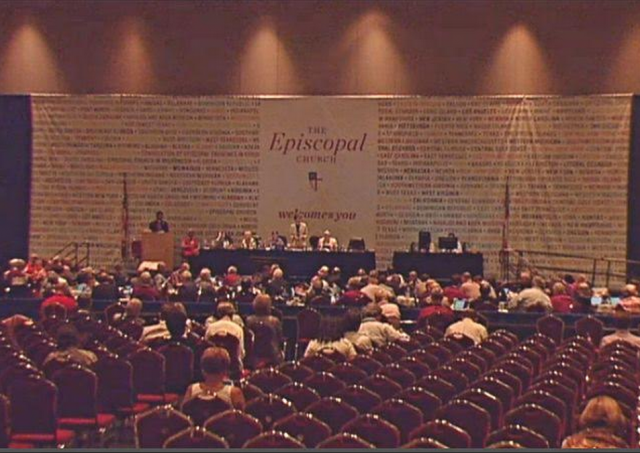
After the United Church of Christ passed an Israel divestment resolution on June 30, 2015, there was concern that the Boycott, Divestment and Sanctions movement might score three victories at church annual meetings this week. But that did not happen. The Mennonite Church USA tabled the divestment resolution, and the Episcopal Church House of Bishops voted it down overwhelmingly on a voice vote (I listened, and there were almost zero people shouting "yes" and a loud chorus of "No"). AP reported on the Mennonite vote:
A leading Mennonite group has delayed a decision on divesting from companies with business tied to Israel's occupation of the Palestinian territories. The Mennonite Church USA was set to vote this week on whether they should sell off stock in companies "known to be profiting from the occupation" and from "destruction of life and property" in the territories. A church spokeswoman said delegates at a national meeting in Kansas City, Missouri, voted 418-336 to table the resolution until their next assembly two years from now. Twenty-eight delegates abstained.

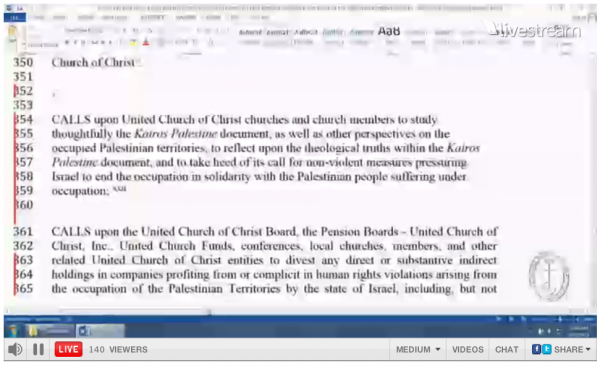
We highlighted recently resolutions at the United Church of Christ's 30th Synod in Cleveland seeking (1) divestment from certain named companies (such as Caterpillar), and (2) declaring Israeli guilty of the Crime of Apartheid as defined in the 1998 Rome Statute creating the International Criminal Court. These take place through years-long efforts by anti-Israel Christian groups like Sabeel, which use Jewish Voice for Peace as religious cover for the noxious efforts. The divestment resolution originally was limited to specified companies, but in committee at the Synod was amended to include sweeping language governing any company that does business, directly or indirectly, in "occupied" territory. United Church Christ Israel Divestment Resolution 1 This would include, for example, companies doing business in the Jewish Quarter of the Old City, which was illegally captured by Jordan and then enthically cleansed of Jews and Jewish landmarks before Israel liberated it in 1967.

Sabeel Ecumenical Liberation Theology Center, a Palestinian Christian organization headquartered in Jerusalem, is a group you probably never heard of. But Sabeel plays a critical role in seeking to reverse Christian support for Israel around the world. In the U.S., Friends of Sabeel - North America (FOSNA) is behind or involved in virtually every divestment resolution pending before various Christian denominations, often teaming up with Jewish Voice for Peace (JVP). You need to know about Sabeel, and how Sabeel and JVP team up against Israel. Sabeel provides the Christian liberation theology, JVP provides the Jewish cover.

1. United Church of Christ

For the past few days, the General Synod of the United Church of Christ (UCC) has been deliberating in Cleveland, Ohio on several resolutions related to Israel. Back in 2005, the UCC passed a resolution condemning Israel’s security barrier and calling on Israel to “tear down the wall” (Israel’s construction of the security barrier began in 2002 as a counterterrorism measure). This week its General Synod is considering a divestment resolution modelled after the one that narrowly passed last year by a 310-303 vote in the General Assembly of the Presbyterian Church (USA), the largest of several Presbyterian denominations in America.

The anti-Israel activists employed as professors who led the fight at the American Studies Association to pass the academic boycott of Israel in December 2013, have been patting themselves on the back ever since. Forget that over 250 university presidents and the major academic organizations condemned the move as a gross violation of academic freedom.  Even the NY Times called the ASA a "pariah." The ASA humiliatingly had to back down from its plan to bar representatives of Israeli academic institutions from its annual meeting, eventually promising that even Bibi Netanyahu could attend. The profs seething with hatred of Israel, and anti-Zionist websites which promoted their academic boycott agenda, saw it differently. In their own minds, they were on the cusp of a historic anti-Israel paradigm change. The future belonged to the boycotters, in their minds. The reality has not worked out that way.  Other than some very small faculty organizations, no major academic group has adopted the boycott. No university in the U.S. is even considering a boycott. But the hyperbolic hateful rhetoric by the profs did have an effect.

The progressive United Church of Christ is no stranger to controversy when it comes to Israel. UCC has had close ties (see pp. 44-46 of linked pdf.) to Friends of Sabeel - North America, the U.S. branch of Sabeel Ecumenical Liberation Theology Center, a Jerusalem-based non-governmental organization that leads efforts to alienate Christians from supporting Israel. (See Recent NGO Monitor Report (pdf.)).  We will have more on Sabeel in a later post. Those ties included a UCC Church in Boston hosting a Sabeel conference in 2007 on finding new paradigms to fit Israel under the definition of Apartheid. But UCC may be about to elevate its controversial status dramatically, with the 30th General Synod commencing June 24 26 having placed before it three resolutions regarding the Israeli-Palestinian dispute, among a total of 16 resolutions. All three of the resolutions carry the following explanation: "The Board of Directors recommends this resolution be sent to a Committee of the General Synod." Anti-Israel activists are treating all three as up for consideration, but whether it goes to a general vote is unclear as of this writing. UCC's promotional material also suggests all three resolutions will come to a vote:

There is a growing "boycott the boycotters" movement afoot in the United States, targeting the anti-Israel Boycott, Divestment and Sanctions (BDS) movement. On the federal level, the 1970s-era anti-boycott legislation addressing the Arab League boycott of Israel is being supplemented by legislation to address the new BDS-form of boycott.  Provisions in pending trade legislation would require that free trade agreements with the European Union impose anti-BDS goals.  A House Resolution has been introduced condemning BDS, and simlar resolutions were passed in Tennessee and Indiana. Illinois and South Carolina have gone further, and passed anti-BDS legislation. The New York State Assembly just passed an anti-BDS resolution, as a prelude to anti-BDS legislation:

The academic boycott of Israel has generated a lot of attention and noise in the past few weeks, even though it has not generated much actual boycotting. No university in the U.S. is considering a boycott, as far as I know, and in many ways ties are expanding. The American Studies Association and a handful of much smaller faculty professional organizations have adopted the boycott, but even ASA had to back down from its key provision excluding most Israeli academics from its annual meeting. There have been, and undoubtedly will be more, attempts to get larger faculty organizations to adopt the boycott, but so far that has not happened. There are complaints from some Israelis also of an undeclared boycott of them personally in the humanities, with some American professors refusing to interact. But beyond the actual results, there is no doubt that the academic boycott movement is a malicious attack not just on Israel, but also on our entire academic system. It is led by some of the most outrageous campus characters, the rhetoric often is abusive, and the environment hostile and threatening. It is no wonder that over 250 university presidents, as well as major academic groups like the American Association of University Professors, condemned the ASA academic boycott. Over 100 members of Congress also signed a letter condemning the ASA. Soon we may be able to add a formal House Resolution to the list.

My wife and I are back, after an intense two weeks in Israel. From the Lebanese to Gaza borders, from the Mediterranean Sea to Judea and Samaria, from the cool evenings of Jerusalem to the heat of the Negev Desert, from an apartment in the Jewish Quarter of the Old City of Jerusalem to Bedouin villages in the north and south, from university campuses to military bases, from faculty to students, from Jews to Muslims ... I can't say we saw it all, but we saw a lot. I've documented most of our big events in daily posts, with the exception of our emotional meetings with the families of Edward Joffe and Leon Kanner, students killed in the 1969 Supersol supermarket bombing by Rasmea Odeh; that post is coming, but I still have new photos, documents and information I have to work through. Here are my 5 Big Takeaways from the trip:

1. Our Revenge Is That "We Are Still Here"

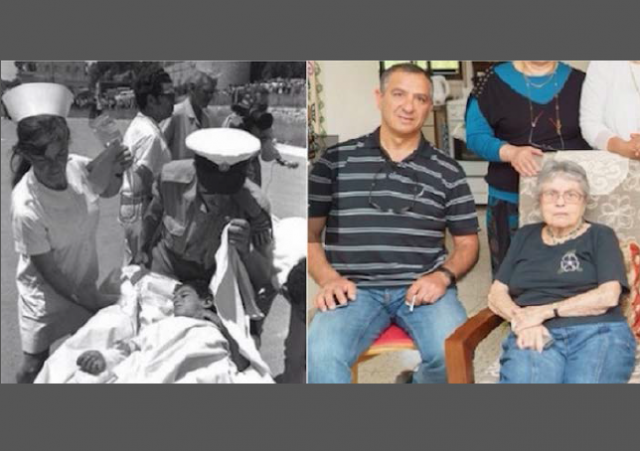
Near the start of our trip, we visited Moshav Avivim on the Lebanese border, where we met Shimon Biton, a survivor of the 1970 bazooka attack on a school bus by the Popular Front for the Liberation of Palestine. Biton, who was six and one-half years old, lost his father in the attack, and himself was shot point blank range by the terrorists when they realized he survived the bazooka attack.  Ten days before we met Biton, he was reunited for the first time in 45 years with the nurse who helped save him.  (Featured Image)

Professor Jacobson has written extensively about the BDS movement and the effort to boycott the boycotters. Senator Ted Cruz has a new idea. Take federal funds away from schools that boycott Israel. He made the remarks at the Champion of Jewish Values International Awards Gala. Among attendees was Sheldon Adelson, an influential donor to Republican politicians. Katie Zezima of the Washington Post writes:
Cruz: Universities that boycott Israel should lose federal funding NEW YORK -- Sen. Ted Cruz said Thursday that universities that boycott Israel should lose their federal funding. Cruz's remarks were aimed at the boycott, divestment and sanctions (BDS) movement, which is gaining traction on college campuses. It calls for U.S. companies and universities to divest from Israel. Cruz has spoken against BDS but sharpened his tone Thursday. The nation needs a president who will ensure that "if a university boycotts the nation of Israel then that university will forfeit federal taxpayer dollars," Cruz said at the Champion of Jewish Values International Awards Gala here, where he received the Defender of Israel Award. "BDS is premised on a lie and it is antisemitism plain and simple."

We've provided extensive coverage of the BDS movement's battle against the inclusion of Israeli-made products at food cooperatives. Most recently (and closest to the hearts of the Legal Insurrection team,) the members of the Ithaca-based GreenStar Food Co Op won a very hard-fought battle against BDS activists fighting for a referendum that called for the boycott of Israeli products. A Co Op in Olympia, Washington, however, has found itself on the opposite end of the spectrum. Members of the Olympia Food Cooperative sued the Co Op's board after board members decided to protest Israel's alleged human rights violations via a Co Op-wide boycott of Israeli-made products. Plaintiffs claimed that the boycott violated the Co Op's own boycott policy; the board, however, invoked Washington's anti-SLAPP statute, claiming that the plaintiffs had filed a frivolous lawsuit as a way of suppressing public discussion. The plaintiff group was SLAPPed (I had to) with over $200,000 in fines and penalties, but appealed, claiming the SLAPP statute itself was unconstitutional. Guess what---they won.

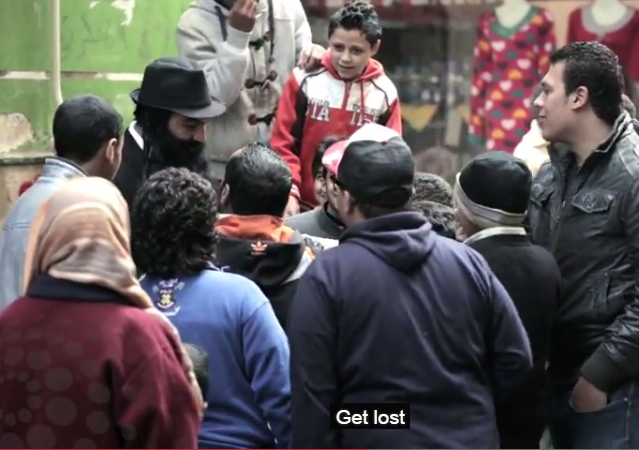
Is this officially a series now? We've done Paris, Britain, Copenhagen and Malmö, where people walking the street dressed in attire indicating they are religious Jews face street harassment, mostly by Muslim young men. We also did Montevideo, where the reaction was positive. Here's Cairo, as the Jerusalem Post reports:
An Egyptian journalist conducted an experiment in which he dressed up as a Jew and asked passersby on the streets of Cairo for directions to a nearby synagogue - with nearly serious consequences for his physical safety. The Cairo-based Internet news site DOTMSR sent the journalist to the streets of Cairo dressed in overtly Hassidic garb - sidecurls, skullcap, beard, and a hat. The “Jewish” journalist was then subjected to threats of violence, epithets, slurs, and shoving from hostile locals.... DOTMSR is an Arab-language Internet news site “that broadcasts high-quality news items in Arabic.” It describes itself as a news outlet that “believes in openness, innovation, and an obligation to accepting those who are different.”

We recently reported on legislation in Illinois barring state pension funds from investing in companies that boycott Israel. The legislation passed both chambers unanimously, a stunning bi-partison rejection of the Boycott, Divestment and Sanctions movement. Gov. Bruce Rauner has promised to sign the legislation. The BDS movement is screaming about the legislation because while boycotting Israelis is cool with them, bocotting the boycotters is the worst violation of human rights ever. That's not much of an exaggeration as to their response -- it is full blown hissy-fit which mischaracterizes the legislation as suppressing speech. The reaction from BDS not only has been a hissy fit, it has been bizarre and revealing. Jewish Voice for Peace, one of the most aggressive BDS organizations, is demanding the State Department change its long-standing definition of anti-Semitism. I've long argued that the anti-Israel boycotters, particularly in academia, were forfeiting their standing to complain when the boycotts boomeranged and were turned on them. I'd rather that BDS never started this fight, but it did and now BDS supporters are realizing they are swimming in the ocean of a pro-Israel American population. The campus and faculty lounge anti-Israel bubbles are exceptions, not the rule. And that strong and increasing public support of Israel is being expressed through elected representatives. The Illinois legislation came at a time of two pending federal bills targeting the international boycott of Israel. But states may be where the action will be, as NY legislators plan to introduced a bill similar to the one passed in Illinois:

The anti-Semitism deeply embedded in the anti-Israel Boycott, Divestment and Sanctions (BDS) movement has been apparent for years, but particularly since the 2014 Gaza War. Rallies against Israel regularly devolved into Jew-baiting throughout Europe, and even in some places in the U.S., like Miami where they chanted, “Jews, remember Khaybar, the army of Muhammad is returning.” At a Boston rally sponsored by Jewish Voice for Peace in July 2014, Israel supporters were attacked by a woman who yelled that they would claim back Jerusalem for Christians and Muslims. It is no surprise that Walking While Jewish is dangerous in many cities in Europe. While there is an intellectual distinction between anti-Zionism and anti-Semitism, in reality on the streets of Europe and some places in the U.S., they are one and the same.

I appeared on Saturday, May 16, 2015, on The Craig Silverman Show on 710 KNUS in Aurora, Colorado. The conversation covered my background, what it means to be a conservative on campus, the anti-Israel boycott movement, the Pope on a Palestinian "state," the Pew Poll on Christians, and the fate of Christians in the Middle East. On Ted Cruz at Harvard Law School:
"When you're going to be political at a place like Harvard Law School, you have to be better than everybody else if you're a conservative. You have to be smarter, you have to be more well-read, you have to be better-prepared, because it's you against a lot of people. And certainly he wouldn't have been the only conservative at Harvard Law School, but he would have been in a severe minority. And when you're in that situation, you have to be better. And that's what I see with a lot of politically active conservative students on campus... [Cruz] had to sharpen his skills because he's basically arguing with everybody or almost everybody. Whereas if you're in a liberal position at a school most people agree with you, you don't need to sharpen your skills and you don't get tested the way you do if you're a conservative."
On the anti-Israel boycott movement:
"We're dealing with people who really are just outright liars. And I say that all the time because that's what they are. And they just make stuff up, they twist facts, they ignore facts."
On Israeli-Palestinian negotiations: