


Image 01 Image 03

Israel Tag

The United Nations Security Council just voted against a controversial Palestinian Authority proposal, introduced by Jordan, requiring Israel to pull back to the 1967 lines (the 1949 Armistice line), including designating all of East Jerusalem (which includes the ancient Jewish Quarter of the Old City). The vote failed to get sufficient votes to force a U.S. veto. Aljazeera reports:
The UN Security Council has rejected a Palestinian resolution calling for peace with Israel within a year and an end to Israel's occupation by 2017. The resolution failed to muster the minimum nine "yes" votes required in the council for adoption. It received eight "yes" votes, two "no" votes from the United States and Australia, and five abstentions, from the UK, Lithuania, Nigeria, South Korea and Rwanda. The US, Israel's closest ally, had reiterated its opposition to the draft resolution earlier on Tuesday. Washington said it could not support the draft because it was not constructive and failed to address Israel's security needs.
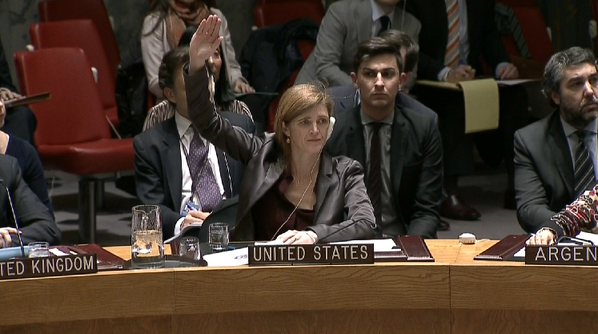
Samantha Power US votes No Palestinian Statehood The Times of Israel adds that the result surprised the Palestinians:
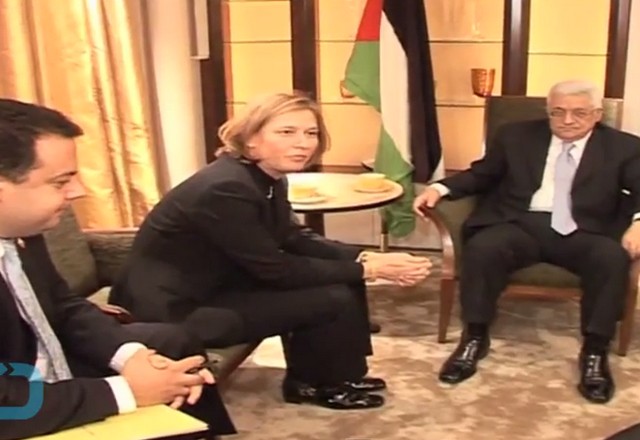
In a recent essay, Jonathan Spyer identified the likely approach the anti-Netanyahu coalition - specifically Isaac Herzog of Labor and Tzipi Livni of Hatnua - will take in preparation for the Israeli elections on March 17. Spyer writes, "The belief underlying the Israeli center-left’s campaign is evidently that if Israel is 'boxed in' it is because of its own 'extremists' and that the solution to this is greater accommodation to the U.S. administration." There's a problem with this approach, though: it may not resonate well with Israeli voters.
But if this is indeed to be the thrust of the center-left’s campaign in the elections, success is likely to continue to elude it. Israelis are deeply aware both of the threats that surround them, and of the cold attitude of the current U.S. administration toward their country. A campaign which seeks to blur or obscure these or to claim that they are largely of Israel’s own making is likely to win its proponents a further term in the opposition.
We only have to go back to last week, when Roger Cohen of the The New York Times published an interview with former Israeli peace negotiator Tzipi Livni, to see how true Spyer's assessment is. Livni, in the column, identifies Palestinian Authority President Mahmoud  Abbas as the one who torpedoed the American-sponsored peace process by failing to accept an American framework agreement, attempting to bolster a unilateral bid for statehood by signing international treaties and finally by agreeing to a unity government with Hamas. Yet even as Livni recounted Abbas refusal to negotiate in the middle of the op-ed, at the beginning and end of the article she asserts that only she and those aligned with her are moderates seeking peace. The problem is the disconnect between her accounting of Abbas' intransigence and her insistence that Likud is what's preventing peace is rather obvious. She can't convincingly claim that Prime Minister Benjamin Netanyahu is the major obstacle to peace when she herself has documented how Abbas scuttled the American peace efforts.

A new Hamas "How To" video is going viral in Palestinian social media circles. It isn't how to rebuild buildings. Or how to make peace with Israel. It's how to stab Jews. How do it properly and inflict maximum damage on the victim and increase the likelihood of killing him or her. The Jewish Press reports:
The “resisters of occupation in the occupied West Bank and Jerusalem” are spreading on Arab social media a frightening video demonstrating tactics on how to stab a Jew to death quickly and efficiently. The 1-minute and 13-second video, as seen below, shows the “teacher” calmly walking up to a “victim,” stabbing him, and walking away. One of the tactics appears to imitate the Islamic State of Iraq and Syria (ISIS) method of beheading. The guide to killing Jews teaches that after stabbing the victim, the knife should be twisted to maximize wounds and cause death.

Prof. Jaccobson blogged yesterday about the tribulations of Israeli Member of Knesset Haneen Zoabi, who is privileged and free to serve in the legislature of the country that she reviles. But there's another Zoabi, in fact a distant cousin, who also has been in the news. Mohammad Zoabi. He's a teenager who describes himself as a "A Proud Israeli Arab Muslim Zionist." Mohammad first came to my attention when he released the video below, a plea to return Eyal Yifrach, Gil-ad Shaar and Naftali Fraenkel, in English, Hebrew and Arabic.

Haneen Zoabi hates Israel. She encourages its enemies. She spews anti-Israel propaganda with reckless abandon. The kidnappers and murderers of three Israeli teens last spring were not terrorists, according to her. Haneen Zoabi also is a member of the Israeli parliament, the Knesset, as part of Arab nationalist party Balad. There have been moves to ban Zoabi from the Knesset, and her disruptive behavior within the Knesset has resulted in a temporary ban. But she's still there, and running again in the upcoming March 2015 elections. There is no such thing as a Haneen Zoabi in reverse in most countries, and certainly in Arab countries, where Zoabi would be in jail or worse. In the U.S., a Zoabi-equivalent probably wouldn't make it into Congress because of our dual-party system. No, in the U.S. a Zoabi would have to settle for an endowed professorship at Columbia, or presidency of the American Studies Association. Danny Danon, a popular "right wing" Israeli politician, knows the public doesn't like Zoabi, and is running an animated campaign ad mocking her for supporting Israeli's enemies in order to boost his own election prospects. Sorry, don't have version with English subtitles, but you probably can figure it out: Now Zoabi is suing. Seriously.

Tzipi Livni, Israel's former peace negotiator, dropped a bombshell yesterday when she explained in an interview with New York Times columnist Roger Cohen, how Palestinian Authority President Mahmoud Abbas torpedoed the American sponsored peace process earlier this year. One would think that Abbas, who claims he wants a state for his people would try and negotiate one. Instead he took unilateral actions that alienated even the likes of Livni. For those who believe that the Palestinians would benefit from statehood, Abbas' behavior is incomprehensible. Why would Abbas pass up a chance to negotiate for a state for his people, something which conventional wisdom tells us would benefit not only the Palestinians, but the whole Middle East as well? (In fact. Abbas may be refusing to compromise with Israel because Palestinians don't want him to.) But that isn't the only recent report of Palestinian leaders putting their own concerns ahead of those of their people. Neri Zilber of the Washington Institute for Near East Policy wrote Gaza's Explosion Waiting to Happen for Politico earlier this week. The central part of Zilber's report focused on the infighting between Fatah and Hamas, that has delayed the rebuilding of Gaza. Fatah, for its part, is supposed to take control of Gaza, but as one Fatah official asked "How do you expect me to go work in the Gaza Strip 'when the Qassam Brigades [Hamas’s elite military wing] goes ahead of me in both power and weapons?'” Zilber summed up the issue:
Seven years of Hamas control over Gaza would be gradually replaced by the Fatah-dominated PA, billions of dollars in donor aid would flow in, and the Gazan people would be liberated from the continued rule of an internationally-designated terrorist organization (and the continued need for an Israeli and Egyptian blockade around the territory). Or at least that was the idea. But all these plans are on hold as Hamas and the PA engage in a game of political chicken, staring each other down , a reality confirmed to me over the past month in conversations with nearly two dozen Israeli and Palestinian officials (from both Fatah and Hamas), international diplomats and non-governmental sources based in Israel and the West Bank, some of whom requested to remain anonymous so as to speak more freely.

In his column yesterday, anti-Israel columnist Roger Cohen of The New York Times talked to Tzipi Livni, candidate for prime minister and Israel's peace negotiator, about why the John Kerry-sponsored peace talks failed earlier this year. Livni tells of the three ways the Palestinians destroyed the peace talks. The administration in March had presented a framework for both sides.
Livni considered it a fair framework, and Netanyahu had indicated willingness to proceed on the basis of it while saying he had reservations. But Abbas declined to give an answer in what his senior negotiator, Saeb Erekat, later described as a “difficult” meeting with Obama. Abbas remained evasive on the framework, which was never made public.
One part of the framework was to accept the 1967 lines (really the 1948 armistice lines) as the basis of negotiations. In other words, Netanyahu made a major concession here and Abbas still refused to play ball. Still at the behest of the administration talks continued and a few weeks later, the Palestinians were at it again.
Then, Livni said, she looked up at a television as she awaited a cabinet meeting and saw Abbas signing letters as part of a process to join 15 international agencies — something he had said he would not do before the deadline.
Abbas offered the excuse that Israel was stalling. Still, this was a unilateral action outside the framework of negotiations and a broken promise. Finally, there was this:

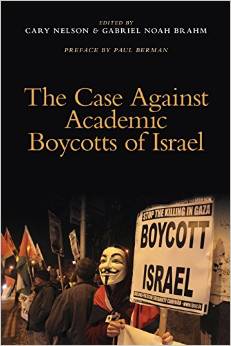
Cary Nelson, Professor Emeritus at the University of Illinois at Champaign-Urbana, is the Editor of a recent book, The Case Against the Academic Boycotts of Israel. The Case Against Academic Boycotts of Israel cover He also was interviewed on Israeli television recently. He makes some good points, similar to those I have made in many of my speeches and appearances. The faculty Propagandists with Ph.D's are the main problem, they use their leverage over students in the Humanities and Social Sciences to intimidate and control the agenda. Academic BDS is a movement led by evil people, and followed by many more uninformed, misinformed and misguided dupes. Evil can never be ignored. BDS is a pox on academia, and should be treated as such. http://youtu.be/jQOs_lE-YFQ?t=1m1s (Added) I'll use this as a chance to promote my interview with Mark Levin on the topic, in case you missed it:

Following the dissolution of the Israeli government this week, Labor Party leader Isaac Herzog and Hatnua leader Tzipi Livni agreed to join forces in an effort to unseat Likud as the governing party. At The Times of Israel Haviv Rettig Gur wrote a positive analysis of the merger, arguing that in bringing Livni on board Herzog aimed to capture the center of the Israeli electorate, rather than ceding it to Likud.
Yet Israel’s political center is actually far larger than the parties who formally declare themselves to be “centrist.” On the key issue that defines the left-right axis, Palestinian statehood, polls have shown that as many as half of those who vote for the explicitly right-wing parties Likud, Yisrael Beytenu and even Jewish Home actually support Palestinian statehood. Countless polls suggest that Israeli centrists – usually defined by pundits as those who support Palestinian independence while distrusting Palestinian willingness to reciprocate with peace – vote for the right because they hear their skepticism reflected in the rhetoric of right-wing leaders. For 20 years, Herzog’s predecessors – Labor has seen 11 leadership changes in 22 years – have been fighting a losing battle against this vast, inchoate center. But on Wednesday night, Herzog launched the left’s most dramatic bid since the 1990s for the Israeli center’s trust.
Herzog, according to Gur, no longer talks about "peace and reconciliation" but of "separation." There are two assumptions to Gur's analysis here that I'm skeptical about.

Last week Prime Minister Benjamin Netanyahu started the process of dissolving his government coalition to bring about new elections in March of next year. One needn't be a particularly close observer of politics to know that President Barack Obama doesn't much like Netanyahu. Will Obama try to interfere with the Israeli election? Akiva Eldar, a left-wing columnist for Ha'aretz, argues in Al-Monitor that, yes, Obama should make it clear that he prefers any candidate to the incumbent.
Some of President Barack Obama’s advisers came to the conclusion that the time had come to remind the Israelis who is the boss. They encouraged the president to set a detailed outline for a permanent agreement between Israel and the Palestinians. They recommend that the process involve a fixed timetable for the establishment of a Palestinian state on the basis of the 1967 lines and the Arab Peace Initiative. According to the plan, a diet of “carrots” would be provided to the party that adopts the outline, and “sticks” would be the fate of the recalcitrant side. When the Israeli voter goes to the polling booth, he or she would know whether they vote for the carrot or the stick. The Palestinian leadership and public will also clearly envisage the end of the occupation, with the advantages that follow the end of it, vis-a-vis perpetuation of the conflict and the drawbacks involved. ...

Last week, Prime Minister Benjamin Netanyahu fired his finance minister (Yair Lapid of Yesh Atid) and justice minister (Tzippi Livni of Hatnua), both coalition partners, effectively bringing down the current government and forcing new elections now scheduled for March 17. The latest polls suggest that Netanyahu would be able to form the next coaltion.
According to a Channel 10 poll, Likud would win 22 seats, Jewish Home 17, Labor 13, Yisrael Beytenu 12, Moshe Kahlon’s as-yet-unnamed party 12, Yesh Atid nine, the ultra-Orthodox United Torah Judaism eight, Shas seven, Meretz seven, Hatnua four and the Arab parties nine. A survey by Channel 2 showed Likud with 22, Jewish Home 17, Labor 13, Kahlon and Yisrael Beytenu with 10 apiece, Yesh Atid with nine, Shas with nine, United Torah Judaism with eight, Meretz with seven, Hatnua with four, and the Arab parties with 11. Both polls would have made pleasant reading for Likud leader Netanyahu, showing a strengthening of the right, and numerous potential coalition options for him.
However, a lot can happen in four months. For example two years ago, Likud created a joint list with Yisrael Beiteinu (Avigdor Liberman's party) and then the combined list lost ten seats in popularity polls in the final month of the campaign.

Iran recently boasted how it had transferred via Syria game-changing missiles to the terrorist Hezbollah, which controls much of Lebanon and is fighting alongside the Assad regime in Syria. Israel has warned about such missile transfers, and reportedly (without Israel admitting it publicly) bombed convoys and facilities in Syria to stop such transfers. It appears from news reports that Israel has acted again. Reuters has confirmed the bombing:
Israel has carried out an air strike targeting a consignment of missiles in Syria bound for Hezbollah in neighboring Lebanon, an Israeli official said on Saturday.... "There was an air strike. The target was not a chemical weapons facility. It was missiles intended for Hezbollah," the official told Reuters.
As with all such breaking events, photos and videos on Twitter are not yet verified as authentic.

Matti Friedman again explains how NGO's and the media prepare the ground for anti-Israel propaganda...

"Nakba" is the phrase Arabs use to refer to the creation of Arab refugees from the British Mandate of Palestine created during the civil war and then Arab armies invasion after Arabs rejected the U.N. General Assembly 1947 Partition Plan. Had the Arabs accepted that plan, there would have been an Arab state created in 1947.  Since Jordan was created from most of the original Mandate, the Partition Plan would have given Arabs the supermajority of the land.  Instead, the Arabs declared holy war on the Jews, and lost the civil war and 1948 War. In the course of that loss, hundreds of thousands of Arabs fled, then were kept in refugee camps by other Arabs, and have been kept as non-citizens in those Arab countries pending the destruction of Israel. The there was another "Nakba" resulting from the Arab rejection of Israel. The story of 850,000 Jewish refugees from Arab countries has been told here many times, but rarely is discussed in the public debate over the Middle East. The silence on the Jewish Nakba is changing. Ben-Dror Yemini, writing in Ynet, What about the Jewish Nakba? (h/t Israel Matzav) writes:

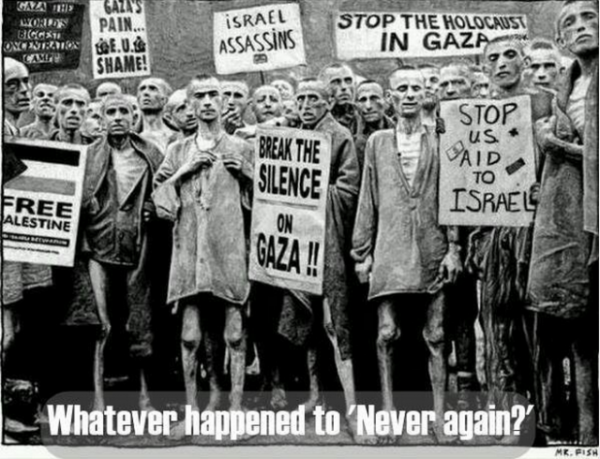
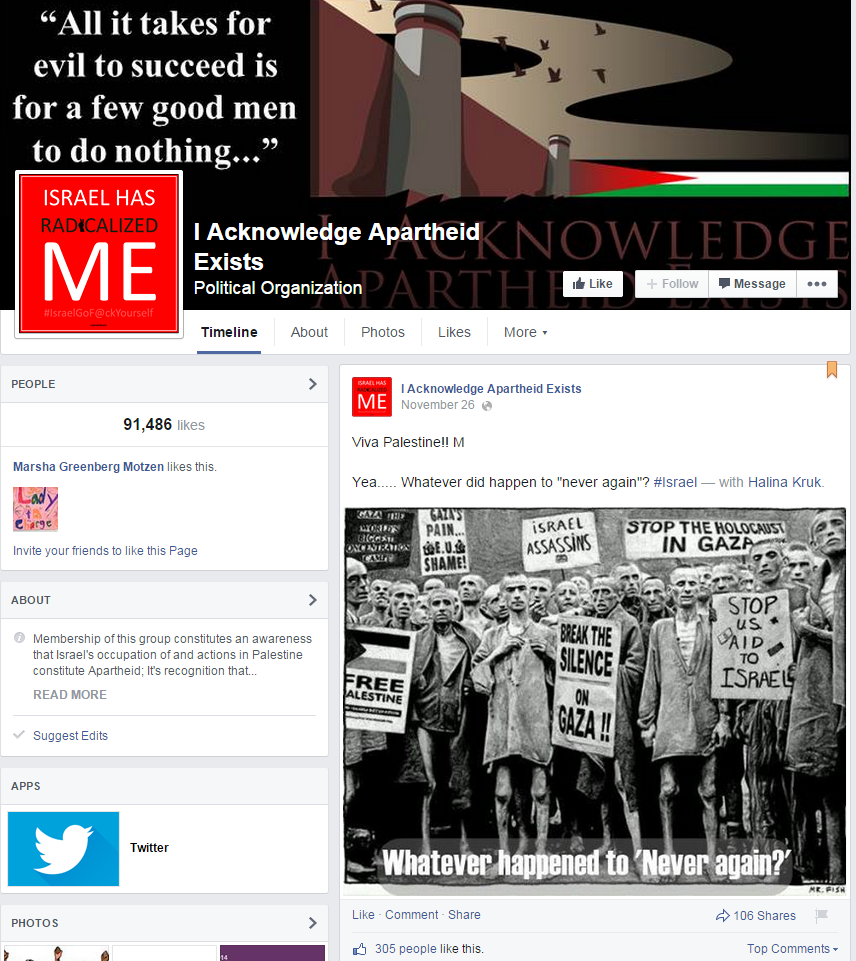
We are dealing with some really sick minds when it comes to the proponents of the Boycott, Divest and Sanctions (BDS) movement propaganda machine. The latest is from a group with over 91,000 Facebook fans, called "I Acknowledge Apartheid Exists." That phrase is an integral part of the BDS movement, which falsely seeks to portray Israel as the equivalent of apartheid South Africa. That claim of Apartheid status was the founding propaganda principle of the BDS movement, which was started at the anti-Semitic 2001 Durban conference. The group has posted a photoshop of Nazi concentration camp inmates holding anti-Israel signs, on its Facebook page. It's unclear if the group created it, or is just promoting it. https://www.facebook.com/IAcknowledgeApartheidExists/photos/a.116419295219428.1073741828.116415985219759/321047701423252/?type=1 The image is being spread by others as well, such as the Central NY Committee for Justice in Palestine: [Note 11-28-2014 10:15 p.m. - sometime tonight CNYCJP removed the image after complaints were posted in its comments in response to Legal Insurrection's coverage, and after the image was CNYCJP's Facebook page for about two days the cache version of the post is here]

We previously posted video of anti-Israel protesters getting in the face (literally) of pro-Israel students at Cornell who were holding counter-protest signs, Cornell Pro-Israel students taunted: “F**k You Zionist scums”. The incident depicted in the prior video actually was the second incident of the day, I have learned. Prior to that confrontation, Ilan Kaplan, a Cornell student on leave but who is still active in the Cornell Jewish community, alleges he was accosted as he held a sign, had his sign torn out of his hands, had water thrown on him, and was threatened. Here is my interview with Kaplan: Language Warning