


Anti-Israel academic boycotters demand Freedom From Criticism
The days of the hateful BDS ideology going unchallenged on campuses and in academic organizations are over....
Strong presence countering BDS propaganda helped water down main anti-Israel resolution and defeat "emergency" resolution....
What is that? An obsolete, defunct resolution passed by the General Assembly (unlike 242 and 338, not by the Security Council, and thus not even binding) . . . in 1947! It partitioned British Palestine into a Jewish state and an Arab state. At the time, every single Arab state and the Palestinian Arab Higher Committee totally rejected 181. In fact, they invaded the area given to the Jews with the express purpose of wiping it off the map. They failed. And now 50 years later, the Palestinians are converts to 181. What's wrong with that?
(1953 - Commando Unit 101 - Ariel Sharon Second from Left, Second Row)(source: YouTube [/caption]
Sharon, among many others, didn't let it happen, and in the course of defending Israel made some errors of judgment that are easy for historians and politicians to criticize with the benefit of hindsight.
Sharon's crossing of the Suez canal during the 1973 War to trap the Egyptian Third Army is legendary.
[caption id="attachment_74807" align="alignnone" width="448"]
(Ariel Sharon and Moshe Dayan, Sinai 1973)[/caption]
“Colleges should not use taxpayer funds to support boycotts, resolutions or any similar actions that are discriminatory and limit academic opportunities.”...
Mr. Curtis Marez President American Studies Association 1120 19th St NW, Suite 301 Washington, DC 20036 Dear Mr. Marez: We write in strong opposition to the American Studies Association’s (ASA) recent decision to boycott Israeli universities and academic institutions. While ASA has every right to express its views on policies pursued by any nation or government, we believe that the decision to blacklist Israeli academic institutions for Israeli government policies with which ASA disagrees demonstrates a blatant disregard for academic freedom. The ASA claims that the boycott “is in solidarity with scholars and students deprived of their academic freedom and it aspires to enlarge that freedom for all, including Palestinians.” We believe that this boycott accomplishes just the opposite. The university is an institution intended to foster, encourage, and inspire constructive dialogue and original thought. However, this boycott undermines academic freedom by prohibiting educational and cultural exchanges with Israeli universities and academic institutions.
Since then, the organization has been forced to defend itself from a barrage of highly vocal critics who have accused the ASA of everything from anti-Semitism to threatening academic freedom. At the conference this week, however, many ASA members reiterated their strong support for the motion. “The boycott is also about the vision of a right to education for people; it’s about a right to democratic participation of all people and it’s about the right to land,” said Alex Lubin, a professor at AUB [American University in Beirut, on leave from University of New Mexico] and ASA member. Despite efforts to publish op-ed pieces explaining the ASA’s position, Lubin said the organization had “effectively been blocked out of [the] U.S. press.” The reason, he said, was “donor dollars that come to them [the publications] from the Israel lobby.” Lubin also said many Americans took issue with the comparison between the treatment of Palestinians and Native Americans.
Below is an open letter to the President and Executive Committee of the American Studies Association. Though written by faculty at Middlebury College, we hope that many other institutional members of the ASA, American Studies programs, individual members, and present and former officers of the organization will support the letter’s call for discussion of the ASA’s mission statement.... To the President and Executive Committee of the American Studies Association: .... The American Studies Program at Middlebury does not support, and will not honor, the American Studies Association’s resolution to boycott academic institutions in Israel.... Beyond our concerns about the merits of academic boycotts in general (and this one in particular), we are concerned that the ASA resolution is inconsistent with the stated mission of the organization. The ASA seems to be neglecting, or at the very least interpreting in a particularly tendentious way, the language of its own constitution. Effectively a mission statement, Article I, Section 2 of the ASA constitution reads:Sec. 2. The object of the association shall be the promotion of the study of American culture through the encouragement of research, teaching, publication, the strengthening of relations among persons and institutions in this country and abroad devoted to such studies, and the broadening of knowledge among the general public about American culture in all its diversity and complexity.
His line that “Universities exist to build bridges of understanding, not to blow them up” insinuates that being in solidarity with Palestinians is on par with terrorism. Not only is this metaphor racist and distasteful, but it was also irresponsible. Supporters of the academic boycott are endangered when their activity is distorted through fear mongering. Cabrera’s use of damaging language is a blatant response to the support GMU SAIA received from faculty as a result of the NO HONOR IN APARTHEID campaign. His response is only a small part of the national “McCarthyite” campaign to destroy the positive learning environments student organizations have created regarding the Palestinian-Israeli conflict on campuses. While academic integrity is often cited as a value of the administration, Cabrera’s rhetoric serves to limit discussion, exploration, and academic freedom around critical issues. While President Cabrera’s support for Israeli apartheid is no secret, his allegiance, to the best of our knowledge, is linked to position and profits.Why does the anti-Israel group assume that referring to blowing up relations among universities is a reference to Palestinians blowing themselves up in cafes, buses, pizza shops and Passover Sedars?
Most universities which were listed as Institutional Members of the American Studies Association have left it up to particular departments which took out the membership to decide whether to continue. Of the 83 Institutional Members listed by ASA, at least 11 deny being members, as detailed...
The bomb that tore through a Dan No. 240 bus in the central Israeli city of Bat Yam on December 22 was assembled in a pressure cooker and activated by cellphone, much like the devices that killed three people and wounded hundreds more during the Boston Marathon in April 2013, the Shin Bet investigation has revealed.... The bomb, which exploded at the corner of Mivtza Sinai and Katzenelson streets in the Tel Aviv suburb of Bat Yam, caused no injuries because an alert passenger had noticed the bag containing the device left unattended by the bus’s rear door. The driver evacuated the bus, and the device was detonated as an Israeli sapper attempted to defuse it. The bus was wrecked, but there were no injuries.... According to information released by the Shin Bet, the bomb, consisted of two kilograms of improvised explosives surrounded by nails and screws and stuffed into a pressure cooker. This was a method akin to the one used by Boston murderers, brothers Dzhokhar and Tamerlan Tsarnaev. It was made popular by an al-Qaeda manual placed online.More on the plot, via Haaretz:
Israeli security forces carried out a series of arrests in the West Bank city of Bethlehem following the attack, detaining members of the Islamic Jihad militant group. The Shin Bet believes that two of the central suspects in the plot to bomb the bus are former security prisoners in Israel: Shahada Ta'amri, 24, and his 21-year-old brother Hamdi Ta'amri, a former cadet in the Jericho Police officers' course. Another central suspect was named as Yousef Salame, 22.
When I was almost fifty four, it was a very good year It was a very good year for kindly faced clerics Whose Justice Minister was an executioner And Defense Minister waged an anti-American war When I was almost fifty four.Nearly two years ago Jeffrey Goldberg interviewed President Obama about how he would deal with the threat from Iran. Given Goldberg's support for Israel, the interview was part of an administration campaign to tell Israel and Israel's supporters in the United States that "we've got Israel's back." It's unsettling now, that Goldberg has declared that For Iran, 2013 Was a Very Good Year.
Remember that interim Iranian nuclear agreement forged in Geneva on Nov. 24, the one accompanied by blaring trumpets and soaring doves? Would it surprise you to know that the agreement -- a deal that doesn’t, by the way, neutralize the threat posed by Iran’s nuclear program, just freezes the program, more or less, in place -- has not yet been implemented? Would it surprise you to learn that this deal might not be implemented for another month, or more? Or that in this long period of non-implementation, Iran is free to do with its nuclear program whatever it wishes? And that one of the things it is doing is building and testing new generations of centrifuges? Ali Akbar Salehi, the head of Iran’s Atomic Energy Agency, recently said , “We have two types of second-generation centrifuges. We also have future generations which are going through their tests.” Happy New Year, everyone.
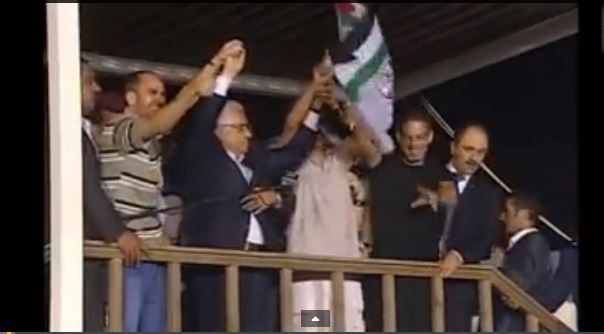
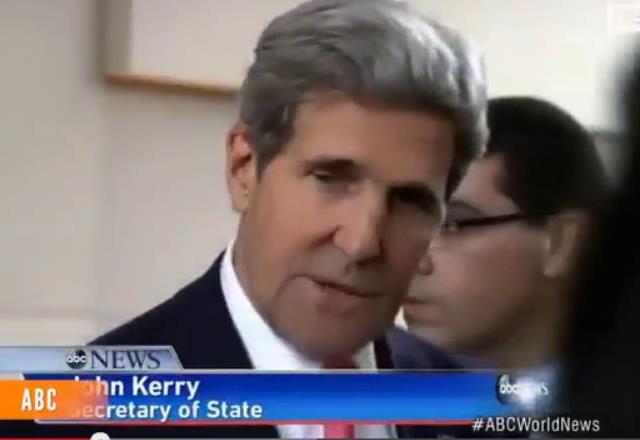
Speaking with Benjamin Netanyahu at a joint press conference before the first of several planned meetings between the two, Kerry said leaders on both sides of the tables already knew what would be included in a US-drafted framework agreement, but added that an agreement was “not mission impossible.” “We know what the issues are and the parameters,” he said of a potential agreement. “The time is soon arriving when leaders will have to make tough decisions,” he added, and said that he would “work with both sides to narrow differences on a framework that will set guidelines for negotiations.” However, Netanyahu, recalling Palestinian celebrations over a prisoner release earlier in the week, said he was skeptical over Ramallah’s commitment to peace. “I know that you are committed to peace; I know that I am committed to peace; but, unfortunately, given the actions and words of Palestinian leaders, there’s growing doubt in Israel that the Palestinians are committed to peace,” Netanyahu said.From the transcript:
PRIME MINISTER NETANYAHU: Welcome back to Jerusalem, John. I want to use this opportunity to express once again my personal appreciation and the appreciation of the people of Israel for your unremitting personal efforts to advance peace between us and the Palestinians. I know that you’re committed to peace, I know that I’m committed to peace, but unfortunately, given the actions and words of Palestinian leaders, there’s growing doubt in Israel that the Palestinians are committed to peace.
Israeli Prime Minister Benjamin Netanyahu would likely have to recognize Israel's pre-1967 war frontier as the starting point for border talks with the Palestinians, an ideological reversal that would put him on a collision course with his hardline base. Palestinian President Mahmoud Abbas fears he'll be pressured to recognize Israel as the homeland of the Jewish people, a step he believes would abrogate the rights of Palestinian refugees and their descendants.The parallelism here is bogus. In the first place the idea that having the "pre-1967 war frontier" (more correctly they should be called "the 1949 armistice lines") as a basis for any peace deal is a departure from the original intent of Resolution 242. After the 1967, Six Day War, there was an international consensus that an Israeli return to its pre-war borders was a "prescription for renewed hostilities."
"I hope the ASA’s call for a boycott produces just the opposite of its intended result – a proliferation of U.S. linkages with Israeli universities"...
Donations tax deductible
to the full extent allowed by law.
Founder
Sr. Contrib Editor
Contrib Editor
Higher Ed
Author
Author
Author
Author
Weekend Editor
Author
Editor Emerita