

Image 01 Image 03

China Tag

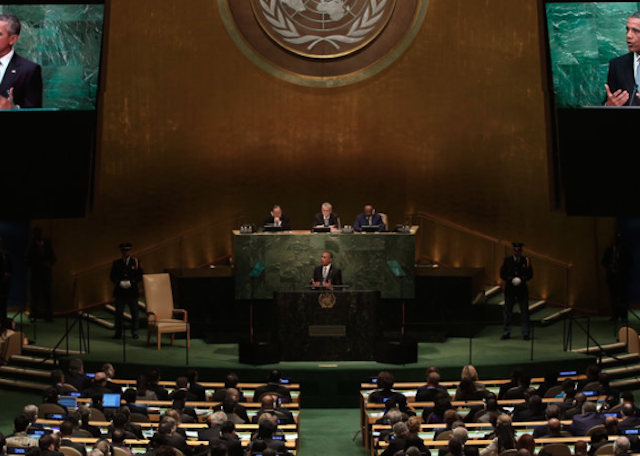
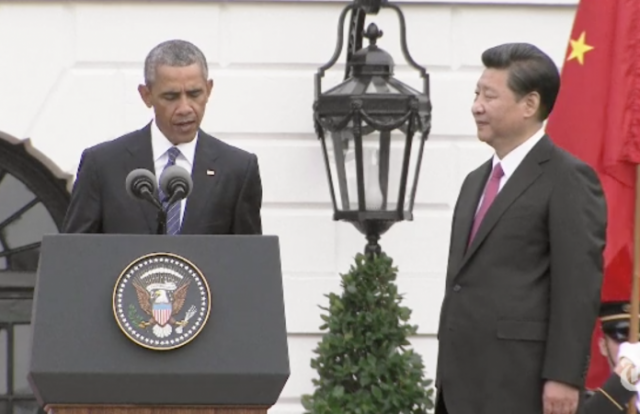
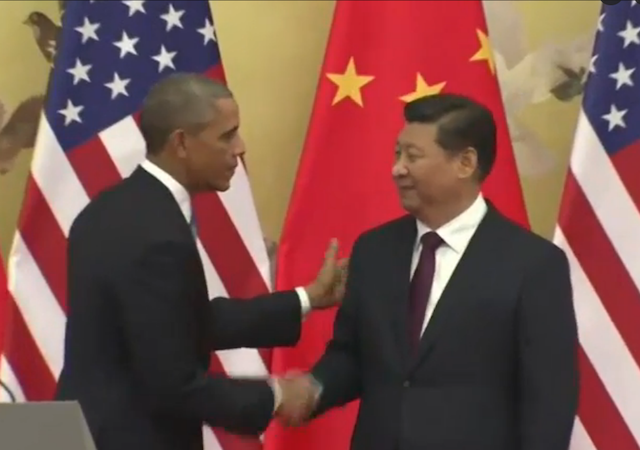
This week, the United States and China shocked the world with a joint announcement pledging to address greenhouse gas emissions. The plan has been touted as "historic" by Administration leaders, but critics say that the end game of this plan is less about controlling climate change, and more about creating a favorable political environment. From CBS News:
Mr. Obama announced that the U.S. would move much faster in cutting pollution, with a goal to reduce emissions by 26 percent to 28 percent by 2025, compared with 2005 levels. Earlier in his presidency, he set a goal to cut emissions by 17 percent by 2020. Xi, whose country's emissions are still growing as it builds new coal plants, didn't commit to cut emissions by a specific amount. Rather, he set a target for China's emissions to peak by 2030, or earlier if possible. He also pledged to increase the share of energy that China will derive from sources other than fossil fuels. Together, the U.S. and China create more than one-third of all greenhouse gas emissions worldwide.
Anyone who has paid attention to China's economic model over the past decade (and beyond,) or the political climate in the U.S. going into the lame duck session, knows that a plan that has the potential to impact economic growth is beyond unrealistic. Republican leadership in the Senate is not impressed:

My stepdaughter, a graduate of UCLA with a degree in Chinese, works in Beijing. Today, she has been regularly protesting updates via Facebook on the pro-democracy protests in Hong Kong, and confirms that tear gas is being used to disperse the massive crowds.
Tens of thousands of pro-democracy demonstrators are surging through the streets of Hong Kong to protest against Beijing’s influence over how the semi-autonomous territory elects its top officials. Police used several rounds of tear gas to scatter the mostly peaceful crowds that had blocked one of Hong Kong’s main thoroughfares in the early evening. But protestors did not disperse entirely. Earlier today, pro-democracy group Occupy Central announced the beginning of a civil disobedience campaign intended to disrupt Asia’s largest financial center until its demands for free elections are met. The campaign, originally planned for October, is riding a wave of momentum following a sit-in over the weekend where televised clashes between police and students, some of whom were pepper sprayed, prompted city residents to rally in support of the students. Organizers say that around 60,000 demonstrators were on the streets today, media reports put that number at 30,000, and police have not given an estimate.

I guess it is not really surprising that Israel is doing well in Chinese social media. Israel and China have signed a series of new trade agreements in recent months, including academic cooperation, as we detailed in Israel-China tech deal another blow to BDS. Those expanding trade connections, based in large part on Chinese desire for Israeli technology and know-how, have continued uninterrupted during the Gaza hostilities:
China is now Israel's second- largest trading partner, with exports of US$2.88 billion and imports of US$7.99 billion last year. Chinese companies are eyeing several high-profile investment deals in Israel. These include tendering for construction of a railway linking Eilat on the Red Sea and Ashdod on the Mediterranean, and purchasing a more than US$1 billion controlling stake in Tnuva, Israel's dairy giant.
Peter Cai at the China Spectator writes on September 2, How Israel is winning the social media war in China:

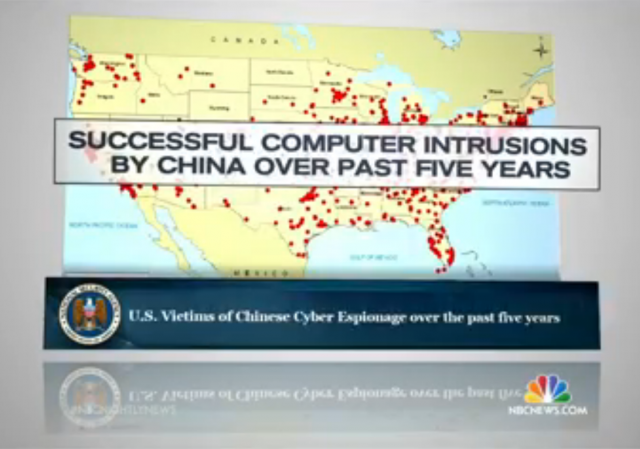
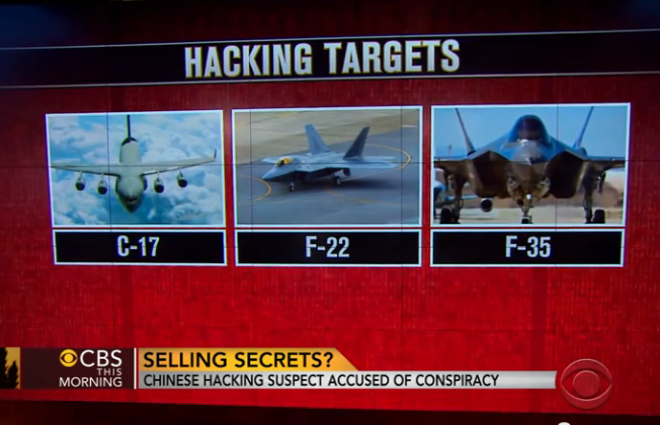
In May, the Obama Administration announced a crackdown of Chinese cyber espionage. The grand jury indictments charged five Chinese People’s Liberation Army members with hacking the computers of a number of U.S. businesses and organizations. Now the U.S. government alleges that Boeing was the target in a new round of Chinese cyber spying.
Su Bin, the owner of a Chinese aviation-technology company with an office in Canada, conspired with two unidentified individuals in China to break into the computer networks of U.S. companies to get information related to military projects, according to charges unsealed yesterday in federal court in Los Angeles. Su advised the two others in China on what data to target, according to the charges. Su’s alleged co-conspirators claimed to have stolen 65 gigabytes of data from Boeing related to the C-17 military cargo plane, according to the criminal complaint. They also allegedly sought data related to other aircraft, including Lockheed Martin’s F-22 and F-35 fighter jets.
As was the case with the indictments in May, there appears to be direct evidence linking Su Bin and the Chinese government.

It looks likes one of the global flashpoints I mentioned earlier this year is heating up. While Iraq descends rapidly into chaos, tensions may be building in another section of the Asian continent. India is poised to double its forces along the border with China.
The new BJP government is keen to send out a strong signal to Beijing regarding border disputes by nearly doubling the deployment of Indo-Tibetan Border Police (ITBP) personnel on the India-China frontier. Top government sources said the ITBP will very soon have more boots on the ground to effectively guard the border that has witnessed several Chinese incursions in the past few years. The previous UPA government was often criticised for being "soft" on the issue of Chinese incursions. The Home Ministry has approved the construction of 54 new border outposts along the disputed frontier with China. A proposal in this regard was made by the ITBP before the polls but the previous government did not go ahead on it. With the new outposts, the number of troops on the ground too will increase. Currently, there are close to 40 outposts and nearly 15,000 troops guard the sensitive zones. Sources said the number could now go up to 30,000. "There were critical gaps regarding security on the China border that need to be filled up," said a senior Home Ministry official. "The increase in deployment should not be construed as an aggressive approach on our part. We are only securing out territory," a top government official said.
What is most interesting is the new prime minister's inauguration is also sending another message to China -- one I suspect it will not much like:

For years many the feeling was that Europe had unquestioned leverage with Israel and therefore could take sides without losing its clout. But trade and tech have taken their toll on this assumption. Israel is building alliances in Asia, and European leverage is sure to suffer. Former Israeli foreign and defense minister, Moshe Arens, explains in Ha'aretz Why Israel is shifting eastward.
On reflection this is not totally unexpected. For many years the economic development of the countries in East Asia has been outpacing the economic development of Europe. Japan made giant strides in the years after World War II. South Korea followed suit. China has become the economic wonder of the twenty-first century. There are, as well, indications of accelerated economic development in India, the world’s largest democracy. It is natural that Israel’s economic relationship with these countries would begin to rival its relationships with the countries of Europe, a Europe which seems to be in permanent economic crisis and lagging behind the Asian tigers. ... Despite the centuries of anti-Semitism that marked most European nations and the guilt borne by them for their actions during the Holocaust, Europe, in recent years through the machinery of the European Union, has waged a constant campaign of criticism and condemnation of the policies pursued by Israeli governments, going so far as to impose economic sanction against Israel.
The second point was made in an op-ed in late February by Clemens Wergin in the New York Times, Why Israel no longer trusts Europe.
To Europe, the Israeli-Palestinian conflict is the root of all problems facing the region — a view in no way altered by the Arab Human Development Reports published by the United Nations since 2002, which showed that Arab autocracies and cultural backwardness were the root of the region’s woes.

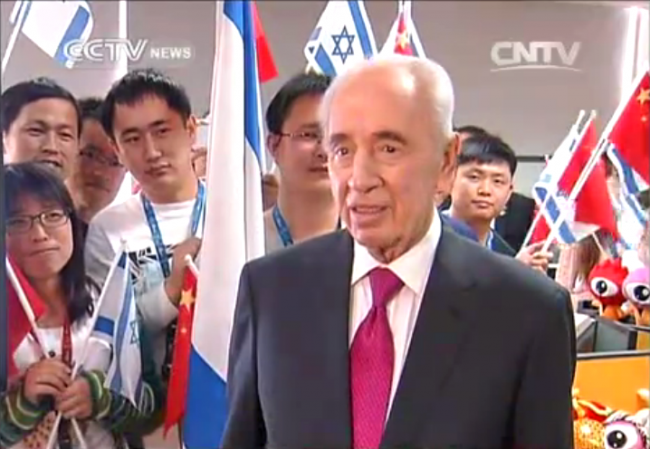
Two days ago we asked, Did Indian election eviscerate BDS?, noting that election of a pro-Israel party and leader made likely vastly expanded business for Israel in India.  We noted also a massive joint academic research deal signed with China. It has just been announced that Israel had signed massive trade deals with various Chinese provinces, and 350 Chinese entrepreneurs attended a tech conference in Israel, as reported by The Jerusalem Post, Israel inks tech pacts with China’s Silicon Valley
Israel signed a bilateral industrial R&D cooperation agreement on Tuesday with China’s Zhejiang Province, known as the Silicon Valley of China, as 350 delegates from the Asian giant attended MIXiii, the Israel Innovation Conference. It also inked agreements with Jiangsu Province’s Science and Technology Department to promote Israeli companies’ participation in Chinese innovation parks and a first-of-its kind pilot program to encourage Israeli companies participation in the Changzhou Innovation Park in Jiangsu (population 79 million). “The science and technology of Israel need market potential and also market rules, and Zhejiang is a great partner,” Zhou Guohni, director- general of Zhejiang Province (population 55 million), told The Jerusalem Post at the signing in Tel Aviv. “We are facing a transformation and upgrade of the industry, and we need Israel’s technology to help transform and upgrade it.” The Economy Ministry’s Chief Scientist Avi Hasson said the agreement “will help many Israeli companies expand into the Chinese market and marks the next stage in the economic and technological relationship between our two countries.”
Read on, the expansion of ties is even wider than described above. Meanwhile, on campuses like UCLA, U. Michigan, Wesleyan and a dozen or two more, naive students are trying to get their student governments to call for divestment from selected companies doing business in Israel. The student governments have no power to effect divestment of university endowments, it's all symbolic. Sure, we're going to fight BDS vigorously, to the end, because it's malicious. Witness what happened at Vassar, where SJP actually posted a Nazi cartoon and cited white supremacists for their anti-Zionist theories.

China is not taking lightly the recent announcement that the United States has charged five Chinese military officers with conspiring to hack into computers of commercial entities in the U.S. for competitive and economic advantage. In response to Monday’s announcement, China’s Assistant Foreign Minister summoned U.S. ambassador to China, Max Baucus, to complain about the indictment. From Reuters:
China summoned the U.S. ambassador after the United States accused five Chinese military officers of hacking into American companies to steal trade secrets, warning Washington it could take further action, the foreign ministry said on Tuesday. The U.S. Ambassador to China, Max Baucus, met with Zheng Zeguang, assistant foreign minister, on Monday shortly after the United States charged the five Chinese, accusing them of hacking into American nuclear, metal and solar companies to steal trade secrets. Zheng "protested" the actions by the United States, saying the indictment had seriously harmed relations between both countries, the foreign ministry said in a statement on its website. Zheng told Baucus that depending on the development of the situation, China "will take further action on the so-called charges by the United States".
A Chinese Foreign Ministry spokesman said in a statement Monday that “The United States fabricated facts in an indictment of five officers for so-called cybertheft by China, a move that seriously violates basic norms of international relations and damages Sino-U.S. cooperation and mutual trust.”

The Justice Department today announced the indictment of several Chinese military officers over accusations of economic cyber espionage against American companies and organizations. From the Washington Post:
A federal grand jury in Pittsburgh has found that five Chinese People's Liberation Army members hacked into the computers of a number of businesses and organizations in western Pennsylvania -- including U.S. Steel, Westinghouse Electric, and United Steel Workers. According to an indictment unsealed Monday, the Chinese men -- Wang Dong, Sun Kailiang, Wen Xinyu, Huang Zhenyu and Gu Chunhui --  have been collectively charged with 31 crimes. This is the first criminal indictment against state-sponsored hackers who allegedly engaged in cyberespionage for economic purposes, according to the Justice Department. And the FBI said it's just the beginning of a larger crackdown. The government said the accused were members of  PLA Unit 61398, a military group based in Shanghai. Last year in a widely reported investigation, the cybersecurity firm Mandiant identified this group as a source of economic cyberspying. At a press conference Monday morning, government officials alleged the defendants hacked into the computer networks of companies as they engaged in trade disputes or competed against Chinese companies for major contracts -- stealing both technical trade secrets and strategic information. In some cases, the U.S. government alleges, the stolen information was used to benefit Chinese state-sponsored companies.
While many suspect it’s unlikely the accused will ever be brought to justice, U.S. authorities emphasized that they were specifically “exposing the faces and names behind the keyboards in Shanghai used to steal from American businesses.”

I don't know much about Indian politics, so I haven't written about the election sweep which threw out the long-dominant Congress Party. I do know that successive Indian governments have had at times contradictory relations with with Israel; not as crazed anti-Israel as many, but not solidly on Israel's side either. Indian-born writer Vijeta Uniyal believes that the election signals a sea change both politically and economically, with India looking to Israel for technology and investment to jump start the moribund Indian economy, India’s PM-elect Narendra Modi: a friend of Israel:
Narendra Modi is the next Prime Minister of India. Modi’s NDA-Alliance won 336 out of 543 seats in the Indian parliament. He has routed the ruling Congress Party led by Rahul Gandhi, the 4th generation member of Nehru-Gandhi dynasty Modi is arguably one of the most capable administrators in India. As Chief Minister of Gujarat State (2002-14) he turned around the economy, created infrastructure and improved public services. With a population of 60 million, Gujarat’s per-capita GDP today is much higher than India’s average. A lot of ink has been spilled in the international press over this relatively unknown man now at the helm in New Delhi. However there is one story readers in Israel need to hear: Modi is a friend of Israel, the like of whom India has not seen before. This fact can be stated without any exaggeration or wishful thinking. All one needs to do is to look at Modi’s track record. Modi is the first Indian leader to have actually visited Israel. He has often expressed admiration for Israel’s achievements in research, technology and innovation; espacially in the field of agriculture and water resources. Every year more than 2000 farmers from Gujarat visit Israel to get trained in advance farming techniques – at their own expense. He welcomed Israeli Companies to enter water management and recycling sector in 50 cities of Gujarat; and invited Israel to be the guest country at Gujarat state’s flagship Agricultural Fair (Vibrant Gujarat Agro Tech Global Fair 2014).

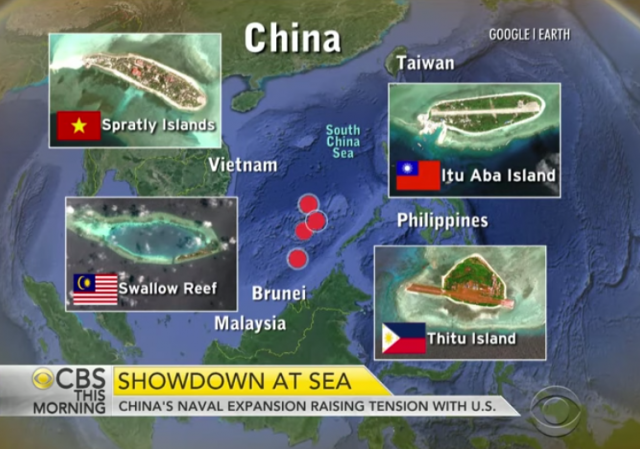
Tensions between China and Vietnam have recently escalated after more than two weeks of conflict over a territorial dispute in the South China Sea. From CNN:
China has evacuated more than 3,000 of its citizens from Vietnam and is sending ships to retrieve more of them after deadly anti-Chinese violence erupted last week over a territorial dispute between the two countries. Five Chinese ships will travel to Vietnam to help with the evacuation, the official Chinese news agency Xinhua reported Sunday, citing the Ministry of Transport. One of the ships has already set off from the southern island province of Hainan, the ministry said. Sixteen critically injured Chinese citizens were flown out of Vietnam on Sunday morning on a chartered medical plane organized by Chinese authorities, Xinhua said. Two Chinese citizens were killed and more than 100 others were injured in the violence that hit parts of Vietnam last week, according to the news agency. Some of the worst violence appeared to have taken place in the central coastal province of Ha Tinh. Foreign factories, particularly those run by companies from China and Taiwan, were burned and looted by rioters outraged over Beijing's decision to send an oil rig into waters of the South China Sea that both countries claim as sovereign territory.
Protests are usually not permitted in Vietnam, but were initially allowed until violence erupted and the situation grew out of control, according to CNN.  Authorities there are now trying to stop the protests.  Reuters reports that police in a few areas of Vietnam on Sunday were directing those gathering for rallies to disperse. The conflict began earlier this month when China first parked the aforementioned oil rig in the disputed waters, triggering back and forth demands from both sides to retreat. From the Associated Press via Yahoo News:

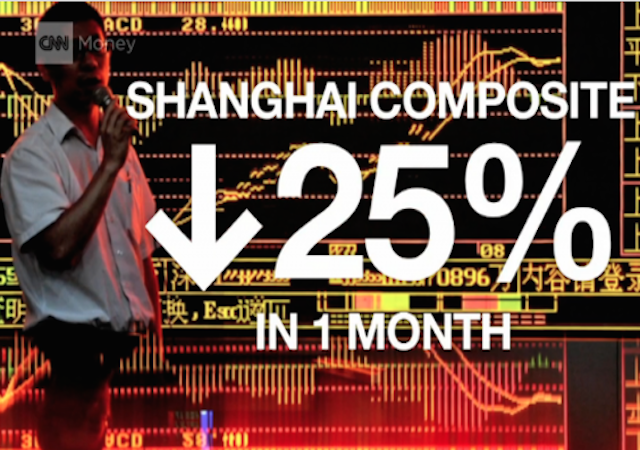
China Housing Market Bubble Start to Pop as Economy Faces Hard-Landing:
China's property bubble has already started to burst as the country struggles to avoid a hard-landing after the housing market became overheated with soaring prices. China's commercial and residential property sectors are not doing well, especially in the city of Hangzho, which has "become the symbol of a market in distress", according to Forbes. The world's largest retailer, Wal-Mart, is closing its Zhaohui store in Hangzhou on April 23 as a part of its overall plan to dump unprofitable locations. The sale of the large store comes as the city has too much supply of commercial properties, according to Forbes. Hangzhou's Grade A office buildings at the end of 2013 had an average occupancy rate of 30%, according to real estate broker Jones Lang LaSalle. In Hangzhou's residential sector, occupancy is weak and prices are declining due to massive overbuilding.
All of this was predicted here, back in 2012 when Elizabeth Warren insisted that we needed to be more like China. And I said, Elizabeth Warren apparently never heard of the Chinese bubble and Stimulus:

Was Edward Snowden just protecting the privacy -- of Russian and Chinese intelligence services?...

At least 29 people were killed Saturday after assailants wielding knives stormed a train station in southwestern China, in what has been described as "an organized, premeditated violent terrorist attack." From the Associated Press via ABC News:

More than 10 assailants slashed scores of people with knives at a train station in southern China in what state media said Sunday was a terrorist assault by ethnic separatists from the far west. Twenty-nine slash victims and four attackers were killed and 143 people wounded.

Police fatally shot four of the assailants, captured one and were searching for the others following the attack late Saturday at the Kunming train station in Yunnan province, the official Xinhua News Agency said. State broadcaster CCTV said two of the attackers were women — one of the slain and the one who was captured and later brought to a hospital for treatment.

Witnesses described assailants dressed in black storming the train station and slashing people indiscriminately with large knives and machetes.

Student Qiao Yunao, 16, was waiting to catch a train at the station when people starting crying out and running, and then saw a man cut another man's neck, drawing blood.

"I was freaking out, and ran to a fast food store, and many people were running in there to take refuge," she told The Associated Press via Sina Weibo, a Chinese microblog. "I saw two attackers, both men, one with a watermelon knife and the other with a fruit knife. They were running and chopping whoever they could."

"It was an organized, premeditated violent terrorist attack, according to the authorities," reported China's official Xinhua news agency.  The identities of the attackers reportedly killed had not yet been confirmed.   Additional reports described the scene at the time of the attack, based on witness accounts.

Japan and India don't necessarily have the warmest relationship with their neighbor, China. China hasn't exactly lessened tensions by enforcing a no-fly zone over Japanese islands. And its rapidly expanding military efforts haven't brought comfort to India's government, especially with a long history of border tensions. Since it has become apparent that the Obama Administration is unreliable in handling complex international policy dynamics, what can Japan and India do? Go the tradition route: Form a strategic regional alliance. China downplays Japanese PM Shinzo Abe's visit to India
China on Monday downplayed Japanese Prime Minister Shinzo Abe's visit to India as a bilateral issue, even as the state-media termed the trip as a failure for not succeeding in pinning down Beijing. "The visit you mentioned is an issue between India and Japan," Chinese Foreign Ministry spokesman Qin Gang told a media briefing while responding to a question on Abe's just-concluded visit to India. The visit evoked considerable media attention in view of the China-Japan diplomatic stand off over the disputed islands in East China Sea.

Just as the NSA-Snowden leak story was being broken by The Guardian via Glenn Greenwald, and to a lesser extent at The Washington Post, I thought about writing a post with the title this post bears.  In the crush of other things, and the uncertainty as...

The third person killed in the bombing of the Boston Marathon has been identified. Via Riehl World News: The third person killed in the Boston Marathon bombings is a 23-year-old Chinese graduate student at Boston University who came to the U.S. because it was her dream to...

I'm watching a 60 Minutes segment about the Chinese real estate bubble: China has been nothing short of a financial miracle. In just 30 years, this state-controlled economy became the world's second largest, deftly managed by government policies and decrees. One sector the authorities concentrated on...