


Image 01 Image 03

China Tag

There has been a fascinating developments in relations between North Korea and China over the past week. Just before Thanksgiving, North Korea’s Kim Jong-un appeared to have snubbed China by not agreeing to meet with Chinese President Xi Jinping’s diplomatic envoy.
Song Tao, head of the Communist Party’s international department, wrapped up his four-day trip to North Korea on Monday, the first visit by a senior Chinese official since 2015.
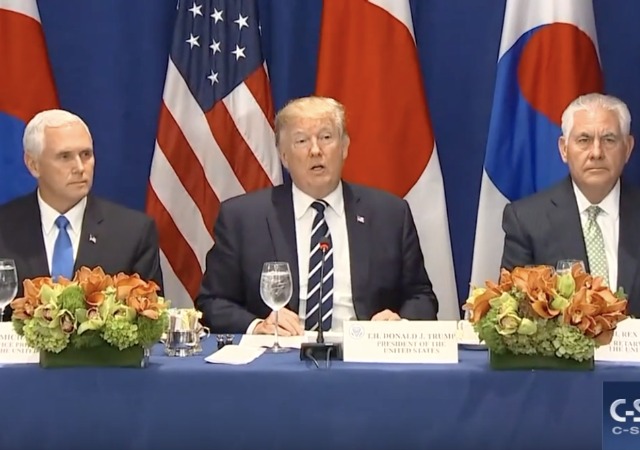
It was a busy day in New York concerning North Korea. We learned that China's central bank told banks to stop working with North Korea. President Donald Trump met with South Korean President Moon Jae-in and Japanese Prime Minister Shinzo Abe to discuss the North Korean nuclear crisis. Trump also announced new sanctions against North Korea. From The Hill:
Speaking at the United Nations before a working lunch with Japanese Prime Minister Shinzo Abe and South Korean President Moon Jae-in, two key allies in the region, Trump said the order would significantly expand the U.S.’s ability to crack down on individuals and companies that do business with North Korea. The president said he had empowered the Treasury Department to “target any individual or entity that conducts trade in goods, services or technology” with North Korea.

While the American Press has been navel-gazing after the Charlottesville violence, there has perhaps been a more significant clash on the other side of the world that seems...under-reported. This weekend, I noted that India’s military has increased operational readiness along the eastern Indian border with China, as the nations have been embroiled in a two-month confrontation on the Doklam plateau (claimed by both China and India’s ally, Bhutan).

Last month, we reported that a territorial dispute along the China-India border is threatening to turn into a military conflict. Now, while the world's attention is focused on North Korea, India has increased its alert level amid increased tension with China.
India's military has increased operational readiness along the eastern Indian border with China, sources said, as neither side shows any sign of backing off from a face-off in a remote Himalayan region near their disputed frontier.

Thousands of North Koreans are fleeing the Communist prison state thanks to an underground Christian network spread across China, reports the British newspaper Daily Express. The 3000-mile long network, run by South Korean and Chinese Christians, also dubbed as the ‘underground railroad’, helps dissidents from the north to escape to freedom into Thailand. Many of these escapees later find a new home in South Korea.

Hoping to capitalize on the burgeoning sharing economy, a Chinese start-up company lost almost all of its wares within weeks of opening up shop. E Umbrella, which opened up operations in eleven different Chinese cities, is now without umbrellas to "share".

A territorial dispute along the China-India border is threatening to turn into a military conflict between the two nuclear-armed nations. The area under dispute is located near the ‘Bhutan tri-junction’, where the borders of China, India, and the tiny Buddhist Kingdom of Bhutan meet. The Chinese envoy to New Delhi described the latest standoff as "the most serious confrontation between the two nations in more than 30 years," Chinese daily South China Morning reported.  China and India fought a war in 1962 over similar border disputes, which ended in a devastating defeat for India. Almost 55 years later, and two Asian giants continue facing off each other along a three thousand kilometre-long contested mountainous border.

Between 2010-2012, the Chinese government murdered or imprisoned 18 to 20 CIA agents after it demolished America's spying operations within the country. The CIA has been investigating how this happened, whether a mole leaked information to Beijing or the Chinese managed to break our codes. The New York Times reported:
Assessing the fallout from an exposed spy operation can be difficult, but the episode was considered particularly damaging. The number of American assets lost in China, officials said, rivaled those lost in the Soviet Union and Russia during the betrayals of both Aldrich Ames and Robert Hanssen, formerly of the C.I.A. and the F.B.I., who divulged intelligence operations to Moscow for years.

A large-scale ransomware attack, WannaCry, that infected computers all over the world left governments, health care institutions, and companies reeling. Britain's National Health Service was infected, resulting in the temporary closure of some emergency rooms. Ransomware infects a computer, locking users out of certain applications or files until a ransom is paid. PC casualties were expected to rise today as workers return to work to find WannaCry infecting their work PCs.

Back in March, South Korea's Constitutional Court removed President Park Geun-hye due to numerous scandals that surrounded her. Authorities arrested her three weeks later and authorities claimed she "abused the mighty power and position as President to take bribes from companies and infringed upon the freedom of corporate management and leaked important confidential official information." Well, Park was friendly with the U.S. and agreed with our officials on North Korea. Her ouster led to an opportunity for more liberal officials to rise to power who want to take a softer approach on North Korea. That's exactly what happened. Democratic candidate Moon Jae-in won the election yesterday, which may "mean an overhaul for Seoul's policy on North Korea. He even said that he would "visit rival North Korea under the right conditions."

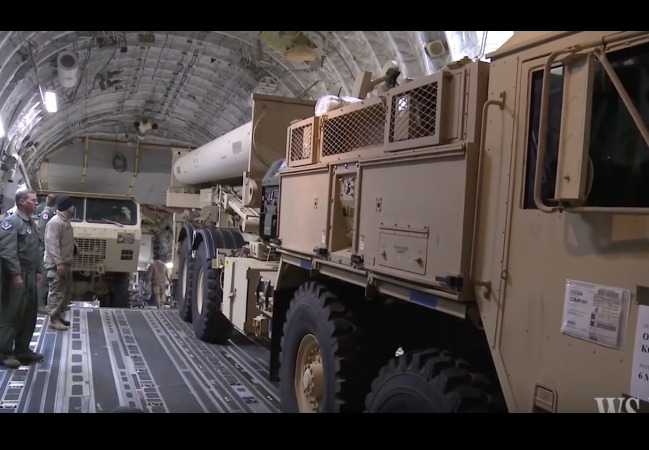
I've chronicled China's opposition to the Terminal High-Altitude Area Defense (THAAD), the U.S. missile-defense system in South Korea. The Chinese government has denied retaliating against the system, but one American cybersecurity firm told The Wall Street Journal that it found evidence that Beijing has used hackers to target THAAD. The firm FireEye discovered that "two cyberespionage groups that the firm linked to Beijing’s military and intelligence agencies have launched a variety of attacks against South Korea’s government, military, defense companies and a big conglomerate."

As tension rise between America and North Korea, it appears that Russian state TV has decided to side with dictator Kim Jong Un. According to Bloomberg, the Kremlin's top TV guy Dmitry Kiselyov made this proclamation after calling President Donald Trump "just the kind of leader the world needed" a few weeks ago. Bloomberg reported:
In the latest sign of the Kremlin’s abrupt about-face on its erstwhile American hero, Kiselyov pronounced Trump “more dangerous” than his North Korean counterpart. “Trump is more impulsive and unpredictable than Kim Jong Un,” he told viewers of his prime-time Sunday “Vesti Nedelyi” program, which earlier this year carried paeans to Trump for his pledge to warm up relations with Russia.

Last weekend President Donald Trump and China’s president Xi Jinping met at Mar-a-Lago. The state dinner featured a side of tactical bombing of Syrian airstrips and a bit of Sound of Music diplomacy from the First Daughter. Knowing the room would be tense, she deployed her charming children to serenade the Chinese President and his wife...in Chinese.
Ivanka assumed, or rightly knew, that there is nothing like having the children or grandchildren of a host put on a cute performance to cut down tensions in a room full of VIPs with competing agendas.