

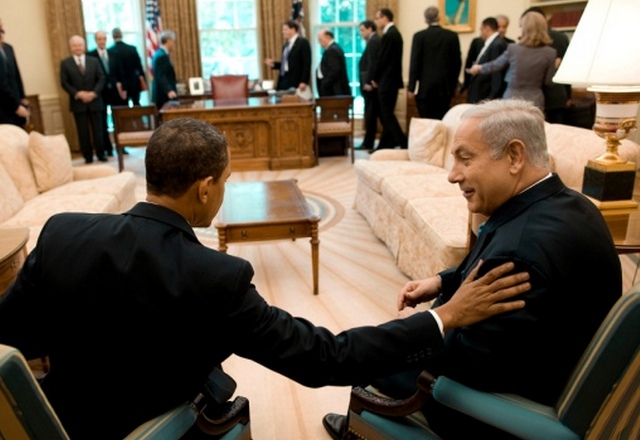
Senior Obama official: Bibi Netanyahu is “chickenshit”
The crisis is in Obama-Israel relations, not U.S.-Israel relations....
The brutal neighborhood in which Israel lives extends beyond Gaza, and so must the strategy....
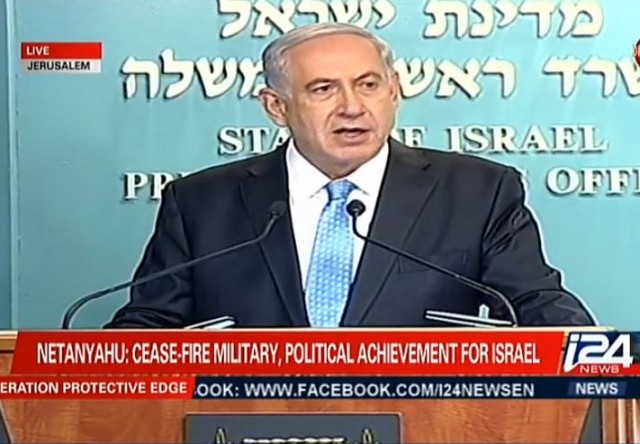
Netanyahu at press conference: Cease fire is both military and diplomatic achievement for Israel. Hamas hit hard, and achieved nothing.
— Herb Keinon (@HerbKeinon) August 27, 2014
. @netanyahu: We have great military and diplomatic achievements. Hamas was struck hard, didn't get 1 of conditions it wanted for ceasefire
— Lahav Harkov (@LahavHarkov) August 27, 2014
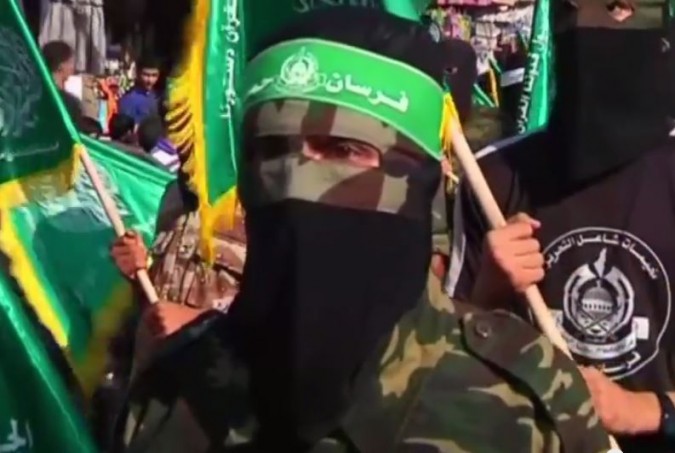
Hamas executed 18 suspected informants for Israel in Gaza on Friday, the Hamas-run Al Aqsa TV reported. This comes one day after an Israeli strike in the Gaza city of Rafah killed three senior leaders of the Qassam Brigades, the Hamas military wing.The Times of Israel adds:
The witness said masked gunmen lined up the seven men in a side street and opened fire on them. He spoke on condition of anonymity, fearing for his own safety. Other witnesses told AFP that six of them were grabbed from among hundreds of worshipers leaving the city’s largest mosque, by men in the uniform of Hamas’s military wing. They were pushed to the ground. One of the masked men shouted: “This is the final moment of the Zionist enemy collaborators,” then the gunmen sprayed them with bullets.
.@FoxNews continues as rare major media outlet consistently giving >real< coverage of what's happening here + in Gaza pic.twitter.com/dzf1tvBknd
— Ron M. (@Jewtastic) August 22, 2014
White House and State Department officials who were leading U.S. efforts to rein in Israel's military campaign in the Gaza Strip were caught off guard last month when they learned that the Israeli military had been quietly securing supplies of ammunition from the Pentagon without their approval. Since then the Obama administration has tightened its control on arms transfers to Israel. But Israeli and U.S. officials say that the adroit bureaucratic maneuvering made it plain how little influence the White House and State Department have with the government of Israeli Prime Minister Benjamin Netanyahu —and that both sides know it.... Then the officials learned that, in addition to asking for tank shells and other munitions, Israel had submitted a request through military-to-military channels for a large number of Hellfire missiles, according to Israeli and American officials.
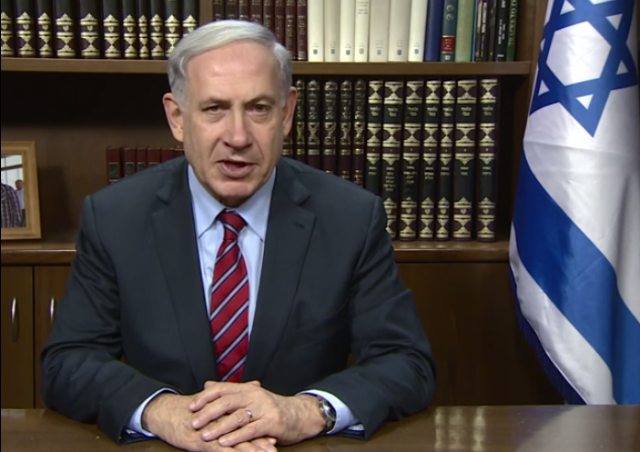
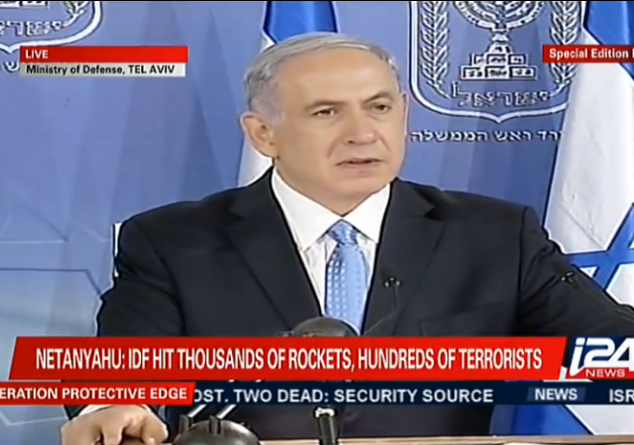
Israeli PM Netanyahu addresses the media in Tel Aviv: "Our forces are completing the demolition of the terror infrastructure"
— i24news_EN (@i24news_EN) August 2, 2014
Israeli PM Netanyahu addresses the media in Tel Aviv: "Our forces are completing the demolition of the terror infrastructure"
— i24news_EN (@i24news_EN) August 2, 2014
Netanyahu uses verb "kidnapped" to describe capture of IDF soldier
— Chemi Shalev (@ChemiShalev) August 2, 2014
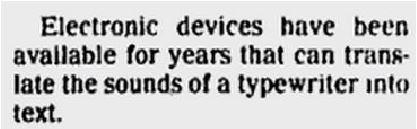
German politicians are considering a return to using manual typewriters for sensitive documents in the wake of the US surveillance scandal. The head of the Bundestag's parliamentary inquiry into NSA activity in Germany said in an interview with the Morgenmagazin TV programme that he and his colleagues were seriously thinking of ditching email completely. Asked "Are you considering typewriters" by the interviewer on Monday night, the Christian Democrat politican Patrick Sensburg said: "As a matter of fact, we have – and not electronic models either". "Really?", the surprised interviewer checked. "Yes, no joke", Sensburg responded.While typewriters might be harder to spy on, they hardly are foolproof, as the U.S. Embassy in Moscow discovered back in the day (1986):
* * *
More on the typewriter espionage here:
President Shimon Peres says Israel is in a deep crisis of morality following the arrest of six people in the killing of Palestinian teen Muhammed Abu Khdeir last week. “We did not believe that such a heinous crime could take place among our people. We mustn’t be such a people,” Peres says. “Today ‘out of Zion shall go forth the shame,’” he says, paraphrasing a famous Bible quote. “There is no justification for death and no crime is more acceptable than another,” the president adds. “My heart aches with the grieving Abu Khdeir family and with the grieving Shaar, Yifrach and Fraenkel families.”
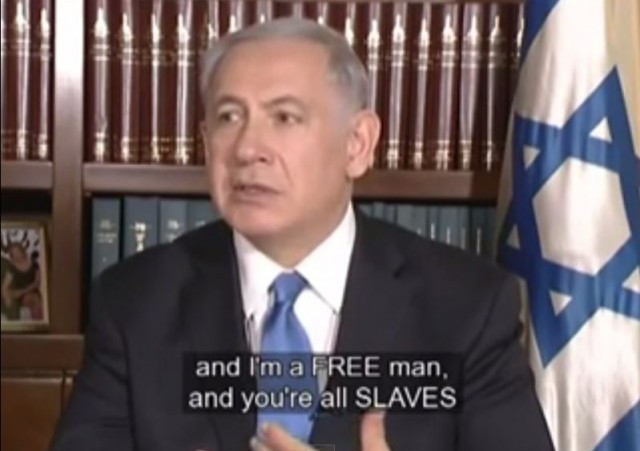
"You're slaves to your gadgets"...
There are some moments a journalist will never forget. In early 1997, Yossi Beilin decided to trust me, and show me the document that proved that peace was within reach. The then-prominent and creative politician from the Labor movement opened up a safe, took out a stack of printed pages, and laid them down on the table like a player with a winning poker hand. Rumors were rife about the Beilin-Abu Mazen agreement, but only a few had the opportunity to see the document with their own eyes or hold it in their hands. I was one of those few. With mouth agape I read the comprehensive outline for peace that had been formulated 18 months earlier by two brilliant champions of peace -- one, Israeli, and one, Palestinian. The document left nothing to chance: Mahmoud Abbas is ready to sign a permanent agreement. The refugee from Safed had overcome the ghosts of the past and the ideas of the past, and was willing to build a joint Israeli-Palestinian future, based on coexistence. If we could only get out from under the Likud’s thumb, and get Benjamin Netanyahu out of office, he will join us, hand in hand, walking toward the two-state solution. Abbas is a serious partner for true peace, the one with whom we can make a historic breakthrough toward reconciliation. We understood. We did what was necessary. In 1999, we ousted Likud and Netanyahu. In 2000, we went to the peace summit at Camp David. Whoops, surprise: Abbas didn’t bring the Beilin-Abu Mazen plan to Camp David, or any other draft of a peace proposal. The opposite was true: He was one of the staunchest objectors, and his demand for the right of return prevented any progress.
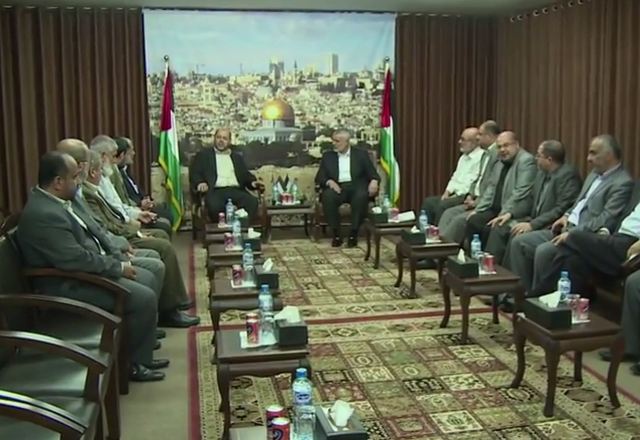
The two groups — the Palestine Liberation Organization, which runs the Palestinian Authority in the West Bank, and Hamas, the militant Islamist group that dominates the Gaza Strip — have reached similar accords before that were never carried out. But the latest deal comes as the fragile American-brokered peace efforts between the Palestinians and Israel are approaching an April 29 deadline without a resolution in sight. People familiar with the discussions have said the Israeli and Palestinian sides were far apart even on how to extend the talks past the deadline.The Times article ends in typical understatement.
Analysts remained skeptical about whether the Palestinian reconciliation efforts would lead to a tangible change on the ground, because neither of the factions has shown interest in genuine power-sharing in the past, and they have deep differences over how to deal with Israel, which Hamas does not recognize. Even so, some experts said that the latest effort at reconciliation appeared more serious than past attempts, because both factions are under growing pressure. Gaza under Hamas has been severely weakened by an Egyptian crackdown on the smuggling tunnels along the Gaza-Egypt border and an Israeli blockade. And Mr. Abbas, for his part, has faced growing criticism from West Bank residents about the negotiations with Israel and his own legitimacy, with Palestinian elections long overdue. He has threatened to dissolve the Palestinian Authority, which exercises limited self-rule in the West Bank, if the talks with Israel end in failure.No Hamas does not recognize Israel. It is also a genocidal terrorist organization devoted to destroying Israel. Note terror is not mentioned.
We don’t know exactly what would happen. What we know is that it gets harder by the day. What we also know is that Israel has become more isolated internationally. We had to stand up in the Security Council in ways that 20 years ago would have involved far more European support, far more support from other parts of the world when it comes to Israel’s position. And that’s a reflection of a genuine sense on the part of a lot of countries out there that this issue continues to fester, is not getting resolved, and that nobody is willing to take the leap to bring it to closure.
Or is this story even true? Is it actually one of those "good-cop/bad-cop" tales instead? It's difficult to say, but I vote ever-so-slightly for "true." My opinion of John Kerry is very low, but I think more of him than I do of Obama. The following seems...
Netanyahu to Abbas: "Recognize the Jewish state. No excuses, no delays. It's time." #AIPAC14
— Yair Rosenberg (@Yair_Rosenberg) March 4, 2014
Peace is Israel's highest aspiration. I am ready to make a historic peace with our neighbours the Palestinians. #AIPAC14 #Netanyahu
— BICOM (@BritainIsrael) March 4, 2014
#BDS movement will fail, said @netanyahu in his #AIPAC14 remarks. More analysis of his speech via @JNSworldnews @ http://t.co/D2groTkSCn
— jns.org (@JNSworldnews) March 4, 2014
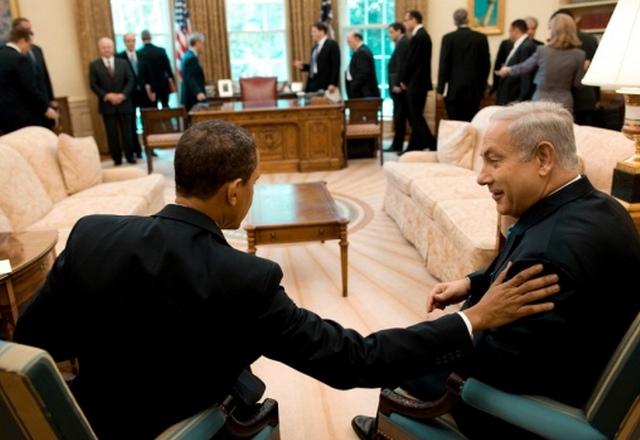
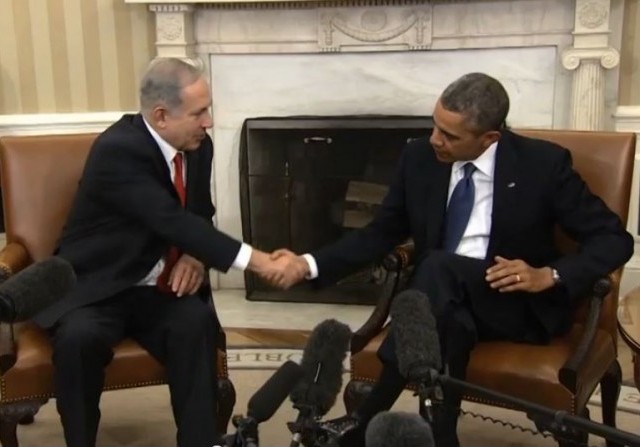
Seeking to salvage an elusive Middle East peace plan, President Barack Obama pressed Israeli Prime Minister Benjamin Netanyahu Monday to make the “tough decisions” needed to move forward on talks with the Palestinians.But facing a U.S.-imposed April deadline, the Israeli leader declared pessimistically that, “Israel has been doing its part and, I regret to say, the Palestinians have not.” Obama and Netanyahu spoke before an Oval Office meeting on a snowy Monday in Washington. The meeting marked a more direct foray by Obama into the peace negotiations, which he has so far largely ceded to Secretary of State John Kerry.Barak Ravid, a correspondent with Haaretz Newspaper, posted tweets from the event - a handful are included below. (Video added -- Transcript here)
Obama: the timeframe for talks is coming to its end and tough decision will have to be made
— Barak Ravid (@BarakRavid) March 3, 2014
Dear Mr. Netanyahu, Please Don’t Speak to My President That WayThat niche is why Goldberg landed an interview with Obama on the eve of Netanyahu's visit to the White House, detailed in Goldberg's column today, Obama to Israel -- Time Is Running Out. The interview is best described as preparing the public for what is to come: The Obama administration twisting Bibi's arm off as to John Kerry's "framework" under the threat of the U.S. stepping aside from defending Israel against the worldwide, decades-long lawfare and boycott movement. It's the same threat John Kerry made several weeks ago, but now it's coming from Obama's own lips, as Goldberg noted (emphasis added):
On the subject of Middle East peace, Obama told me that the U.S.'s friendship with Israel is undying, but he also issued what I took to be a veiled threat: The U.S., though willing to defend an isolated Israel at the United Nations and in other international bodies, might soon be unable to do so effectively. “If you see no peace deal and continued aggressive settlement construction -- and we have seen more aggressive settlement construction over the last couple years than we’ve seen in a very long time,” Obama said. “If Palestinians come to believe that the possibility of a contiguous sovereign Palestinian state is no longer within reach, then our ability to manage the international fallout is going to be limited.”For Goldberg to characterize Obama's statement as a "veiled threat" is pretty significant. To me, it wasn't a veiled threat, it was just a threat.
Donations tax deductible
to the full extent allowed by law.
Founder
Sr. Contrib Editor
Contrib Editor
Higher Ed
Author
Author
Author
Author
Author
Author
Editor Emerita