


Image 01 Image 03

Uncategorized

On June 12, 2014, three Israeli teens were kidnapped and murdered in the West Bank by a Hamas-affiliated group. The bodies would be found on June 30. During June, an intensive search was conducted for the teens and the murderers, including the arrest of many Hamas members in the West Bank and a crackdown on its operations. Militants in Gaza fired a total of 62 rockets into Israel during June (even before the kidnapping), and Israel retaliated by targeting rocket crews and militants in Gaza: On June 30, 2014, 16 rockets were fired into Israel by Hamas, leading to more Israeli targeting and a massive Hamas rocket offensive. Hamas or other militants fired over a dozen rockets a day the first few days of July, and then on July 7 as Israel retaliated with airstrikes, the daily count grew to 80 rockets on July 7 and 156 on July 8.

Yes, that headline is for real. Judging by what happened this week during a Senate Judiciary Committee hearing, I'm almost positive that the Obama Administration is ready to negotiate with Edward Snowden. From the Wall Street Journal:
Sen. John Cornyn (R., Texas), at a Senate Judiciary Committee hearing, asked Ms. Yates about recent reports that the U.S. government was in talks with Mr. Snowden and his attorneys over a possible deal that would give him minimal prison time in exchange for returning to the United States and cooperating with U.S. officials. Mr. Snowden leaked large amounts of records about secret U.S. spy programs beginning in 2013, sparking a large public debate about whether there should be curbs on government surveillance. “Mr. Snowden needs to return to the United States and face justice,” Ms. Yates said in response to Mr. Cornyn’s question. She didn’t indicate whether or not the Justice Department was in talks with Mr. Snowden over a plea agreement, though it would have been unusual for her to make such an admission before Congress.
The Committee is right to push on this. A few days ago, former AG Eric Holder (miss him yet?) said in an interview with Yahoo! News that the possibility of a plea bargain is more realistic than you would think:

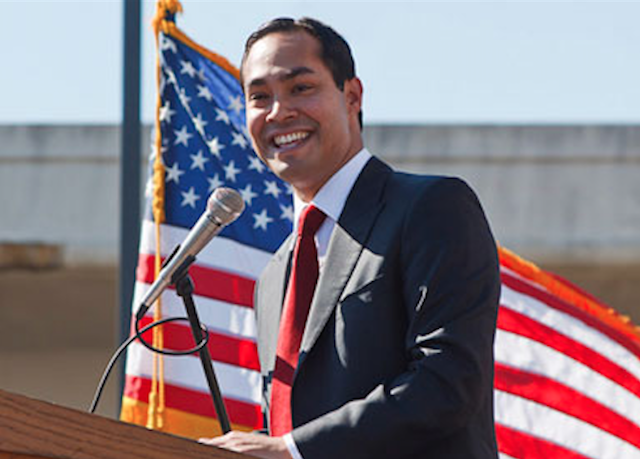
Earlier this month, the Supreme Court (am I allowed to call it the "Kennedy Court" yet? That would be fun...) made serious waves in the administrative law world when it handed down a ruling that will make it much easier for activists to prove local-level discrimination against minority candidates for low income housing. Even Justice Kennedy, who led the majority's charge in favor of an expanded disparate impact analysis, was forced to admit that the ruling could cause an eventual return to racial quota systems. We're not quite there yet, but rest assured---the crack team at Housing and Urban Development, led by San Antonio golden boy Julian Castro, is keeping an eye on things. A new rule, floated by HUD and released today by the Obama Administration, will require cities and towns to to look for patterns of racial bias in local housing. Officials will then be forced to report every 3 to 5 years on the state of the housing market, and self-set goals for reducing segregation in their jurisdictions. This information won't just go into a bureaucratic vacuum; instead, it'll head straight for---you guessed it---another government database. WaPo explains:

I remember my first unfriending-by-way-of-politics. I was 25; I'd made it all the way to my second year of law school without alienating a single person in the digital space---give me a medal. I had posted something negative about nuclear proliferation in Iran, drawing the ire of one of my best friends who also happened to be 100% Persian. Over the course of three or four heated comments, it was friendship over, both online and in the real world. 7 years of friendship, down the drain in an off-cycle. It deserved better. I like to think I've grown out of the kinds of superficial political arguments that end relationships, but there's something about an election cycle that brings out the worst in all of us. Semi-anonymity is a truth serum, and sites like Facebook and Twitter are handing it out for free. Does our addiction to social media mean that our relationships will forever wallow in an extra layer of tension? Probably; and now there's a new app called Who Deleted Me that will show you just how big of an impact your online posts are having on your friends, family and colleagues. Buzzfeed spotted it:

We have been covering the absurdity of the "Yes Means Yes" movement, and the violation of fundamental due process rights under the banner of "rape culture," for quite some time: In our coverage, we frequently have posted this parody video from 2007. Now life is imitating parody, as reported in The Washington Examiner (via Instapundit), Advocacy group distributes sexual 'consent contracts' to college students:

Time has really flown by, hasn't it? Would you believe the famous recall election that Scott Walker won in Wisconsin was three years ago? As you may recall, it was a big night at Legal Insurrection with fireworks and music on the site. Our Wisconsin Recall Tag has the history. Wisconsin first lady Tonette Walker tweeted out this reminder yesterday: Here's a great video from the Walker team to commemorate the event:

Mrs. Clinton joined CNN Tuesday night for an interview that was stranger than fiction. In fact, I'm honestly not sure if the awkward conversation was meant to be self-parody or an earnest attempt at a prime time interview. The pants suit, the seemingly botoxed brow and resultant crazy eyes, and the passionate dedication to fibbery made for fascinating television. Following the Clinton Campaign Press Play Pen-Gate, Camp Clinton presumable decided to prove the scoffers, mockers, and justifiably incensed members of the press corps wrong. "We don't think so little of press that we actually, like, rope them off! See?! We're like, totes about press access. We chat it up with the press alllllllll the time, like we're doing right now with CNN!" - the Clinton Campaign (not an exact quote). We'll start with one of the interview's best moments:

"People should and do trust me"

During my family’s visit of Berlin, Germany yesterday, an American president was prominently featured as part of the tour we took. Our guide spoke glowingly of a speech that he heard, and one which still resonates with him to this day. As we passed the Bradenburg Gate, he quoted Ronald Reagan's 1987 speech by saying, "Mr. Gorbachev, tear down this wall!" Our guide lived 3 blocks away from the infamous Berlin Wall, the remnants of which are covered in art and graffiti or which are boxed up as souvenirs of a seemingly distant era. While the entire speech is iconic, reviewing Reagan's words again, I was struck by this passage:

Monday, Carly Fiorina's campaign announced they'd raised a total of $1.4 million dollars since their early May launch. But $1.4 million is a drop in the bucket compared the fundraising of a few other Republican presidential contenders. According to the Wall Street Journal, "In an email entitled “Momentum,” Frank Sadler, her campaign manager, reminded supporters Mrs. Fiorina’s campaign “launched from a standing start,” and took a glancing shot at Republican front runner Jeb Bush, the son and brother of presidents."
“Until she announced her candidacy, Carly was leading two highly effective charitable organizations,” he wrote. “She was not building the political infrastructure that other presidential candidates spend years (or generations) to cultivate.” He doesn’t mention the fundraising number—which covers money raised through June 30, the end of the second quarter—until the second page of his memo. Mrs. Fiorina, who is considered a longshot candidate for the GOP nomination, is winning 2% of Republican primary voters’ support, according to a RealClearPolitics average of five recent national polls.
Sadler isn't wrong. Baring the ground game Fiorina built in her failed Senate run, her campaign started without much of a foundation. Now that Fiorina is fully invested in the race, the wisdom of jumping in cold is a discussion for another time.

Yesterday the Washington Free Beacon reported that that the Obama administration is willing to do whatever it takes to prevent a veto override when Congress votes on the Iran deal. This morning, CNN hosted a veritable White House press conference about the subject. Former State Department Iran negotiator Hillary Mann Leverett and Obama shill and Haaretz contributor Peter Beinart were anchor Chris Cuomo's entire panel. One point that Beinart made that deserves examination is his assertion that “Iranian dissidents want this deal to go through,” on the theory that opening up Iran will lessen the regime’s human rights abuses. He’s made the same argument here, and we're likely to hear it again in the coming weeks. It's worth asking, then, whether the human rights situation in Iran stands to improve. To begin with, Beinart is being disingenuous when he says that dissidents support the deal. Eli Lake documented in 2013 that, while some support it, many others do not.

Things are bad in both of China's big exchanges; both the Shanghai and Shenzen are seeing companies halting their trading on both:
Over 700 Chinese companies have halted trading to "self preserve," according to the state media. That means about a quarter of the companies listed on China's two big exchanges -- the Shanghai and Shenzhen -- are no longer trading. China's stock markets are in trouble. The Shanghai Composite Index has fallen over 25% since mid-June. The Shenzhen, which has more tech companies and is often compared to America's Nasdaq Index, is down even more.
Government intervention has not helped:
Chinese stocks fell on Tuesday, taking little comfort from a slew of support measures unleashed by Beijing in recent days, and unnerved by Chinese Premier Li Keqiang's failure to mention the market chaos in a statement on the economy. Before the market opened, Li said in comments posted on a government website that China had the confidence and ability to deal with challenges faced by its economy, but had nothing to say on the three-week plunge that has knocked around 30 percent off Chinese shares since mid-June.
Morgan Stanley Asia Chairman Stephen Roach said some of China's problems can be traced back to issues related to the debt-to-GDP ratio:

Another day, another deadline busted. Officials attending nuclear policy talks in Vienna announced today that the deadline set by negotiators has been extended three days to July 10. This is the third time in a year that officials have blown past a deadline, but spokespeople from various parties blame this failure to agree on several "thorny" issues that appear to be hanging in the balance between total failure and...well, whatever level of "failure" will be represented by whatever terrible deal eventually emerges from this mess. Via the Wall Street Journal:
EU foreign policy chief Federica Mogherini told reporters the two sides weren’t formally extending the deadline but would effectively stop the clock on the talks. “The news is, we are continuing the negotiations in these hours. You might see some ministers leaving in the next hours and then ready to come back in the coming hours and days,” said Ms. Mogherini, who chairs the six-power group. “We are continuing to negotiate for the next couple of days. That does not mean we are extending our deadlines,” she said, adding that “we are interpreting” the July 7 end-date “in a flexible way.” Ms. Mogherini said the negotiations have hit the most difficult and sensitive final issues, but that sealing a nuclear agreement “is still possible.”

Since the Taliban rose to power in 1996, the people of Afghanistan have lived a live of fear and deprivation. A cursory search for ground footage in preparation for this article offered little in the way of troop movement or news spots, but much in terms of brutal executions; the western world is still reeling in the wake of the horror that is ISIS, but for people living in Afghanistan and the surrounding areas, the violence isn't a new trend---it's a way of life. As a rule, Taliban leadership has roundly refused to meet with leaders of the Afghan leadership; that, coupled with the brutality and absolute polarity of the ideological conflict itself, has made the Afghan war less easy to comprehend than other conflicts in the region. Recent developments, however, could signal the beginning of the end of outright hostilities. This evening (local time,) leaders from both the Taliban and the Afghan government are meeting in Islamabad to continue to discuss peace terms. Parties have been meeting for several months at various locations around the world---a fact that Taliban ground forces have roundly tried to cover up---but this meeting is being touted as having greater significance than the previously-disavowed discussions. More from the Wall Street Journal:
A senior Afghan official said U.S. and Chinese officials took part in Tuesday’s meeting as observers. Their attendance, together with Pakistan’s willingness to play host, is significant as it points to a broadening involvement of key players in a possible peace process. But it was unclear whether the meeting in Islamabad was fully backed by Taliban leadership. Zabiullah Mujahid, a spokesman for the militant group, said he wasn’t able to confirm whether the Islamabad talks took place at all.

This week the Boycott, Divestment and Sanctions (BDS) movement and its supporters will be celebrating the 10th anniversary of the supposedly grassroots launch of the BDS movement by Palestinian "civil society" organizations. The Associated Press, through its writer Tia Goldenberg, has a lengthy article on the BDS movement. The article is receiving a lot of attention, including a Drudge link, and because it is AP is being reprinted (under varying titles) at numerous news website. The article starts with BDS's supposed grassroots beginnings, Boycott Israel drive gains strength, raising alarm:
Ten years ago, a small group of Palestinian activists had a novel idea: inspired by the anti-apartheid movement, they called for a global boycott movement against Israel as a nonviolent method to promote the Palestinian struggle for independence.
That narrative of how the BDS movement began is false, and demonstrably so. The boycott call issued in July 2005 was not the result of a small group of activists getting together, it was the result of a multi-year organized effort for a global boycott of Israel, most prominently in a boycott call issued at the 2001 UN Durban Conference which was so anti-Semitic the U.S. walked out. We have explored this history many times at Legal Insurrection. Here is the actual history of the BDS movement:

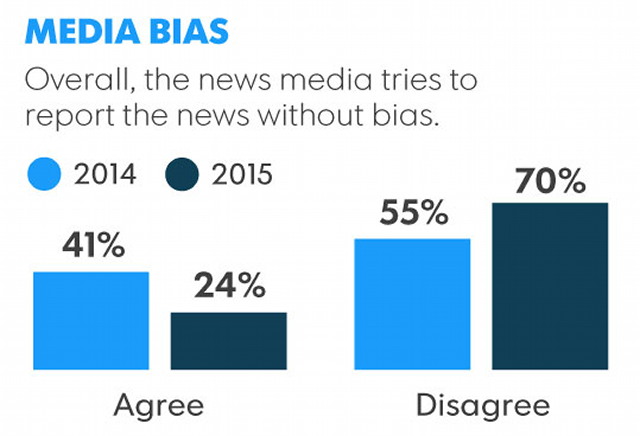
Media bias is no longer a problem perceived only by conservative bloggers. A Gallup poll last fall found 60% didn't trust mass media but a new survey from USA Today and the Newseum Institute finds that 70% of Americans believe the media is biased. Clearly, the scandals of Brian Williams and George Stephanopolous played a role. Bradford Thomas of Truth Revolt:
Media Fail: 70% Believe News Reporting Intentionally Biased A new survey by USA Today and the First Amendment Center found that Americans' distrust of the news media has skyrocketed over the last year, the number of American adults believing news reporting is biased jumping up to 70 percent, while less than a quarter now say they trust the news media. The 2015 State of the First Amendment Survey released Friday found that only 24 percent of American adults believe that "overall, the news media tries to report the news without bias," a 17-point drop from last year and the lowest number since the poll began in 2004. More than two-thirds, 70 percent, disagreed with that statement, a 15-point increase since last year.
One positive finding in the survey was an increase in support for the First Amendment.

Somewhat overshadowed by the Independence Day holiday weekend, Rick Perry's unorthodox jobs and economic growth speech ruffled all the right feathers. Candidate job plans tend to blur together because regardless of party affiliation, they're virtually indistinguishable. Reduce/raise taxes, decrease/increase regulation, "get America working again!", "yada yada yada middle class!" Then there's always "something strangling something." Whether it's speech writer laziness or well tested imagery I don't know, but there's always something being strangled. "Bring jobs back to America!" [insert story of someone candidate met while campaigning and how current administration/elected official's policies have made it hard for anecdotal individual to find work] and so on. And that's pretty much every single economic policy speech in modern history. Or at least it was until last Thursday. Perry's economic opportunity speech at the National Press Club last week was unlike any other speech of its kind and brilliantly so.

Remember the Miles of New Sidewalks, and Empty Stores I wrote about on July 6, 2010? It concerned federal Stimulus Plan "shovel ready" construction of miles of sidewalks in Warren, Rhode Island, which were built pretty much just for the sake of building them:
Warren, Rhode Island, has new sidewalks from the center of town down Rte 103 to the Massachusetts border, almost two miles away. Thanks to the Stimulus Plan. I have driven that road hundreds of times, and also have cycled the route many times. I never noticed any particular problem with the sidewalks. I also almost never noticed anyone using the sidewalks, particularly once you leave the very center of town. The road is a local main road, not exactly a walk in the park. But there are new sidewalks as far as the eye can see.... Warren, Rhode Island, also has plenty of empty storefronts. The sidewalks will not change that, and neither will the Stimulus Plan.
Here's what the newly constructed sidewalks looked like in 2010:

Today, former President George W. Bush celebrates his 69th birthday. To commemorate this great man, world class leader, and Texan, we've compiled some of our favorite W moments.

This great moment in baseball history