



Image 01 Image 03

Le·gal In·sur·rec·tion

/var/www/vhosts/legalinsurrection.com/httpdocs/wp-content/themes/bridge-child/readFeeds.incFALSE

Earlier, I weighed in on how the media and administration are handling the Ebola epidemic, using language to minimize the fact that it is a hemorrhagic fever. It the wake of reports that Colorado children who suffered from an infection of the very aggressive respiratory pathogen, Enterovirus D-68, have also experienced limb paralysis, today's "Bio-Insurrection" research has revealed that there is a nice, new moniker associated with it: Non-Polio Enterovirus. From our Department of Health: LI #09 Non-polio enterovirus I made this discovery while I was searching for confirmation that a child's recent death was associated with an Enterovirus D-68 infection. Sadly, it was.


LATEST NEWS

First Dallas, now Houston. Thankfully, Governor Perry put together a Task Force on Infectious Disease Preparedness and Response. The task force, "will assess and enhance the state's existing capabilities to prepare for and respond to pandemic disease, such as the Ebola virus." Perry also, "called on the federal government to immediately begin enhanced screening procedures at all points of entry, including obtaining additional information, checking temperatures and staffing quarantine stations to help prevent the disease from entering the country." According to a local ABC News affiliate:
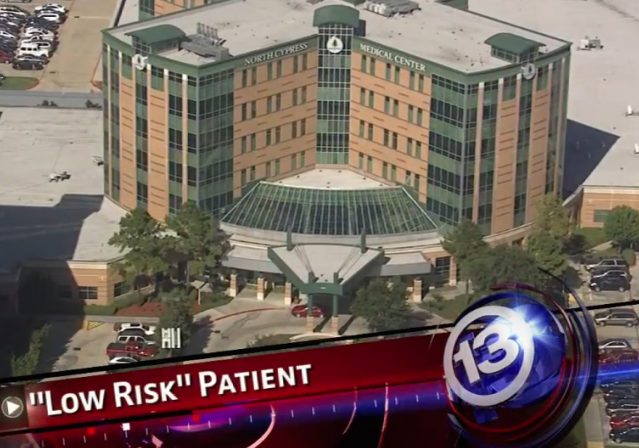
A hospital in Cypress says it is treating a patient with an "extremely low-risk" chance of having Ebola.

The North Cypress Medical Center, located along the Northwest Freeway, says the patient was admitted Monday and is being monitored. The hospital issued the following statement about the patient's admission:

"North Cypress Medical Center is treating a patient who has not been diagnosed with ebola. He is considered to be of extremely low risk to the ebola virus. Hospital personnel are taking all precautions as prescribed by the Harris County Health Department and the U.S. Center for Disease Control. The patient is in stable condition and is showing no signs of a fever. Admitted earlier today (October 6th), he has been isolated from other patients. We are working closely with local health and CDC officials who will determine all the steps we need to take to ensure the patient's recovery and the community's safety." 

Over the weekend, it was thought a person in Katy may have had Ebola, but that turned out to be malaria. 

The health department says they've conducted two Ebola tests on patients in the Houston area. Both have come back negative.

The 7th U.S. Circuit Court of Appeals has ruled that Wisconsin's new voter ID laws are constitutional, meaning that those heading to the polls in November will need to show ID before casting a vote. Via ABC News:
State elections officials are preparing for the photo ID law to be in effect for the Nov. 4 election, even as opponents continue their legal fight. The American Civil Liberties Union and the Advancement Project asked the U.S. Supreme Court last week to take emergency action and block the law. ... A lower court judge, U.S. District Judge Lynn Adelman, struck the law down as unconstitutional in April, saying it unfairly burdens poor and minority voters who may lack such identification. Republican Attorney General J.B. Van Hollen asked the 7th Circuit to overturn that ruling. The three-judge panel agreed with Van Hollen. The judges said Wisconsin's law is substantially similar to one in Indiana that the U.S Supreme Court declared was constitutional.
Last month, the same panel of the 7th Circuit issued a short Order vacating the district court injunction staying enforcement of the law, and instead held that the voter ID laws would indeed be in effect for this November’s election. The court indicated that a full decision on the merits would be forthcoming. Progressive activists in Wisconsin and across the country had a meltdown following the ruling:

More than six months after Malaysia Air Flight 370 vanished without explanation over the Indian Ocean, crews are ready to renew the effort to locate the crash site and what remains of the downed plane. Although the media obsessed over the strange disappearance, actual reports on evidence regarding the plane's whereabouts were few and far between. Since then, however, crews have been preparing for a new search that will use sonar, video, and fuel sensor technology to explore the remote stretch of the Indian Ocean where authorities suspect the plane went down. Via The Times of Israel:
The search has been on hold for four months so crews could map the seabed in the search zone, about 1,800 kilometers (1,100 miles) west of Australia. The 60,000-square kilometer (23,000-square mile) search site lies along what is known as the “seventh arc” — a stretch of ocean where investigators believe the aircraft ran out of fuel and crashed. Officials analyzed transmissions between the plane and a satellite to estimate where it entered the water. Two other ships being provided by Dutch contractor Fugro are expected to join the Malaysian-contracted GO Phoenix later this month. The ships will be dragging sonar devices called towfish through the water about 100 meters (330 feet) above the seabed to hunt for the wreckage. The towfish are also equipped with sensors that can detect the presence of jet fuel, and are expected to be able to cope with the dizzying depths of the search zone, which is 6.5 kilometers (4 miles) deep in places.

It isn't over until the votes are counted, and miracles can happen, but it isn't looking good for Martha Robertson, the Democratic challenger to Rep. Tom Reed in my home NY-23 district. Once up a time, Robertson was a lead Democratic prospect to turn a seat from Red to Blue. But now Robertson is being written off by every non-partisan analyst following the race. We asked whether it was time for the DCCC to abandon Robertson, and pull its reserved television advertising. This NY Daily News analysis, showing Democrats struggling in upstate NY, cannot be good news for Robertson:
One year ago, Republicans had just shut down the government, and Democrats declared they might win back the House, in part by picking up Republican-held seats in New York. A year later, Democratic hopes of gaining up to three seats in New York are gone. They are more likely to lose three, and hope simply to break even. Democratic Congressional Campaign Committee Chairman Rep. of Long Island calls New York a “microcosm” for the rest of the country. New York is proving Steve Israel right, as Democrats’ defensive posture in the Empire State mirrors a national political landscape where President Obama’s unpopularity leaves his party hoping to simply limit Republican gains. “If Democrats are ever going to win back the House, they need to pick up seats in upstate New York,” said David Wasserman, who analyzes House races for the Cook Political Report. That isn’t happening this year.
As to NY-23, The Daily News says Robertson's chances have collapsed:

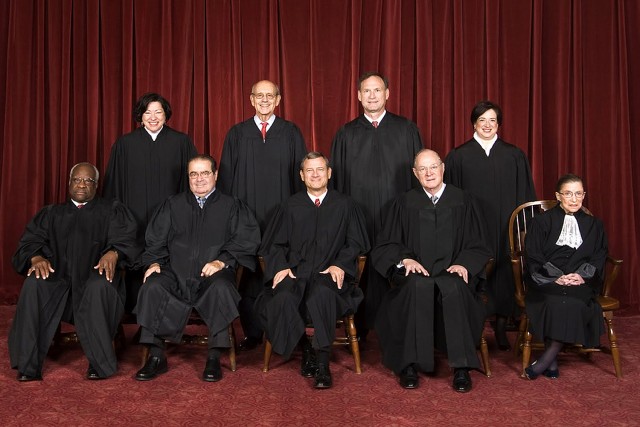
Many if not most observers expected the Supreme Court to take at least one of the cases for which review was sought in which the issue of whether same-sex marriage bans were constitutional was squarely presented. None of the Supreme Court's decisions in DOMA or the Prop. 8 litigation decided that issue. But the Supreme Court did not take any of the cases, leaving in place Court of Appeals decisions that seem to clear the way for same-sex marriages in numerous states. ScotusBlog reports:
The Supreme Court had issued the first round of orders from the September 29 Conference last Thursday, adding eleven new cases to its docket for the new Term.  Many people had anticipated that one or more of the same-sex marriage petitions might be on that list, but the Court did not act on any of them at the time.  Last month Justice Ruth Bader Ginsburg had suggested that the Court might not step into the controversy at this point, because there was no disagreement among the lower courts on that issue.  Today her prediction proved true, with the Court denying review (without any comment) of the seven petitions:  Bogan v. Baskin (Indiana); Walker v. Wolf (Wisconsin); Herbert v. Kitchen (Utah); McQuigg v. Bostic (Virginia); Rainey v. Bostic (Virginia); Schaefer v. Bostic(Virginia); and Smith v. Bishop (Oklahoma).
The NY Times explains the impact:

According to a recent Gallup poll, voters will be sending a message to President Obama---and it may not bode well for Democrats. Out of the just over 1000 registered voters surveyed, 32% of respondents said that their vote in the midterms would serve as a message of opposition to Obama; in contrast, 20% of those surveyed said that their vote would serve as a message of support. Gallup's writeup of the poll explains why this is significant in terms of Republicans' chances in November:
Gallup first asked this question in 1998, the year Republicans were moving toward impeaching President Bill Clinton for lying about his affair with a White House intern. That year, when Clinton's approval rating was 63%, more voters said their choice of candidate in the fall election would be made to show support rather than opposition to Clinton. Democrats had a strong showing in that fall's elections, gaining seats in the House of Representatives, bucking the historical pattern by which the president's party loses seats in Congress in midterm elections. In the next midterm election, voters by an even larger margin said their vote would be made to support rather than oppose President George W. Bush, who had a 66% approval rating at the time of the elections. These attitudes were consistent with the eventual outcome, as Republicans increased their majority in the House and gained majority control of the Senate.
Gallup Registered Voters Message 2014 Election October That's the shot; now here's the chaser: out of registered voters polled, 58% Republicans said that their vote would act as a message of opposition to Obama, while only 38% of Democrats polled said their vote would act as a message of support.

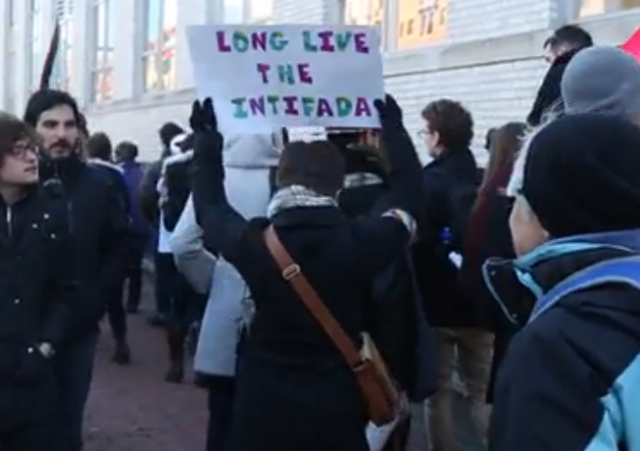
We have posted many times about how the Boycott Divestment and Sanctions movement, through faculty and Students for Justice in Palestine branches, has turned campuses and classrooms into political battlefields in the worst way. When Northeastern University SJP marches to the chant of "Long Live the Intifada," they are celebrating the bloody suicide bombing campaign. When Vassar College SJP pickets a class and forces a professor to walk the guantlet just because the course involved a trip to Israel, and anti-Israel students jeer Jewish students who spoke up for Israel, they are sending a message of continued conflict -- so it was no surprise when Vassar SJP tweeted out a Nazi cartoon. When NYU SJP dorm storms and invades the privacy of students in their dorm rooms to leaflet against Israel, they bring the war into bedrooms. When the faculty members of American Studies Association bring the war to campus through an academic boycott of Israel led by people whose explicit goal is the destruction of Israel, it sends a message to students that to be pro-Israel is to be unacceptable in the classroom. When faculty are willing to destroy academic freedom for everyone in order to hurt Israel, yet play victim when their own academic freedom allegedly is impinged, the argument no longer is over principle but pure power. When conspiracy theories involving Jewish control of the media and the money are central to the arguments of BDS supporters who claim not to be anti-Semitic, anti-Semitism flourishes. When a central thesis of the student, faculty and off-campus leadership of the BDS movement on campuses is that Zionism is the cause of anti-Semitism, and even Naziism, anti-Semitism is rationalized. When stoking and exploiting racial tension is a common tactic used to increase hatred of Israel, and BDS refuses to allow Arab and Jewish students to interact for fear of "normalization," BDS tears campuses apart. When making it costly to be pro-Israel on campus is the major achievement of student BDS activists, discussion is impossible. When BDS banners and messages are at the front of Jew-baiting crowds in Europe, Boston and Miami, it's clear what BDS is about.

Have you noticed that everything nowadays gets videotaped? With everyone suddenly having a smart-phone that photographs and videotapes, every newsworthy or even trivial event gets recorded and presented on YouTube, Twitter, Facebook, or onto someone’s blog. This phenomenon has coincided with the movement of “citizen journalists,” who aim to bring the straight news to blogs and websites all over, giving the unvarnished news to anyone who cares to check the website in question, oftentimes pointed there by the Drudge Report or another news aggregator. No licenses or formal credentials are needed – just a thirst for getting the straight truth out there for viewers or readers to watch and make up their own minds. What about videotaping the police? So much of what they do is newsworthy, and their salaries are paid by our tax-dollars. You would think that videotaping the police in a public area, not interfering with them, would be perfectly fine. Try telling that to Emily Good, the Rochester, New York resident who in 2011 saw the local police arresting someone right in front of her house. From her front yard, Ms. Good pulled out her iPod and started filming. One of the officers involved saw the filming and claimed that he felt unsafe with her filming from that location, so Ms. Good backed up and kept filming. The officer ordered Ms. Good to stop filming and go inside her house, which she refused. Then the officer arrested Ms. Good, claiming that she was obstructing the arrest. The criminal case against Ms. Good was dismissed as soon as a local prosecutor read some of the details, but she spent many hours in jail, and several police officers later showed up at a meeting of supporters and issued parking tickets for cars parked more than 12 inches from the curb.

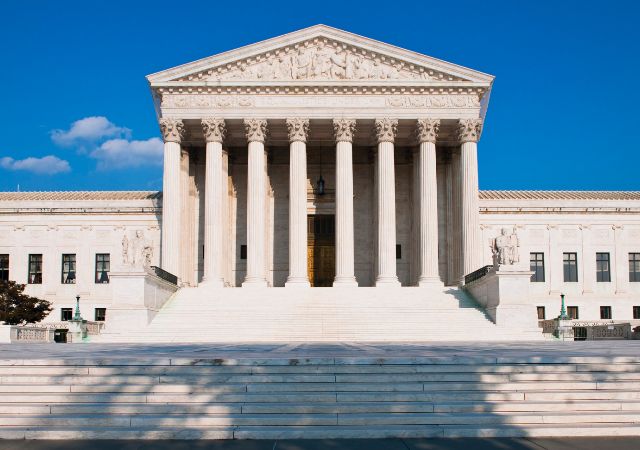
A new poll from Harris Interactive suggests that 70% of Americans are uncomfortable with using a system of lifetime appointments to fill vacancies on our nation's highest Court. This shouldn't come as a shock, and neither should that fact that millennials are far less likely to object to the idea of lifetime appointments (only 63% object) as compared to baby boomers (73%), "matures" (76%), and---perhaps most interestingly---Gen Xers (71%.) A generational gap isn't surprising because, for all intents and purposes, the Court is generally painted as some sort of next-level legislative body, expected to respond to the ever-fluid world views of pundits, protesters, and various voting demographics. (Don't believe me? Review the news coverage from the Court's rejection of DOMA.) As a card-carrying member of the bizarro generation tucked neatly between "GenX" and "Millennial," I can testify to the fact that as we grow, so grows our exposure to various ideas about how government should respond to a diversifying society, and vice versa. The problem with this viewpoint isn't that it's likely to change the system overnight---this would require a Constitutional amendment---but that it comes from a bloc of people who harbor a fundamental misunderstanding of the point and purpose of a Supreme Court.
The Harris Poll asked Americans to deliberate on the nation's highest court, and found that despite two-thirds of Americans (68%) feeling it's a crucial governing body for the success of the United States, nearly half of Americans (47%, up from 42% in 2010) say they are not knowledgeable about the Supreme Court confirmation process. Just over half of Americans (53%, down from 58% in 2010) indicate being that they're knowledgeable about the process, with one in ten (11%) saying specifically that they are very knowledgeable about it and just over four in ten (42%) saying they're somewhat knowledgeable.
Less than half of those who have an opinion about how the court should be run know how we currently choose justices. Excellent. Then there's this gem: