

Image 01 Image 03

United Nations Tag

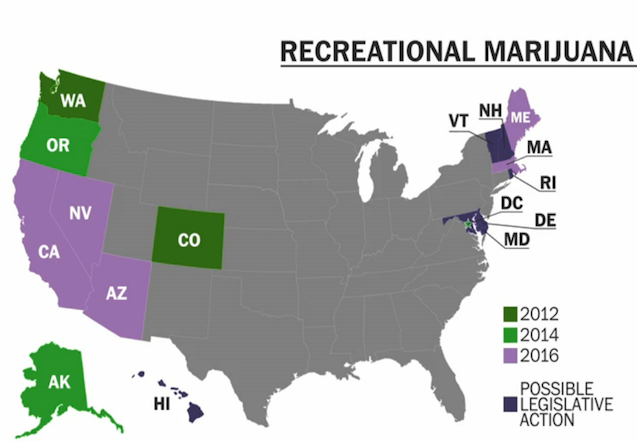
Residents of Oregon, Alaska, and the District of Columbia voted in this month's election to legalize marijuana within their states' borders, and this has some officials at the United Nations working overtime to convince U.S. officials to force the states to get in line with international norms. Via Reuters:
"I don't see how (the new laws) can be compatible with existing conventions," Yury Fedotov, executive director of the United Nations Office on Drugs and Crime (UNODC), told reporters. Asked whether there was anything the UNODC could do about it, Fedotov said he would raise the problem next week with the U.S. State Department and other U.N. agencies.
After Washington state and Colorado voted in 2012 to legalize recreational marijuana, the Justice Department made waves when it announced that it wouldn't challenge the new laws, causing some to question whether or not this could cause similar legislative initiatives in other states. Now, two more states and the District have voted to legalize, which means that if the UN wants to roll back legalization, they'll need to work fast, because the legislative trend is spreading:
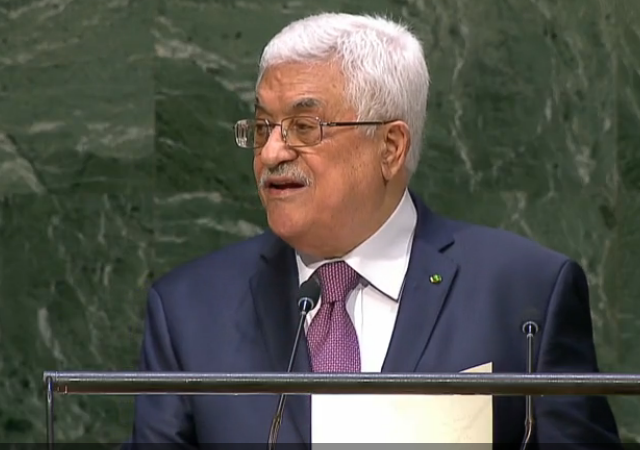
Mahmoud Abbas showed his hand today at the U.N., accusing Israel of genocide, getting a predictable reaction, via Times of Israel:
In his address, Abbas accused Israel of committing genocide in its recent conflict with terrorist groups in the Gaza Strip — calling 2014 “a year of a new war of genocide perpetrated against the Palestinian people” — and said that Israel was not interested in living in peace with its Palestinian neighbors. “It’s a speech of incitement full of lies,” an unnamed source from the PMO told the Hebrew press. “That’s not how someone who wants peace speaks.” Israeli Foreign Minister Avigdor Liberman said in a statement shortly after Abbas’s speech that the PA president demonstrated that “he doesn’t want and cannot be a partner for a logical diplomatic resolution.”
Here is part of the speech, in which Abbas heaps verbal abuse on Israel:

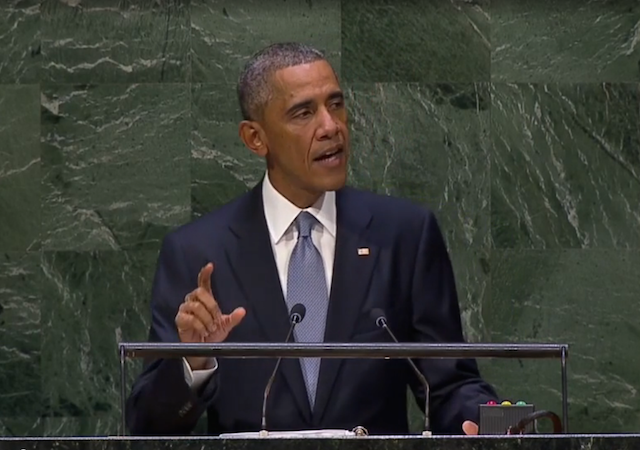
President Obama addressed the United Nations today with the confidence of a world leader, although some would argue that he has yet to display competence in the area of actual international leadership:
Each of these problems demands urgent attention. But they are also symptoms of a broader problem – the failure of our international system to keep pace with an interconnected world. We have not invested adequately in the public health capacity of developing countries. Too often, we have failed to enforce international norms when it’s inconvenient to do so. And we have not confronted forcefully enough the intolerance, sectarianism, and hopelessness that feeds violent extremism in too many parts of the globe. Fellow delegates, we come together as United Nations with a choice to make. We can renew the international system that has enabled so much progress, or allow ourselves to be pulled back by an undertow of instability. We can reaffirm our collective responsibility to confront global problems, or be swamped by more and more outbreaks of instability. For America, the choice is clear. We choose hope over fear. We see the future not as something out of our control, but as something we can shape for the better through concerted and collective effort. We reject fatalism or cynicism when it comes to human affairs; we choose to work for the world as it should be, as our children deserve it to be.

Fox News reports that the United States has executed a series of drone strikes against al-Shabaab strongholds in Somalia. The Pentagon is still reportedly assessing the success of the strike, which was aimed at al-Shabaab leadership:
A senior Somali official, speaking on condition of anonymity, told The Associated Press that a U.S. drone targeted al-Shabaab leader Ahmed Abdi Godane as he left a meeting of the group's top leaders. The official told AP that intelligence indicated Godane "might have been killed along with other militants." The official said that the strike took place in a forest near Sablale district, 105 miles south of Mogadishu, where the group trains its fighters. The governor of Somalia's Lower Shabelle region, Abdiqadir Mohamed Nor, told The Associated Press that as government and African Union forces were heading to a town in Sablale district, they heard something that sounded like an "earthquake" as drones struck al-Shabaab bases. ... The U.S. action comes after Somalia's government forces regained control of a high security prison in the capital that was attacked Sunday by seven heavily armed suspected Islamic militants who attempted to free other extremists held there. The Pentagon statement did not indicate whether the U.S. action was related to the prison attack.
Al-Shabaab claims responsibility for an attack on a Mogadishu prison that occurred just prior to the American drone strikes. The prison, which serves as an interrogation center for the Somali government, is believed to be home to captured extremists. The Pentagon would not confirm that the U.S. took action in response to this attack.

The United Nations Human Rights Council (UNHRC) has appointed a former New York State judge, Mary McGowan Davis to be the third commission member to investigate possible war crimes that might have occurred during Operation Protective Edge. The commission is to be headed by Prof. William Schabas. UN Watch reports:
The President of the United Nations Human Rights Council, Ambassador Baudelaire Ndong Ella (Gabon), today announced the appointment of Mary McGowan Davis as an additional member of the Commission of Inquiry charged with investigating human rights violations in the Occupied Palestinian Territory, in particular the occupied Gaza Strip, in the context of the military operations conducted since 13 June 2014. Justice McGowan Davis will join William Schabas and Doudou Diène whose appointments were announced by the Council President on 11 August. ... In carrying out its work, the Commission of Inquiry will aim to establish the facts and circumstances of human rights violations and crimes perpetrated in order to identify those responsible. The Council also requested that the Commission of Inquiry present a written report to the Human Rights Council at its twenty-eighth session in March 2015.
The report will unofficially be called Goldstone II after the Goldstone report, headed by Judge Richard Goldstone of South Africa launched by the UNHRC after Israel's Operation Cast Lead in 2008-9 to stop rocket fire by Hamas from Gaza.

Live Video and Twitter feed at bottom of post Last night the United Nations Security Council issued a Presidential Statement (less than a Resolution) demanding an immediate Gaza ceasefire. Hamas kept firing missiles, and Israel now is responding. Israel has rejected a ceasefire that does not include security guarantees. A devastating critique of John Kerry's botched ceasefire attempt, from left-wing Israeli author Ari Shavit:
If Israel is forced to ultimately undertake an expanded ground operation in which dozens of young Israelis and hundreds of Palestinian civilians could lose their lives, it would be appropriate to name the offensive after the person who caused it: John Kerry. But if the escalation does not happen, instead we should remember that those who prevented it are three people the Obama administration loathes: Abdel-Fattah al-Sissi, Benjamin Netanyahu and Moshe Ya’alon.
There was an explosion at Shifa Hospital (used by Hamas as a safe haven) which immediately was blamed on Israel, but now appears likely to have been a Hamas rocket misfire. We will update as the day goes on.

[Council meeting now over] The United Nations Security Council held an emergency meeting at the request of Jordan. The live tweets are below. The main outcome is that Secretary-General Ban Ki-moon will leave Saturday for the Middle East to try to mediate a ceasefire. Security Council Emergency Meeting Gaza undersecretary of the UN Jeff Feltman

The killing of four boys on a Gaza beach has generated enormous criticism of Israel. Israel itself has expressed sorrow at the killing (see Featured Image Tweet). But one fact not reported anywhere except WaPo is that the area was known to be used for rocket launching: This clip is from British news. Note how the interviewer doesn't even attempt to hide his bias. Welcome to British media, and increasingly, U.S. left-wing media. Mark Regev, a spokesperson for the Israeli Prime Minister's office, held his own and handled it well:

The Washington Post's fact checker, Glenn Kessler asks, "Did the United Nations demand Iran suspend uranium enrichment as part of a final deal?" At issue are statements made by Senators Robert Menendez and Bob Corker about Iran's right to enrich on the Sunday morning talks shows. Kessler, for example, took exception to Corker's response here:
CBS NEWS’S JOHN DICKERSON: Senator Corker, is it a red line for you? You talked about the standards of any ultimate deal. Is enrichment of any kind by Iran, is that something everybody should stay focused on? That any deal that includes that is a non-starter for you, because, of course, the Iranians say that they expect to be able to keep enriching? SEN. BOB CORKER (R-Tenn.): Yes, so to me that’s a baseline that the U.N. Security Council has agreed to, I think, six times, certainly this administration negotiated that in 2010. So they negotiated that in 2010. So as long as they can enrich, it seems to me that we are violating the very standards that we set in place in the first place. – exchange on CBS’s “Face the Nation,” Dec. 1, 2013
Kessler didn't hand out any Pinnochios to the senators but still found fault with their responses:
With their comments, Menendez and Corker might have left viewers with the impression that the U.N. resolutions already require a suspension of enrichment in any final agreement. That’s not the case — though it can certainly be an ongoing demand. The administration, for its part, appears to have set that goal aside in an effort to keep the diplomacy moving. The lawmakers are certainly within their rights to call attention to this decision, but they should be more precise in their language about what the U.N. resolutions actually require. Given that they were speaking on live television and this is a complex issue, their comments, at this point, do not yet rise to the level of a Pinocchio.
Perhaps the senators were a bit sloppy, but I think the question asked of them was misleading. The question shouldn't have been whether Iran would be allowed to enrich uranium as part of any final agreement, but whether Iran would prove that its nuclear program was strictly civilian. In introducing his analysis, Kessler wrote:

We have written many times before about how we only hear about the non-Jewish Arab refugees created when the Arab armies invaded Israel in 1948, but hear almost nothing about Jewish refugees from Arab countries: The claim that the Nakbah -- the catastrophe -- created only one refugee problem is a fundamental part of anti-Israeli agitation and an impedement to peace as Palestinians insist on a right of return for non-Jewish refugees and their descendents. In fact, there were an equal number of Jewish refugees who fled Arab countries for Israel. (The Forgotten Refugees - Full Documentary Movie is available on YouTube) Approximately half of Israel's current Jewish population are such Jewish refugees from Arab countries or their descendents. This exchange of populations goes unrecognized because Israel absorbed and welcomed its refugess, while Arab countries -- long before there was a "Palestinian" national identity -- kept the non-Jewish Arab refugees in separate camps and refused them and their descendents citizenship or other civil rights in many cases. There is an effort to change this misperception and to recognize the Jewish Nakbah, the ethnic cleansing of Jews in Arab countries, as part of any international discussion of Palestinian refugees. The effort at the U.N. is being led by Israeli Ambassador Ron Prosor, as reported by The Times of Israel, UN Jewish refugees panel aims ‘to rectify history’:

In the more recent iterations of the Star Trek television show, there were villains called Cardassians. They were even more ruthless than the Klingons. They also had a remarkable justice system as is shown in the following dialogue:
Gul Dukat: In Cardassia, the verdict is always known before the trial begins; and it's always the same. Commander Sisko: In that case, why bother with a trial at all? Gul Dukat: Because the people demand it. They enjoy watching justice triumph over evil, every time. They find it comforting. Commander Sisko: Isn't there ever a chance you might try an innocent man by mistake? Gul Dukat: Cardassians don't make mistakes. Commander Sisko: I'll have to remember that.
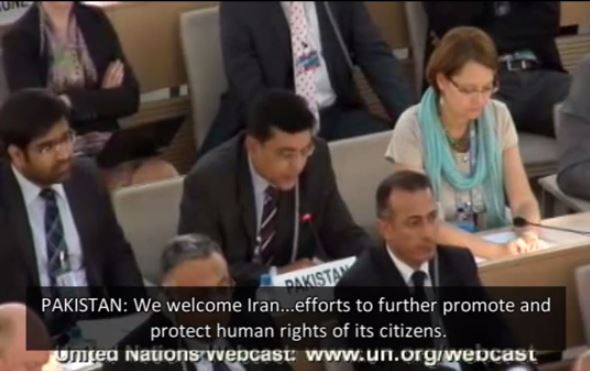
When reading Anne Bayefsky's latest account of the machinations of UN Human Rights Council, it's hard to think of a better analogy than the Cardassia's predetermined verdicts.  Israel is scheduled to sit before the UNHRC and be subjected to its Universal Periodic Review (UPR), here's how it works, as Anne Bayefsky explains:
As the UPR theory goes, once every four years the Council spends a few hours talking about the human rights record of each UN member state. The process has a number of stages. The country under consideration sends representatives to make some speeches about its terrific human rights situation. Other states are each given no more than two minutes to comment and make recommendations for improvement. The state concerned voices its acceptance or rejection of those recommendations. NGOs – including phony NGOs sponsored by governments – are allotted a limited time to make comments. And then the recommendations – and the government’s rejection of any of them – are put into a report which is perfunctorily “adopted.” In practice, the UPR looks like this. A very large number of friends of each rights-abusing country line up to praise its human rights record and generate a long list of faux congratulatory recommendations which can be easily “accepted.” The favor is repaid when their pals’ turns come along. These states then announce that serious recommendations “do not enjoy their support.” The praise and the rejections, all get included in a report that contains no findings and no conclusions, and there are no decisions to take action.