

Image 01 Image 03

United Nations Tag

Apparently, the White House is bowing to pressure from the Office of the United Nations High Commissioner for Refugees (yes, such a position actually exists) and is going to look for alternate ways to bring Syrian refugees into the country. Fox News reports:
The Obama administration appears to be bowing to international pressure and pursuing under-the-radar “alternative” ways to bring in more Syrian and other refugees -- as soon as this year. The latest indication that the administration is preparing to take in more than the 10,000 Syrians this year it already has committed to follows a March 30 “high-level meeting” on Syrian refugee admission in Geneva, Switzerland -- convened by the Office of the United Nations High Commissioner for Refugees. At the meeting, attended by State Department officials, U.N. High Commissioner for Refugees Filippo Grandi called for countries to pursue “alternative avenues” for refugees – such as student and work visas, and expanded family reunification programs.

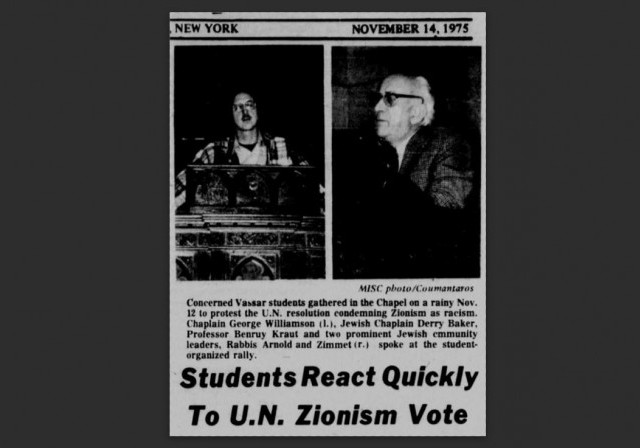
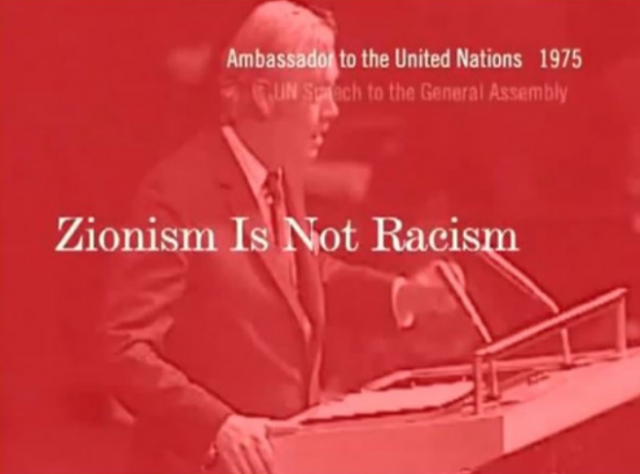
The Vassar College Student Association  council is voting anonymously on March 6, 2016, on an anti-Israel Boycott, Divestment and Sanctions resolution proposed by Vassar Students for Justice in Palestine (SJP) and Vassar Jewish Voice for Peace (JVP). For details, see Vassar anti-Israel activists attempt stealth academic boycott Resolution. For years the BDS campaign on campus has been punctuated by crude and misleading accusations against Israel, and an implicit and sometimes explicit argument that Zionism is inherently racist. Overt anti-Semitism rears its head from time to time. In researching Vassar's history, I came upon an interesting historical contrast with the current situation. In November 1975, the U.N. General Assembly passed the notorious (and now rescinded) "Zionism is Racism" Resolution. Then U.S. UN Ambassador Daniel Moynihan spoke eloquently in rebuttal of spoke of the “infamous” Zionism is Racism act.

As negotiations to negotiate an end to the Syrian civil war plod along, the UN has admitted, internally, that it is powerless to enforce any Syria peace deal. According to Foreign Policy, the UN knows it cannot enforce or even monitor any peace deal it brokers:
In a confidential strategy paper exclusively obtained by Foreign Policy, the office of the United Nations’ top envoy to Syria warns that the U.N. would be unable to monitor or enforce any peace deal that might emerge from landmark political talks underway in Geneva. The paper raised concerns the world might harbor unrealistic expectations about the U.N.’s ability to oversee and verify a cease-fire in a civil war beset by a dizzying array of armed factions and terrorist groups. “The current international and national political context and the current operational environment strongly suggest that a U.N. peacekeeping response relying on international troops or military observers would be an unsuitable modality for ceasefire monitoring,” according to the “Draft Ceasefire Modalities Concept Paper” by U.N. envoy to Syria Staffan de Mistura’s team. In plain English, that means Syria will be far too dangerous for some time for traditional U.N. peacekeepers to handle.

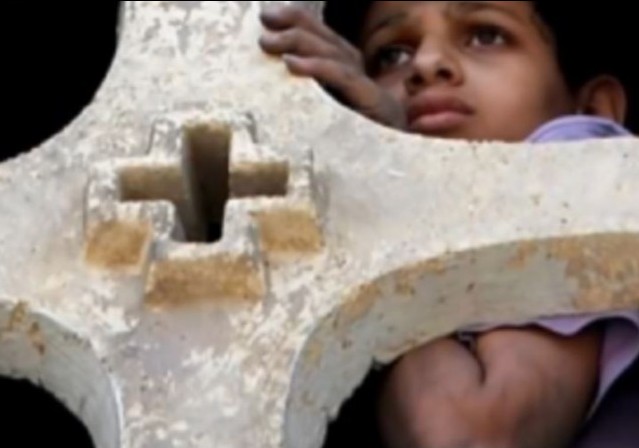
The number of Syrian Christian refugees the United States has taken in is extremely small. And yet this is a group that ought logically to be first in line because members face the most obvious danger and persecution---not only in Syria, but in several Arab or Muslim countries to which they might have fled. Syrian Christians would also have little chance of being terrorists. We already have seen how little Obama has said or done about the plight of Christians in the Middle East today, both rhetorically and in terms of action. So it's no stretch to imagine that the lack of Syrian Christian refugees may be the result of a deliberate policy of this administration. However, at least some of the lack of Christians among the Middle Eastern refugees to the US is a reflection of the way the system works vis-a-vis the UN, which usually does the initial vetting for us---a system that, by the way, desperately needs changing:

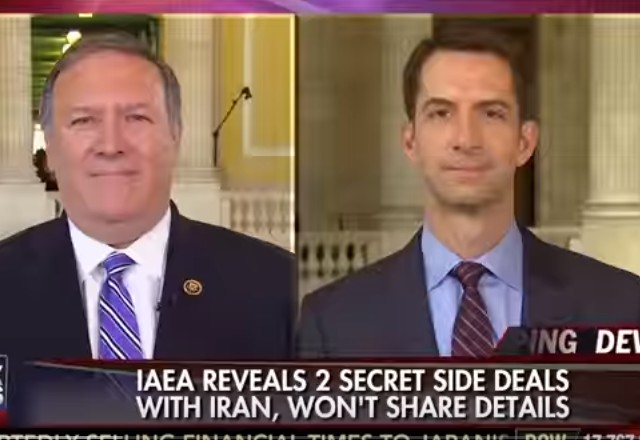
Rep. Mike Pompeo (R - Kan.) and Sen. Tom Cotton (R - Ark.) have a lot in common. Both are army veterans and both are graduates of Harvard Law School. And both have been doing a great job of exposing aspects of the nuclear deal with Iran that the administration would rather keep quiet. This week it was reported that an inquiry from Pompeo got the State Department to admit that the nuclear deal was never signed and is not "legally binding." Julia Frifield, the Assistant Secretary of State for Legislative Affairs, wrote in response to Pompeo's inquiry if he could see the signed agreement, in a letter reproduced at the congressman's website, that the nuclear deal was not binding and that it was not signed by any party. The key parts of the letter read:
The Joint Comprehensive Plan of Action (JCPOA) is not a treaty or an executive agreement, and is not a signed document ...

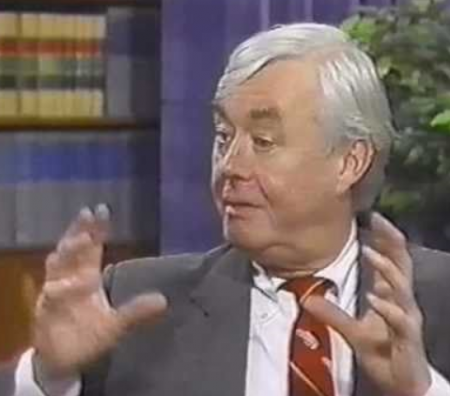
Forty years ago, on November 10, 1975, the United Nations General Assembly (UNGA) adopted resolution 3379, which declared the Jewish people’s national aspirations to live in their ancient homeland to be a form of racism. On that day, 104 UN delegates acted shamefully. But two ambassadors—one from the United States, the other from Israel—joined together to speak the “conscience of the world” and condemn the blatant expression of bigotry. By all accounts, they made a good tag team. Daniel Patrick Moynihan, the U.S. Ambassador, was an Irish-Catholic who was born in Tulsa, Oklahoma but moved to New York City as a young child, growing up on the rough and tumble streets of Harlem and eventually serving in the United States Navy. [caption id="attachment_149832" align="alignnone" width="450"]Daniel Patrick Moynihan Daniel Patrick Moynihan[/caption] Chaim Herzog, the son of Ireland’s Chief Rabbi, was raised in Dublin but migrated to Palestine in 1935 where he fought for the Haganah, Mandatory Palestine’s Jewish paramilitary force, the British Army, and later the Israel Defense Forces.

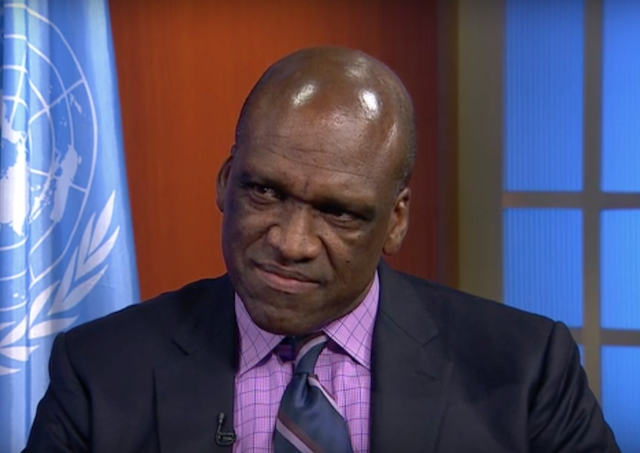
Today US authorities charged former United Nations General Assembly President John Ashe with accepting over a million dollars in bribes from Chinese real estate mogul Ng Lap Seng in exchange for lucrative government contracts. More via Fox News:
In exchange for the money, federal prosecutors say Ashe used his position as Permanent Resident to the United Nations for Antigua and Barbuda and General Assembly head to introduce a U.N. document in support of a real estate project being developed by Chinese billionaire Ng Lap Seng. Prosecutors say some of the bribe money was used to pay for Ashe's family vacation and to construct a basketball court at his home in Dobbs Ferry, N.Y. He opened two bank accounts to receive the funds and then underreported his income by more than $1.2 million, officials said. “There is a lot more work to do,” Preet Bharara, the U.S. Attorney for the Southern District of New York, told reporters on Tuesday when asked about the probe. He said more charges were possible, adding, “We will be asking the question: Is bribery business as usual at the U.N.?”

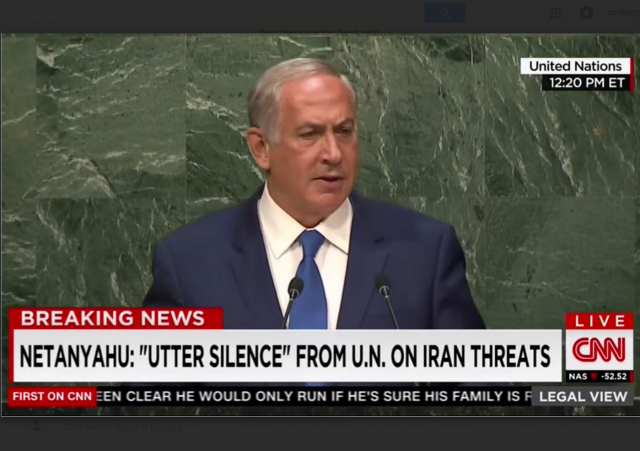
Israeli Prime Minister Benjamin Netanyahu spoke before the U.N. General Assembly today. It was a powerful speech -- one of, if not his best. The full speech is at the bottom of the post. The full text is here. Here are some highlights. Too bad neither John Kerry nor Amb. Samantha Power were present to hear it, and as a show of solidarity. Netanyahu had a powerful 45 seconds of silence shaming the U.N. for its silence on Iran's threats to destroy Israel. In the face of repeated Iranian threats and U.N. anti-Israel resolutions, Netanyahu declared "Israel will do whatever it must do to defend our state and to defend our people."

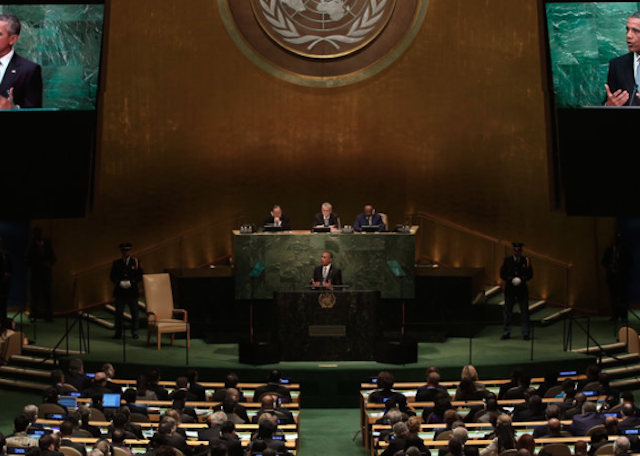
Today before the United Nations General Assembly, Barack Obama and Vladimir Putin sparred publicly over how their respective nations have approached a solution to crises in Ukraine and Syria. For both leaders, these speeches were an opportunity to regain control of a spiraling military, security, and human rights narrative that is now being influenced not only by the spread of Islamic terrorism, but the effects of mass migration out of the Middle East and Africa and into Europe. President Obama lashed out at Putin over Russia's aggression toward Ukraine and criticized Putin's leadership (or, lack thereof) on the Syrian crisis. Oddly enough, though, Obama somehow managed leave himself space to justify a partnership with Russia as a way of addressing conflict in Syria. From the New York Times:
Mr. Obama made a forceful defense of diplomacy but also castigated Russia by name multiple times in his speech for its defense of the Syrian government, its takeover of Crimea and its actions supporting Ukrainian rebels. “Dangerous currents risk pulling us back into a darker, more disordered world,” Mr. Obama said. Those currents include major powers that want to ignore international rules and impose order through force of military power, he said.

The United States Ambassador to the United Nations, Samantha Power recently wrote a piece for Politico arguing the Congress not reject the nuclear deal with Iran. In short she argued that rejecting the deal would leave the United States, not Iran isolated and the ability of the United States would be greatly compromised in its ability to influence outcomes globally. Towards the end she summed up her argument:
The Iran nuclear deal has been championed by the president of the United States, every one of America’s European friends and countless other countries around the world. If Congress rejects the deal, we will project globally an America that is internally divided, unreliable and dismissive of the views of those with whom we built Iran’s sanctions architecture in the first place. Although it is hard to measure the precise impact of these perceptions, I and other American diplomats around the world draw every day on our nation’s soft power, which greatly enhances our ability to mobilize other countries to our side. While that soft power is built in many ways, two of its most important sources are the belief among other countries’ leaders and publics that we share similar values, and that America delivers on its commitments. Of course, there is no substitute for the essential deterrent and coercive effects rooted in the hard power of America’s unmatched military arsenal. But we should not underestimate the political capital we will lose—political capital that we draw upon for influence—if we walk away from this deal.
What makes Power's plea so inexplicable is her record. As Claudia Rosett explained back in July:

The United Nations has declared a war on racism and slavery. Not on real slavery, as practiced by Saudi Arabia and Qatar with an immigrant labour force, but as practiced by the people of Netherlands during their Christmas festivities.  The U.N.’s self-proclaimed “Committee on the Elimination of Racial Discrimination” told the Netherlands to end its "Black Pete" Christmas tradition, in which Dutch people wear blackfaces, calling it a “reminder of slavery.” The actor portraying “Zwarte Piet”, as the jovial companion of Santa Claus is called in Dutch, usually puts on blackface make-up along with a fancy hat and Renaissance attire. (As the Dutch folklore goes, Santa’s companion is a Moor from Spain.) But the crusaders against racial discrimination at U.N. are not having any of it. According to the New York Times:

A number of stories have been reported since the signing of the Joint Comprehensive Plan of Action (JCPOA), as the nuclear deal with Iran is known, that raise serious questions about its effectiveness to prevent Iran from developing a nuclear weapon and even about whether or not it will stop a war.

Syria's Secret Chemical Weapons Stockpile

The Wall Street Journal reported on July 23 (Google link) that Syria, contrary to previous reports, had maintained “caches of even deadlier nerve agents.” Why it's important: The first reason is that Iran is the main sponsor of Assad regime. Given that it has supported the use of WMD in Syria and suffered no consequences for this will likely embolden it. The second reason is more practical. The chemical weapons inspectors were limited by the Assad regime where they could go. They also feared that if they reported something that would displease the authorities they would be barred from other sites. The same problem will exist with Iran. But being able to declare military sites out of bounds for inspections, Iran will limit inspectors' access, compromising the effectiveness of inspections regime.

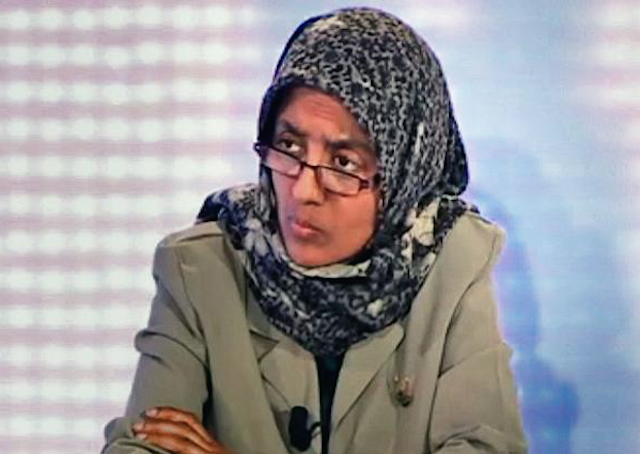
A report from the London Times has revealed that a senior employee of Amnesty International failed to disclose ties to Hamas, the Muslim Brotherhood, and the greater global Islamist network. Yasmin Hussein, 51, was until recently head of Amnesty's international advocacy division, and played an active role in the charity's advocacy at the United Nations. An investigation into Hussein's connections uncovered ties to "a secretive network of global Islamists" both through her husband, who was investigated for working closely with the Muslim Brotherhood, and via her activities with a UK-based aid agency that was banned from Israel for their alleged support of Hamas terrorism. More from the Times of London (hat tip to UN Watch):
Ms Hussein, who is understood to receive a salary of more than £90,000, told The Times that she had “never had any association whatsoever with . . . the Muslim Brotherhood”. Her husband, Wael Musabbeh, was one of several alleged British Islamists, none of them defendants, named in documents released after a 2013 trial in the UAE that led to the jailing of more than 60 Emirati citizens who were tried for conspiracy and sedition.

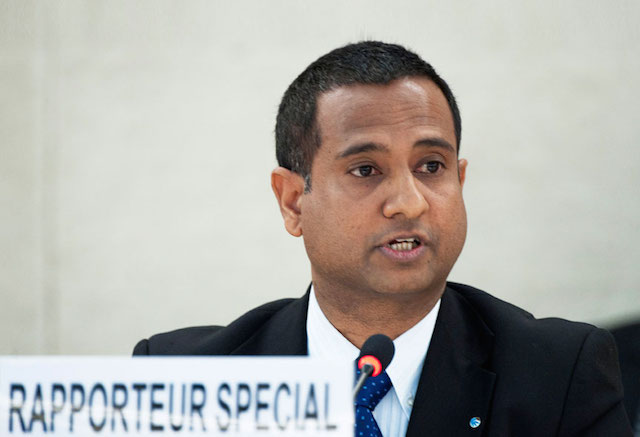
Yesterday, we posted about Iran's latest---and blatant---two-fold attempt to undermine the United States' moral authority and intimidate Jews living in Israel. The content of Ayatollah Ali Khamenei's 400-page screed on the inviability of both western hegemony and the state of Israel wasn't particularly shocking, but it should serve as yet another wake up call for those who think it's within the realm of possibility for Iran to play by the rules when it comes to human rights, international relations, or even a budding nuclear program. For their part, Iranian officials are determined not only to flaunt the rules, but to make sure that those violations never make it onto the record. They've launched a smear campaign against Ahmed Shaheed, the United Nations special rapporteur on the situation of human rights in Iran. The Guardian reports:
In a concerted effort aimed at discrediting Ahmed Shaheed in the eyes of the general public, Iranian state-run agencies and semi-official websites simultaneously carried articles claiming that the Saudi embassy in Kuwait had paid the UN envoy $1m to take an anti-Iran position. It dominated many Iranian front pages on Tuesday and an Iranian official later used the false information to question Shaheed’s credibility.

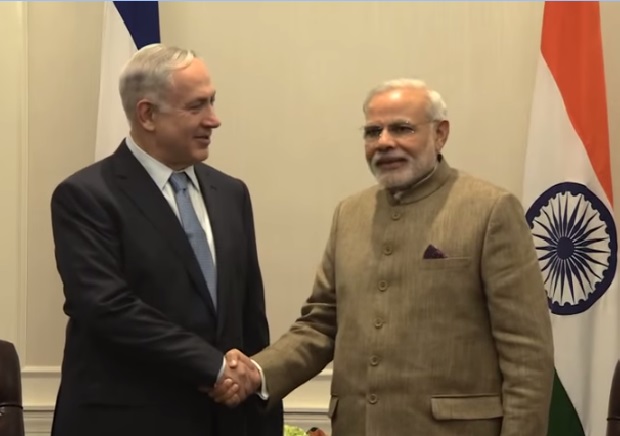
For the second time in a few weeks, India has abstained at the United Nations instead of voting on an Israel-related resolution. On July 3, 2015 India abstained from weighing in on a UN Human Rights Council resolution condemning Israel for 2014 Gaza conflict. The anti-Israel resolution passed with 47 votes in favour, with the US opposing, and India amongst 5 nations abstaining. Then on Monday, Israel unsuccessfully tried to table a resolution to challenge the official recognition of Hamas-linked NGO in the UN’s Economic and Social Council (ECOSOC). It is fair to ask: why abstain? Israel is one of India's leading defense partners, and an emerging trade partner. But considering the fact that until recently India was referred to as the "23rd Arab state" for siding with Arab-block on every anti-Israel resolution at the UN, this is a huge diplomatic shift for the world's largest democracy. Since India normalized diplomatic ties with the Jewish State in 1991, Israel has become India’s partner of choice when it comes modernizing the country’s military capabilities. The government is collaborating with Israel in agriculture, water management, and renewable and clean technologies; and India’s technology-driven IT giants have made significant investments in Israel’s innovation and startup ecosystem.

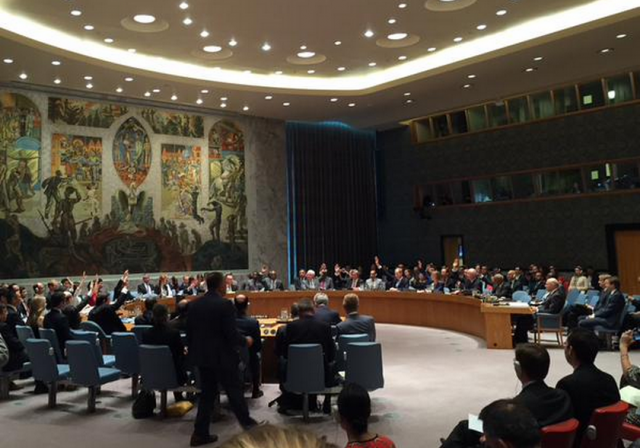
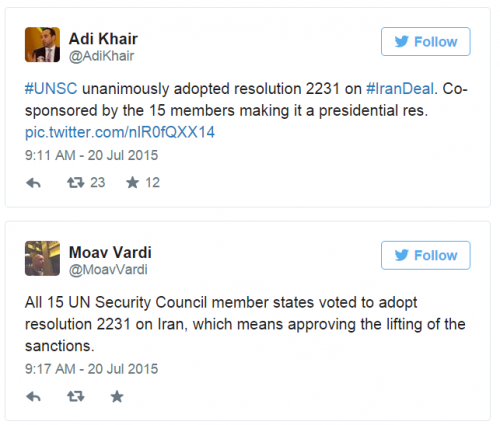
Guess the Obama administration isn't waiting for Congress. The United Nations Security Council, at around 9 a.m. (Eastern) this morning, unanimously approved the Iran nuclear deal, Resolution 2231, 15-0. https://twitter.com/AdiKhair/status/623118022337761280 [caption id="attachment_135057" align="alignnone" width="600"][U.S. Ambassador to U.N. Samantha Power, Iran Nuclear Deal Vote] [U.S. Ambassador to U.N. Samantha Power, Iran Nuclear Deal Vote][/caption]

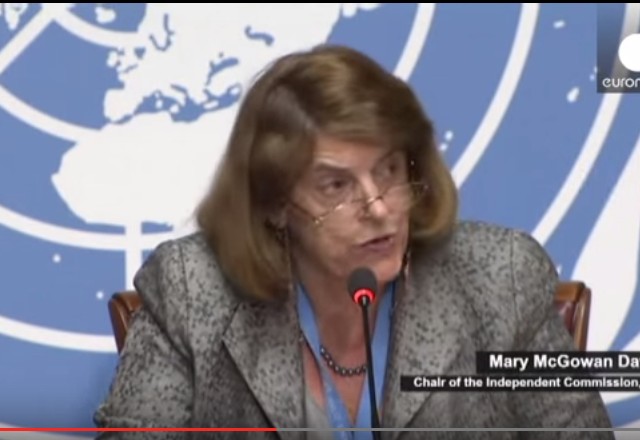
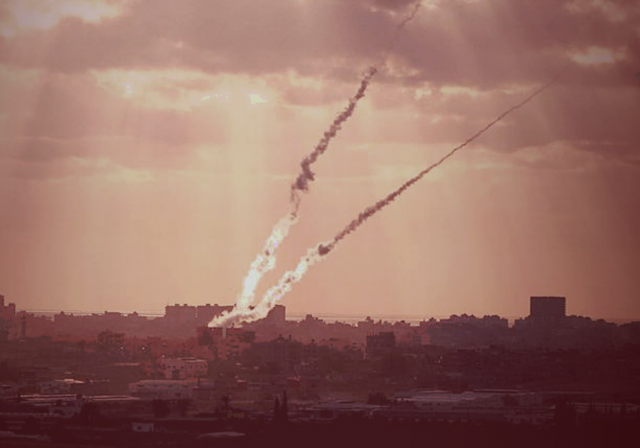
First the good news, the so-called Schabas report, the United Nations Human Rights Council inquiry into last year's war between Hamas and Israel, isn't as bad as its predecessor, the infamous, discredited Goldstone report. But it's still pretty bad. The Schabas report is named for the judge who originally headed it, William Schabas. Schabas stepped down when it was reported that he had done paid work for the Palestinian Authority. Schabas had previously said that he wanted to see Israel's Prime Minister Benjamin Netanyahu tried for war crimes had to step down when it was clear that he was hopelessly compromised. After he resigned the commission was headed by former New York State justice, Mary McGowan Davis. For the most part media outlets reported that the conclusion of the report is that both sides "may have committed war crimes." There are two problems with this. The first is that it is inconclusive. The second and more serious one is that it put Israel and Hamas, which precipitated the conflict by launching rockets into Israel, on the same level. Rockets fired from Gaza civilian area at Israel

It's too late to undo the massive propaganda campaign surrounding the 2014 Gaza conflict, which Israel called Operation Protective Edge. False statistics about civilian casualties were put out by Hamas ministries and then adopted without question by the UN, "human rights" groups, and the media to create the narrative that "most" or "almost all" or the "vast majority" of deaths were civilian. Critics of Israel have yet to explain how Israel was supposed to stop Hamas from firing rockets, tunneling under the border, or landing commandos by sea without firing into the civilian areas from which Hamas was operating. During the 2014 Gaza conflict, we covered the deliberate Hamas tactic of firing from civilian areas (including those next to hospitals and apartments,) as well as how Hamas used the main Gaza hospital as a military headquarters. Almost all of this was covered up by the media: http://youtu.be/Nu-e5qWXx-k Round two in the propaganda war against Israel will take place this week, when the U.N. Human Rights Council releases its report on alleged Israeli war crimes. The UNHCR is the body completely obsessed with Israel.