
Image 01 Image 03

Economy Tag

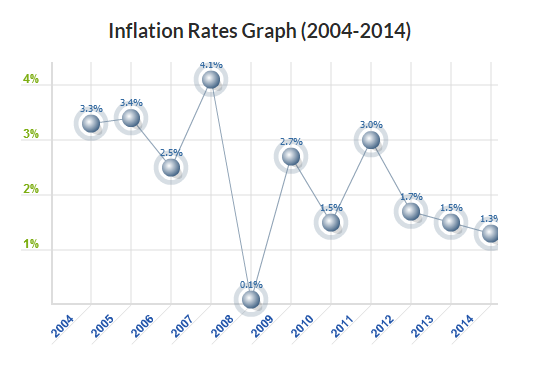
Entering 2015, most economists expected that the Federal Reserve would finally begin raising short-term interest rates. Fewer than two weeks in to the year and that thesis is already beginning to crumble. For seven years, the Fed kept interest rates at rock-bottom levels and employed a massive money-printing program called Quantitative Easing in the hopes of boosting the money supply, expanding credit, and causing inflation to jump-start the economy (so the theory goes). Many experts have long waited for the Fed to "normalize" policy and raise rates, for reasons that include a desire to stop expanding the money supply, and wanting the Fed to have a cushion to lower them once again when another crisis occurs. While credit finally appears to be coming more available, neither the mild-mannered inflation the Fed wanted nor the rampant hyperinflation Fed detractors prophesied has materialized. In 2014 the CPI inflation rate was 1.3%, the lowest since 2008. However, most economists, including those at the Fed, like to see 2% inflation. [caption id="attachment_112614" align="aligncenter" width="542"]InflationRates Graph from www.usinflationcalculator.com.[/caption]
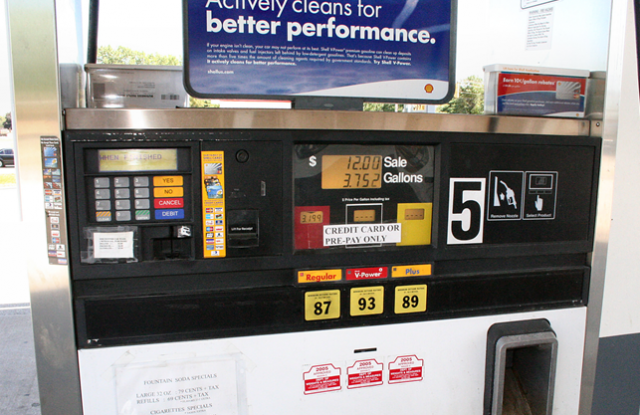
When it was confirmed that the Republicans would be taking over the US Senate after November's historic election many of us, fueled by a potent combination of conservative activism and Obama administration incompetence, were expecting big things. One of the items on the "Wish List" was tax reform. As the old adage goes: Be careful what you wish for... you just might get it. Even before formally taking charge of the US Senate Commerce, Science and Transportation Committee, Senator John Thune (R-SD) weighed the option of solving our infrastructure problems with...a tax hike!  When FNC's Chris Wallace queried Thune about raising gas taxes, his response was astonishing.
The incoming Republican leader of the Senate Transportation Committee said Sunday an increase is up for consideration, as “we have to look at all the options.” “I don’t think we take anything off the table at this point,” John Thune said on “Fox News Sunday.” Prices at the pump are at the lowest point in years — the nationwide average has tumbled more than a dollar in the last year, reaching $2.20 on Monday. That’s given drivers significant relief at the same time as the federal highway fund continues to face huge shortages. Thune said the fund is looking at “about a $100 billion shortfall.”
The full segment is here, and the pertinent exchange starts at 9:50. Translation for those who don't speak politicoese: He would "prefer" not to do it does not mean he "absolutely won't" do it.

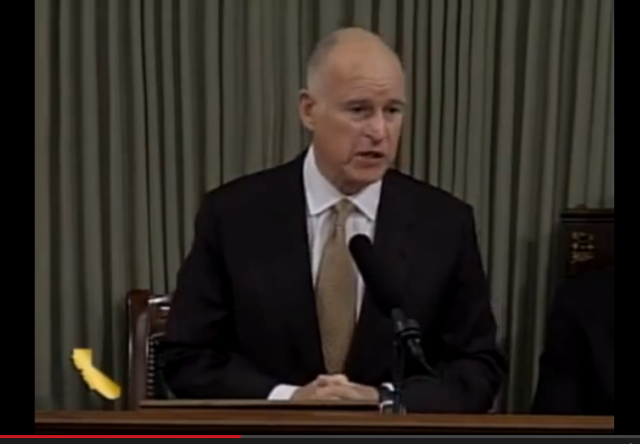
Californians are starting 2015 with a fresh round of new taxes, and the inauguration of Democrat Jerry Brown for an unprecedented fourth term as California's governor. As part of his inaugural address, Brown derided critics of the state's current economy, and conjured up a fantasy of balanced budgets and robust employment.
“We are at a crossroads,” Brown said in his inaugural address. “With big and important new programs now launched and the budget carefully balanced, the challenge is to build for the future, not steal from it, to live within our means and to keep California ever golden and creative, as our forebears have shown and our descendents would expect.”
However, the true fiscal picture for the Golden State is a little less dreamy:

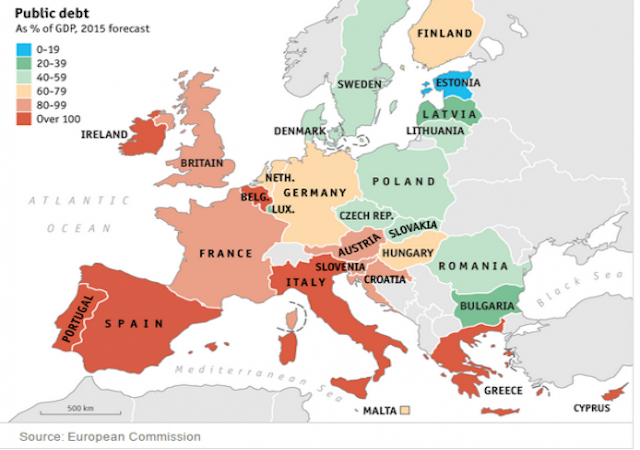
The label "Sick Man of Europe" has been awarded to many a European nation and empire since it was first used to describe the decrepit Ottoman Empire in the mid-19th century. Today, it seems the entirety of Europe, save the United Kingdom and Switzerland, is worthy of the "sick man" title. The Eurozone is teetering on the brink of yet another economic crisis thanks to continued low growth, high debt, and the rise of populist political parties in the weaker Euro economies. The euro currency dropped 11% against the dollar this year, falling to its lowest levels in two years. Russia, as I have already covered, is reeling in the face of 2014's plummet in oil prices and faces a crisis in its own currency; in fact, Russia's GDP contracted 0.5% in November, marking the first Russian decline since 2009, and is expected to decline 0.8% in 2015. Even Scandinavian economies, like those in Denmark, Norway, and Sweden, are positioned for trouble in 2015. With its economy tanking, there is little consensus on what Russia will look like politically in 2015. Basically, Putin has three choices: 1) Weather the storm hoping for a speedy recovery in oil prices, 2) Militaristic voyeurism (to boost domestic popularity, power, and perhaps induce a crisis that would prop up oil prices), or 3) Commit to real economic reforms along the lines of divesting state assets, weeding out corruption, and promoting a diversified economy. But right now most analysts and pundits are nervously looking at the political situation in Greece. On Monday, the Greek Parliament failed to elect a president, forcing a snap election, which will be held on Jan. 25. The current center-right coalition, led by Prime Minister Antonis Samaras's New Democracy Party, is expected to lose to the far-left populist party Syriza. Syriza's economic platform seeks to reverse austerity measures put in place after the first round of bailouts in 2010 and to repudiate much of Greece's debt, which currently sits at over 174% of GDP.

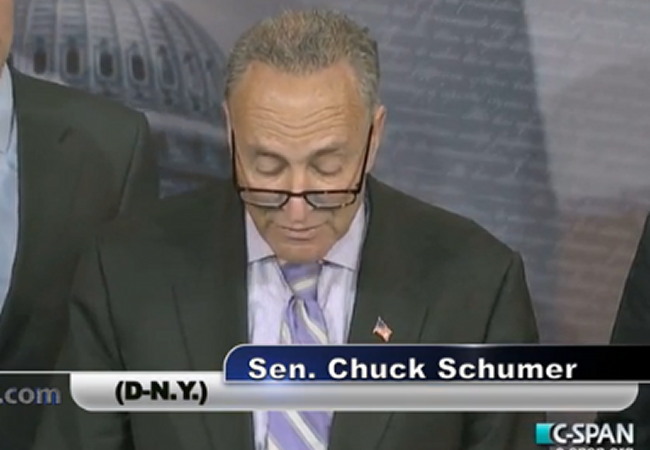
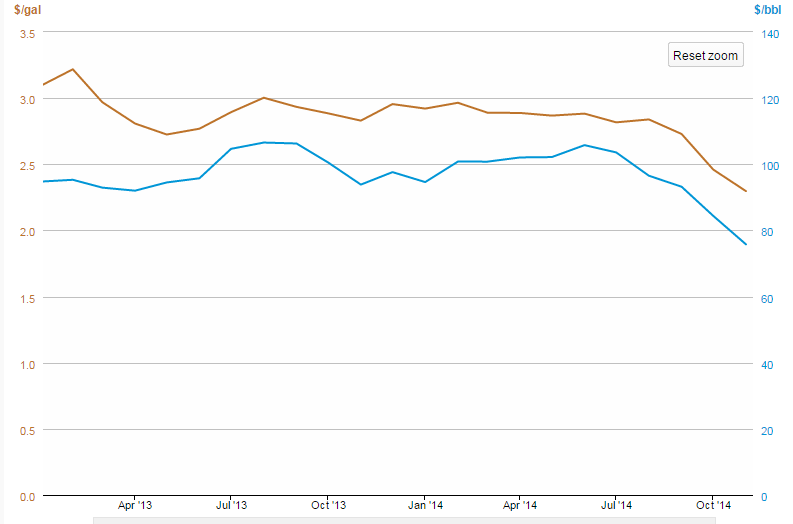
Last week, Senator Chuck Schumer (D-NY) said he wants the Department of Justice and the Department of Transportation to investigate why airfares are not decreasing along with falling oil prices. On the surface, Schumer’s observation makes sense. Crude oil and jet fuel prices are strongly correlated, and on average jet fuel comprises a third of airlines’ operating expenses. As such, the declining cost of oil, and therefore jet fuel, should reduce airlines’ expenses, thereby giving them the opportunity to charge lower airfares to consumers. [caption id="attachment_110349" align="aligncenter" width="473"]Chart from U.S. Energy Information Administration. Blue is WTI crude oil, orange is jet fuel. Chart from U.S. Energy Information Administration. Blue is WTI crude oil, orange is jet fuel.[/caption] The key word here is “opportunity.” Even though Schumer says “it’s safe to say that the airlines can afford to pass at least some of these savings onto the consumer,” reality is far from this populist idealism. The airlines’ first obligation is to their shareholders and employees, who have legitimate claims to these savings in the forms of higher dividends and wages. Then there is the issue of the government telling private businesses how they should set their prices—as if Washington bureaucrats know the first thing about airline pricing strategy, arguably the most complex in existence.

Last week, traffic on two Los Angeles freeways came to a halt as fire crews responded to a massive inferno that incinerated a downtown luxury apartment complex under construction. There is currently no cause that has been officially determined by arson investigators. The best lead in this case may be two men who were captured on video near the scene, in recordings taken shortly after the fire ignited.
Investigators asked for the public’s help Monday to identify two men seen on surveillance video taken the day of the massive apartment fire in downtown L.A. last week. Two men authorities say are potential witnesses are seen in surveillance video walking in the area of the fire, which caused tens of millions of dollars in damage Dec. 8 to the seven-story Da Vinci Complex, 906 N. Fremont Ave.. The two individuals are not considered suspects or persons of interest, and investigators would like to interview them because they were in the area of the fire, officials said. One edited video apparently shows a man in a black jacket, black pants and a black and white baseball cap grabbing at the fence around the apartment complex as it burned before firefighters pull him away from the fence, KNX 1070’s Claudia Peschiutta reports. ...A second video shows a different man, wearing a football jersey with the number 21, a backpack and a baseball cap walking by the area.
A CBS Local video reviews the details as they are known:

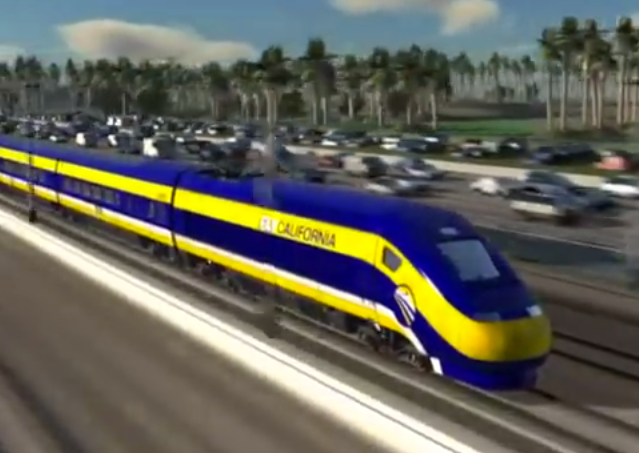
We have been chronicling the journey of California's vaunted "high speed train" construction project, which has been anything but speedy. When we last checked, Sacramento judge Michael Kenney had wisely ruled that state officials cannot pursue a plan to tap billions of dollars in voter-approved bond funding for construction---a decision that could cause indefinite delays in the massive $68 billion project. It looked like the project was poised to be derailed. In July of this year, however, the Third Appellate District Court ruled that the "voters clearly intended to place the Authority in a financial straitjacket by establishing a mandatory multistep process to ensure the financial viability of the project." But then the panel decided to allow the plan to move forward. The Wall Street Journal editorial board took exception to this seemingly questionable ruling:
The court could require the authority to redo its plan, but the judges say that would be unnecessary since the Director of Finance must still approve a rigorous final plan before the authority can spend the bond revenue. In other words, the law's procedural requirements don't matter. Yet the bond referendum had ordered a preliminary plan for legislative review precisely so lawmakers could force the rail authority to address their concerns before appropriating the bonds. This added a modicum of political accountability. So here we have the spectacle of legislators ignoring the very taxpayer protections that they had used to gull voters into approving a ballot measure that might never have passed without those protections. The lesson is that politicians will grab any new power or spending authority voters give them. They'll blow through the caveats and dare voters to sue to stop them.

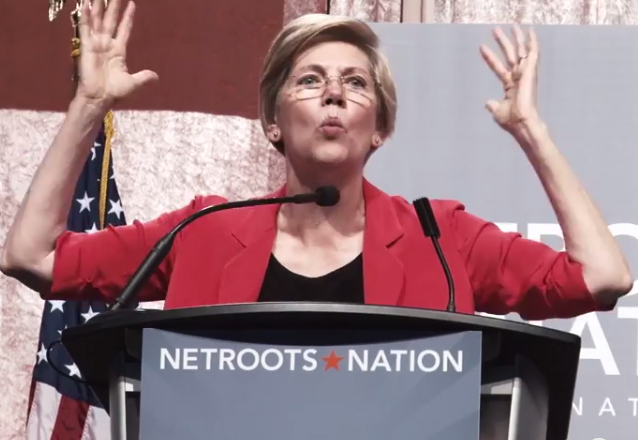
Well here's something different. As Netroots Nation cries out for income and wealth distribution and props up the class warrior Elizabeth Warren to cult status, some careful economic analysis finds that income inequality is decreasing globally and that redistribution in the U.S. would hurt the developing world. In an Op-Ed in The NY Times, George Mason Univ. economist Tyler Cowan writes, Income Inequality Is Not Rising Globally. It's Falling:
Income inequality has surged as a political and economic issue, but the numbers don’t show that inequality is rising from a global perspective. Yes, the problem has become more acute within most individual nations, yet income inequality for the world as a whole has been falling for most of the last 20 years. It’s a fact that hasn’t been noted often enough. The finding comes from a recent investigation by Christoph Lakner, a consultant at the World Bank, and Branko Milanovic, senior scholar at the Luxembourg Income Study Center. And while such a framing may sound startling at first, it should be intuitive upon reflection. The economic surges of China, India and some other nations have been among the most egalitarian developments in history....

The Democratic Party has made it clear that they're planning to run on "income inequality" in 2014. Liberal Washington Post writer Greg Sargent has even suggested this strategy is part of the reason for Senator Harry Reid's recent attacks on the Koch brothers. It's ironic that...

As I was reviewing the economic news of 2013, I felt a few updates might be in order as we conclude the wild ride that this year has been. One of the most fascinating stories of the year, from my capitalism-loving point-of-view, centered on Cyprus.  In...

Today the Wall Street Journal's Paul Vigna referred to the U.S. economy as the "Stall-Speed Economy" after the latest economic data was released this morning. Most striking: revised numbers show the U.S. economy grew at only a 1.3% annual rate in the April through June...

Today would be Milton Friedman's 100th birthday. I've played this video before, but it's particularly timely in light of the "you didn't build that" narrative which has become the foundation of the Obama campaign taken from Elizabeth Warren who took it from George Lakoff. ...

As you know from the primaries, I'm no fan of John Sununu. But when it comes to Obama's complete lack of understanding and disdain for what makes this country's economy work, Sununu got it right yesterday Despite the media hoopla, tell me exactly what was wrong with this statement: In...