

Image 01 Image 03

ISIS Tag

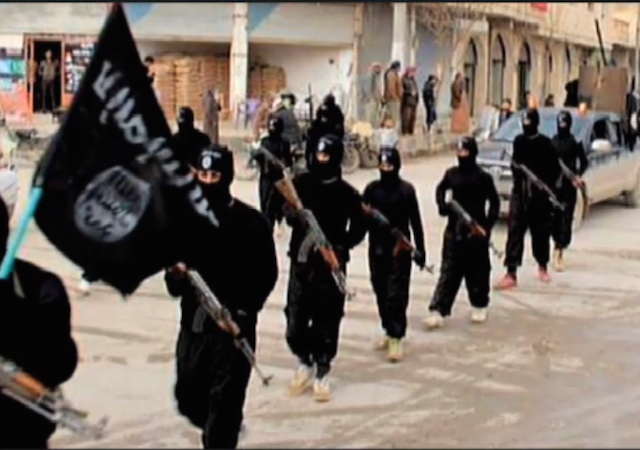
In September of 2014, President Obama addressed the nation and described the counterterrorism strategy that he claimed would be used to "degrade and ultimately destroy" ISIS in the Middle East. Since then, the fight to destroy the Islamic State has encountered setbacks that have caused both seasoned military analysts and casual observers to question whether or not the Administration's policy mandating the prevention of civilian casualties is an effective tactic to destroy an enemy whose strategy depends on the use of civilian infrastructure as a shield. High-profile critics like Senator John McCain (R-AZ) have put Administration officials on defense, and yesterday, US Central Command air force leader Air Force Lt. Gen. John W. Hesterman III did his best to get out in front of the debate:
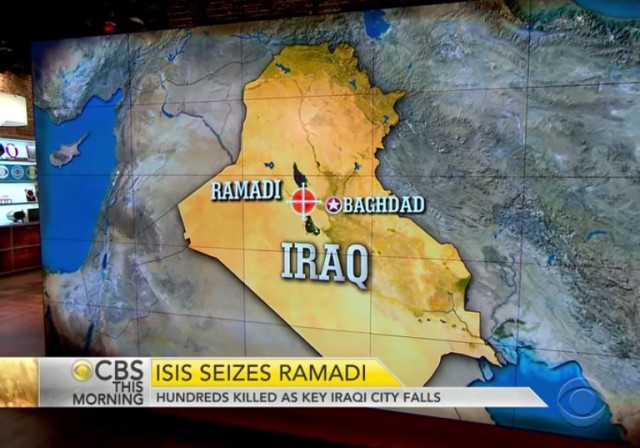
In a news conference he said was called to counter misconceptions about the use of air power in an unconventional war, Air Force Lt. Gen. John W. Hesterman III asserted Friday that pilots are killing more than 1,000 militants a month while avoiding civilian casualties and Iraqi government forces. As the Islamic State has made territorial gains in Anbar province, including the capital Ramadi, critics have accused U.S. commanders of being too cautious, missing opportunities to kill the militants and disrupt their supply lines.

After being maligned by the press for "inviting" violence by taking a stand for free speech at her Garland, Texas "Draw Mohammad" event, Pamela Gellar was target of a beheading plot. Usaamah Rahim, who was being investigated by the FBI, was shot and killed by Boston police Tuesday. Rahim and an alleged co-conspirator, planned to behead Pamela Gellar.

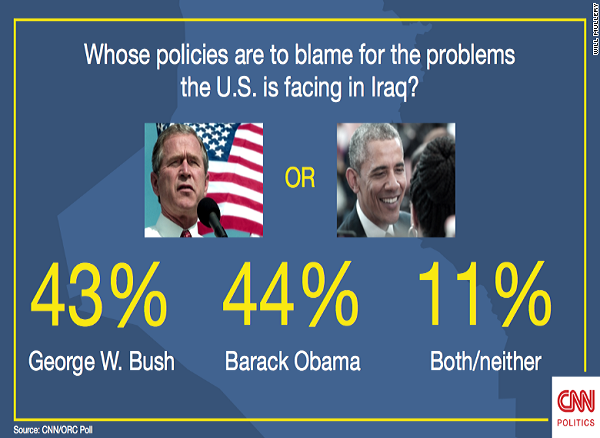
When he withdrew troops from Iraq, Obama himself proclaimed, "we are leaving behind a sovereign, stable, and self-reliant Iraq."  That was in 2011.  Flash forward to now, and Iraq is none of those things; indeed, Iraq is now an ISIS strong-hold, part of their declared caliphate. Throughout Obama's presidency, we've heard him blame President Bush for everything from the still-flailing economy to the rise of ISIS.  His supporters within the media have ensured that this message is the one that Americans hear most often, and for (too many) years, (far too many) Americans have believed what they were told. No longer. A CNN poll found that, for the first time, more Americans blame Obama than President Bush for the instability in Iraq:

[N]early the same percent of people blame President Barack Obama's policies for the current situation in Iraq as those who hold President George W. Bush responsible, the survey showed.

Overall, 44% say they blame Obama's policies for the problems in Iraq and 43% blame Bush; 11% say both are equally responsible.

Late last month, Fox News broke an exclusive story about how the dramatic uptick in social media use by ISIS militants and their supporters has led to problems in the intelligence community. Due to a recent increase in online activity, ISIS has been able to effectively clog the pipes with so much content and discussion that analysts are having a hard time distinguishing rhetoric from legitimate threats. Not only is ISIS really good at propaganda, they've also been incredibly effective in getting people to play along. Their social media game is strong, and recently, the extremist organization has made moves to up the quality of their presence on more traditional mediums---namely, TV and video. It's all part of a tactic to reach beyond their strongholds in the Middle East and into the homes of young men and women in the west. Al-Bayan, the ISIS-controlled public radio network, is described as sounding similar to NPR; similarly, videos posted to YouTube and various ISIS websites display a marked increase in production value, all aimed at catching the attention of people who are used to being fed quality propaganda, as opposed to the grainy, shaky offerings of a few years back.

They came. They saw. They protested without hurting themselves or others. I promised a round of applause for Phoenix Mayor Greg Stanton if he and his city management and law enforcement teams managed to keep the peace between protesters and counterprotesters at last night's free speech/anti-Islam/whatever you want to call it rally. The verdict? They managed! Mr. Stanton, this one's for you. USA Today explains how things played out:
Police presence increased by 6:30 p.m. to physically separate the two sides outside the Islamic Community Center of Phoenix. About 20 cars and 15 motorcycles traveled from a protester meeting point at a nearby park to the mosque around 6 p.m., where people from the two sides used megaphones to yell at each other and were at times nose-to-nose. A large group of counter protesters held signs reading "Love not Hate," as others waved American flags and one man ripped the Quran in half. Counter protesters wearing blue lined the side closest to the mosque. They said they came from Redemption Church in Tempe and wore the color to be a peaceful presence. Few people showed up for the mosque's scheduled prayer service.
Supporters on both sides of the issue took to Twitter to speak their minds---and air their grievances:

On Friday, the Federal Bureau of Investigation, Department of Homeland Security and National Counterterrorism Center sent out a joint bulletin informing law enforcement and military personnel that, although there were no credible threats hovering over holiday weekend events, officials are "aware of recent information suggesting US military bases, locations, and events could be targeted in the near-term." Happy Memorial Day! This information isn't really news to anyone following national security and foreign policy news, but the reason for the concern is novel: the dramatic uptick in social media activity by groups like ISIS has led to new sources of "insider threats" and chatter about security and maintenance procedures at sites that officials now believe are being considered as potential targets. Fox News has the exclusive:
Importantly, it speaks to the sheer volume of social media activity by pro-ISIS users, and the challenge that poses for analysts and investigators. "The large number of social media postings by US-based ISIL supporters is challenging for investigators in differentiating those supporters focused only on promoting pro-ISIL rhetoric, which may be protected speech, vice [versus] detecting those prepared to engage in violence on the group's behalf," the bulletin said.

The Obama administration's recent claim that their strategy against ISIS is working is being met with skepticism. On Special Report Thursday night, Charles Krauthammer pointed out the farce of their position. Transcript via Real Clear Politics:
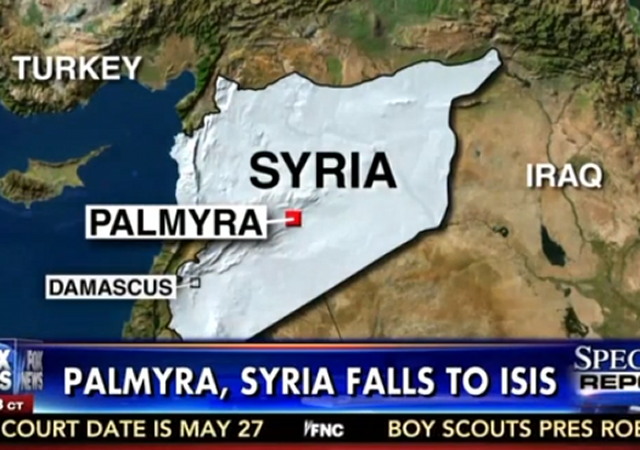
The administration is sounding like Baghdad Bob during the invasion of Iraq. They're losing. Everybody understands that. ISIS, it wasn't only that they took over in Iraq, but it took over the town of -- the city of Amara in Syria which gives them control of half of Syria and later in the day today, they took over a crucial crossing point between Syria and Iraq, essentially erasing the frontier and making it easier to resupply Ramadi. These are huge strategic gains. They're not tactical defeats. And what Obama says, well, it's not because it's the guys trained by us who were in Ramadi, this is nuts. The idea is if you're going to have success, you have to have training and you have to have will. The idea that what the Iraqis are lacking is training is ridiculous. We've been training them for 15 years. If the troops haven't got their heart in the battle, it will not succeed. And that's what happened in Mosul when they ran away and that's what happened in Ramadi when they ran away.
Here's the video via Newsbusters: Krauthammer isn't alone in this view.

Over the weekend, Islamic State forces took effective control of the Iraqi city of Ramadi. Yesterday Pentagon spokesman Army Col. Steve Warren attempted to put the loss of ground in perspective, while emphasizing the unique challenges urban warfare presents to a still-young fighting force. From the DoD:
“To read too much into this is a mistake,” Warren said. “This is one fight, one episode, in which Iraqi Security Forces were not able to prevail –- today.” While ISIL was able to gain the upper hand in Ramadi, “what this means for our strategy is simply that we -- the coalition and Iraqi partners -- now have to go back and retake Ramadi,” Warren said. Defense Department officials have always said there would be ebbs and flows in Iraq’s fight against ISIL, he said, adding that “it’s a difficult, complex, bloody fight, and there will be victories and setbacks.” Iraq and coalition forces will retake Ramadi, Warren said, “In the same way we are slowly but surely retaking others parts of Iraq with Iraqi ground forces, combined with coalition air power.”
Ramadi has held several places in the Iraqi war lexicon: flashpoint, stronghold, symbol. This reality was reflected in last month's meltdown over Joint Chiefs Chairman Martin Dempsey's comments about the longterm symbolic importance of the city as compared to other areas in the current conflict zone:

Are you looking for a special place to visit on your summer vacation? You're in luck. ISIS has opened a luxury hotel in Iraq. Heather Saul of the Independent:
Isis opens 262-room luxury hotel in Mosul Isis has purportedly opened its own luxury hotel in Iraq's second city Mosul for members of the extremist group to stay in while visiting. Pictures circulated by Isis-affiliated social media accounts show members tending to a well-maintained garden, polishing floors and cleaning windows, expansive swimming pools and two black Isis flags flying at the front of the multi-storey building. The hotel is believed to be the Ninawa International Hotel, which received a number of positive reviews on TripAdvisor before being overtaken by militants and stripped of its branding. It has 262 rooms, two restaurants, two ballrooms and a gymnasium, among other facilities.
Paul Detrick of Reason TV produced this promotional video for the hotel:

By now, you've no doubt heard that Pamela Gellar hosted a free speech event in Texas which focused on cartoon images of Mohammed and that an Islamist terror plot to kill attendees was foiled. Many in media - and not just liberals -have gone out of their way to blame the victim, Geller and those attending the event, and have even gone so far as questioning the limits of free speech in America. A writer at the Washington Post wondered why Geller didn't apologize. CNN's Chris Cuomo argued that 'hate speech' isn't protected by the First Amendment which was so dumb he was even called out by the far left site Salon. Geller appeared on the Sean Hannity show Wednesday night and confronted the British Muslim cleric Anjem Choudary, who openly called for her death on national television. If you watch the Hannity show, you're probably familiar with Choudary. Allahpundit of Hot Air jokes that Choudary has probably appeared on the show more times than Alan Colmes. The exchange is over 10 minutes long but you should watch the whole thing: Despite threats Geller has received, she said federal security agencies haven't contacted her.

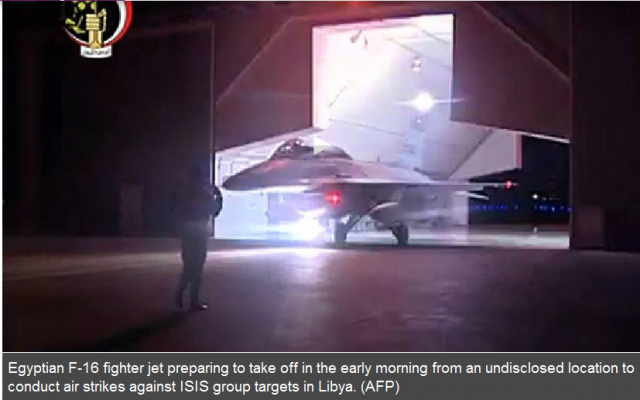
Amid all the violence and chaos on the streets of Baltimore, I thought I would check on the status of the chaos and violence in Libya. The last time we reported about the region, Egypt's commandos were striking ISIS, its air force was bombing terror strongholds, and its President, Abdel Fattah el-Sisi, was calling for a United Nations resolution mandating an international coalition to intervene. As one might have projected, the UN response has been less than robust. So, Egypt is planning another operation.
Egypt reportedly is preparing a large-scale ground and air assault along the Libyan border to oust the Islamic State group from eastern Libya. DebkaFile, quoting military and intelligence sources, said naval and marine forces are assembling at Egypt's Mediterranean ports for a possible assault on Derna, the militants' provincial capital. DebkaFile noted the Islamic State group, also known as ISIS, represents an unacceptable threat to Egypt, and President Abdel Fattah el-Sisi has been warned extremists already have penetrated some Egyptian towns and military units. ISIS fighters are being smuggled through the Sinai Peninsula and Egypt from Syria and Iraq by drug rings, DebkaFile said.

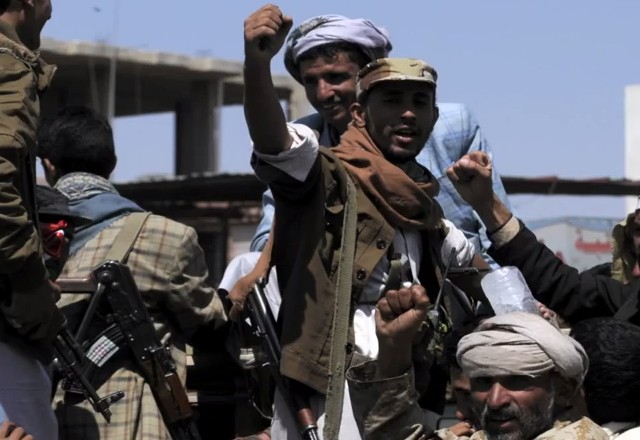
Earlier this month, officials with the United Nations had a delicate situation on their hands. The situation in Yemen was spiraling, and their best laid plans were quickly being turned to rubble as Saudi coalition airstrikes smashed through key territory in an effort to protect strategic port cities from the advance of Iranian-backed Houthi rebels. The international community was concerned. For both Saudi and Iran, the airstrikes represented a turning point in discussions that had spiraled from tense to impossible; the UN fired (he "resigned," officially) envoy and Moroccan diplomat Jamal Benomar, citing his apparent inability to get the warring factions to play nicely, and doubled down on the diplomacy narrative as world leaders began to express impatience with the bloodshed. Benomar has now opened up to the media, accusing Saudi of derailing an impending peace deal in Yemen and solidifying already-stubborn positions on who should be involved in Yemen's democratic political process. From the Wall Street Journal:

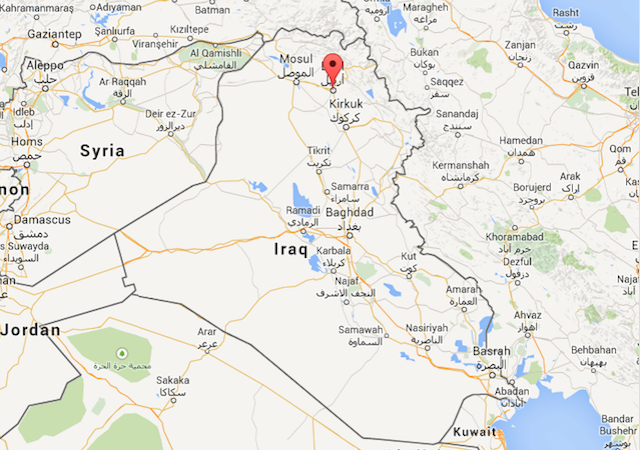
A car bomb exploded today outside the U.S. consulate in Erbil. According to the State Department, all officials are accounted for, but as of now no one has claimed responsibility for the attack. Via NBC News:
There were no immediate reports of injuries to consulate personnel or local guards, the State Department official said. The Associated Press, citing one of its reporters at the scene, said that the blast set nearby cars on fire. Talmadge Payne, an American working as a consultant for a non-government organization in Erbil, told NBC News that he was sitting on the roof of his hotel, about a half-mile from the consulate, and felt the blast. "If I could feel the blast from here it must have been pretty significant," he said. "The room shook, and a few things fell off the shelves." He said there was a firefight, then about 10 minutes of calm, then more gunfire.
Photos posted to Twitter show a sizable explosion that caused extensive damage and may have killed up to 3 people:

Get ready for some more mixed messaging on the US role in the Middle East, because we could be in for a doozy---even when it comes to ISIS. We've talked a lot here about the mixed messages the administration is sending regarding our mission in the Middle East. We have "boots on the ground"---but we don't. We're in it to win it---but we need to hold back and not commit to a real offensive. Officials overseas have gone so far as to publicly question whether or not Obama knows exactly what we're doing over there. It seems like Congress feels the same way. House Speaker John Boehner is now saying that it will be "virtually impossible" for Congress to pass Obama's proposed authorization for the use of military force against ISIS in the Middle East. Why? Because it makes no sense.

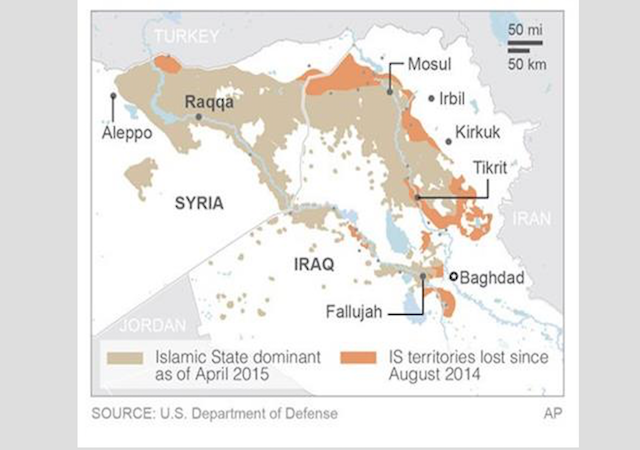
How's the war on ISIS going? Perhaps not as badly---or as well---as you might think. New numbers released by the Pentagon show that ISIS has lost control of almost 7000 square miles of territory in Iraq since August of last year. This is a good sign---any front line withdrawal means that we're dealing with an enemy on defense. However, ISIS still controls some key territories in the region, including a still-contested oil refinery. (Why is it dangerous for ISIS to maintain control of oil lands? Read my piece on the subject here: ISIS: Funded by Sex, Oil, and Crime.) The AP explains the change in territory:
A new map released by the Pentagon shows that U.S. and coalition forces regained key territory near Tikrit, Sinjar Mountain and Mosul Dam.

ISIS doesn't just want to recruit new soldiers into the fold---they want to show those soldiers that joining the cause is more than just a one-off decision. It's a future. Over the last few days, the Islamic State in Syria has posted several pictures of "graduation ceremonies," celebrating the end of training for green recruits and the beginning of their service in what ISIS fighters hope to portray as a legitimate caliphate. Why the trappings of statehood? Because that's the goal, here:
“There are two messages being sent by ISIS besides the obvious shock factor: First, their caliphate is an actual functioning and legitimate state. Second, this is long-term struggle,” said Ryan Mauro, national security analyst and adjunct professor of Homeland Security for the Clarion Project. “This is a way of saying that ISIS has succeeded (in creating a state) where Al Qaeda, the Muslim Brotherhood and other Islamists have failed.” By promoting their special force in a series of propaganda photos, experts said ISIS is sending a message to potential recruits that it has created a professional, deadly and well-equipped force ready to protect its expanding Caliphate.

Last time we checked in, the White House was wallowing in a state of denial over the devolving situation in Yemen. The UN held a meeting to discuss the fall of the Western-backed Hadi government, and while the diplomats were talking, Iran executed a blatant arms dump on behalf of the Houthi rebels, who have been contributing to chaos in Yemen since late last year. America postured while the Saudis went to war, launching air strikes against Iranian-made missile launchers and destroying Houthi-controlled military barracks and air bases. Now, as coalition air strikes rage on, the Saudis have constructed a blockade as a way of preventing Iran---or anyone else---from rearming the Houthi. Via the AP:
As night fell, intense explosions could be heard throughout the rebel-held capital Sanaa, where warplanes had carried out strikes since the early morning. Military officials from both sides of the conflict said that airstrikes were targeting areas east and south of the third largest city of Taiz, as well as its airport, while naval artillery and airstrikes hit coastal areas east of Aden. "It's like an earthquake," Sanaa resident Ammar Ahmed said by telephone. "Never in my life have I heard such explosions or heard such raids."

The U.S. military is worried about ISIS---and not because of their violent offensive tactics. ISIS is good at propaganda. Really good. Their use of social media to recruit and promote themselves is unlike anything we've seen from an extremist group, and what's worse---it's working. Military officials believe that ISIS may even be winning the "propaganda war" in the Middle East. No stranger to propaganda themselves, the U.S. military decided to fight back. The Department of Defense recently dropped 60,000 copies of a leaflet depicting potential ISIS recruits literally being put through a meat grinder. Why propaganda? The U.S. military believes that, for all their bravado, ISIS is currently running a precarious defense in the Middle East. They're teetering in Iraq, and losing ground in Syria, partially due to coalition airstrikes targeting strongholds. The AP explains:
The leaflets, part of an information campaign to discourage people from joining the extremist group, were dropped in a canister by an F-15 fighter jet last week. ""The message of this leaflet is, if you allow yourself to be recruited by Daesh, you will find yourself in a meat grinder. And it's not beneficial to your health," said Army Col. Steve Warren, a Pentagon spokesman who released a copy of the leaflet Thursday in response to media requests. Daesh is the Arabic acronym for the Islamic State group.
("Daesh" is the Arabic acronym for ISIS.) Take a look at it: