

Image 01 Image 03

Health Care Tag

You know those hot air hand dryers found in almost all public restrooms? Time-consuming, don't really dry your hands thoroughly --- and now we discover that they throw a bunch of viruses into the air, particularly the newer design called the Dyson:
Researchers have long known that warm hand dryers can launch bacteria into the air—compared to dabbing with paper towels, which unleashes virtually none. But new jet air dryers, made by Dyson, are significantly more problematic—they launch far more viruses into the air, which linger for longer periods of time and reach much farther distances, researchers recently reported in the Journal of Applied Microbiology. This is particularly concerning because viruses, unlike many infectious bacteria, can easily maintain their infectiousness in the air and on surfaces, and just a few viral particles can spark an infection.
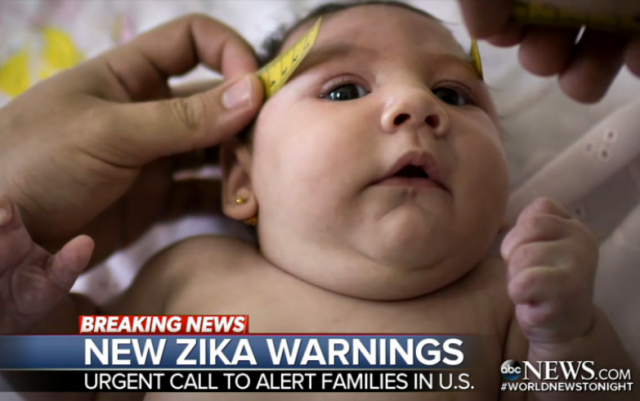
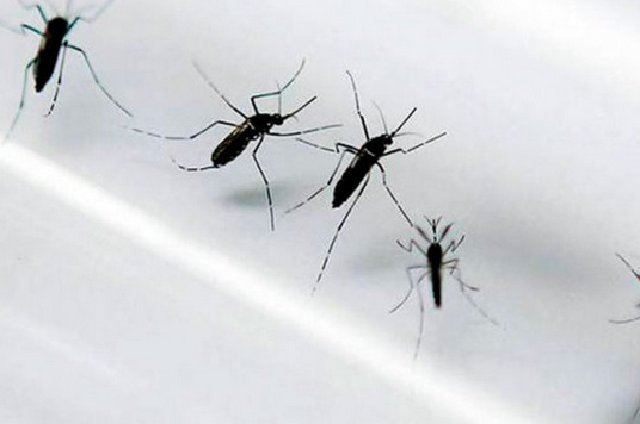
A new a new report from the U.S. Centers for Disease Control and Prevention confirms that the Zika virus can cause a rare birth defect called microcephaly, as well as other brain and neurological effcts.
Health officials across the globe have suspected for months a link between the virus and the birth defect, characterized by an abnormally small head and brain. Officials said today the evidence is overwhelming that exposure to virus in utero causes the birth defect. CDC Director Dr. Tom Frieden called the news a "turning point" in a fight against the virus that has continued to spread throughout the Americas.

I attended two fascinating lectures at a local biosafety conference this week. The first talk addressed "The Zika Virus Invasion" and the second revealed a potential new weapon to control the spread of the pathogen that has been linked to birth defects and neurological disorders. The Scripps Research Institute's Biosafety Officer, Dr. Laurence Cagnon, focused on entirely on the Zika Virus in her intriguing talk. The expert on virology and microbiology discussed the history of Zika research and reviewed recommendations for working with infected samples and mosquitoes safely. "We are still limited about what we actually know about Zika," said Cagnon. "The recommendations are to treat Zika as guilty until proven innocent". Cagnon noted that before the outbreak in Brazil was widely reported, along with the associated microcephaly birth defects, only 171 professional articles mentioned the Zika Virus. In comparison, thousands were available on other well-known mosquito-borne diseases (including several I have covered here, including dengue fever, chikungunya, and Ebola).

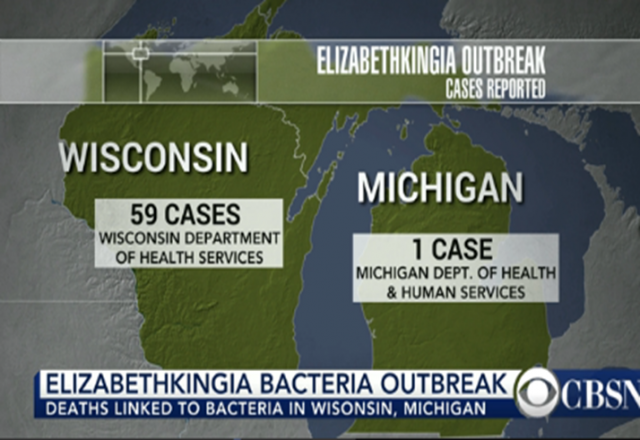
As the primary battle in Wisconsin heats up with the endorsement of Senator Ted Cruz by Governor Scott Walker, an different kind of fight is occurring among the state's citizens. As of this report, nearly 60 Wisconsin residents have been stricken with bloodstream infection from a bacteria called Elizabethkingia, and 18 have died. Additionally, one Michigan resident has also died from an infection.

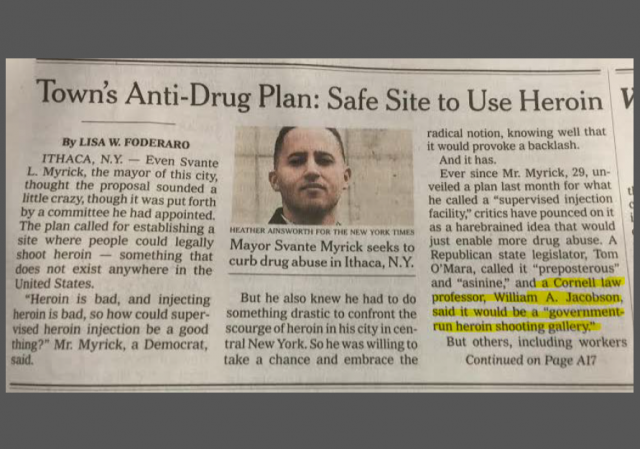
It doesn't sound quite as good as "on the cover of The Rolling Stone." A reader emailed me a photo of a NY Times front page story today in which I am quoted. Thing is, the Times article suggests I opposed the proposal:
Ever since Mr. Myrick, 29, unveiled a plan last month for what he called a “supervised injection facility,” critics have pounced on it as a harebrained idea that would just enable more drug abuse. A Republican state legislator, Tom O’Mara, called it “preposterous” and “asinine,” and a Cornell law professor, William A. Jacobson, said it would be a “government-run heroin shooting gallery.”
In fact, in my blog post from which the quote was taken, to which The Times links in the online version, I was ambivalent:

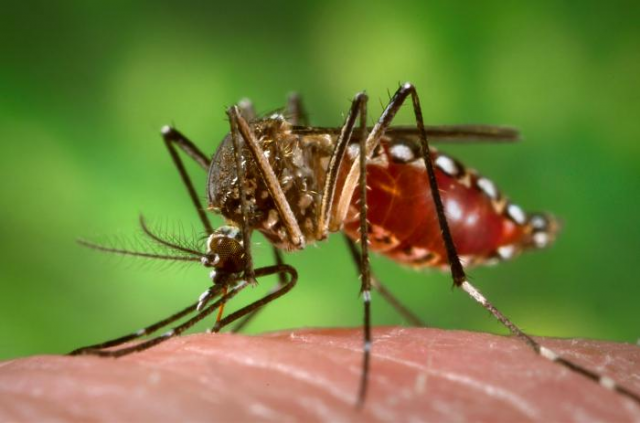
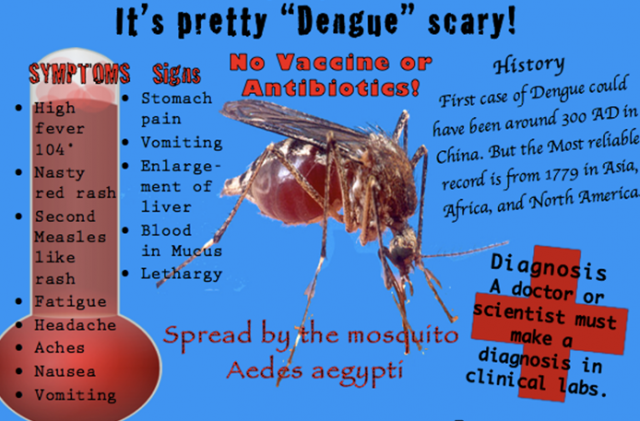
As of our last report on the Zika virus, the number of confirmed cases of infection among those living in the United States was steadily rising and several woman had pregnancies that were likely impacted by the mosquito-borne pathogen. While President Obama says "not to panic", the normally glacially responsive Food and Drug Administration took the initial steps to pave the way for the use of genetically modified mosquitoes in the fight to eradicate the virus. The agency has just published a draft of its environmental impact study of OX513A, a male Aedes aegypti mosquito genetically modified to pass on a lethal gene to his offspring.

In a move being called "ghoulish" by one critic, Britain's National Health Service (NHS) has announced plans to ask pregnant women to carry to term babies that have severe birth defects so that, once delivered or still born, their babies' organs can be harvested for transplant. The Daily Mail reports:

Women whose babies develop fatal defects in the early stages of pregnancy will be given advice on going ahead with the birth so the NHS can harvest their organs, The Mail on Sunday can reveal.

Most expectant mothers opt for termination after being told the devastating news their child has no chance of survival once born.

But now, amid a chronic shortage of donated organs, mums will be 'supported' to have the baby at nine months so that the child's vital organs can be taken for transplant.

. . . .  The move was revealed at a medical conference where NHS transplant surgeons said they wanted to take more organs from babies nationally to address a dire shortage.

The number of confirmed cases of Zika among those living in the United States is steadily rising.
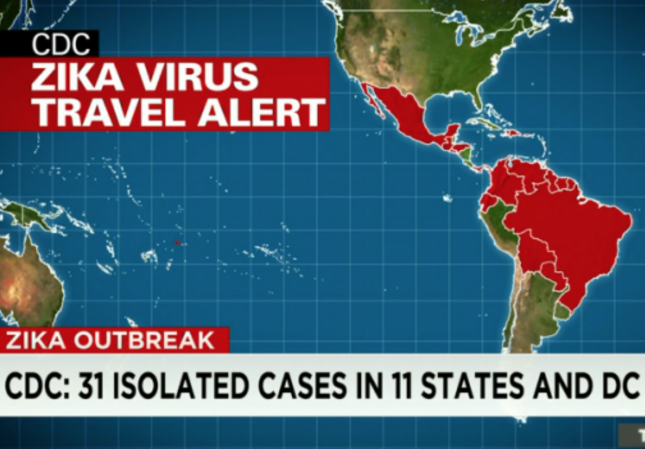
There have been 107 cases of Zika virus among U.S. travelers returning from Zika-infected areas, the U.S. Centers for Disease Control and Prevention said Friday. The CDC also reported 40 locally acquired cases of the virus in U.S. territories. Thirty-five are in Puerto Rico, four are in American Samoa, and one is in the U.S. Virgin Islands.
As I have noted, one of the most significant concerns associated with infection by the virus is a birth defect called microcephaly. This condition, associated with abnormal smallness of the head and incomplete brain development, occurs when a pregnant woman is either bitten by a mosquito or infected via other modes of blood-borne pathogen transmission.

Aloha to an American tropical disease crisis!
Hawai’i County Mayor Billy Kenoi declared a State of Emergency in Hawai’i County Monday morning as the Big Island continues to face the dengue fever outbreak. As of Friday, Feb. 5, a total of 250 individuals had been infected with the dengue virus since the beginning of the outbreak. Three of the individuals remained “potentially infectious” on Friday. Hawai’i Department of Health officials will update the numbers again Monday afternoon.
As with Zika, specific mosquito species are the carrier or the virus. Dengue fever is characterized by an array of symptoms, including high fever, severe headache, severe pain behind the eyes, and joint pain. A variety, known as dengue hemorrhagic fever, may be fatal. As with Zika, standing water associated with discarded tires is a contributor to this crisis. In this case, Hawaii County will prohibit the acceptance of tires at its landfills.

Obama now says that there is no reason to panic over a virus that has been linked to an outbreaks in birth defects in South America:
President Obama is asking people not to panic about the Zika virus. "The good news is this is not like Ebola, people don't die of Zika — a lot of people get it and don't even know that they have it," the president said in an interview with Gayle King that aired Monday on "CBS This Morning."
While I agree panic is unwarranted, concern is not...especially after Centers for Disease Control and Prevention announced that its emergency operations center has been put on a “Level 1” status. The President is also asking for $1.8 billion in funding for the resources to combat the disease.

It looks like Zika virus is truly the new Ebola. Concerns about the Zika virus have grown to the point that Utah Congressman Chris Stewart wants to divert funding from the fight against Ebola to use against this latest epidemic.
Stewart says his bill, which would unlock more than a billion dollars for the CDC and National Institute of Health, would ensure the agencies had the resources they need to research and combat the virus. “Congress has already allocated funding to fight many of the world’s infectious diseases, like Ebola, and I want to make sure this funding can also be used to combat the Zika virus,” Stewart said. The Zika Response and Safety Act would allow federal agencies to use funds allocated for Ebola research in the fight against the Zika virus, according to a press release from Stewart’s office. Stewart states that of the $2.4 billion allocated for Ebola research, about $1.4 billion was unused as of September of 2015.
Dallas County Health and Human Services has confirmed acase of Zika infection that occurred on American soil...through sexual transmission.

The World Health Organization officially declared a "public health emergency of international concern" over the wildfire spread of the Zika virus.
The agency said the emergency is warranted because of how fast the mosquito-borne virus is spreading and its suspected link to an alarming spike in babies born with abnormally small heads -- a condition called microcephaly -- in Brazil and French Polynesia. Reports of a serious neurological condition, called Guillame-Barre Syndrome, that can lead to paralysis, have also risen in areas where the virus has been reported. Health officials have specifically seen clusters of this in El Salvador, Brazil and French Polynesia, according to WHO's Dr. Bruce Aylward.
Brazilian officials are claiming the outbreak is even worse than reported, because most cases show no overt symptoms of "Zika". Therefore, testing potentially infected people (especially pregnant women) will be one element of controlling the public health crisis.

Just as President Obama declared victory in the combat against the Ebola virus, fears about another one are spreading. Zika virus, which is a mosquito-borne virus that can cause birth defects when women become infected during pregnancy, has hit South America hard and health professionals around the world are now responding to the new infectious disease crisis.
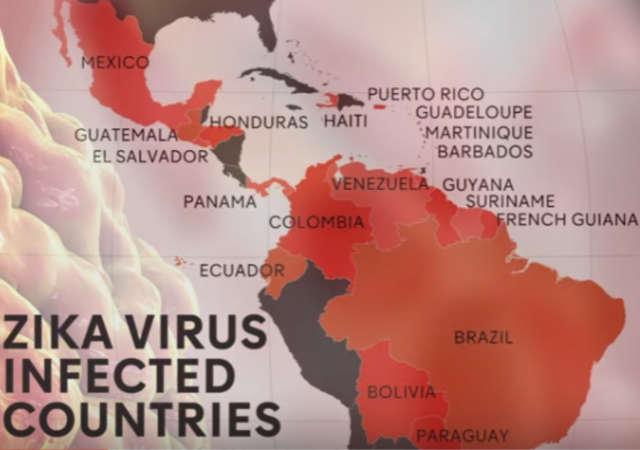
Officials in four Latin American and Caribbean nations have warned women to avoid pregnancy amid concerns over an illness causing severe birth defects. Colombia, Ecuador, El Salvador and Jamaica recommended to delay pregnancies until more was known about the mosquito-borne Zika virus. This followed an outbreak in Brazil. Brazil said the number of babies born with suspected microcephaly - or abnormally small heads - had reached nearly 4,000 since October.

Bernie Sanders' "Democrat socialist" policies sound good and have a lot of popular support among certain demographics, but when pressed on how he would pay for all the free stuff he's promising, he's a bit nonplussed.  Pesky details like that just don't interest him; it's all about the utopian ideal in his dreamy little head, not about reality. For example, although he pledged to release his plan for paying for his health care plan before the Iowa caucuses, he's now decided that might be a mistake and is considering breaking that particular pledge. CNN reports:

Bernie Sanders could break his pledge to release details on how he would pay for his health care plan before the Iowa caucuses, according to a top aide.

Professor David E. Bernstein has written a great last-minute Christmas present or belated Hanukkah gift. Lawless: The Obama Administration's Unprecedented Assault on the Constitution and the Rule of Law is sure to ruin the holiday for whoever reads it - Republicans because it confirms President Obama has run roughshod over Congress and the Constitution, and Democrats because it confirms what they have so long denied.  Which is why everybody should read it, digest it, debate it and institute changes to prevent future presidents of any party from doing such damage again. Bernstein teaches Constitutional Law, among other things, at George Mason University School of law, and his easy facility with technical, legalistic topics makes Lawless accessible and understandable without eliding over details. The picture Bernstein paints so adroitly is of an unprecedented and unlawful consolidation of power in the executive, and a president unrestrained by his own promises, by custom, by standards of legal ethics, by statute or by the Constitution.

Back in September, the New York Times reported that Turing Pharmaceuticals had increased the price of its HIV drug, Daraprim, from $13.70 per tablet to $750 per tablet.

Specialists in infectious disease are protesting a gigantic overnight increase in the price of a 62-year-old drug that is the standard of care for treating a life-threatening parasitic infection.

The drug, called Daraprim, was acquired in August by Turing Pharmaceuticals, a start-up run by a former hedge fund manager. Turing immediately raised the price to $750 a tablet from $13.50, bringing the annual cost of treatment for some patients to hundreds of thousands of dollars.

Watch Turing CEO Martin Shkreli explain his decision on Fox Business:

Substance abuse and addiction have always been an issue in America but these problems have never figured as largely in a Republican primary as they do now. According to a recent poll in New Hampshire, drug addiction was the number one concern of respondents, topping even jobs and the economy. Heather Haddon reports at the Wall Street Journal:
Drug Deaths Becoming a 2016 Presidential Election Issue New Hampshire poll participants put it above jobs and economy as something candidates should address Buddy Phaneuf, owner of New Hampshire’s largest funeral home network, has overseen burials and cremations in more than 50 heroin-related deaths this year. The average age of the decedent: 32. Christopher Stawasz, manager of an ambulance service in Nashua, said the city set a record of 28 overdoses in September, then topped it with 37 in October. “It’s surreal,” he said. “It’s just day after day.”