


Image 01 Image 03

Cornell Tag

We previously wrote about the deer sterilization program run by the Village of Cayuga Heights, NY, which borders the Cornell University campus and has large deer and faculty populations. After years of bitter debate, Cayuga Heights decided that the deer population would be controlled through sterilization at enormous expense: The Cayuga Heights deer control was mostly a failure because, you know, deer move around, so sterilizing deer in Cayuga Heights didn't prevent new deer from coming into the area.  And so on. As far as I know, no plans were made to control the faculty population. I was not aware that Cornell had its own sterilization program.  I was aware that deer are all over campus. The Cornell sterilization program combined on-campus sterilization with off-campus/regional hunting. What possibly could go wrong? As the Washington Post reports (via Ithaca Voice), just about everything, Trying to limit the number of deer, with surprising results:

A few weeks ago, we covered the story of Columbia studentEmma Sulkowicz, who alleged she was raped by another student. Rather than pursue the matter all the way through the legal system (she dropped her case), Sulkowicz took her case to the University tribunal. Her alleged rapist was not found guilty by the campus tribunal, so Sulkowicz decided to protest her trauma through performance art (and college credit) and carry a mattress around campus as long as her alleged rapist remained on campus.  Carrying the mantel of Sulkowicz's cause, what was supposed to be a national day of action and a million mattress march, was not widely protested.  The only two protests we could find are at Texas Tech and Cornell. At Texas Tech:

Some Texas Tech University students have demonstrated against what they say is a "rape culture" on campus by laying bed sheets spray-painted with "No means No" at three locations.

The women's actions Wednesday came a day after university officials sent an email to students and faculty that called activities at a recent off-campus fraternity party "reprehensible."

A picture of a banner at the Sept. 20 Phi Delta Theta fraternity gathering, briefly posted online, read, "No means yes," followed by a graphic sexual remark.

University spokesman Chris Cook said the school learned of the banner the day after the party and began investigating immediately. Last week the university established a task force to review Greek organizations.

The bed sheets displayed Wednesday were removed by police after about 30 minutes.

Cornell took the call to action more seriously and approximately one hundred students showed up to protest. According to Casey Breznick at The Cornell Review (he also writes for Legal Insurrection and College Insurrection), a National Day of Protest Against Rape Culture took an odd turn yesterday. The protest was co-sponsored by Students for Justice in Palestine, Black Students United, Crunch: The Kinky Club at Cornell, Cornell Organization for Labor Action, the Cornell Progressive, DASH: Direction Action to Stop Heterosexism,Women of Color Coalition, and Grrls Fight Back. The protest was meant to be the decisive blow to "rape culture" on Cornell's campus. To that end, students read poems aloud. Breznick reports:

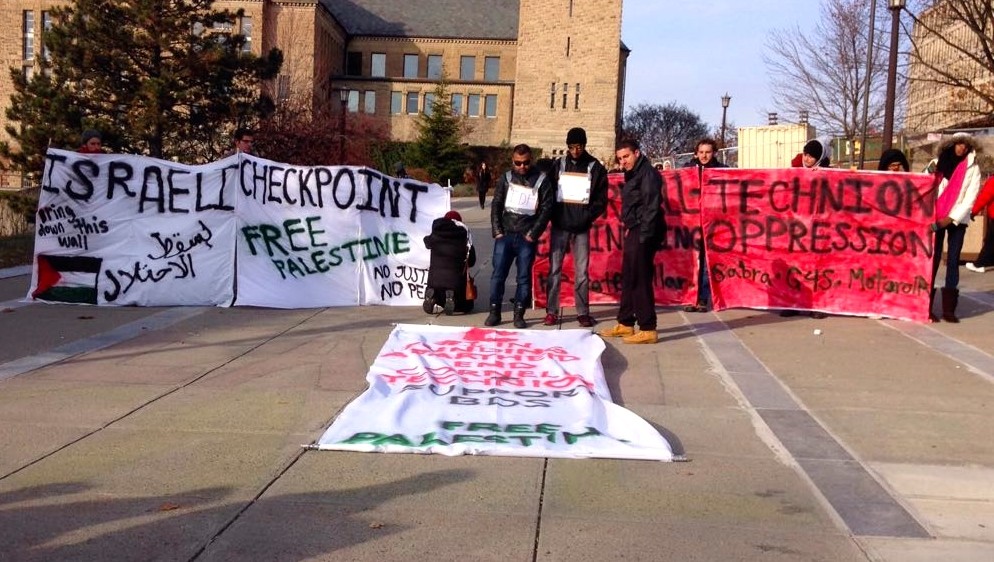
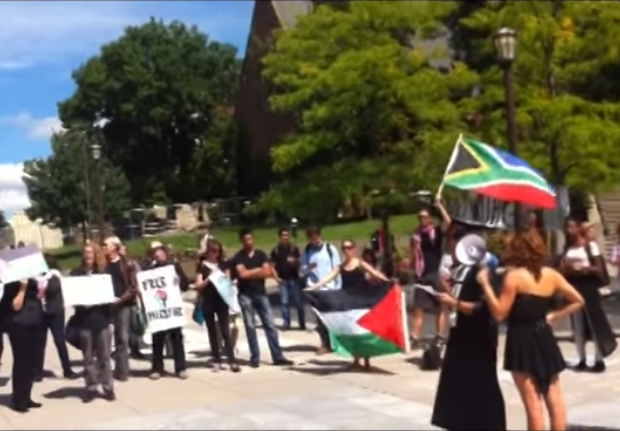
I have noted before the disturbing trend of anti-Israel Boycott Divestment and Sanctions (BDS) supporters blaming Israel and/or Zionism for the recent outbursts of anti-Semitism around the world. I first noted the issue in connection with a tweet from Professor Steven Salaita, where he tweeted that "By eagerly conflating Jewishness and Israel, Zionists are partly responsible when people say antisemitic shit in response to Israeli terror." [Salaita's tweets became a big issue, although that tweet has not receive a lot of attention.] In that post, I noted that Salaita was far from alone. There has been a trend to use the "Zionism causes anti-Semitism" verbiage as a way of deflecting the grossly anti-Semitic BDS-led protests seen around the world under the guise of protesting the Gaza conflict. Fast forward to last week at Cornell, when Students for Justice in Palestine held what was to be a mobilization rally on campus related to Gaza. Casey Breznick is Editor-in-Chief of the conservative Cornell Review undergraduate journal. Casey also writes for Legal Insurrection (posts here) and College Insurrection (posts here), sustaining our long history of providing conservative Cornell undergraduates with a platform.

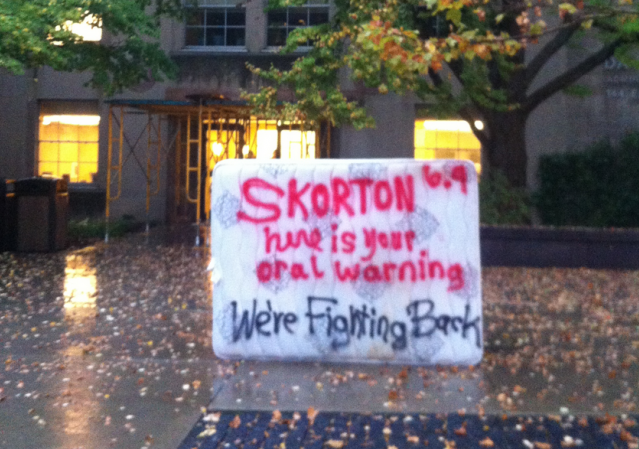
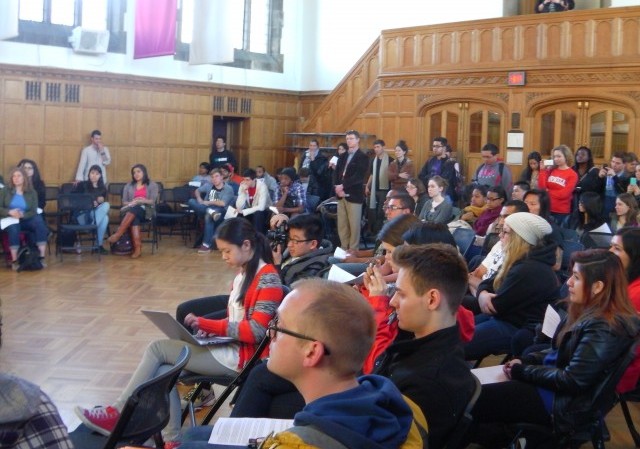
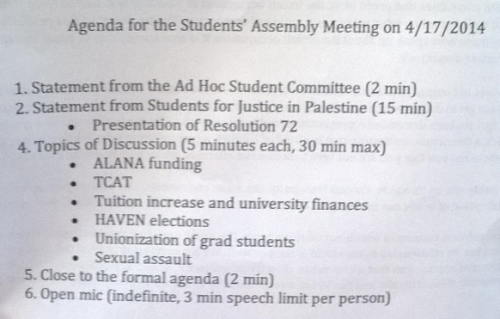
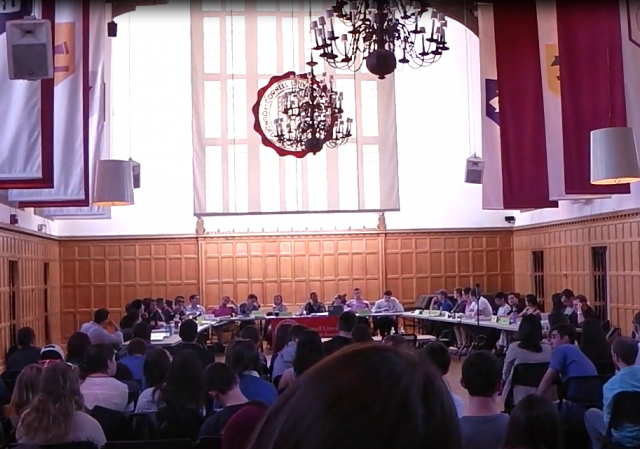
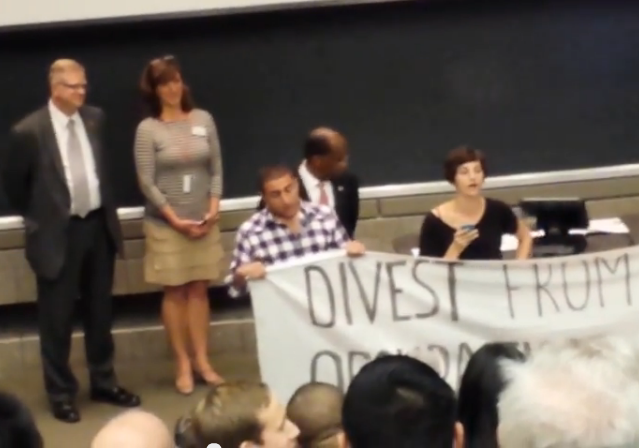
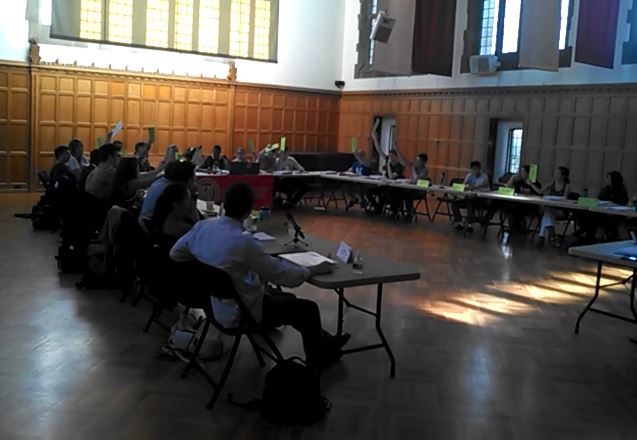
As mentioned last night, and as expected, there was a protest by student groups seeking divestment from companies doing business in Israel in reaction to last week's 15-8-1 decision of the Cornell Student Assembly to table indefinitely the proposed divestment resolution. About 75 protestors attended the Student Assembly meeting. I heard one of them refer to hundreds, but it was not that many, and many drifted out after a while. Here's a video of the pro-divestment students walking from their gathering area to Willard Straight Hall, where the Assembly meets. You can see there just weren't that many, certainly not hundreds. A disappointing turnout considering the priority the anti-Israel groups place on the protest. The Assembly then voted to suspend the rules and its session, in what appeared to be a preplanned maneuver, according to multiple people who were in the room at the start. I arrived later, because I had class. Effectively, the Assembly went out of session, and then let the anti-Israel students spend almost two hours giving speeches, in what the protesters termed an alternative assembly. There also were other unrelated topics, such as free bus passes, that consumed some of the protest discussion. Here's the Alternative Agenda: Cornell Alternative Assembly Agenda 4-17-2014 The only interesting part was that David Skorton, President of Cornell, previously was scheduled to appear before the Assembly, and kept that appointment. So the President was present during part of this alternative assembly, but not because of the protest. There were some minor theatrics as protestors vented a little, but nothing major. Skorton gave a short speech about improving the process, and left:

In a move reminiscent of the exploitation of the Yom Kippur Jewish holiday in 1973 to launch an attack on Israel, Cornell Students for Justice in Palestine has launched a last minute, sneak Divestment Resolution which is to come up for initial discussion on less than 48 hours notice this Thursday afternoon, April 10, at 4:30 p.m. The notice was just posted on the Cornell Assembly website, although I heard rumors earlier today it might be coming. Cornell Assembly Divestment Proposed April 8 The full Resolution linked on the Assembly website is embedded at the bottom of this post. Here's the operative part:
(22) Be it resolved, that Cornell University will further examine its assets for investments in companies that a) provide military support for, or weaponry to, the occupation of Palestinian territory or b) facilitate the building or maintenance of the illegal separation wall or the demolition of Palestinian homes, or c) facilitate the building, maintenance or economic development of illegal Israeli settlements on occupied Palestinian territory, (23) Be it further resolved, that Cornell University will make information about all of its assets public, pertaining especially to its investments, (24) And be it finally resolved, that Cornell University will end its complicity with the Israeli occupation of the Palestinian territories and divest its holdings from the aforementioned companies and any other companies that profit directly from Israeli military occupation in the West Bank and the Gaza Strip. Moreover, Cornell University will not make further investments in companies that materially support or profit from Israel’s occupation of Palestinian territory.
Passover starts Monday night, April 14, and many Jewish students at Cornell leave on Thursday to head home for the holidays. If the Resolution is not tabled on Thursday, the Resolution will come to a formal vote on the following Thursday, April 17, in the middle of Passover, just a day after Jewish students return to campus after Passover Seders. By so scheduling the Resolution, SJP and its supporters in the Student Assembly have sought to put Jewish students and campus groups at a disadvantage, literally forcing them to choose between celebrating the Jewish People's Exodus from slavery in Egypt or organizing to fight the Divestment Resolution.

It's hard being a principled member of the anti-Israel Boycott, Divest and Sanction movement. With Israel being a leader in computer, medical and other technologies, one would have to enter a time machine back to the 1950s to truly boycott Israeli products. The Cornell Students For Justice...

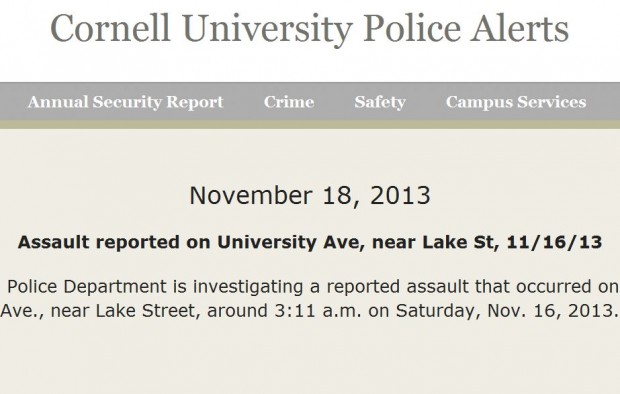
The so-called knockout game is receiving a lot of media attention. It's hard to know if it is escalating in frequency, or just getting more media coverage: An incident on November 16, 2013 at the edge of the Cornell University campus in Ithaca, NY, appears to fit this pattern of an unprovoked, seemingly random sucker punch to the face of a stranger without any apparent robbery or other motive (emphasis added):

November 18, 2013 Assault reported on University Ave, near Lake St, 11/16/13 The Ithaca Police Department is investigating a reported assault that occurred on

University Ave., near Lake Street, around 3:11 a.m. on Saturday, Nov. 16, 2013.

According to the male victim, he and a friend were walking on University Ave., near Lake Street, when they were approached by two males. The victim reports that the two males did not say anything, but one of the males punched the victim in the face with a closed fist causing pain and physical injury. The victim describes the perpetrators as a tall black male wearing dark clothing and a shorter Hispanic male also wearing dark clothing. The perpetrators then fled the area in a southerly direction on University Ave. The extent of the injury to the victim was not immediately apparent at the time of the incident and has been upgraded to an Assault.

The Cornell Review, the conservative newspaper on campus, has a long history of serving up great interns for Legal Insurrection. You may remember Kathleen McCaffrey who was the first Legal Insurrection writer (other than me) and to whom we bid farewell in May 2012 after 1.5 years and over 300 posts (and who recently got married, congratulations!); Michael Alan (who wrote from time to time, and also took the video of the Syracuse Honor Flight return), and of course, Laurel Conrad our current intern, and President of the Cornell Review. So it is with much pleasure that we note The Cornell Review has received the Buckley Award from the Collegiate Network, part of the Intercollegiate Studies Institute, which supports conservative students on campuses around the country. [caption id="attachment_71186" align="alignnone" width="350"](L-R: Collegiate Network program officer Lillian Gerken; Cornell Review President Laurel Conrad and Editor-in-Chief Michael Navarro; Intercollegiate Studies Institute Pres. Chris Long) (L-R: Collegiate Network program officer Lillian Gerken; Cornell Review President Laurel Conrad and Editor-in-Chief Michael Navarro; Intercollegiate Studies Institute Pres. Chris Long)[/caption] Here's the statement read at the award ceremony:

In addition to the real shutdowns at the WWII Memorial and elsewhere, we can expect to see all sorts of non-shutdowns blamed on the federal government partial shutdown. I noticed this along a path in the Collegetown section of Ithaca, a path along the Gorge next...