


Image 01 Image 03

SJP Tag

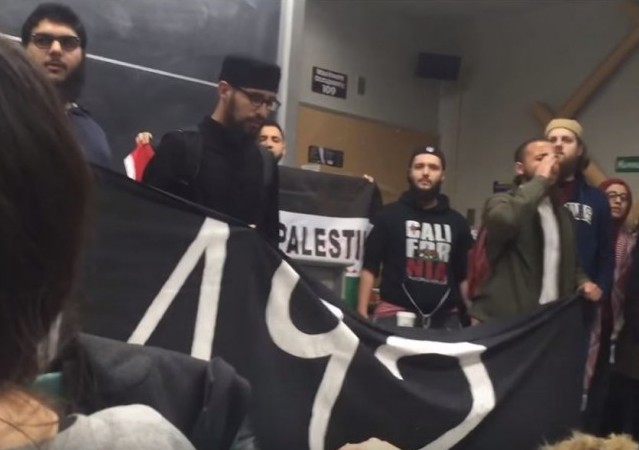
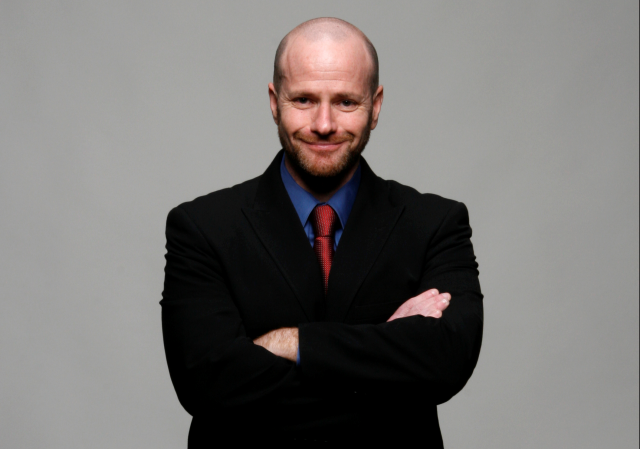
You may recall the disruption of an Israeli Studies event at UT-Austin on November 13, 2015, which we have covered extensively. (See list of posts at bottom.) The event was led by well-known and highly-regarded UT-Austin Professor Ami Pedahzur, who is Israeli, and the guest speaker was an Israeli professor teaching at Stanford University. The event was organized by the Israel Studies Department. As the event started, a group of students from the UT-Austin Palestine Solidarity Committee (PSC) disrupted the event, shouted, refused to sit and participate, and acted in a generally intimidating manner, including chanting "Long Live the Intifada." Such a chant about the bloody suicide bombing and current knife attacks, when directed at Israelis, reasonably could have been viewed as an attempt to intimidate, at best, or a threat, at worst.

Supporters of the anti-Israel Boycott, Divestment and Sanctions (BDS) movement had high hopes at passing a divestment motion at the U. Minnesota student government. Students for Justice in Palestine (SJP) put everything they had into it. https://twitter.com/SJP_UMN/status/707341046640816129 The student council at U. Minnesota, however, was having none of it, and passed a motion to strike both the divestment resolution and a counter-resolution to declare BDS anti-Semitic. This was similar to what happened at Cornell two years ago, when a motion to table was passed. This is the most devastating blow to the BDS because they don't get to put on their multi-hour dog and pony show making false accusations for the cameras and their supporters. They don't get to dominate everyone's time. U. Minnesota Hillel issued the following statement on Facebook:

In a vote tonight, the Vassar College Student Association (VSA) council passed by a vote of 15-7 an anti-Israel Resolution which adopts the full BDS movement list of demands and calls for divestment from certain companies. The BDS Resolution was a joint effort of Students for Justice in Palestine and Jewish Voice for Peace. A student representative of Jewish Voice for Peace stated opposition to the State of Israel, as tweeted by the student newspaper. I have confirmed with someone in the room that the statement actually was made, and that it was by a JVP student: https://twitter.com/miscellanynews/status/706643701142069248

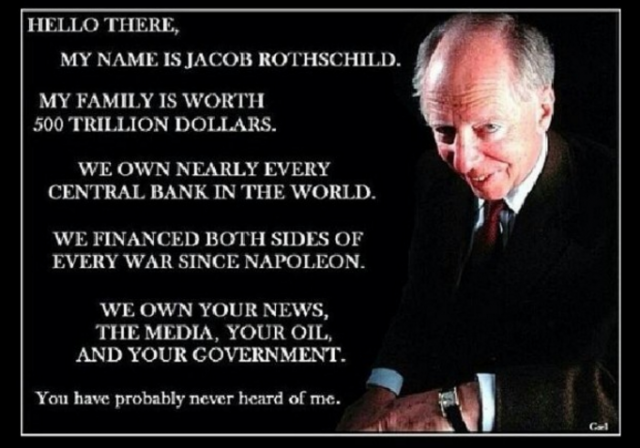
Joy Karega is the "social justice writing" assistant professor at Oberlin College who posted blatantly anti-Semitic conspiracy claims on her Facebook page. Those posts included claims that the Jewish Rothschild family controls the media and politicians, that Israel is behind ISIS/ISIL, and that the 9/11 and the Charlie Hebdo attacks were Mossad false-flag operations. https://www.facebook.com/jakare01/posts/644193039018145 Equally important, and something overlooked by the media except us, Karega is a big supporter of the Boycott, Divestment and Sanctions movement, and helped organize a BDS event at Oberlin just as few days ago at Oberlin at the request of the Oberlin Students for Justice in Palestine.

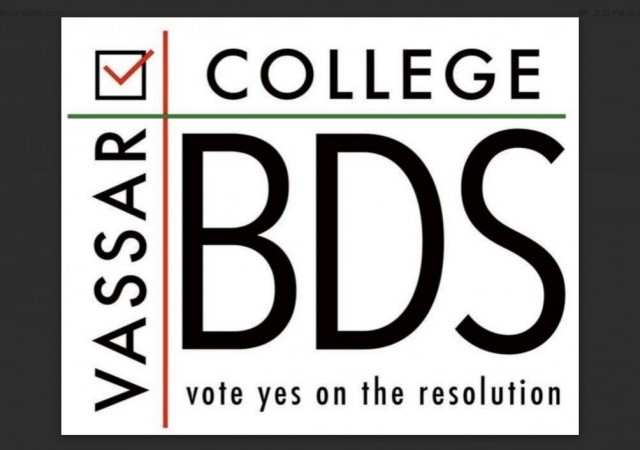
The Vassar College Student Association is in the midst of a highly contentious debate over whether to adopt an anti-Israel Boycott, Divestment and Sanctions (BDS) resolution and bylaws amendment proposed by Students for Justice in Palestine and Jewish Voice for Peace.  SJP takes the position that the BDS resolution includes an academic boycott, though there is no explicit language to that effect in the resolution. There also is a counter-resolution by Vassar J Street U which condemns Israel's occupation of the West Bank, but does not call for a boycott. The vote is Sunday night, March 6, 2016. The BDS vote will be anonymous, while the J Street U vote will be on the record. Scroll through our Vassar College Tag for numerous recent reports on the campus atmosphere and conflict created by the BDS resolution, as well as the history of BDS and anti-Semitism at Vassar. There was an important development today. In a mass email to all students, VSA's Executive Board indicated it had been informed by the administration that Student Activity Funds used to fund VSA may be taken out of the control of VSA should the BDS resolution be adopted. (Full email at bottom of post.)

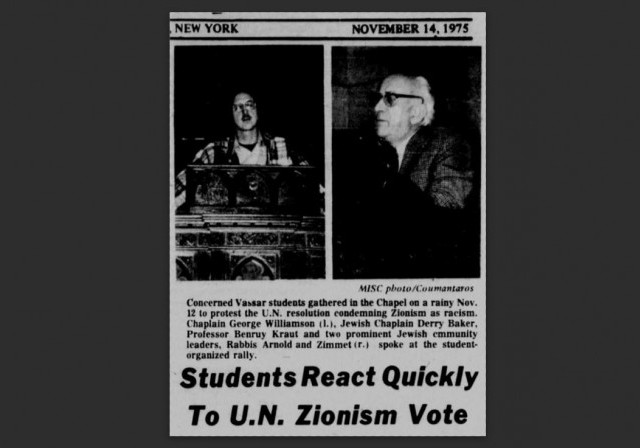
The Vassar College Student Association  council is voting anonymously on March 6, 2016, on an anti-Israel Boycott, Divestment and Sanctions resolution proposed by Vassar Students for Justice in Palestine (SJP) and Vassar Jewish Voice for Peace (JVP). For details, see Vassar anti-Israel activists attempt stealth academic boycott Resolution. For years the BDS campaign on campus has been punctuated by crude and misleading accusations against Israel, and an implicit and sometimes explicit argument that Zionism is inherently racist. Overt anti-Semitism rears its head from time to time. In researching Vassar's history, I came upon an interesting historical contrast with the current situation. In November 1975, the U.N. General Assembly passed the notorious (and now rescinded) "Zionism is Racism" Resolution. Then U.S. UN Ambassador Daniel Moynihan spoke eloquently in rebuttal of spoke of the “infamous” Zionism is Racism act.

One of the most controversial aspects of the anti-Israel Boycott, Divestment and Sanctions movement is the academic boycott. That academic boycott has been condemned and rejected by the Presidents of over 250 American universities and colleges, and major groups such as the American Council on Education (1700+ Higher Ed Institutions), Association of Public and Land-grant Universities (216 Universities and University Systems), Association of American Universities (62 Universities). The American Association of University Professors (approx. 48,000 members) not only rejects the academic boycott, it also calls it a violation of academic freedom. Almost all resolutions introduced at student governments by groups such as Students for Justice in Palestine (SJP) focus on divestment from companies allegedly aiding Israel's violation of Palestinian human rights. These are symbolic resolutions since student governments have no say on university finances; sometimes they pass, but more often they fail.

Last week The Tower magazine broke the story of a "social justice writing" professor at Oberlin, Joy Karega, who engaged in some bizarre anti-Semitic and anti-Israel commentary on Facebook. The short version is that Karega, at least based on what she posts on Facbeook, sees Zionist and Jewish conspiracies almost everywhere, including claiming Israel was behind 9/11, and that the Charlie Hebdo attack and downing of Malaysian Airlines Flight 17 were Mossad false flag operations. She also circulated and posted about the Rothschild family controlling the media and seeking global domination, so no mere anti-Zionist loon here. Karega Oberlin Netanyahu ISIS

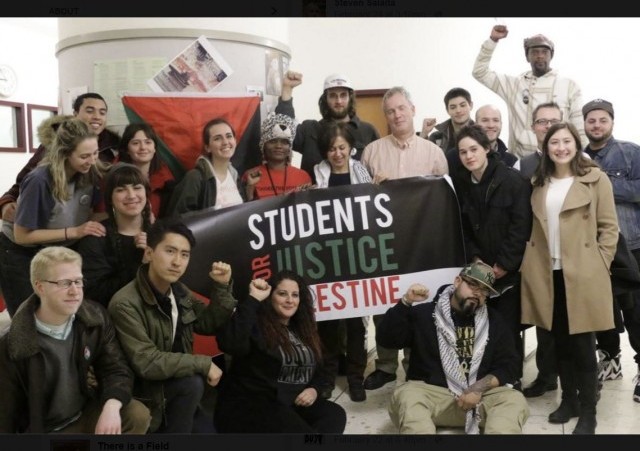
The anti-Israel Boycott, Divestment and Sanctions (BDS) movement always has used disruption and intimidation on campus as a tactic to initimidate Israeli and pro-Israel speakers and students on campus. Students for Justice in Palestine (SJP) is a leader in this regard, but hardly alone. There have been two developments in the past year or two. First, using the intellectual pretext of "intersectionality," anti-Israel coalitions are build based upon (i) explicitly racial criteria of opposing "white settler colonialism," and (ii) co-opting unrelated social justice causes, such as Black Lives Matter and even rape crisis groups. Second, as reflected in our reporting and a recent study, disruption has become the preferred tactic, as divestment and other such efforts prove futile even when passed by student governments. Just today, for example, a boycott resolution which had passed the McGill University student assembly was voted down in an all-campus vote, Anti-Israel Boycott Resolution goes down in flames at McGill University.

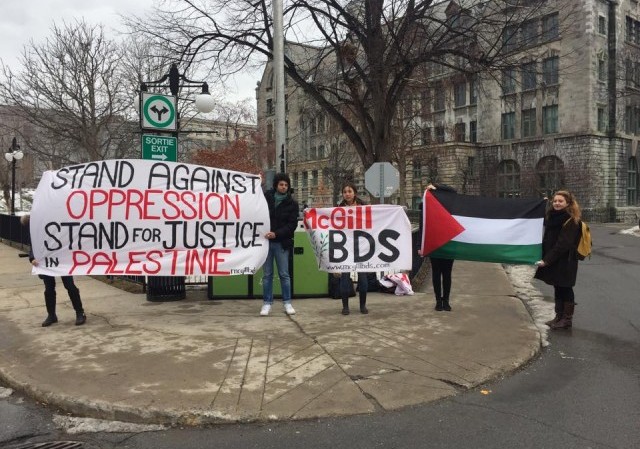
McGill University in Montreal was the latest effort by anti-Israel students to pass a Boycott, Divestment and Sanctions motion. Initially, at a student assembly packed by BDS supporters, the motion passed:
The Student Society of McGill University has voted to boycott Israel. The idea came up for a vote twice before in the last 18 months at McGill University, and was put forward again Monday night by the Boycott, Divestment and Sanctions (BDS) movement. This time, it succeeded. “What we basically did is write a motion and brought it to the general assembly at our student union today. The motion is on boycott, divestment and sanctions against Israel,” said Laura Khoury of the McGill BDS Action Network. Close to 900 undergraduate students filled nearly four overflow rooms for the hour-long debate. Students voted 512 to 357 in favour of adopting the motion. While it may have been a small portion of the student population of 30,000, they say vote sends a message.
https://www.facebook.com/mcgillbds/photos/pb.891815224265030.-2207520000.1456618956./891870604259492/?type=3&theater

As documented before, Vassar College in Poughkeepsie, NY, has faced a waive of anti-Israel, and in some cases anti-Semitic, activity on campus for the past two years centered around the Boycott, Divestment and Sanctions (BDS) movement. The latest spark is a combined effort by Vassar Students for Justice in Palestine and Vassar Jewish Voice for Peace, to pass an anti-Israel divestment resolution targeting companies, including Ben and Jerry's Ice Cream, that supposedly contribute to the oppression of Palestinians. The controversy has put a lot of pressure not just on the Vassar administration, but also the Vassar Student Association, which is considering the BDS resolution for a March 6 vote. The Miscellany News, the student newspaper, reports that the students on VSA just voted to take the BDS vote in secret:

On Monday night, February 15, 2016, the student government council at the University of Illinois - Chicago unanimously (14-0) passed a divestment resolution proposed by Students for Justice in Palestine and a coalition of other student groups. That passage is being promoted by anti-Israel activists, including Jewish Voice for Peace, as a major victory for the Boycott, Divestment and Sanctions (BDS) campus movement. But passage of the resolution isn't the real story. The real story is that the resolution that passed did not single out Israel, and applied to any and all alleged human rights abuses anywhere in the world, specifically also mentioning the United States, China, Britain and other countries. As such, the watered-down resolution amounted to a universal statement of principles, not a condemnation of Israel. The UIC Coalition for Peace, which included pro-Israel students, can claim this as a victory for fair treatment of Israel.

Vassar College has been rocked by a series of anti-Israel, anti-Semitic events. Apparently the President of Vassar, Catharine Hill, has received numerous alumni complaints and concerns, because she issued a statement to alumni seeking to allay their concerns. But in the process, the President sought to shift the responsibility by blaming "online publications" and "social media" for the controversy. I don't know if the President included Legal Insurrection in her criticism, but please scroll through our Vassar College Tag so you can see how thoroughly we have documented all our reporting. As background, anti-Israel activism has led to anti-Semitic incidents in 2014 and 2016. Among other things, in 2014 Jewish students who stood up at a campus-wide forumwere mocked and jeered by a raucous crowd of students and faculty, a class was picketed and a professor forced to cross a picket line of ululating students because the course involved a trip to Israel (and the West Bank), Students for Justice in Palestine posted a Nazi cartoon on social media, and pro-Israel displays were vandalized.

Concentrated, intense anti-Israel activity at Vassar College in early 2014 resulted in gross displays of anti-Jewish hostility, as I documented at the time, Anti-Israel academic boycott turns ugly at Vassar. Thirty-nine Vassar professors signed a letter in the student newspaper supporting the academic boycott of Israel, and aggressive protests by Students for Justice in Palestine created a pervasive climate of fear on campus. When I was invited by a student group to speak on campus, no academic department would co-sponsor my appearance despite the fact that several departments co-sponsored the appearance the week before of the anti-Israel activists Ali Abunimah and Max Blumenthal. The hostility following my appearance on campus was so intense that Vassar SJP circulated on social media a Nazi cartoon. Since then, there has been near continuous anti-Israel activism on campus, including an appearance by the leader of national Jewish Voice for Peace (JVP), and a dining hall boycott of Sabra Hummus (which later was reversed).

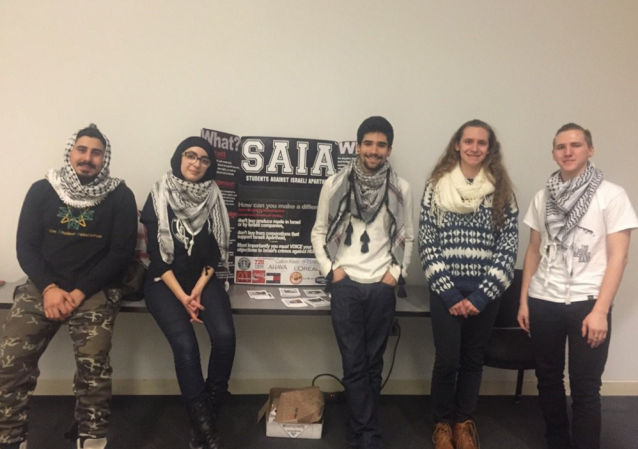
In January 2015, we reported on how anti-Israeli Boycott, Divestment and Sanctions (BDS) movement supporters hijacked a Dr. Martin Luther King, Jr. Day event on the San Mateo Bridge. Some Stanford students turned a Black Lives Matter march into an anti-Israel event by unfurling a huge Palestinian Flag on the bridge span at its highest point.  Hundreds of motorists were trapped, and they caused accidents. One of the key activists involved was Kristian Davis Bailey, a leader of attempt to demonize Israel by tying Zionism to problems of non-whites in the U.S. through the theory of "intersectionality." [caption id="attachment_113857" align="alignnone" width="600"]https://twitter.com/farah_salazar/status/558214869648814080 [January 2015, San Mateo Bridge, image via Farah Salazar Twitter][/caption]It is a highly racist approach, seeking to exploit racial tensions by portraying Israel -- and Israel alone -- as the cause of problems it has nothing to do with. As we saw recently in Chicago at an LGBT conference and Oberlin College, because "intersectionality" theory portrays Israel as uniquely evil in the world, the distinction between anti-Zionism and anti-Semitism quickly blurs. This year, we are aware of two attempts to co-opt the memory of Dr. King by putting on anti-Israel events as part of MLK Day activities. There likely were many more that we don't know about. At George Mason University, the MLK Day Program featured and event by Students Against Israeli Apartheid showing an anti-Israel film.

We have covered the antics of Students for Justice in Palestine, and similar anti-Israel groups, many times, including pervasive efforts to shut down opposing pro-Israel viewpoints. The latest example is at Brown University in Providence, Rhode Island, where SJP is objecting to and planning to protest the joint appearance of actor Michael Douglas and Nathan Sharansky. Douglas and Sharansky are appearing as part of a tour about 'Jewish Journeys,' as the Providence Journal reports, Michael Douglas, Natan Sharansky to discuss 'Jewish Journeys' at Brown:
Movie star Michael Douglas and onetime refusenik Natan Sharansky will discuss "Judaism, Israel and current-day anti-Semitism" at Brown University on Thursday.
The event is the kickoff of a three-university "Jewish Journeys" tour that will also take them to Stanford on Feb. 2 and the University of California Santa Barbara the next day. The 7:30 p.m. event at Brown's Salomon Center for Teaching is free, but registration is required.
Michael Douglas Natan Sharansky Jewish Journeys tour The topic of anti-Semitism and the delegitimization of Israel on campuses is a focus of the tour:

For several years we have been documenting the increasingly aggressive tactics of anti-Israel protesters on campus. Recently, an Israeli professor's guest lecture was disrupted at the University of Minnesota Law School, and the Palestine Solidarity Committee at UT-Austin (led by law student Mohammed Nabulsi) disrupted an Israeli Studies event: These tactics are nothing new. Students for Justice in Palestine branches at numerous universities have engaged in such tactics: 

Oberlin College is an institution in turmoil over the past several years, and anti-Israel activism is part of the problem. Now, over 200 alumni are claiming the anti-Israel activism has created a hostile environment for Jews, and the alumni are demanding the college take action to address the problem. The issue of when anti-Israelism crosses into anti-Semitism is a hot topic on campuses recently because of the very aggressive tactics of anti-Israel campus groups, and the intense demonization of Israel. "Intersectionality" analysis is used by anti-Israel activists to try to co-opt the Black Lives Matter movement and other similar movements:
Every real or perceived problem is either blamed on or connected to Israel. The concerted effort to turn the Black Lives Matter movement into an anti-Israel movement has at its core the claim that Israel is the root of problems of non-whites in the United States. Thus, if a police chief somewhere attended a one-week anti-terrorism seminar in Israel years ago, every act of brutality by a cop on the beat is blamed on Israel.
When City University of New York Students for Justice in Palestine, for example, tried to turn the Million Student March into an anti-Israel event and blamed high tuition on Zionists, the CUNY Vice Chancellor called it “thinly-veiled bigotry, prejudice, anti-Semitism.” At Vassar College, SJP circulated a Nazi cartoon after weeks of anti-Israel activism that included picketing a course which involved travel to Israel. Prof. Miriam Elman laid out the history and analysis in Fighting The Hate: When Does Anti-Israel Become Anti-Semitic? As described below, it appears Oberlin may need to go through a similar self-evaluation.