

Image 01 Image 03

NY Times Tag

Over the past few days the reporting from Geneva changed from anticipation of an imminent deal to a final "no deal." Or "no deal" for now. The New York Times reported Talks With Iran Fail to Produce a Nuclear Agreement. As almost all reporting on the P5+1 talks with Iran go it gives the credit to (or places the blame on) France for the failure of the two sides to reach an agreement.
The proposal under consideration in Geneva was to have been the first stage of a multipart agreement. It called for Iran to freeze its nuclear program for up to six months to allow negotiations on a long-term agreement without the worry that Iran was racing ahead to build a bomb. In exchange, the West was to have provided some easing of the international sanctions that have battered Iran’s economy. After years of off-again, on-again talks, the deal would have been the first to brake Iran’s nuclear program.Despite the diplomats’ insistence on progress, the failure to clinch an agreement raised questions about the future of the nuclear talks, given the fierce criticism that the mere prospect of a deal whipped up in Israel and among Republicans and some Democrats in Congress.
Unfortunately, this frames the scuttling of the talks in terms of those looking for a compromise versus pro-Israel ideologues. Subsequent reporting in the article is more specific about some, but not all, of the real issues involved.
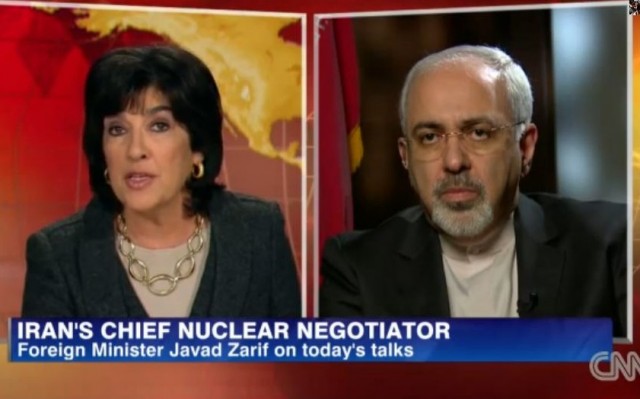
We have noted degree to which America's media, including Thomas Erdbrink, the Tehran bureau chief for the New York Times, tells us that the most vicious anti-American statements from Iran are really expressions of admiration. Check out a few of Erdbrink's recent tweets. https://twitter.com/ThomasErdbrink/status/397332815559151616 https://twitter.com/ThomasErdbrink/status/397332340931706880 Erdbrink calls Jalili a hardliner. But in a recent article he reported on Iran's Supreme Leader Ayatollah Khamenei as not being a hardliner:
With talks over Iran’s nuclear program set to resume in Geneva this week, both sides engaged in a bit of public diplomacy Sunday: Iran’s supreme leader moved to quiet hard-liners in his country by expressing support for his negotiating team, while the chief American negotiator reiterated in an Israeli television interview that “no deal is better than a bad deal.” The supreme leader, Ayatollah Ali Khamenei, who holds Iran’s final word on the nuclear talks, told a group of students here that he was not optimistic the negotiations would succeed, but he also sent a negative message to the conservative clerics and military commanders who in recent weeks have attacked the diplomatic initiative.

The Committee for Accuracy in Middle East Reporting in America (CAMERA) is a valuable resource on which we frequently rely for news tips and information regarding the Middle East.  I'm not sure how I ended up on CAMERA's email update list, and I'm not even sure...

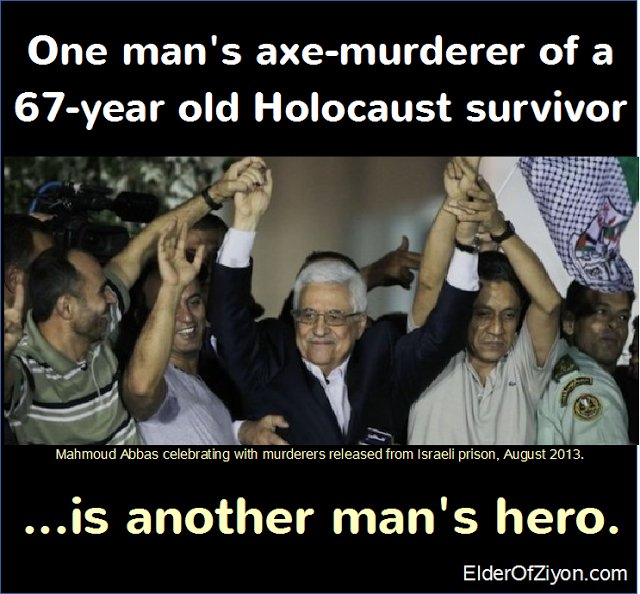
As we've noted earlier, much of the media is obsessed with settlements, intent on portraying them as the main obstacle to peace. There's a tendency on the other side to take one of the most outrageous examples of Palestinian behavior and dismiss it. As Professor Jacobson noted last week, Israel, in order to entice the Palestinians to negotiate for a state of their own offered to release 104 prisoners from jail. These aren't just prisoners. Most, if not all, are remorseless murderers who are treated as heroes by all segments of Palestinian society, including their leaders. Jonathan Tobin made an apt observation about this phenomenon:
One group of people was happy as murderers went free while others wept. But the gulf here is more than emotional or merely, as the Times seemed to describe it, a difficult process that is part of the price Israel must pay for the chance of peace. In fact, the “emotional gulf” is indicative of a vast cultural divide between these two peoples that explains more about the absence of peace than any lecture about history, borders, or refugees. Simply put, so long as the Palestinians honor murderers, there is no reason to believe they are willing to end the conflict.
Consider the way the New York Times in the article cited by Tobin portrayed the Israeli reaction to the prisoner release:
In Israel, where the returnees are widely viewed as terrorists, the release on Tuesday, like the one in August, has stirred protests and anguish. Many said it was too heavy a price to pay for entering negotiations with no guarantee of a peace accord.
"[W]idely viewed?!?!" This statement is incredible. It's not only in Israel that they are "viewed as terrorists," but by definition. Only in the crazy New York Times worldview is the definition of terrorists subjective.

On June 16, 2009, in the earliest days of discussion about what form Obamacare would take, I wrote, Deception and Tyranny Key To Health Care Reform:
The only way the Obama administration and Democrats can force through the types of changes they envision for the health care system is through deception and tyranny. Honesty and freedom have no place in a system of national health care.
And now the deception and tyranny is being exposed for all to see.  You cannot keep your insurance plan and doctor, and administratively Obamacare is not ready for prime time.  Worse still, the dysfunctional nature of restructuring 1/6th of the economy is having ripple effects throughout the health care industry, with patients put at risk and doctors drafting exit plans. Meanwhile, the Editors of The NY Times are trying to wordsmith away Obama's clearly knowing false statement that people could keep their insurance plans by saying Obama "misspoke." Obama and his aides knew at the time that it was not accurate -- they even kicked around whether to make the statement. At least some other outlets are not playing the game. From NY Mag, this fairly comprehensive account of how many time that promise was made (h/t Twitchy): Meanwhile, CBS News reveals this morning that despite Obama's and Kathleen Sebekius's repeated assurances earlier this year that healthcare.gov was ready to go, there were clear and present warnings otherwise, Memo reveals health care adviser warned W.H. was losing control 3 years ago:

To read through recent news reports one could assume that the biggest obstacle to Palestinian Israeli peace are "settlements." To cement that impression the New York Times published an article, 1,500 Units to Be Added in Settlement, Israel Says. The caption of a photograph directly beneath the headline reads:
A Palestinian construction worker at a building site on Wednesday in the Ramat Shlomo settlement in East Jerusalem.
If there is an official "East Jerusalem," I am unaware of it, but perhaps the paper meant "east Jerusalem." However if you read down a few paragraphs you learn:
The 1,500 new apartments are to be added to Ramat Shlomo, a largely religious neighborhood of 20,000 on the city’s northern edge. They were originally announced during a 2010 visit to Jerusalem by Vice President Joseph R. Biden, causing a diplomatic crisis that dampened Israel’s relationship with the White House and Europe for months.
So actually, Ramat Shlomo isn't in the city's east but in its north (or northeast) and it's not a settlement but a neighborhood. And while the announcement led to a major diplomatic blowup, it was of the administration's making. The Vice-President, Secretary of State and President could have remained silent. Everyone expects sections of Jerusalem, even those illegally occupied by Jordan from 1948 to 1967 to be part of Israel in any final agreement with the Palestinians. The announcement had occurred during an Israeli ban on settlement building outside of Jerusalem. That settlement ban brought about no serious negotiations. (The PA returned to the table only a few weeks before the end of the freeze and, when the freeze expired, walked away.) If settlement freezes were so important to the Palestinians, why didn't they negotiate then? So "settlements" provide a convenient excuse for a Palestinian refusal to negotiate or concede anything to Israel. But should they?

Last week as we noted, the New York Times ran a devastating article about President Obama's Syria policy. The Times reported, among other things, that the President was disinterested in planning discussions about Syria. Two other articles reported that America's Middle East allies generally and the Saudis specifically were upset by the administration's Middle East policy. I guess that the New York Times had enough serious reporting about the shortcomings of the Obama administration's Middle East policy, because over the weekend, it published Rice Offers a More Modest Strategy for Mideast by its foremost White House cheerleader, Mark Landler. (Landler contributed to the Syria report, but was not one of the bylined reporters.)
Each Saturday morning in July and August, Susan E. Rice, President Obama’s new national security adviser, gathered half a dozen aides in her corner office in the White House to plot America’s future in the Middle East. The policy review, a kind of midcourse correction, has set the United States on a new heading in the world’s most turbulent region. At the United Nations last month, Mr. Obama laid out the priorities he has adopted as a result of the review. The United States, he declared, would focus on negotiating a nuclear deal with Iran, brokering peace between the Israelis and the Palestinians and mitigating the strife in Syria. Everything else would take a back seat.
The article goes on to point out that even Egypt was no longer a priority. In a jab at President Obama's predecessor we learn:

Israel is being told it must test Iran's intentions. But the lesson of the Oslo Accords is that untrustworthy partners cannot be trusted without grave consequences....

I told you just a couple of days ago that the Gallup headline of a decline in Tea Party popularity was misleading. The misleading headline, ignoring the details of the poll, was picked up far and wide, Congrats @Gallup for inspiring these 5 misleading anti-Tea Party headlines. The Washington Post yesterday, however, revealed that the Tea Party popularity was rising, Obamacare fight reenergizes tea party movement (emphasis added):

WaPo Tea Party Support Rising

The tea party movement rose to prominence in the early years of Obama’s presidency, helping drive a surge of conservative activism that helped flip control of the House to Republicans in 2010. At the time, according to CBS-New York Times polling, nearly a third of Americans considered themselves tea party supporters. The movement’s popularity, though faded, shows signs of growing again: A quarter of Americans in a new CBS-New York Times survey between Sept. 19 and 23 said they support the tea party, up four points from two weeks earlier.
"Oddly" enough, it was really hard to find the poll to which WaPo was referring. The rise in Tea Party popularity in the CBS-New York Times survey didn't get the attention of the misleading Gallup headline.  I could not find any stories about that finding prior to the WaPo article. The rise in Tea Party support didn't get headlines at The Times, or at CBS News which ran this misleading headline about the Gallup poll instead, but nowhere in the article mentioned its own contrary findings:

CBS News Gallup Tea Party 9-26-2013

Eventually I found the poll, here it is. CBS-NYT poll cover The question about Tea Party support shows that Tea Party support rose rapidly this month, is higher than it has been for over a year, and is in the same range it has been in since early 2010, with the exception of the surge in support around the 2010 election:

NY Times Op-Ed placement inadvertently reflects Obama's foreign policy...

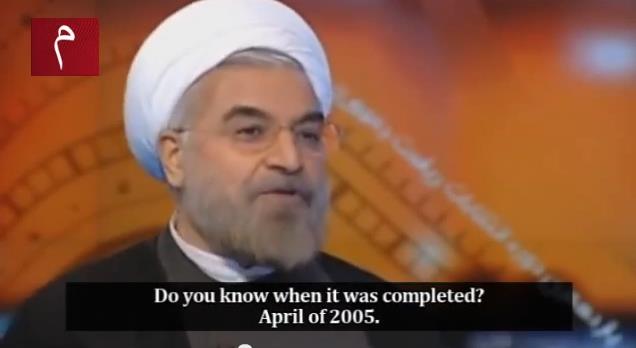
In recent weeks, the New York Times has been playing up the moderation of Iran's new government, especially that of its new president Hassan Rouhani. Yesterday's editorial, President Rouhani Comes to Town ahead of Rouhani's speech before the U.N. later this week, is one more element of that campaign.
All eyes at this week’s United Nations General Assembly will be on Iran’s new president, Hassan Rouhani. Since taking office in August, he has sent encouraging signals about his willingness to engage more constructively with the West than his predecessor, Mahmoud Ahmadinejad, who insisted on proceeding with Iran’s nuclear program, denied the Holocaust and seemed unconcerned as his country slipped into deeper economic distress. Mr. Rouhani’s assembly address on Tuesday gives him a chance to provide concrete evidence that his talk of change is real.
https://twitter.com/michaeldweiss/status/381099542533271553 Perhaps the most important article to appear last week in the media was Iranians Dial Up Presence in Syria in the Wall Street Journal (Google search terms)
The busloads of Shiite militiamen from Iraq, Syria and other Arab states have been arriving at the Iranian base in recent weeks, under cover of darkness, for instruction in urban warfare and the teachings of Iran's clerics, according to Iranian military figures and residents in the area. The fighters' mission: Fortify the Syrian regime of President Bashar al-Assad against Sunni rebels, the U.S. and Israel. ... The fighters "are told that the war in Syria is akin to [an] epic battle for Shiite Islam, and if they die they will be martyrs of the highest rank," says an Iranian military officer briefed on the training camp, which is 15 miles outside Tehran and called Amir Al-Momenin, or Commander of the Faithful. The training of thousands of fighters is an outgrowth of Iran's decision last year to immerse itself in the Syrian civil war on behalf of its struggling ally, the Assad regime, in an effort to shift the balance of power in the Middle East. Syria's bloodshed is shaping into more than a civil war: It is now a proxy war among regional powers jockeying for influence in the wake of the Arab Spring revolutions.
https://twitter.com/UANI/status/380085805097971714

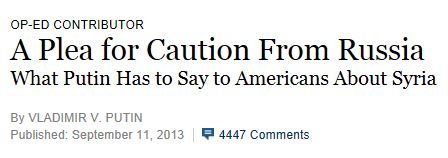
Within the past two weeks, two of the most prestigious American newspapers published op-eds of enemies of the United States. Earlier this month, the New York Times published an op-ed by Vladimir Putin of Russia arguing that the United States would make matters worse by attacking Syria and (among other things) denying that it was the Syrian government that used chemical weapons. Putin's op-ed also offered Russia's support for a negotiated agreement to end the Syrian civil war. Later we learned that the op-ed was placed with the assistance of an American PR firm.

Putin Op Ed NY Times headline

The public editor of the New York Times later defended the placement of the op-ed. In the course of her defense, she quoted editorial page editor, Andrew Rosenthal:
“There is no ideological litmus test” for an Op-Ed article, he said. In addition, he said, it is not the purpose of the Op-Ed pages to help or hurt the American government. It is to present a variety of interesting and newsworthy points of view, at least some of which will be contrary to The Times’s own point of view, expressed in its editorials. The Times has published very few Op-Ed pieces by heads of state, Mr. Rosenthal said, partly because they have their own ways of getting their messages out. ... I asked him about Mr. Putin’s statement that there is “every reason to believe” that the poison gas has been used by opposition forces, not the Syrian government – which many now do not believe to be true. Mr. Rosenthal said that “falls into the category of opinion.”
The "ideological litmus test" argument is misdirection.  The Times has not hesitated to refuse Op-Eds from political figures seeking to set the record straight, including John McCain and Scott Walker.

NY Times McCain Op Ed Refusal

The goal of Putin's op-ed was to solidify American public opinion against an attack on Syria. Assuming that that was President Obama's intent, Putin's main goal was to undermine the public position of the American president. (Admittedly, even without the op-ed, the American public was against such a strike. Furthermore, once President Obama chose to ask Congress for the authorization of force, it pretty much eliminated any chance that he would use attack Syria.) Rosenthal's odd assertion that a false statement could be excused as an "opinion," is beyond ridiculous. (More on this later.) A subsequent new article, As Obama Pauses Action, Putin Takes Center Stage, highlighted Putin's role in protecting Syria at America's expense.
In an Op-Ed article in The New York Times released on Wednesday, Mr. Putin laid down a strong challenge to Mr. Obama’s vision of how to address the turmoil, arguing that a military strike risked “spreading the conflict far beyond Syria’s borders” and would violate international law, undermining postwar stability. “It is alarming that military intervention in internal conflicts in foreign countries has become commonplace for the United States,” Mr. Putin wrote. “Is it in America’s long-term interest? I doubt it.” ... Now he appears to be relishing a role as a statesman. His spokesman, Dmitri S. Peskov, said in an interview that the Russian president was not seeking “ownership of the initiative,” but wanted only to promote a political solution to head off a wider military conflict in the Middle East.
By mentioning the op-ed in the course of a news article, the Times gave the op-ed an extra boost of credibility. Now it wasn't just an opinion, but a news item promoted by the New York Times. True, the report later acknowledged that Putin's claim about chemical weapons was dubious. But by writing an article about how President Putin was becoming a statesman (at America's expense) and citing the op-ed they had just published as proof of that, they elevated an opinion article into news.