


Image 01 Image 03

BDS Tag

Last week I drove out to Rochester, NY to give a talk titled ‘Fighting the Hate: When Does Anti-Israel Become Anti-Semitic?’. Sponsored by ROC4Israel, a new pro-Israel organization that we featured in a post back in October, my lecture centered on how legitimate criticism of Israel can be distinguished from criticism that crosses the line into anti-Semitic hate speech. A video of my 60 minute lecture, which also captures its accompanying PowerPoint slide show, is now available on YouTube (full embed lower in post). Below I highlight the main themes. I break the hour-long lecture into segments so that readers can click on to those parts of the talk that are of most interest.

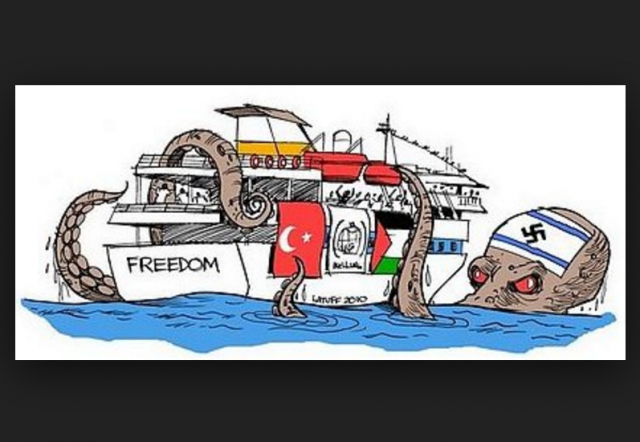
The trend for the BDS movement is to make demonization of Israel the center of the progressive universe through the theory of "intersectionality." Israel is placed at the center of all evil in the world, the unifying focus regardless of the issue:
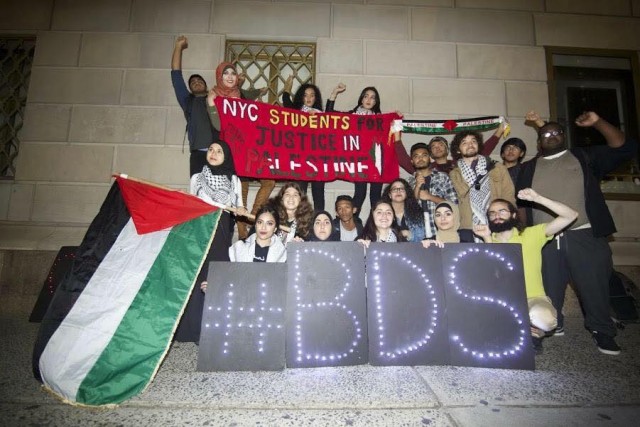
Every real or perceived problem is either blamed on or connected to Israel. The concerted effort to turn the Black Lives Matter movement into an anti-Israel movement has at its core the claim that Israel is the root of problems of non-whites in the United States. Thus, if a police chief somewhere attended a one-week anti-terrorism seminar in Israel years ago, every act of brutality by a cop on the beat is blamed on Israel. So too, Students for Justice in Palestine protesters in New York City even blamed high tuition on Zionists, leading to rebukes by administrators against such thinly-veiled anti-Semitism. The Jew once again is made the source of all evil, the conspiratorial puppet-master controlling all and responsible for all. And Israel alone receives such treatment and is used as the link to connect all injustices in the world.
This anti-Semitic use of "intersectionality" theory flourishes because a generation of students -- many of whom now are faculty -- have been schooled based on lies about the creation of Israel and the Arab refugees created in the civil war and invasion by Arab armies. In that false narrative, the Jews are wholly evil and the Arabs are wholly innocent.

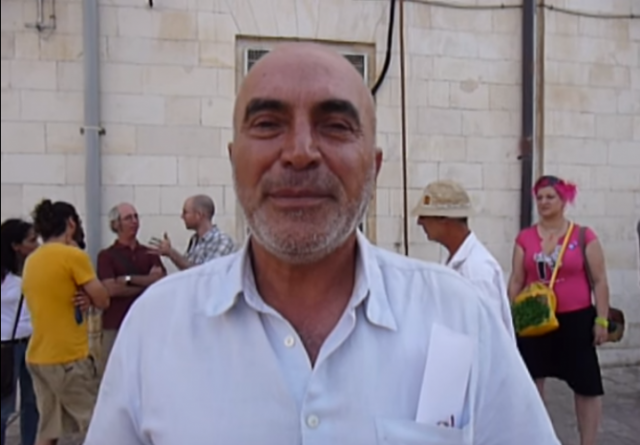
This story is almost too unbelievable to be true, but it is true. Ezra Nawi is not just another Israeli leftist activist. He was one of the most prominent Israeli activists engaged in direct action to interfere with Israeli military activities in Judea and Samaria (the "West Bank"). Nawi's actions brought him accolades abroad. He was featured in a favorable NY Times article in 2009:
For his activist colleagues, Mr. Nawi’s instinctual connection to the Palestinians is valuable. Ezra Nawi was in his element. Behind the wheel of his well-worn jeep one recent Saturday morning, working two cellphones in Arabic as he bounded through the terraced hills and hardscrabble villages near Hebron, he was greeted warmly by Palestinians near and far.

I really had expected the worst regarding the anti-Israel resolution being voted on at the Business Meeting taking place at the American Historical Association's Annual Meeting in Atlanta. For full background and details, see our prior post, American Historical Association to Consider Anti-Israel Resolution. The Times of Israel also had an extensive write-up today, in which I was extensively quoted. If the Resolution had passed the Business Meeting, it likely would have gone to a full membership vote. I thought the Resolution had a chance because, as I was quoted in The Times of Israel:
“The way these business meetings go is most people don’t show up,” Jacobson said. “Most don’t even go to the annual meeting, and most who do go to the annual meeting don’t go to the business meeting. It comes on the last day, late in the afternoon, when a lot of people have already left town. So if you have an organized group of a couple of hundred people, they may be able to get this through the business meeting because they are the ones most motivated to show up.”
The vote just took place, and the Resolution was soundly defeated, 51 for, 111 against.

Spain has a particularly virulent anti-Israel movement both in the form of Boycott, Divestment and Sanctions, and rogue judges who threaten to issue warrants for the arrest of Israeli officials. As to BDS, recall it was the Valencia BDS group that got American Jewish singer Matisyahu banned from a reggae festival after he refused to sign a declaration denouncing Israel. The decision was reversed after an outcry and statements by the Spanish government that the action was illegal discrimination. The Spanish court system just dealt another blow to BDS efforts, finding that excluding Ariel University, located beyond the 1949 armistice line in Samaria (West Bank), from academic programs in Spain constituted illegal discrimination. The Jerusalem Post reports, In setback for BDS, Spain awards West Bank school €70,000:

We wrote previously about the scheduled anti-Israel resolutions at the seasonal faculty association meetings in 2015-2016. We are now in the midst of this season, with the American Historical Association (AHA) annual meeting in Atlanta this week. Once again, we see an attempt to politicize a reputable scholarly organization by a small group of radicals with an anti-Israel agenda. On the table at the AHA Business Meeting on Saturday, January 9, 2016, is a resolution condemning Israel's alleged mistreatment of Palestinians in education. Under the AHA Constitution, if the resolution passes the Business Meeting, it goes to the AHA Council for approval, non-concurrence or veto. If the Council votes not to concur, it goes to a full membership vote.[*] Unlike resolutions at the American Studies Association in 2013 (which passed) and currently at the American Anthropological Association (pending a membership vote), the AHA resolution does not explicitly call on the AHA to adopt the academic boycott of Israel pushed by the Boycott, Divestment and Sanctions (BDS) movement. Rather, the AHA resolution is similar to the resolution which previously failed to pass a membership vote at the Moddern Language Association in 2014, denouncing Israel for allegedly violating the academic freedom of Palestinians. But the AHA resolution is just as much a part of the BDS agenda, and would set the stage in later years for a full BDS resolution at AHA. Where BDS supporters think they can pass a full academic boycott they do; where they think they can't, they try interim steps. I analyze the AHA resolution below.

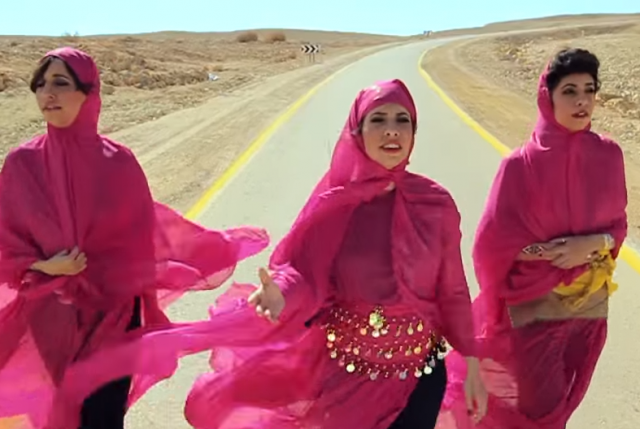
A somewhat unlikely story, via The Washington Post, These singing sisters are wildly popular in Yemen. And they’re Israeli Jews:
With their ebony hair and Yemeni accented Arabic, singing sisters Tair, Liron and Tagel Haim would probably not seem out of place on the streets of Yemen’s capital, Sanaa. But the sisters, collectively known as A-Wa, or “yes” in Arabic slang, are actually descendants of Yemeni Jews who immigrated to Israel decades ago. Today, they live in Tel Aviv. While siblings singing sweet harmonies together might not be big news, these Jewish sisters — who mix near extinct Yemenite poetry with fast-paced hip-hop and electronic beats — just might be.

A recent article from Adrienne Yaron has an important kernel of truth surrounded by a myriad of analytical errors and false conclusions.  The central point that BDS is a cover for defamation of Israel and development of a critical mass of anti-Israel and anti-Jewish hatred on false pretenses is sound.  The suggestions that BDS is incapable of having an economic impact and that BDS should therefore be mocked rather than substantively opposed is not. Yaron's core and accurate observation is that BDS's economic arguments are a vehicle for simple malice:
The real goal and purpose of BDS is to defame Israel, and attempt to discredit it in the eyes of foreign observers, in order to exert political pressure. BDS demonstrations are an opportunity for them to spew antisemitic vitriol and express their vicious hatred of the Jewish state. BDS’ [sic] only real power is in propagating its hateful ideology.
This is absolutely true, with ample evidence from BDS supporters' anti-Jewish and anti-Israel deceptions and violence, and the overlap between BDS and actual or implicit support for terrorism.

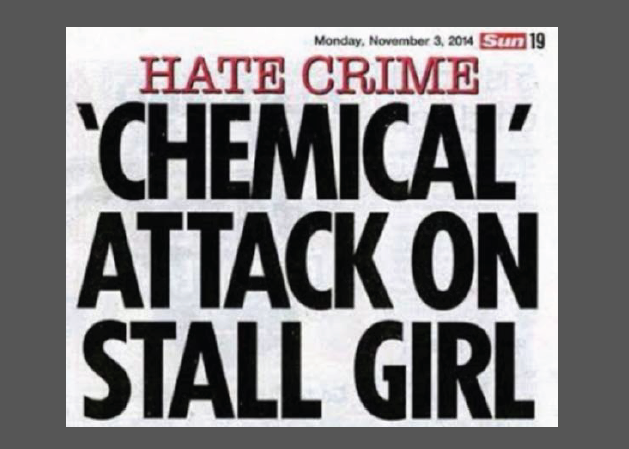
According to media reports last week (see, for example, here and here) Scott Harrison, a Scottish anti-Israel activist, was sentenced last week to a year in jail. Back on October 25, 2014 he threw acid in the face of an 18-year-old woman manning a stall in Glasgow shopping center. The stall was owned by the Israeli cosmetics company Kedem. The victim, Greek-born Iona Georgianna, said she felt like her face was “melting” during the horrible attack. Luckily, a quick-thinking co-worker had the good sense to throw water on her head, sparing Georgianna from the worst of the acid’s effects. A Scottish court handed down the 12-month sentence for assault to injury. Harrison will be held in custody pending the results of an appeal filed by his lawyers.

Proponents of the Boycott, Divest & Sanction (“BDS”) campaign are faced with growing legislative opposition.  In the US, New York is poised to become the third state to enact binding anti-BDS legislation.  In Britain, new rules will essentially prohibit BDS in local government altogether. Proposed New York Law The New York Senate and General Assembly are considering legislation that would prevent the state from contracting with or investing in companies that boycott Israel.  The stated purpose of Senate Bill S6086 is “To prohibit New York State from contracting with or investing taxpayer money in corporations who have a stated policy of boycotting Israel.”  The Senate’s justification is:
The Boycott, Divest, Sanctions movement (BDS) is a harmful discriminatory policy effectuated by a growing number of companies. The BDS movement is nothing more than thinly veiled anti-semitism. This bill would ensure that New York continues its long history of standing up to discrimination by condemning this movement and not doing business with these companies.

I was interviewed recently by Legal Insurrection reader Dr. Kenneth Friedman, for the Baltimore Jewish family magazine, Where What When:
The WHERE WHAT WHEN is a monthly family magazine of Jewish information, inspiration, and opinion. Established in 1985, it is Baltimore's liveliest Jewish magazine, approximate readership is 40,000. The Where What When is directed to the wide spectrum of Baltimore's Jewish population and has become a powerful voice in the community.
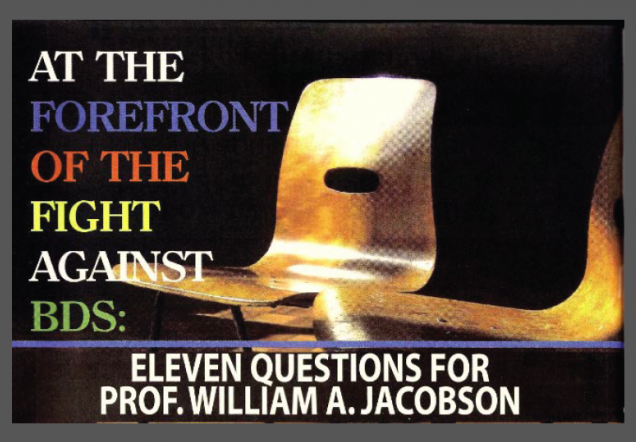
The topic was the Boycott, Divestment and Sanctions movement. Here is the full interview, At the Forefront of the Fight against BDS: Eleven Questions for Prof. William A. Jacobson: KF: Talk a little bit about how you got involved as an activist and particularly as it pertains to the fight against BDS.

We have carried many stories over the years about anti-Israel activists in Europe and the U.S. using the heckler's veto to shut down speeches and events. A recent example was at the University of Texas at Austin, when members of the Palestine Solidarity Committee disrupted an Israel Studies event, then claimed their own speech was suppressed because their protest was not allowed to continue. The UT-Austin students disrupting the event were campus leaders of the Boycott, Divestment and Sanctions (BDS) movement. Now another example from the University of Haifa, Israel, in which radical Arab students disrupted a speech by a visiting Egyptian scholar who is affiliated with Yale University.

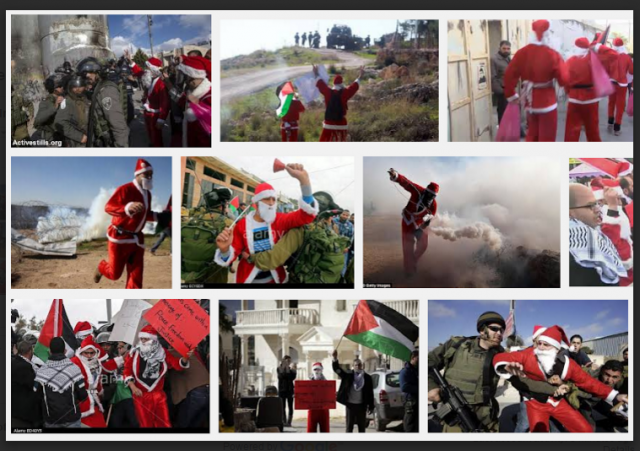
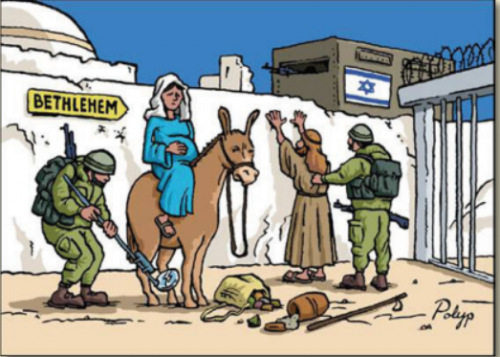
Drawing on the stories of the annunciation of the birth of Jesus, Christmas is viewed as a time of peace and goodwill to all. But for anti-Israel activists and organizations, the holiday season is a perfect occasion to conduct political warfare against the Jewish state.

NGOs, The PA, and The Hijacking

For years vehemently anti-Israel NGOs (non-governmental organizations), charities, and even church groups have been exploiting Christmas symbols, themes, and traditions in order to promote one-sided narratives of the Israeli-Palestinian conflict. Exploiting Christmas for anti-Israel These recast religiously-themed narratives situate Israel and Jews as the villains and omit any mention of terrorism, or Israel’s need to protect its citizens from harm. Palestinian Christians in these narratives are depicted as undeservedly maltreated by Israel. Special attention is given to how Palestinians are allegedly hurt by the security barrier surrounding Bethlehem and its adjacent communities.

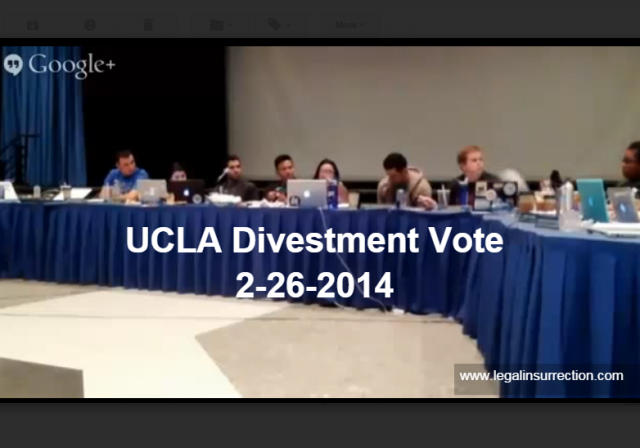
On Tuesday night, February 25, 2014, I stayed up late watching the live stream of the UCLA student council debate over an anti-Israel divestment resolution. It was one of many such resolutions on campuses at a time when groups like Students for Justice in Palestine were in an aggressive posture, particularly at UCLA. A guest author familiar with the UCLA campus scene wrote about the tactics being used against pro-Israel students, UCLA testing ground for next generation of anti-Israel campus tactics. At some point early in the morning the next day, I called it quits. Given the 3-hour time difference, it appeared the event would go on well into the early morning hours. I went to bed figuring I'd find out the result in the morning. Sometime around 9 a.m. on February 26, 2014, I logged onto the computer, went to the live stream, and it was still going on, and the vote was about to take place. I watched the divestment resolution go down to defeat:

The Boycott, Divest & Sanction ("BDS") movement and the broader campaign to delegitimize Israel has had a tough few weeks.  In academia and industry, the boycott campaign has been exposed as potentially discriminatory and unlawful, and yet another panel of experts has affirmed that Israel's use of force against Hamas is not only legitimate, but exemplary. Law Professors Eugene Kontorovich and Steven Davidoff Solomon of the Northwestern University and University of California - Berkeley, respectively, make the case that boycotts by academic associations are unlawful.  As one might expect, academic associations each have a stated purpose, typically to collect, share, expand and advance knowledge in the relevant field.  Profs. Kontorovich and Davidoff explain that such associations cannot legally do anything other than pursue those stated purposes, and:
Boycott resolutions that are beyond the powers of an organization are void, and individual members can sue to have a court declare them invalid. The individuals serving on the boards of these organizations may be liable for damages. Consider the American Historical Association. Its constitution—a corporate charter—states that its purpose “shall be the promotion of historical studies” and the “broadening of historical knowledge among the general public.” There’s nothing in this charter that would authorize a boycott. And an anti-Israel boycott will do nothing to promote “historical studies” or broaden “historical knowledge.” A boycott by definition restricts study and research: The explanatory material attached to the [American Anthropological Association ("AAA")] resolution, for example, says it would restrict the organization from sharing scholarly journals with Israeli universities.

Galway, Ireland. They stood huddled in the corner of the lecture theatre whispering ominously. A final pep talk perhaps, or a hasty revision of tactics. Then the leader surged forward, arms flailing, voice bellowing, clad in the colours of Palestine. ‘Get the f–k off our campus, now, you f–king Zionist, f–king prick,’ his body literally convulsing with rage. His acolytes obediently pounded the desks in wild approval. ‘We don’t want your Israeli money around here.’ Professor Alan Johnson, a respected political theorist and one of British Labour’s most astute thinkers, stoically continued his address, speaking in his characteristic soft, measured, thoughtful tones. He presented his analysis of the Israeli-Palestinian conflict, unsparing in his criticism of both sides, and stated the progressive case for peace: two states for two peoples. But the protestors weren’t there to engage with ideas, or to advance a negotiated, peaceful outcome to the conflict. They were there to ‘resist’. (language warning)

Many college campuses are seeing sets of “Demands” issued by students to administrations, often seeking to suppress speech the students deem offensive and to increase faculty and student affirmative action policies and programs. Hamilton College students using the name "The Movement" recently set what was believed to be a record 83 Demands. At least one of the Demands, for a "President of Color," was promptly ignored by the college when it named its new President recently. Oberlin College students, however, may be about to set a new record for length if not number of Demands. Oberlin, a self-proclaimed progressive institution, has seen racial strife on campus in recent years, including The Great Oberlin College Racism Hoax of 2013 perpetrated primarily by a progressive white student trying to get the campus talking about race. Even after the hoax was exposed, the resulting campus conflict was exploited to advance “even more extreme policies.” (You can listen to my explanation of the hoax and result here.) More recent strife on campus involved protests by the Black Student Union over the quality of food in the Afrikan Heritage House. Oberlin also is known for non-racial activism, such at the "trigger warning" protests against the appearance of Christina Hoff Sommers. A student tipped us off that starting last night students began circulating and signing a 14-page list of 50 separate demands, in the name of the Black Students Union (BSU).

The phrase "All evil in the world must be traced to Israel" is how researcher Nurit Baytch perceptively characterized the propaganda tactics of anti-Israel activist Max Blumenthal. It's a phrase that increasingly characterizes the anti-Israel campus movement. Every real or perceived problem is either blamed on or connected to Israel. The concerted effort to turn the Black Lives Matter movement into an anti-Israel movement has at its core the claim that Israel is the root of problems of non-whites in the United States. Thus, if a police chief somewhere attended a one-week anti-terrorism seminar in Israel years ago, every act of brutality by a cop on the beat is blamed on Israel. So too, Students for Justice in Palestine protesters in New York City even blamed high tuition on Zionists, leading to rebukes by administrators against such thinly-veiled anti-Semitism. The Jew once again is made the source of all evil, the conspiratorial puppet-master controlling all and responsible for all. And Israel alone receives such treatment and is used as the link to connect all injustices in the world. That some of the worst perpetrators are Jewish progressives doesn't change the nature of the attack. Jay Michaelson in The Forward looks to the concept of "intersectionality" to understand why the students behind these seemingly attenuated connections view Israel as tied to everything: