
Image 01 Image 03

Rand Paul Tag

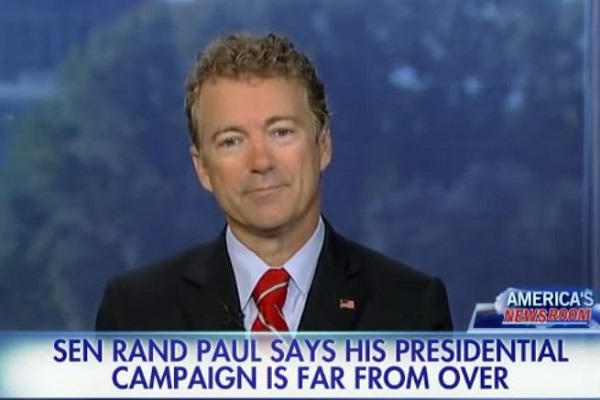
Rand Paul's disappointing poll numbers and fundraising for his presidential campaign are reportedly a cause for concern among the GOP both in his home state of Kentucky and in Washington. Last week, reports indicated that donors and the Kentucky GOP were urging Rand to focus on his senate reelection bid rather than on his flailing presidential campaign. The AP reported:
A defiant Rand Paul is brushing off weak fundraising and weaker poll numbers as would-be donors and home state Republicans push him to abandon an uphill presidential bid to focus on his Senate re-election. . . . . But back in Kentucky, a growing chorus of Republicans suggested that Paul's Senate re-election was by no means guaranteed, despite the state's strong GOP leanings and the lack of a clear Democratic challenger. "He could lose both positions," said Patricia Vincent, chairwoman of the Graves County Republican Party. "He just needs to work a little bit more to make sure he still has a seat in the Senate."
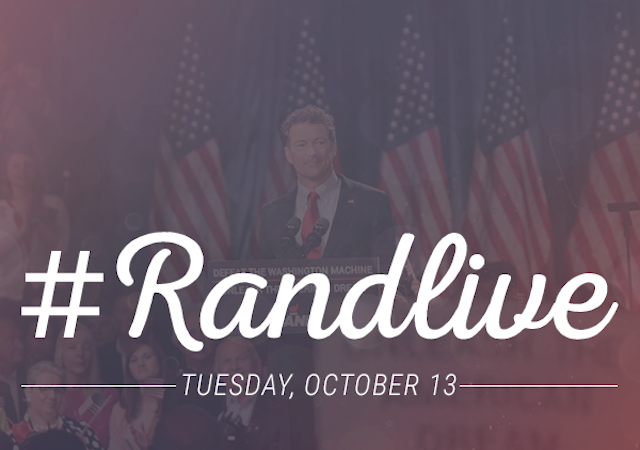
Rand Paul's star has faded within the crowded Republican field, but his team is hoping that a novel digital effort will draw enough attention to Paul (and his policies) to turn things back in the right direction. Today, Rand Paul is livestreaming...everything. The stream will be available on Paul's Facebook page and Ustream channel, offering what the campaign has touted as unprecedented access into life on the campaign trail. Via Rare:
The Paul campaign’s Chief Digital Strategist Vincent Harris told Rare, “In an effort to continue his efforts to run the most digital savvy and transparent campaign on either side of the aisle, Senator Paul will be the first Presidential candidate to live-stream an entire day on the campaign trail.” The live stream, which will be viewable through the campaign’s Facebook and UStream.tv pages, will begin with Paul’s morning in Iowa and will last throughout the entire day. The coverage will wrap up Tuesday night with Paul reacting live to the Democratic debate—the first time Hillary Clinton will have to face Bernie Sanders and the rest of her competitors. Now that could be fun.
Paul announced the decision yesterday on Twitter:

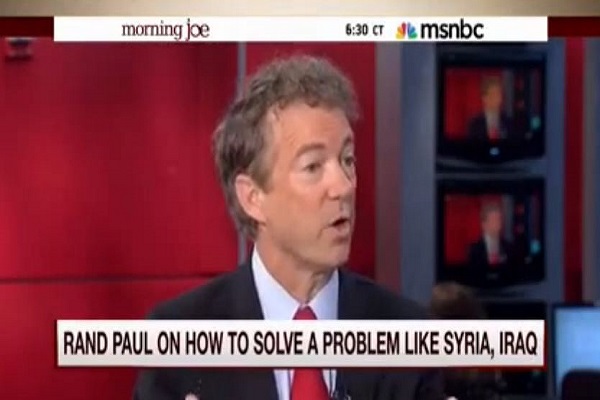
Rand Paul is in trouble. The Real Clear Politics average has him at just 2.3% in the polls, putting him well behind outliers like John Kasich (3.2%), Mike Huckabee (2.9%), and Chris Christie (2.6%). Substantive comments in last month's CNN debate didn't help him much---but Carly Fiorina's popularity spiked. Enter a golden opportunity for Paul to hitch a ride on Fiorina's media wave. During an interview yesterday with Wolf Blitzer, he lashed out against Fiorina's hardline stance against dealing with Putin and tolerating Assad's regime in Syria:

Insider speculation pegged Paul as the next to drop out of the crowded Republican primary weeks ago. Today, one of three Paul-supporting SuperPACs has stopped raising money until they see, "the campaign correct its problems." Politico reports:
One of the three super PACs supporting Rand Paul’s presidential campaign has stopped raising money, dealing a damaging blow to an already cash-starved campaign. In a Tuesday telephone interview, Ed Crane, who oversees the group, PurplePAC, accused Paul of abandoning his libertarian views -- and suggested it was a primary reason the Kentucky senator had plummeted in the polls. “I have stopped raising money for him until I see the campaign correct its problems,” said Crane, who co-founded the Cato Institute think tank and serves as its president emeritus. “I wasn’t going to raise money to spend on a futile crusade.” “I don’t see the point in it right now,” he added. PurplePAC has been in existence for around two years, but over the summer Crane transformed it into a Paul-focused vehicle. It joined two other super PACs, America’s Liberty and Concerned American Voters, that were expressly designed to support Paul. In July, PurplePAC announced that it had raised around $1.2 million - the vast majority of it coming from Jeff Yass, a Philadelphia options trader. Crane said the organization currently had over $1 million cash on hand, but no longer wanted to ask for contributions. “I just don’t want to do that to my friends,” he said. The libertarian views that catapulted Paul to national prominence had “disappeared,” Crane said, leaving many of Paul's longtime backers miffed.

As we recently reported, Rand Paul has been dealing with the unique issue of running for president and his senate seat at the same time. Yesterday, his plans were approved. Dave Weigel of the Washington Post:
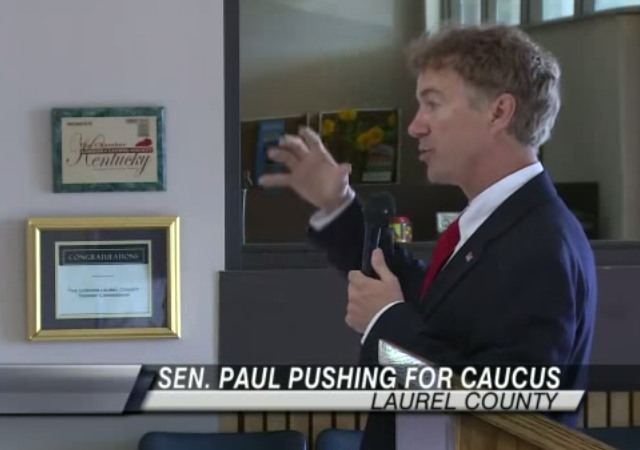
Rand Paul sells Kentucky GOP on presidential caucus Sen. Rand Paul (R-Ky.) avoided a major headache Saturday after Kentucky Republican Party approved a rule change that would allow him to run for president while seeking reelection to his Senate seat. "I applaud the Republican Party of Kentucky on their decision to hold a caucus in the upcoming Republican presidential cycle," Paul said in a statement. "The people of Kentucky deserve a voice as the GOP chooses their next nominee, and holding a caucus will ensure that Kentucky is relevant and participates early in the process." The party's central committee approved Kentucky's first-ever presidential caucus for March 5, 2016. The vote was 111 to 36, a stronger showing than expected, after a drama that took most of the day -- ending just 20 minutes before the meeting had to end. Two-third of the central committee were needed to approve the caucus.

Rand Paul is dealing with some tricky rules as he tries to run for president and hold on to his senate seat at the same time. Chris Moody of CNN reports:
Rand Paul's tough choice Rand Paul has a choice: Spend nearly half a million dollars to keep his increasingly longshot presidential ambitions alive in his home state or leave the Senate. For now, he's choosing to pony up. Paul's political future rests partially in the hands of nearly 350 Republican officials in Kentucky, who will decide Saturday whether to approve a costly plan that would allow him to run in Kentucky for president and the U.S. Senate simultaneously—and possibly salvage his chances of staying in electoral politics after 2016. The proposal, which acts as a work-around of a state law that forbids candidates in Kentucky from running for two federal offices at the same time, would establish a presidential caucus in early March in addition to the state primary scheduled two months later.

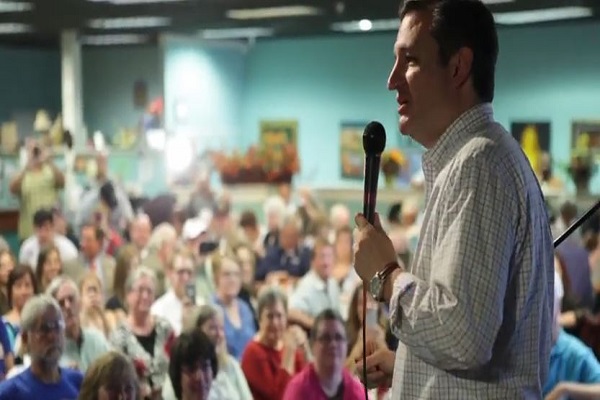
The Ted Cruz campaign is holding its own in terms of polls and campaign fundraising; indeed, according to reports, the Cruz campaign raked in $1 million within the first 100 hours following last Thursday's debate.  His #CruzCountry bus tour is also creating a lot of buzz on Twitter, with enthusiastic supporters tweeting that they've just met the "next president." Watch: Winning the presidency is clearly Cruz's goal, and he seems to be playing a long game.

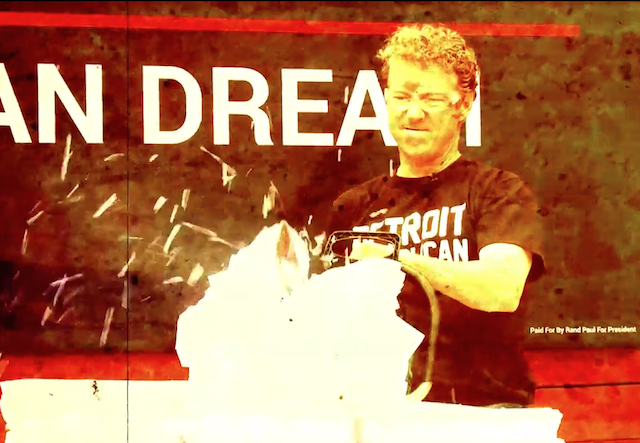
Rand Paul released a new ad today, and it's truly a must-see---especially if you're a fan of chainsaws, woodchippers, large bonfires, the national anthem, or tax reform. Who am I kidding? Americans are fans of all those things! Let's get right to it: At about the 37 second mark, the video turns interactive, asking viewers which method they believe Paul should use to lay waste to a paper copy of the tax code:

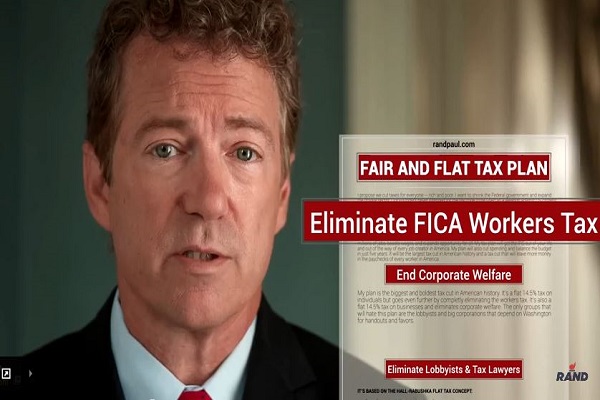
Earlier this year, Rasmussen released a poll showing that only 31% of Americans trust the IRS to enforce tax laws fairly.  Given the targeting of conservatives, reports of refunds going to illegals who didn't pay taxes, and the sharing of confidential tax payer information with the White House, it's surprising the percentage is that high. It seems clear that there is growing dissatisfaction with the IRS and with the nation's ridiculously complex tax laws.  At 74,608 pages, the U. S. tax code is both ponderous and confusing. With all of the new taxes buried in ObamaCare alone, the tax code has grown by nearly 3,000 pages since 2010. In response to all of this, Americans are more ready than ever for substantial tax reform, and hearing the call, Rand Paul released a new video outlining his new tax plan that appears to be a hybrid of the fair tax and the flat tax. Here's the statement from his website:
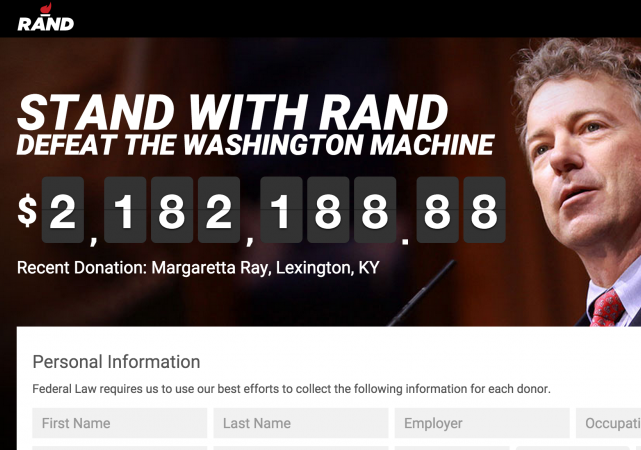
I stand with Rand in his fight to defeat the Washington Machine and drive a stake through the heart of the IRS by: Ending the workers tax: This plan will end the FICA payroll tax, the largest tax for many working Americans. It goes to zero. Eliminating the headaches and complications in filing federal taxes by allowing every taxpayer to file a simple, one-page return with a low and fair tax rate of 14.5%, saving American families over $2 TRILLION in the first 10 years;

Rand Paul is in trouble. At least, it looks like Rand Paul is in trouble. When answering questions about fundraising posed by Politico last week, spokesmen from both the official campaign and America's Liberty PAC couched on their actual numbers. PAC spokesman Jesse Benton may have revealed much more than he intended when he said, “Results to date have been solid and give us lots of room for optimism as we continue. We also know this is a marathon, not a sprint.” Oof. Marathon-not-sprint is never where you want to be when other candidates are charming the multimillionaires who make national presidential campaigns tick. Part of me believes it shouldn't be this way. Paul has been making headlines as an anti-establishment pot-stirrer with his opposition to the impending PATRIOT Act extension. Back in 2013, an overwhelming majority of Americans stood in solidarity with Paul after he held a 13-hour filibuster protesting the use of drone strikes against American citizens. Senator Paul has been much more adept than fellow presidential contender Senator Cruz at influencing his colleagues on issues of policy without crossing the line into willful alienation---so what's the problem? The other side of my brain knows, though---and so do donors and strategists. More from Politico:

I like a lot of what Rand Paul has to say; I'm on board with limited Constitutional government, auditing the Fed, thoughtful deregulation, and major tax reform.  When it comes to foreign policy and America's place in the world, however, I can't think of another Republican with whom I disagree more.  (Except maybe his father.) And I'm not alone.  Rand has been trying to affirm his strength on national security precisely because there are a lot GOP primary voters who do not share his isolationist leanings.  As Kemberlee noted in September of last year, Rand's "I'm neither an isolationist nor an interventionist" may not have appeal . . .  to either side. His rhetoric has changed rather dramatically from last fall, however.  Now he's going so far as to argue that Republican hawks "created" ISIS.  This statement is getting a lot of attention, and for good reason: it's an amazing and strange thing to say.  Watch:

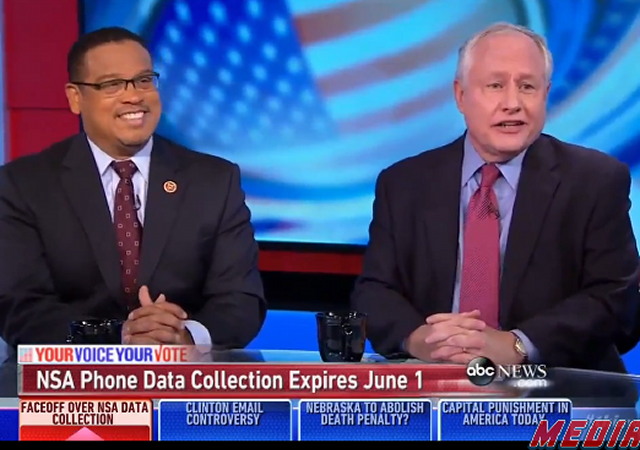
Rand Paul inhabits a unique position in the Republican Party. While he's conservative on some issues, his Libertarian views on others put him at odds with the establishment. His recent filibuster on the Patriot Act is a prime example. Bill Kristol of the Weekly Standard voiced his thoughts on the issue in an appearance on ABC News Sunday. I'm not sure this is a fair line of attack. Evan McMurry of Mediaite has the story:
Kristol: Liberal Democrats Had Rand Paul’s Policies Before He Did A This Week panel noted that Representative Keith Ellison (D-MN) #standswithRand (sigh) over the NSA’s bulk collection of communications data and criminal justice reform, causing Weekly Standard editor Bill Kristol to call for a point of clarification. “That’s not fair to Keith,” Kristol said. “Rand stands with Keith. Seriously. They had these positions first. Rand Paul has decided that he wants to be a liberal Democrat, undercut necessary intelligence collection and weaken law enforcement services, and Rand Paul thinks that’s going to sell in the Republican primary.
Here's the video:

Sen. Paul made headlines a few weeks ago when he lobbed the abortion gotcha questions back into the Democrat's court. This week, Paul released a video detailing his pro-life stance. On Facebook, Sen. Paul's official campaign account included the following statement:
I strongly believe in the sanctity of life and that an abortion takes the life of an innocent human being. As a physician, one of the first things we learn is to ‘do no harm.’ Since the Roe v. Wade decision, over 50 million children have been killed in abortion procedures. This is a tragedy. We cannot have liberty if we do not first protect life. As President, I will champion an agenda that supports and defends all human life, no matter how defenseless.
"Can a country founded on God-given rights continue to thrive without understanding that life is a precious gift from our Creator?" asks Paul. A bit theatric, but well done nonetheless:

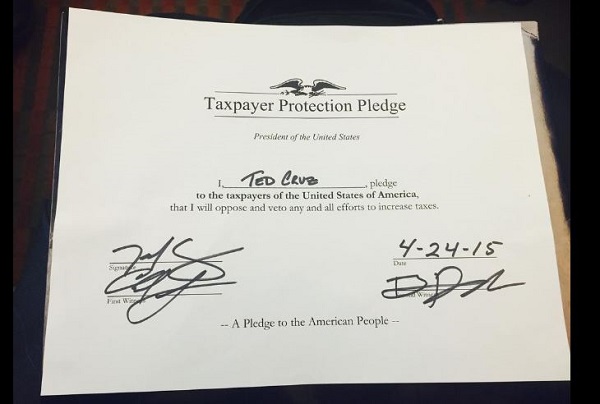
While I'm not a fan of Grover Norquist, I do appreciate his Americans for Tax Reform's work each election cycle to get candidates on the record regarding tax increases.  It's not the be-all-and-end-all, but it does indicate to voters where candidates stand in terms of big government and taxation.  The Hill reports:
The Taxpayer Protection Pledge is maintained by Grover Norquist’s group, Americans for Tax Reform (ATR), and has been signed by the majority of Republicans in Congress. The group says it has shared the pledge with all candidates running for federal office since 1986. In separate statements, Norquist said their signatures show Paul and Cruz continue “to protect American taxpayers against higher taxes.” Signing the pledge could help the senators draw a contrast with former Florida Gov. Jeb Bush, who is expected to also launch a presidential bid and is considered a leading candidate for the GOP nomination.
Ted Cruz tweeted a photo of himself signing it to underscore his seriousness:

Rand Paul has managed to do something no Republican before him has done. In a series of recent comments and media appearances, the Kentucky senator has turned the abortion debate around, calling on Democrats and their media allies to defend their position on late-term abortion. Paul's position is summarized perfectly in this clip from Katie Yoders of News Busters:
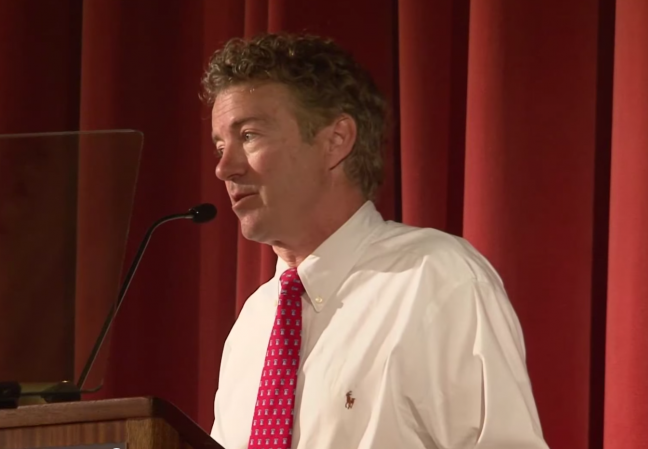
Rand Paul: Ask the Other Side ‘When Does Life Begin?’ It’s time for pro-lifers to go on the offense, or so Sen. Rand Paul suggests. On April 16, Sen. Paul (R-Ky.) addressed the pro-life movement at the Susan B. Anthony Campaign for Life Summit in Washington, D.C. Referencing his back-and-forth with DNC Chair Debbie Wasserman Schultz (D-Fla.), the 2016 presidential candidate stressed that the pro-life movement must ask the other side, “When does life begin?” That question, he suggested, will keep the media from placing pro-lifers “neatly” in a “box.”
Here's the video: Paul has repeatedly called on DNC chair Debbie Wasserman Schultz to respond. Her efforts have been clumsy and evasive at best.

Thus far, the GOP presidential field officially includes three of the Senate's best. We're still waiting on the Governors to join the party. It's still early, but how are the current candidates fairing on the fundraising front? Ted Cruz The first to hop in the race, Cruz raised $ 4.3 million in his first 9 days of campaigning. A respectable start. If Governor Perry jumps in the race as anticipated, Cruz might lose some of his early fundraising steam. Governor Perry has a well established donor base in the Lone Star State that could suck funds away from Cruz. According to the Dallas Morning News, although Cruz has the early lead, he's in for stiff competition as the field continues to expand. By all accounts Governor Bush will be the moneyed man to beat.
Still, Cruz is expected to trail other major candidates in the fund-raising battle. Former Florida Gov. Jeb Bush reportedly had a $100 million fund-raising goal for the quarter that ended March 31, while Cruz would be happy to get $50 million for the entire campaign.

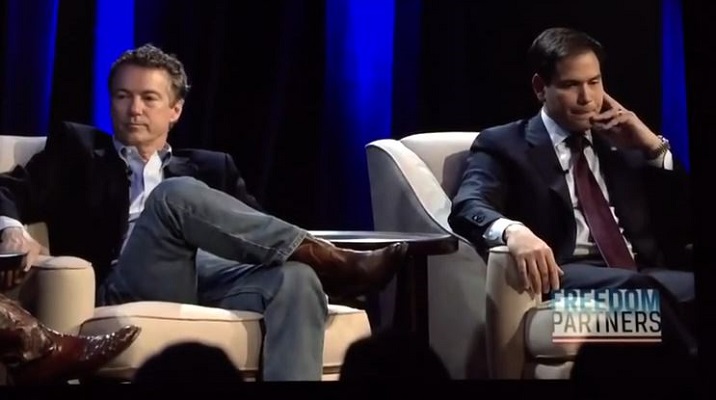
So far, two first-term GOP senators have declared their presidential candidacy (Cruz and Paul), with Rubio set to do so Monday. On both sides of the aisle, there are a lot of questions and concern as people wonder what these first-termers have accomplished.  This is, of course, a fair question to ask, but to be equally fair, we should take note of Harry Reid's lockdown of the Senate for the past six years. Not only were Republican senators unable to accomplish much in Reid's Senate, but neither were Democrat senators (some of whom lost their seats as a result, at least in part).  The National Review reported in January of last year:
The New York Times reported last week on Reid’s “brutish style” and “uncompromising control” over the amendments process in the Senate. Why are more people finally catching on to Reid’s flagrant disregard for Senate customs? In part because conservatives aren’t the only ones complaining. Democrats such as Amy Klobuchar of Minnesota — who wants to repeal Obamacare’s medical-device tax — and Kirsten Gillibrand of New York — who has waged a highly publicized campaign to reform the way the military handles sexual-assault cases — have been denied votes on their proposed amendments to various bills. Gillibrand had hoped to attach her sexual-assault amendment to the defense-appropriations bill that passed in December, but no amendments were allowed. Klobuchar has called for “a more open amendment process” because she’d like a vote on repealing the medical-device tax.
We all watched as frustrated politicians on both sides of the aisle complained that there were more than 300 bills "sitting on Harry Reid's desk," so it seems less than reasonable to focus on legislative accomplishments by first-term GOP senators who were apparently very busily working on legislation that then ended up mired down by Reid.  Even House Dems were urging Reid to pass their bills in the Senate.  To no avail.