

We cover below the following:
I. Some background on anti-Israel activity at NYU
II. Background on SJP's Divestment campaign at NYU
III. Background on BDS at the University of California's union last year
IV. Background on NYU's new radicalized union.
V. Discussion of the petition itself (including (a) the process; (b) campaigns and (c) the substance of the actual resolution)
VI. The opposition campaign and counter-petition (which NYU faculty, students, and alumni can still sign)
VII. Conclusion
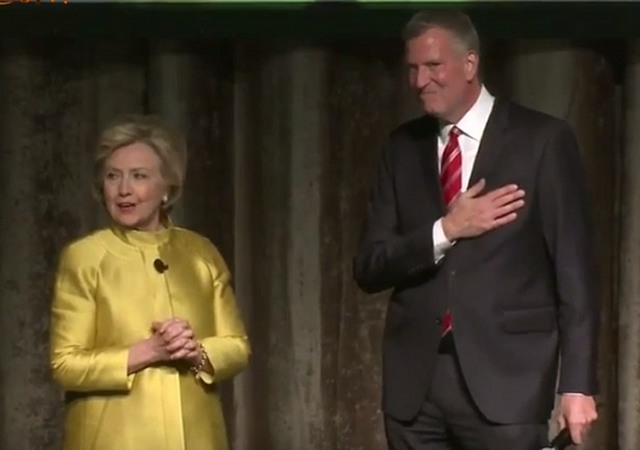
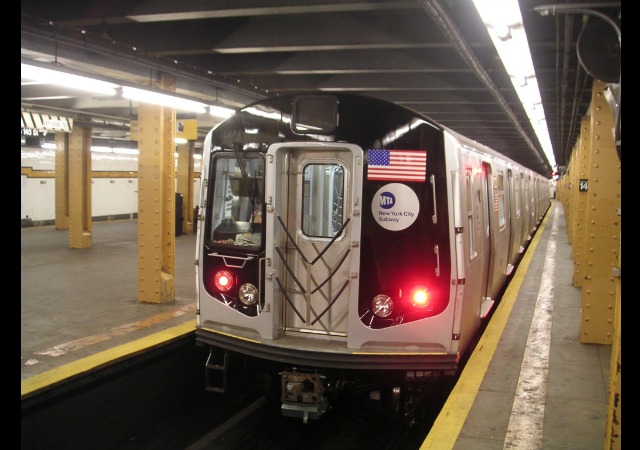
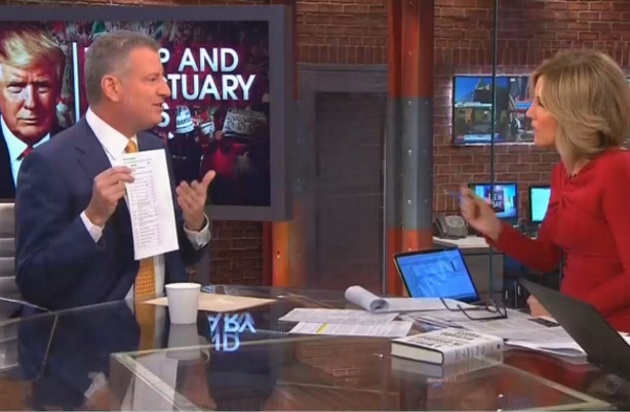
New York mayor Bill de Blasio is trying to put a positive spin on a recent rash of stabbings and slashings across the city. He credits the NYPD taking guns off of the street. "I'm not a criminologist but I can safely say that guns are being taken off the street in an unprecedented way. Some people, unfortunately, are turning to a different weapon," de Blasio says. New Yorkers have been on edge because of a series of highly-reported attacks, including several seemingly random attacks on the subways. The city was averaging more than 10 stabbing attacks a day in the first six weeks of the year.
I knew that hundreds of firemen died that day, but I didn't know about Squad 1, a Special Operations Unit that responds to emergencies throughout NYC. According to its Facebook page:
Though felony assaults are down in the park this year, misdemeanor assaults are up. There were 15 misdemeanor assaults between Jan. 1 and July 26 of this year, as opposed to 11 for the same period last year. And narcotics arrests in the park have more than doubled this year. There were 23 drug busts between Jan. 1 and July 26 of this year, as opposed to 10 for the same period last year. Still, the number of criminal summonses has taken a nose dive, Perhaps pointing to more lax enforcement if such quality of life offenses as loitering, disorderly conduct, or public drinking and urinating. Between Jan. 1 and July 26, parks cops wrote 2,100 summonses. But during the same months of last year, they wrote 3,026 summonses.
Administration officials are studying how to curb the price of a fare Uber can charge during peak hours, prevent livery drivers from dropping non-Uber customers for Uber rides, and help taxis develop their own app to make hailing a cab easier, say sources familiar with City Hall.
Who Needs Quality of Life, Anyway? Last week, the New York City Council announced that it was preparing legislation to reduce the penalties for a host of “minor crimes.” Open urination, drinking alcohol in public, riding bikes on the sidewalk, and other public-order infractions like subway fare-beating would no longer be considered criminal violations but rather civil offenses, akin to parking near a crosswalk. Instead of receiving a summons to appear in court, violators could pay a fine through the mail. Proponents offer a simple explanation for why the changes are necessary: the negative effect that interaction with the criminal justice system has on those who receive summonses. Council Member Jumaane Williams has separately bemoaned the arrest of people for “minor infractions” in the subway on the grounds that “an arrest can cause significant stress” for the arrestee, as well as imposing “financial hardship.”The public urination proposal is turning into something of a pissing contest among politicians:
Official Host Allison Hagendorf and three correspondents will provide live, commercial-free, webcast coverage of the festivities leading up to the Ball Drop at midnight including backstage access, behind-the-scenes stories and interviews with revelers, performers and other celebrities. Additional highlights include the lighting and raising of the New Year’s Eve Ball at 6 p.m. EST, hourly countdowns, activities engaging the revelers, AP’s Year-End News video, live musical performances (TBA) and Special Guest the International Rescue Committee joined by the Mayor of New York City to push the Waterford Crystal button that signals the Ball Drop.
Social psychologists and police officers tend to agree that if a window in a building is broken and is left unrepaired, all the rest of the windows will soon be broken. This is as true in nice neighborhoods as in rundown ones. Window-breaking does not necessarily occur on a large scale because some areas are inhabited by determined window-breakers whereas others are populated by window-lovers; rather, one unrepaired broken window is a signal that no one cares, and so breaking more windows costs nothing.The squeegee men and similar public displays of lawlessness were held in check even after Rudy left office -- until now. The election of uber-liberal Bill DeBlasio ushered in a new era of the bad old days, as The NY Post reports:
They were the ultimate symbol of the lawlessness and blight of the 1980s and early 1990s — and now they’re making a comeback. Squeegee men are menacing motorists across New York City, including spots near the Holland, Lincoln and Queens-Midtown tunnels, as well as the Queensboro Bridge, The Post has learned.
Hide your Big Gulps, again, New York. Mayor Bill de Blasio announced this week his administration will pick up where former mayor Michael Bloomberg left off and will continue the battle to ban sodas larger than 16 ounces. The city will appeal a state court ruling that axed the ban last year. City lawyers will argue the case at the Court of Appeals on June 4, the New York Daily News reported this week. Former Mayor Michael Bloomberg got lots of headlines in 2012 when he declared war on Big Gulps and other large sugary drinks.Bloomberg's administration was excitedly awaiting implementation of his ban on large sodas to take place last March. A state judge intervened a day prior however, and "permanently restrained" the city "from implementing or enforcing the new regulations."
Mayor Bill de Blasio was sworn in Wednesday, promising to usher in a sweeping agenda that would remake the nation's largest city as a foundry for liberal ideas. Among the Democrat's early priorities are higher taxes on city residents making more than $500,000 a year, universal prekindergarten, de-emphasizing standardized testing in public schools and reining in aggressive street stops by the police The new mayor, whose campaign theme was ending a "tale of two cities," has made clear that he would like to be a national leader in trying to combat income inequality. Scott Stringer, the city's new comptroller, said the 52-year-old Mr. de Blasio would tackle the income gap "in a way that hasn't been a priority since Lyndon Johnson's war on poverty." The city for the past 20 years has been ruled by mayors who won office as Republicans: Rudy Giuliani and Michael Bloomberg. During those years, violent crime fell to record lows, mirroring national trends, while high-school graduation rates rose and development moved into neighborhoods once seen as dangerous. The agencies Mr. de Blasio says he wants to change—the New York Police Department and the Department of Education, to name two—were often held up as national models.It gets worse:
High taxes. Crime. Too hot in summer, too cold in winter. Democrats. Too expensive. Public sector unions which control everything. Want me to continue? Thanks to reader Alex who, after seeing yesterdays post about Manhattan Mini Storage advertising, sent this photo and wrote: I took a picture of this billboard last...
to be anti-Republican in New York, because almost everyone who disagrees with you already has moved to Texas. We've seen these subway ads taking shots at Republicans before. Thanks to reader Thomas who took this photo and writes: Spotted on the #1 train en route to my office. MMS...
It was announced today that Joel Klein would be stepping down from his post as New York City's School Chancellor. For those of you unfamiliar with his work, Klein has served since 2002, when the state legislature gave the mayor's office control of the school...
Donations tax deductible
to the full extent allowed by law.
Founder
Sr. Contrib Editor
Contrib Editor
Higher Ed
Author
Author
Author
Author
Author
Author
Editor Emerita