

Image 01 Image 03

Iran Tag

Yesterday we reported that Iranian officials were furious that the Obama administration's "fact sheet" spun the nuclear deal in ways not agreed-upon.  The Iranians are crowing that their right to enrich uranium was confirmed while the Obama administration is saying the opposite. Now comes word that the "deal" is not actually final, that there are details to be worked out, and that there is a window before the agreement comes into effect. https://twitter.com/DanRiehl/status/405820620132200448 US now indicates Iran interim deal wasn’t quite finalized:
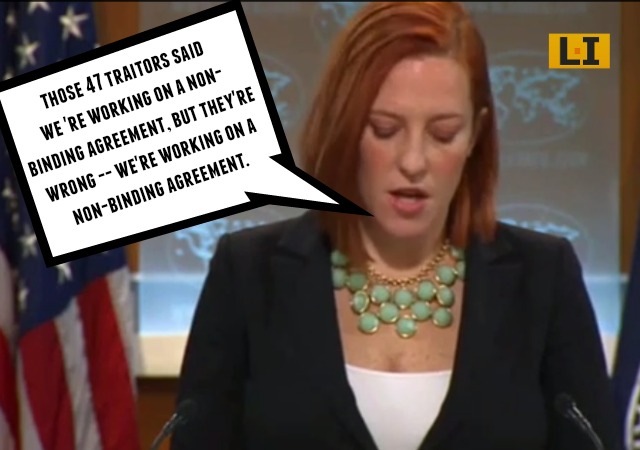
Iran is currently enjoying a “window” of time before the six-month deal signed in Geneva early Sunday goes into effect, during which it is not bound to take any credible steps toward disabling its ability to produce a nuclear weapon, the State Department acknowledged Tuesday. State Department spokeswoman Jen Psaki said that the six-month interim period, during which Iran would take steps to rein in its nuclear program in exchange for sanctions relief, has not yet begun. Furthermore, there are still a number of details to be worked out, she said, without specifying what points had yet to be finalized.

Seriously. https://twitter.com/DanRiehl/status/405455788228882433 From Fars News Agency, Iran Strongly Rejects Text of Geneva Agreement Released by White House: TEHRAN (FNA)- The Iranian Foreign Ministry on Tuesday called invalid a press release by the White House alleged to be the text of the nuclear agreement struck by Iran and the...

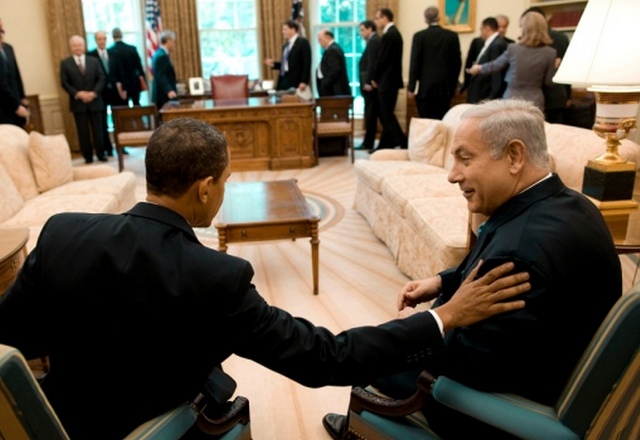
I don't think it's overstatement to say that Obama successfully has isolated Israeli Prime Minister Benjamin Netanyahu by bringing the major world powers plus Germany into an Iran nuclear agreement publicly opposed by Netanyahu (and quietly by many Arab countries). The perennial thorn in Obama's Mideast side stands almost alone in publicly opposing the deal.  The agreement helps keep the Mullahs in power through removal of sanctions while normalizing Iranian uranium enrichment.  More than that, the statements accompanying the deal announcement treat Iran as the regional power to resolve a host of issues, including Syria. In exchange, Iran agrees to slight compromises that push back the "breakout" period to produce a nuclear weapon by a few weeks or months at most. Jeffrey Goldberg assesses Israel's isolation, In Iran, Obama Achieves 50 Percent of His Goals:
U.S. President Barack Obama has had two overarching goals in the Iran crisis. The first was to stop the Iranian regime from gaining possession of a nuclear weapon. The second was to prevent Israel from attacking Iran’s nuclear facilities. This weekend, the president achieved one of these goals. He boxed-in Israeli Prime Minister Benjamin Netanyahu so comprehensively that it's unimaginable Israel will strike Iran in the foreseeable future. Netanyahu had his best chance to attack in 2010 and 2011, and he missed it. He came close but was swayed by Obama’s demand that he keep his planes parked. It would be a foolhardy act -- one that could turn Israel into a true pariah state, and bring about the collapse of sanctions and possible war in the Middle East -- if Israel were to attack Iran now, in the middle of negotiations.
I think it's much broader than forestalling an Israeli attack.

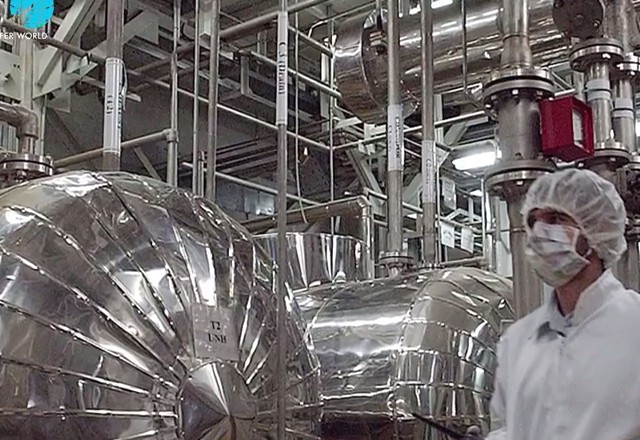
The nuclear agreement with Iran is being touted by the Obama administration as a significant step in keeping Iran from moving towards nuclear weapons. In reality, the agreement is confirmation of Iran's uranium enrichment program at a relatively high level, although some of the highest level enrichment is supposed to be suspended. The fact is that in return for a weakening of sanctions that were putting great pressure on Iran, the centrifuges keep spinning, the facilities are maintained, and at best the length of time for an Iranian nuclear "breakout" has been lengthened for a short period. Eli Lake at The Daily Beast notes the significance:
Under the interim agreement Iran will be allowed to enrich uranium at low levels. Iran's foreign minister, Javad Zarif said the deal recognized his country's nuclear program. This is a major victory for Iran whose leaders have insisted for nearly a decade that it has the right to enrich uranium under the Nuclear Non-Proliferation Treaty. Officially, the Obama administration has not recognized that any country has this right under the treaty. It has argued that Iran has to adhere to the terms of prior U.N. Security Council resolutions that prohibit Iran from enrichment.
It is smoke and mirrors, allowing the Obama administration to declare diplomatic victory, change the subject, and create the straw man argument that anyone opposed to the agreement wants war. https://twitter.com/JohnCornyn/status/404624480837722112 https://twitter.com/dansenor/status/404626184865996800

The details are just coming out, but it appears that Iran gets to keep its uranium enrichment program, albeit on a somewhat reduced level pending 6 months of monitoring. The U.S. agreed not to unilaterally impose new sanctions during this time period, something previously under consideration in Congress with strong bipartisan support. There also will be an easing of some sanctions. https://twitter.com/BarakRavid/status/404475962093367296 https://twitter.com/jaketapper/status/404476002375831552 https://twitter.com/Rania_ElGamal/status/404474360314220545 Obama press conference Iran Geneva Agreement

On Wednesday, The Israel Project hosted a conference call with Dr. Emily Landau of Israel's Institute for National Security Studies. Dr. Landau is a non-proliferation expert and spoke about the problems with the agreement apparently being negotiated between the P5+1 (United States, China, France, Great Britain, Russia and Germany) and Iran. Landau focused on four elements of the agreement, as reported that are problematic. She evaluated these terms by the stated standard of an interim by President Obama that "goal of this short term deal is to be absolutely certain that while we’re talking to the Iranians, they’re not busy advancing their program."
  1. According to reports, P5+1 are willing to allow Iran to continue enriching uranium to 3.5%. At this point Dr. Landau said that there is "no plausible civilian explanation" for Iran to need more low enriched uranium, given "its vast stockpile of 3.5% enriched uranium." Given the number of centrifuges Iran has, even at this level, allowing enrichment allows Iran to advance its nuclear program.
  2. A second point that Dr. Landau focused on was Iran's recently installed next generation centrifuges. These centrifuges can enrich uranium at four to five times the speed of Iran's currently operating centrifuges. The agreement will apparently will allow Iran to test these centrifuges. Since this is an interim deal, why allow Iran to get these centrifuges ready to operate? If the P5+1 isn't able to close a permanent deal with Iran in 6 months, then these centrifuges will be ready to enrich then. Again this marks an advancement in Iran's nuclear program.
  3. The third element of the dealt that concerns Landau is that it won't stop the construction at the Arak heavy water reactor. This is the point that French foreign minister objected to. So hopefully this will be addressed.
  4. The final element that is problematic is that apparently an inspections regime has been spelled out for various sites in Iran, but not for Parchin. Parchin is where the IAEA detected a containment chamber that could be used for testing nuclear trigger devices. Although Iran has been detected cleaning the site, it is hoped that inspectors could find some residual evidence of what was going on there.
The third and fourth points are especially important as both of them indicate that Iran's nuclear program is military not civilian. (One does build a reactor of the type at Arak unless one wishes to produce weapons grade plutonium; a trigger is a necessary component of a nuclear bomb.)

There was a double suicide bombing targeting the Iranian Embassy in Beirut earlier today. There are at least 25 dead, including one diplomat. An al-Qaeda linked group is claiming credit, but the Iranians are blaming Israel. The bobming is assumed to be in retaliation for Iran's involvement in...

Almost exactly one year ago reports surfaced that Valerie Jarrett was engaged in "secret" negotiations with Iran as Obama's personal emissary. The reports originated with Iranian bloggers, and was reported also by The New York Times. The Obama administration categorically denied the reports. Now Israeli television is reporting similar involvement, via the Times of Israel, ‘Geneva talks a facade, US-Iran worked secretly on deal for past year’:
The Geneva negotiations between the so-called P5+1 powers and Iran are a mere “facade,” because the terms of a deal on Iran’s nuclear program have been negotiated in talks between a top adviser to President Barack Obama and a leading Iranian nuclear official that have continued in secret for more than a year, Israeli television reported Sunday....

White House spokesman Bernadette Meehan was quoted by Haaretz as saying that the report was “absolutely, 100 percent false.”

The report, which relied on unnamed senior Israeli officials, said the US team to the secret talks was led by Obama adviser Valerie Jarrett. Her primary interlocutor, the report said, was the head of the Atomic Energy Organization of Iran, Ali Akbar Salehi. The talks have been taking place in various Gulf states.

Not sure I agree with the linkage of Obama's broken promise that you can keep your insurance plan and his promise that Iran will not get nukes. One he knew was false at the time he made the promise, the other was, um, ...

Let's review some of the administration's diplomatic activity over the past week. Lee Smith:
Haaretz reports that the administration misled Israel regarding the terms of the proposed interim agreement with Iran over its nuclear weapons program. One senior Israeli official explained that on Wednesday Israel had seen an outline that the Israelis “didn't love but could live with.” Thursday morning French and British officials, and not the White House, told the Israelis that the terms had changed and were much more favorable than what they’d been shown previously. “Suddenly it changed to something much worse that included a much more significant lifting of sanctions,” said the Israeli official. “The feeling was that the Americans are much more eager to reach an agreement than the Iranians.”
Natan B. Sachs lays out some of the particulars.
On substance, the Israelis, like the French, appear very concerned about the provisions of the interim deal that: (a) permitted Tehran to continue some uranium enrichment; (b) allowed Iran to continue building the heavy water reactor in Arak (with only an Iranian commitment not to activate it), which would preserve the Iranian short-cut to nuclear capabilities via a plutonium — rather than uranium — track; and, most notably, (c) provided Tehran with incentives that the Israelis see as the beginning of the dismantling of the sanctions regime. Israel’s concern is that the proposed sanctions relief will not, in practice, be reversible, while the Iranian commitments could be easily reversed (and in the case of Arak will not even be halted).
The French objections to the deal led the P5+1 countries to demand more of Iran, so the Iranian team left without a deal to return for consultations.

Aside from the specific problems with the potential deal between the so-called P5+1 and Iran (and the way it's reported), there's a historical precedent that's troubling. One of the reasons many in the West saw Iranian President Hassan Rouhani's election as a harbinger for rapprochement with Iran was because when Rouhani was Iran's lead nuclear negotiator a decade ago, the West (specifically Britain, France and Germany) and Iran reached a deal. Here's how the Financial Times described what happened: "Western governments will welcome Mr Rohani as a leader they can deal with – it was under his watch as chief nuclear negotiator that Iran had temporarily suspended its uranium enrichment a decade ago." Similar sentiments have been "reported" elsewhere. If that's the reason to be hopeful for an agreement with Iran, it's even more of a reason to suspect Iran's motives now that Rouhani's in charge of the country. In 2006, Rouhani boasted how he had duped the West. It was a boast that he repeated again in an interview before the elections in Iran earlier this year, Rouhani was anxious to show that he was not too moderate to lead the country.

Far from honoring the commitment, in which Iran said “it has decided voluntarily to suspend all uranium enrichment and reprocessing activities,” Rouhani told the interviewer that all Iran did was merely suspend “ten centrifuges” in the Natanz enrichment facility. “And not a total suspension. Just reduced the yield.”

Unimpressed, interviewer Abedini asserted that work had been suspended at the UCF — the Uranium Enrichment Facility at Isfahan. Quite the contrary, Rouhani countered, detailing the completion of various phases of work at Isfahan under his watch in 2004 and 2005. He went on to state proudly that the Iranian heavy water reactor at Arak was also developed under his watch, in 2004. ...

Over the past few days the reporting from Geneva changed from anticipation of an imminent deal to a final "no deal." Or "no deal" for now. The New York Times reported Talks With Iran Fail to Produce a Nuclear Agreement. As almost all reporting on the P5+1 talks with Iran go it gives the credit to (or places the blame on) France for the failure of the two sides to reach an agreement.
The proposal under consideration in Geneva was to have been the first stage of a multipart agreement. It called for Iran to freeze its nuclear program for up to six months to allow negotiations on a long-term agreement without the worry that Iran was racing ahead to build a bomb. In exchange, the West was to have provided some easing of the international sanctions that have battered Iran’s economy. After years of off-again, on-again talks, the deal would have been the first to brake Iran’s nuclear program.Despite the diplomats’ insistence on progress, the failure to clinch an agreement raised questions about the future of the nuclear talks, given the fierce criticism that the mere prospect of a deal whipped up in Israel and among Republicans and some Democrats in Congress.
Unfortunately, this frames the scuttling of the talks in terms of those looking for a compromise versus pro-Israel ideologues. Subsequent reporting in the article is more specific about some, but not all, of the real issues involved.

With a fevered and frantic breathless pace, Obama via John Kerry has been pushing to sign a sell-out deal with Iran that would ease sanctions without shutting down Iran's nuke program. Benjamin Netanyahu was furious when he found out that Kerry had misrepresented what the proposed agreement would be, not to mention Kerry running at the mouth to bash Israel on the talks with the Palestinians. Netanyahu was not alone.  France was uncomfortable with the deal Kerry wanted to sign, even as Kerry huddled with the Iranians trying to get 'er done. Thank you France for at least buying us some time to prevent the historic sell out of Israel that was in the offing as recently as early today. Via NY Times, Talks with Iran Fail to Produce a Nuclear Pact:
In the end, though, it was not only divisions between Iran and the major powers that prevented a deal, but fissures within the negotiating group. Earlier in the day, France objected strenuously that a proposed deal would do too little to curb Iran’s uranium enrichment or to stop the development of a nuclear reactor capable of producing plutonium.

“The Geneva meeting allowed us to advance, but we were not able to conclude because there are still some questions to be addressed,” the French foreign minister, Laurent Fabius, told reporters.

The Times of Israel reports:

We are on the cusp of the most historic sell-out of Israel by any United States administration. We told you all along that in his second term Obama would impose a settlement on Israel according to what he viewed as reasonable: Obama will force his vision of a...

We have noted degree to which America's media, including Thomas Erdbrink, the Tehran bureau chief for the New York Times, tells us that the most vicious anti-American statements from Iran are really expressions of admiration. Check out a few of Erdbrink's recent tweets. https://twitter.com/ThomasErdbrink/status/397332815559151616 https://twitter.com/ThomasErdbrink/status/397332340931706880 Erdbrink calls Jalili a hardliner. But in a recent article he reported on Iran's Supreme Leader Ayatollah Khamenei as not being a hardliner:
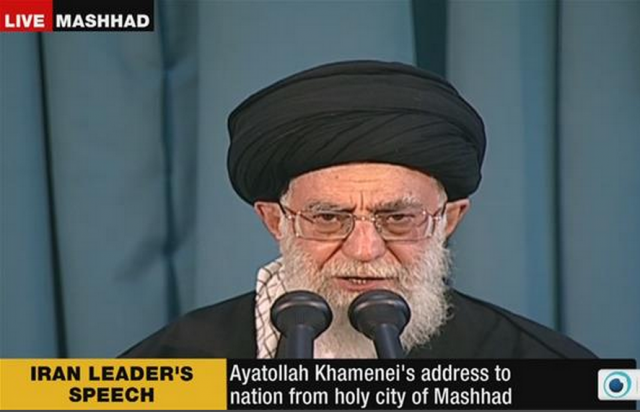
With talks over Iran’s nuclear program set to resume in Geneva this week, both sides engaged in a bit of public diplomacy Sunday: Iran’s supreme leader moved to quiet hard-liners in his country by expressing support for his negotiating team, while the chief American negotiator reiterated in an Israeli television interview that “no deal is better than a bad deal.” The supreme leader, Ayatollah Ali Khamenei, who holds Iran’s final word on the nuclear talks, told a group of students here that he was not optimistic the negotiations would succeed, but he also sent a negative message to the conservative clerics and military commanders who in recent weeks have attacked the diplomatic initiative.

I had to laugh listening to the audio of the NY Times Tehran Bureau Chief explaining away the intensified and widespread chants of Death to America on the streets of Tehran as not really meaning "Death to America" (h/t Althouse):
On this 34th anniversary of the takeover of the U.S. Embassy in Tehran, thousands of Iranians gathered outside that building to once again chant "Death to America." But New York Times Bureau Chief Thomas Erdbrink told NPR's Steve Inskeep on Monday that though the shouts were the same as they've been since 1979 and the demonstration was larger than in recent years, the people he interviewed there were not virulently anti-American. "All the people I spoke with," Erbrink said, "didn't really mind Iran talking to the United States ... [and they] admitted they want to see some sort of solution" to three-plus decades of fractured relations.
I laughed not because the subject is funny, but because it reminded me of left-wing guru Professor Juan Cole from March 2009, insisting that when they chant Death to American in Iran, they really mean "could you get me a visa, I'd really like to visit Disneyland" (video below, at 3:08):

But you knew that, because we have been following the antics of Turkish Prime Minister Recep Tayyip Erdoğan for years. Erdogan blames the Jews for Egypt and he has video! (so do we) Turkish Deputy Prime Minister blames “Jewish Diaspora” for Gezi Park protests Turkish Prime Minister drops...