


The roots of the Copenhagen attack
on February 16, 2015
11 Comments
So now we know the identity of Copenhagen shooter Omar Abdel Hamid El-Hussein, whose crime has mirrored the recent terrorist attacks in Paris but with a smaller death total and a single perpetrator. More details will no doubt emerge, but already it seems fairly clear what's going on here: a continuation of the assault on the West's freedom of speech, perpetrated by a fundamentalist Muslim terrorist (or one in sympathy with fundamentalist Muslim terrorists).
The idea is to silence what they see as blasphemy against Islam, as well as to exert a chilling effect on anyone who would sympathize with or support such freedom of speech. In addition, it is an attack on Jews and those who would protect them. The goal? Non-Muslims should not be free to criticize Islam in ways that the group deems blasphemous; Jews would not be free to practice Judaism; and the penalty for both crimes would be death.
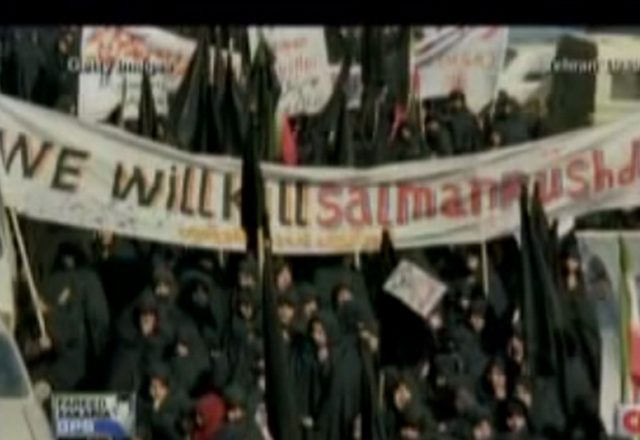
The moment when the West should have become aware of the growing seriousness of the threat to Western free speech was the 1989 fatwa against author Salman Rushdie. Perhaps some people were able to minimize it at the time by reminding themselves that Rushdie had been born a Muslim in India, which made him an apostate when he renounced the religion. But he was definitely a Westerner, having lived in Britain since the age of fourteen, and his books were written in English and aimed at a Western audience. To refresh your memory:
Many Muslims accused Rushdie of blasphemy or unbelief [for his novel The Satanic Verses] and in 1989 Ayatollah Ruhollah Khomeini of Iran issued a fatwa ordering Muslims to kill Rushdie. Numerous killings, attempted killings, and bombings resulted from Muslim anger over the novel. The Iranian government backed the fatwa against Rushdie until 1998, when the succeeding government of Iranian President Mohammad Khatami said it no longer supported the killing of Rushdie. However, the fatwa remains in place.