


Image 01 Image 03

BDS Tag

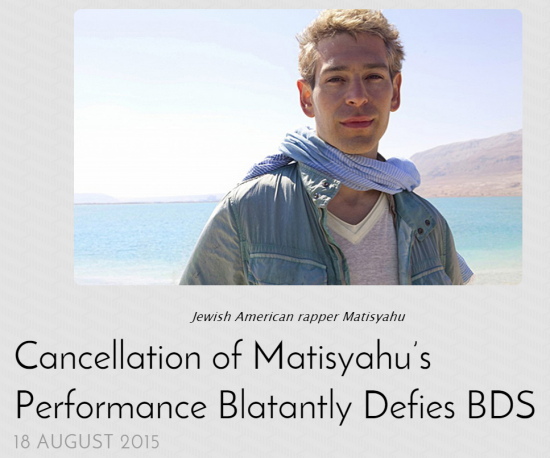
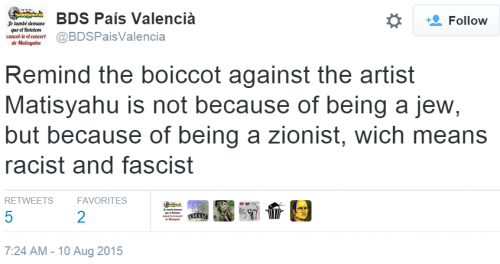
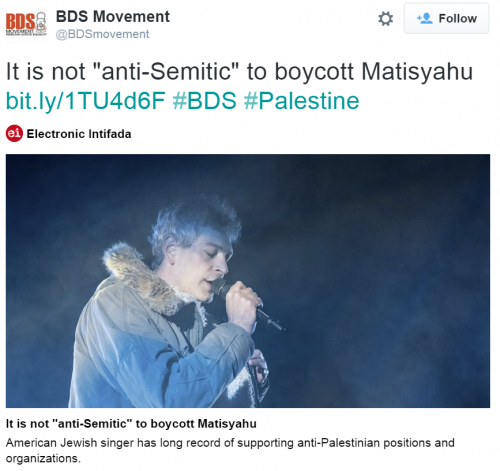
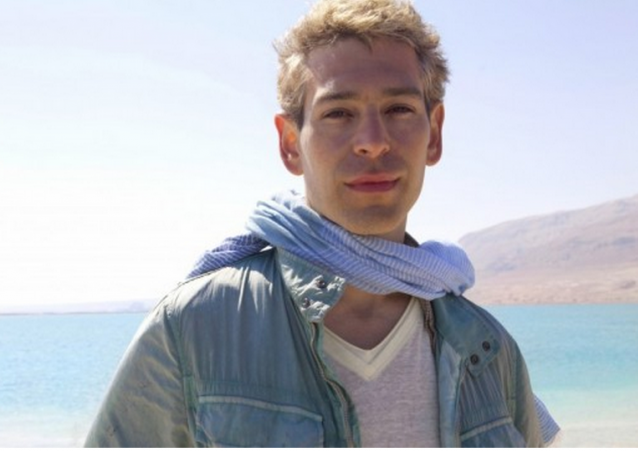
We wrote the other day about how the Boycott, Divestment and Movement pressured the Spanish Rototom Reggae festival to ban American Jewish musician Matisyahu because he refused to sign a pledge supporting a Palestinian state. Matishayu's position was that he's just a musician and shouldn't have to take a political pledge, particularly since he was singled out because he's Jewish. No non-Jewish musicians were pressured to sign any pledges. He wrote on his Facebook page:
"The festival organizers contacted me because they were getting pressure from the BDS movement. They wanted me to write a letter, or make a video, stating my positions on Zionism and the Israeli-Palestinian conflict to pacify the BDS people. I support peace and compassion for all people. My music speaks for itself, and I do not insert politics into my music. Music has the power to transcend the intellect, ideas, and politics, and it can unite people in the process. The festival kept insisting that I clarify my personal views; which felt like clear pressure to agree with the BDS political agenda. Honestly it was appalling and offensive, that as the one publicly Jewish-American artist scheduled for the festival they were trying to coerce me into political statements. Were any of the other artists scheduled to perform asked to make political statements in order to perform? No artist deserves to be put in such a situation simply to perform his or her art. Regardless of race, creed, country, cultural background, etc, my goal is to play music for all people. As musicians that is what we seek. - Blessed Love, Matis"

For years we have been arguing that at most there is a thin line between the Israel hatred of the Boycott, Divestment and Sanctions (BDS) movement and hatred of Jews. BDS was born at the anti-Semitic 2001 Durban conference, but was repackaged as a grassroots "civil society" movement in 2005, and now has duped many progressives into thinking BDS is just about Israel leaving the West Bank. Groups like Jewish Voice for Peace do BDS's bidding is perpetuating this charade. That thin line has all but disappeared in Europe, where BDS paves the was to anti-Semitism: So it is, in a sense, no surprise to hear the outrageous news that American Jewish musician Matisyahu has been banned at a Spanish Reggae music festival due to pressure from the BDS movement after he failed to sign a statement recognizing a Palestinian state. BDS has shifted from its practice of banning and attacking Israeli musicians, to Jewish musicians who fail to pledge allegiance to the BDS movement. It was a natural shift for the movement. https://twitter.com/matisyahu/status/623024234701328384 The Times of Israel reports:

After a murder and multiple stabbing at the Jerusalem Gay Pride Parade last Thursday, by an individual who perpetrated an attack a decade ago, the anti-Israel movement has kicked into high gear. There is a concerted effort to undermine an indisputable truth -- Israel is the safest, most-welcoming, most open society for LGBT individuals in the Middle East. The term "Pinkwashing" is a growing part of the anti-Israel movement's attack on Israel, by claiming that Israel promotes its positive gay rights record in order to (pink) wash its alleged crimes against Palestinians. (There also are Greenwashing and Redwashing claims made against Israel.) The pinkwashing movement, which has a particular hold among anti-Israel students and faculty on campuses, seeks to turn Israel's positive gay rights record into something bad. The pinkwashing movement is nearly silent, at the same time, on the plight of Palestinian gays, who are relentlessly persecuted and often flee for their lives. This latest effort to exploit the Jerusalem Gay Pride Parade attack, however, is even worse. Call it "Reverse Pinkwashing," seeking to use an isolated incident to deny the truth about Israel's gay rights record in order to wash away the violent and pervasive persecution of LGBT individuals in Palestinian society. Below I examine the crime, the Israeli gay rights record, the dismal status of gays in Palestinian society, and the Reverse Pinkwashing exploitation in the wake of the attack.

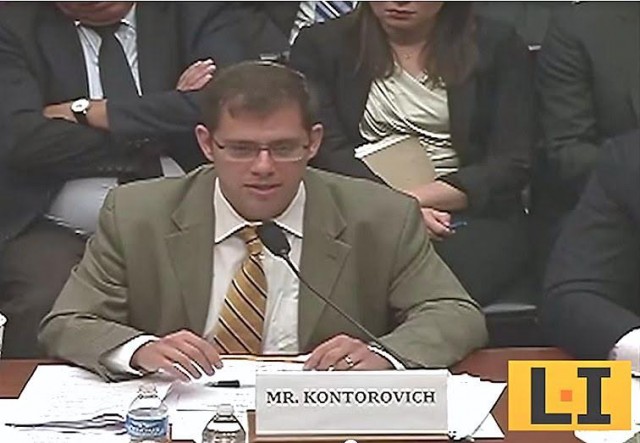
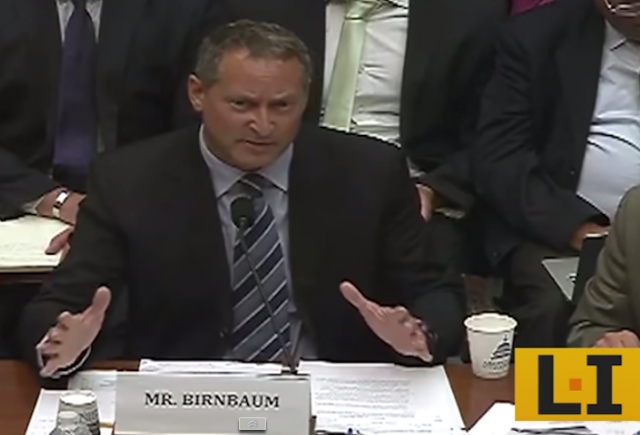
The Security Subcommittee of The House Committee on Oversight and Government Reform Committee held a hearing on July 28, 2015, on The Impact of the Boycott, Divestment, and Sanctions Movement The Tower has a write up on the full scope of the hearing. In a prior post, we featured the testimony of Daniel Birnbaum, CEO of SodaStream International, about the threats, intimidation and violence of the BDS movement directed at SodaStream for 8 years, Epic House Testimony – BDS in business of “Manipulation, Violence and Destruction” In this post, we focus on the testimony of Northwestern Univ. Law Professor Eugene Kontorovich Prof. Kontorovich's full written presentation (embedded at bottom of this post) contains important background as to the role Congress can play in opposing BDS consistent with U.S. law, policy and history of involvement in the issue. The subjects covered include:
  1. Background on Economic Warfare Against Israel
  2. U.S. Policy on Boycotts of Israeli Entities
  3. The Scope of Anti-boycott laws
  4. The Argument that Boycotts of Israel are Justified or Required by International law
  5. Potential European Measures and their Implications for International Trade Law
Here is Prof. Kontorovich's appearance before Congress:

The Security Subcommittee of The House Committee on Oversight and Government Reform Committee held a hearing on July 28, 2015, on The Impact of the Boycott, Divestment, and Sanctions Movement. According to the House Advisory, the purpose was
  •  To better understand the Boycott, Divestment, and Sanctions (BDS) Movement, and review the economic impact of the Movement on American and Israeli businesses. 
  • To review how the goals of BDS may or may not be affected by International Trade Law, U.S. federal law, and state law. 
  • To seek to establish the formal position of the Administration with regard to BDS.
  • To review potential actions by the Department of State to maintain free and open trade among the U.S., Europe, and Israel.
The Tower has a write up on the full scope of the hearing. In a later post we will focus on the testimony of Northwestern Univ. Law Professor Eugene Kontorovich, whose lecture on The Legal Case for Israel is a must watch. Today we focus on the testimony of Daniel Birnbaum, CEO of SodaStream International.

This could be a series. In fact, with this post, maybe it is a series. We have covered many times the faculty members who demand the boycott of Israeli academic institutions (BDS) -- which necessarily involves boycotting the individuals who work at those institutions -- and then complain when the boycotters become the boycotted. Controversial professor Steven Salaita had his contingent offer of employment to join the American Indian Studies Department at University of Illinois at Urbana-Champaign rejected by the University of Illinois Board of Trustees after Salaita went on a multi-month Twitter rant.  Salaita, a leader of the anti-Israel academic boycott, claims academic freedom for himself as he seeks to deny it to others. (Salaita's federal lawsuit is going through motion and discovery practice now.) As a result of the Salaita non-hiring, an academic boycott of UI-UC was organized, to the cheering of pro-Salaita pro-BDS UI-UC professors in the Humanities and Social Sciences. But something funny happened on the way the the boycott -- it turned out that the only people hurt by the boycott of UI-UC were the pro-Salaita folks in the Humanities and Social Sciences. As we reported in Academic boycotter doesn’t like being boycotted, UI-UC professor and anti-Israel academic boycott supporter Susan Koshy, an associate professor of English, Asian-American studies, and South Asian and Middle Eastern studies at UI-UC, complained:
For someone like me, who is inside the university and supports Salaita, the boycott [of UI-UC] represents an experiential impasse. I find myself in the impossible position of being the target of a boycott as a member of an institution whose actions I and many others here have challenged. Unlike faculty members outside Urbana-Champaign whose safe target is another university, our target is our own. The frequently repeated joke here—How do we boycott ourselves?—captures this problem. How do you oppose your own institution yet protect valuable parts of it at the same time?

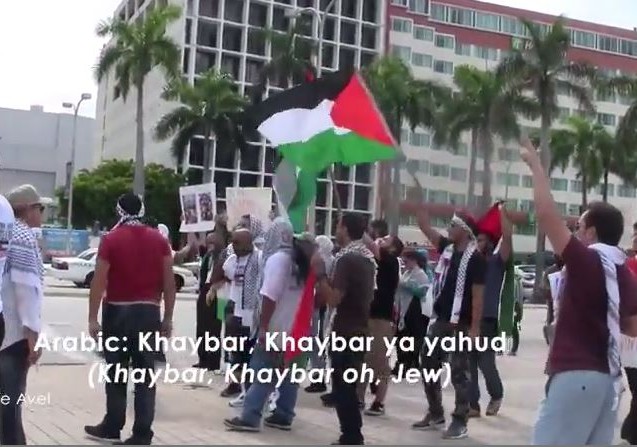
This is the third in our series revisiting our coverage of the 2014 Gaza conflict. In the first post, we reported how the war did not start the way the anti-Israel propagandists content, with an Israeli attack in retaliation for the kidnapping and murder of three Israeli teens by a Hamas-affiliated cell in the West Bank. To the contrary, the kidnapping resulted in an Israeli crackdown in the West Bank, but it was relentless Hamas rocket fire from Gaza into Israel that precipitated Israeli air attacks on Hamas and Islamic Jihad in Gaza, Gaza July 8, 2014 – Hamas Rockets Ignite War. Having debunked (again) the myth that Israel started the Gaza conflict, we debunked another myth, that the thousands of deaths and injuries were the result of Israel's desire to assault Gaza. In fact, after the first week of air attacks and Hamas rocket fire and infiltrations, Egypt proposed a ceasefire. Had both sides accepted that ceasefire, there would have been no Israeli ground invasion, and the deaths and casualties a small fraction of the ultimate total. Israel accepted the ceasefire, Hamas rejected it. The result was more Hamas rocket fire, and an Israeli ground invasion. Gaza July 18, 2014 – Ground War After Hamas Rejects Ceasefire. Now another myth busted -- that protests in Europe and elsewhere were merely anti-Zionist, not anti-Semitic, and in any event, isolated. In fact, virtually everywhere there was a major "pro-Palestinian" rally, there was blatant anti-Semitism accompanied by threats and violence. And not just overseas. In Miami, Boston and San Francisco as well. Here are the events we covered. It's not an exhaustive list, by any means.

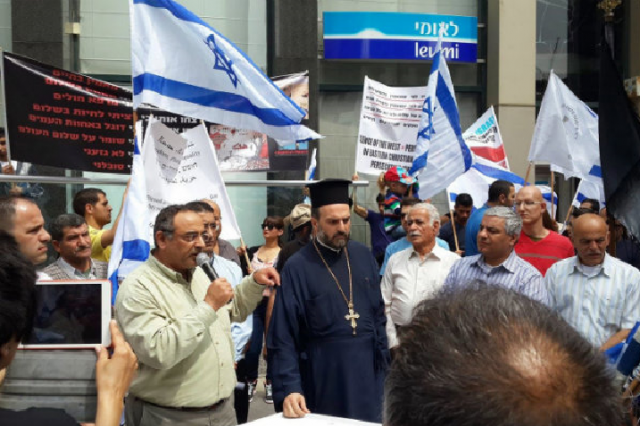
On July 16, Israel’s Christian Empowerment Council (CEC) released a short pamphlet titled Test The Spirits: A Christian Guide to the Anti-Israel Boycott Movement (BDS). It’s authored by Father Gabriel Naddaf, a Greek Orthodox priest from Nazareth in the Galilee. The new guide garnered some publicity in Israel. But here in the U.S., other than a press release featured by JNS and a few other websites, it hasn’t received a lot of attention. Spread the word about this terrific new resource. Test The Spirits rejects the isolation and vilification of Israel under the banner of Christian values. It’s an unreserved and heartfelt vindication of the Jewish state and the Jewish people. http://www.cecisrael.org/

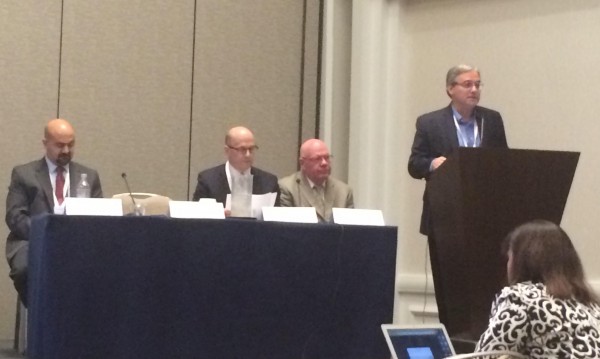
On Wednesday, July 22, 2015, I was on a panel at the Annual Meeting of the American Legislative Exchange Council (ALEC).  Keynote speakers at the Annual Meeting include Scott Walker and Ted Cruz. The topic of my panel was Freedom of Thought in Higher Education. The panel chair was Utah State Senator Howard Stephenson, and fellow panelists Dr. Peter Wood, President of the National Association of Scholars, and Robert Shibley, Executive Director of The Foundation for Individual Rights in Education (FIRE). The panel was the best attended workshop of the day, with over 100 attendees, mostly state legislators. [caption id="attachment_135470" align="alignnone" width="600"]William A. Jacobson Cornell ALEC Annual Meeting 2015 [L-R - Robert Shibley, Peter Wood, Howard Stephenson, William Jacobson][/caption]My portion focused on the anti-Israel academic boycott and broader boycott movement (BDS). About one-third of the more than 100 mostly state legislators in attendance had heard of BDS. I covered the history of BDS, which was created at the anti-Semitic 2001 Durban Conference, and how systematic academic boycotts pose systemic risk which is appropriate for narrowly tailored legislation that protects the system without unduly infringing on academic freedom and free speech. I discussed, among other things, my challenge to the tax exempt status of the American Studies Association.

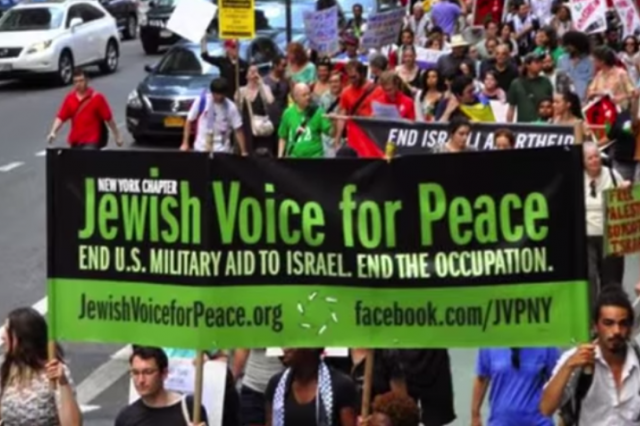
In recent posts we have discussed Jewish Voice for Peace (JVP), a U.S. based organization that has established itself as the “Jewish wing” of the Palestinian solidarity movement. JVP plays a critical role in numerous aspects of the anti-Israel Boycott, Divestment and Sanctions (BDS) movement in the United States by giving Jewish cover. In so presenting itself as the Jewish justification for BDS, JVP serves the role of washing away the stains of anti-Semitism and anti-Zionism which are central to the BDS movement's founding and conduct.

1. JVP - Not a Major Player in Jewish Life

Founded in 1996 by a small group of left-wing San Francisco Bay Area Jews, JVP worked in relative obscurity for years. Today it looks poised to break into the big leagues of American Jewish organizational life. According to its website and recent press releases, JVP currently has a youth wing and a Rabbinic Council, over 65 member-led chapters across the country, and 200,000+ online supporters. But looks can be deceiving. It’s difficult to pin these numbers down. According to Yitzhak Santis, Chief Programs Officer for the Jerusalem-based watchdog group NGO Monitor, “JVP provides no evidence” for its claim of tens of thousands of Jewish American followers. It doesn’t actually require that its members be Jewish or American.

Marie Brenner, writing in Vanity Fair, explores whether Jews should leave France. The French language version of the article is titled Paris En Flammes. With my distant recollection of high school french, that translates as Paris in Flames. But the English language version has a more descriptive title, The Troubling Question in the French Jewish Community: Is It Time to Leave?:
How can anyone be allowed to paint a swastika on the statue of Marianne, the goddess of French liberty, in the very center of the Place de la République?” That was what the chairman of one of France’s most celebrated luxury brands was thinking last July, when a tall man in a black shirt and a kaffiyeh leapt to the ledge of Marianne’s pedestal and scrawled a black swastika. All around him, thousands of angry demonstrators were swarming the square with fake rockets, Palestinian and Hamas flags, even the black-and-white banners of ISIS. Here, barely a mile and a half from the Galeries Lafayette, the heart of bourgeois Paris, the chants: “MORT AUX JUIFS! MORT AUX JUIFS!” Death to the Jews. It was Saturday, July 26, 2014, and a pro-Palestinian demonstration turned into a day of terror in one of the most fashionable neighborhoods of the city.
http://www.liveleak.com/view?i=e7b_1420820113 We covered those riots last summer (some of the videos in the posts have gone bad):

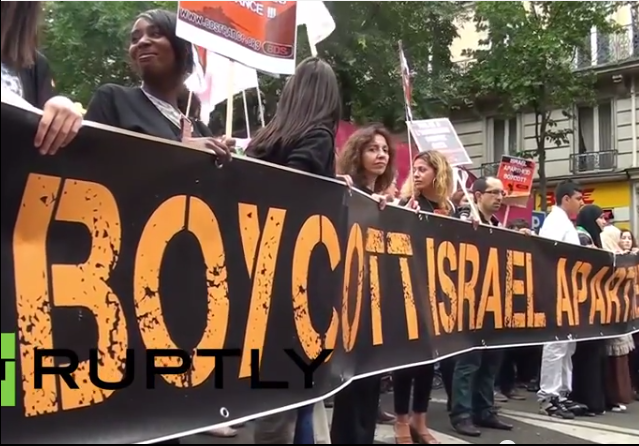
This week the Boycott, Divestment and Sanctions (BDS) movement and its supporters will be celebrating the 10th anniversary of the supposedly grassroots launch of the BDS movement by Palestinian "civil society" organizations. The Associated Press, through its writer Tia Goldenberg, has a lengthy article on the BDS movement. The article is receiving a lot of attention, including a Drudge link, and because it is AP is being reprinted (under varying titles) at numerous news website. The article starts with BDS's supposed grassroots beginnings, Boycott Israel drive gains strength, raising alarm:
Ten years ago, a small group of Palestinian activists had a novel idea: inspired by the anti-apartheid movement, they called for a global boycott movement against Israel as a nonviolent method to promote the Palestinian struggle for independence.
That narrative of how the BDS movement began is false, and demonstrably so. The boycott call issued in July 2005 was not the result of a small group of activists getting together, it was the result of a multi-year organized effort for a global boycott of Israel, most prominently in a boycott call issued at the 2001 UN Durban Conference which was so anti-Semitic the U.S. walked out. We have explored this history many times at Legal Insurrection. Here is the actual history of the BDS movement:

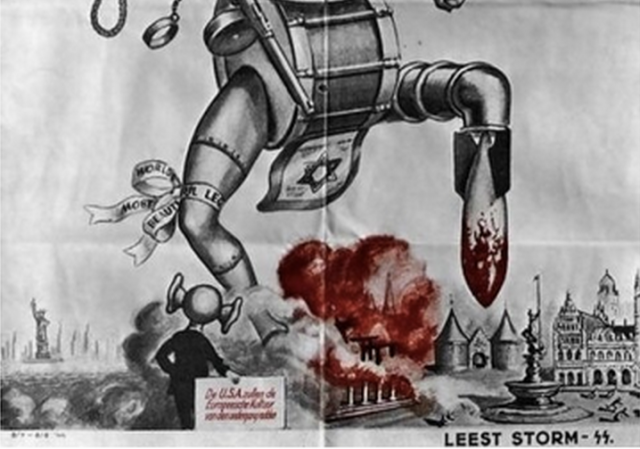
In the spring of 2014, a series of ugly incidents rocked the campus of Vassar College, a small liberal arts college just north of New York City. It started with a boycott protest against a course that involved travel to Israel and the West Bank, including forcing a professor and students to walk a gauntlet of people ululating (audio example here). It culminated in the posting on social media of a Nazi cartoon portraying Jewish control of the U.S. The group mounting the protest and posting the plainly anti-Semitic cartoon was Vassar Students for Justice in Palestine. The series of events was ignited by passage of an academic boycott of Israel by the American Studies Association, a rejection of the boycott by Vassar's president (along with 250 other university presidents), and a counter-reaction by 39 Vassar professors who defended the boycott.  SJP took it from there. It's all detailed in my post Anti-Israel academic boycott turns ugly at Vassar and a series of follow up posts, including about my debate challenge to the 39 professors (which was not accepted): With everything happening on the anti-Israel boycott front, both good and bad, Vassar had faded a little from memory, until I saw a July 3, 2015 Op-Ed in The Washington Post by Jill Schneiderman, one of the two Vassar professors teaching the boycotted course. For Schneiderman, the memories obviously haven't faded, and remain raw. The Op-Ed is How academic efforts to boycott Israel harm our students. Read the whole thing. Here is an excerpt:

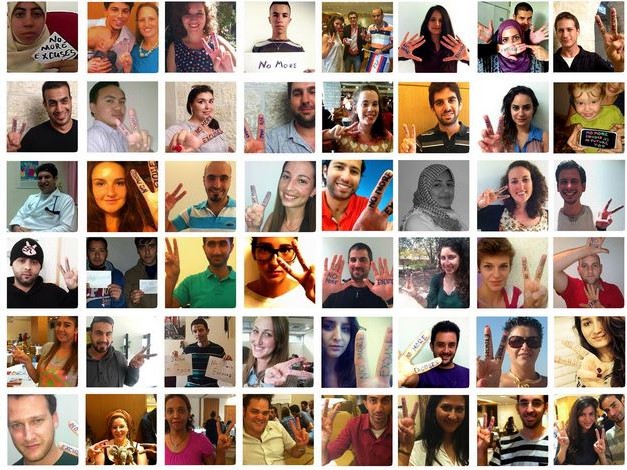
The United Church of Christ recently passed a resolution adopting part of the Boycott, Divestment and Sanctions (BDS) platform. The resolution purported to demand divestment from the "occupation," but in fact a late amendment broadened it substantially to include virtually every Israeli company, as I explained in my prior analysis. (Another resolution, declaring Israeli guilty of the Crime of Apartheid, had a split vote short of the 2/3 needed for passage.) Throughout the committee-level and annual meeting debate and presentations about divestment, aligning UCC with BDS was repeatedly stressed as part of a peaceful process of ending the conflict. The anti-Israel Jewish Voice for Peace played a central role in Jew-washing the nature of the BDS movement, allowing BDS supporters at UCC to say - hey, look, there are Jews who support what we are doing. [caption id="attachment_132637" align="alignnone" width="600"][Speaker in support of divestment says "Stand with Jewish Voice for Peace"] [Speaker in support of divestment says "Stand with Jewish Voice for Peace"][/caption]If UCC's delegates and leadership thought aligning UCC with BDS was a move towards peace, it was severely duped. Here's a perfect example of how BDS is against peaceful reconciliation. The YaLa Young Leaders conference attempts to bring Israeli youth together with Arab youth from around the world. We first wrote about the conference in 2014. Since then, it has grown to even greater success:

After the United Church of Christ passed an Israel divestment resolution on June 30, 2015, there was concern that the Boycott, Divestment and Sanctions movement might score three victories at church annual meetings this week. But that did not happen. The Mennonite Church USA tabled the divestment resolution, and the Episcopal Church House of Bishops voted it down overwhelmingly on a voice vote (I listened, and there were almost zero people shouting "yes" and a loud chorus of "No"). AP reported on the Mennonite vote:
A leading Mennonite group has delayed a decision on divesting from companies with business tied to Israel's occupation of the Palestinian territories. The Mennonite Church USA was set to vote this week on whether they should sell off stock in companies "known to be profiting from the occupation" and from "destruction of life and property" in the territories. A church spokeswoman said delegates at a national meeting in Kansas City, Missouri, voted 418-336 to table the resolution until their next assembly two years from now. Twenty-eight delegates abstained.

We highlighted recently resolutions at the United Church of Christ's 30th Synod in Cleveland seeking (1) divestment from certain named companies (such as Caterpillar), and (2) declaring Israeli guilty of the Crime of Apartheid as defined in the 1998 Rome Statute creating the International Criminal Court. These take place through years-long efforts by anti-Israel Christian groups like Sabeel, which use Jewish Voice for Peace as religious cover for the noxious efforts. The divestment resolution originally was limited to specified companies, but in committee at the Synod was amended to include sweeping language governing any company that does business, directly or indirectly, in "occupied" territory. United Church Christ Israel Divestment Resolution 1 This would include, for example, companies doing business in the Jewish Quarter of the Old City, which was illegally captured by Jordan and then enthically cleansed of Jews and Jewish landmarks before Israel liberated it in 1967.

Sabeel Ecumenical Liberation Theology Center, a Palestinian Christian organization headquartered in Jerusalem, is a group you probably never heard of. But Sabeel plays a critical role in seeking to reverse Christian support for Israel around the world. In the U.S., Friends of Sabeel - North America (FOSNA) is behind or involved in virtually every divestment resolution pending before various Christian denominations, often teaming up with Jewish Voice for Peace (JVP). You need to know about Sabeel, and how Sabeel and JVP team up against Israel. Sabeel provides the Christian liberation theology, JVP provides the Jewish cover.

1. United Church of Christ

For the past few days, the General Synod of the United Church of Christ (UCC) has been deliberating in Cleveland, Ohio on several resolutions related to Israel. Back in 2005, the UCC passed a resolution condemning Israel’s security barrier and calling on Israel to “tear down the wall” (Israel’s construction of the security barrier began in 2002 as a counterterrorism measure). This week its General Synod is considering a divestment resolution modelled after the one that narrowly passed last year by a 310-303 vote in the General Assembly of the Presbyterian Church (USA), the largest of several Presbyterian denominations in America.

The anti-Israel activists employed as professors who led the fight at the American Studies Association to pass the academic boycott of Israel in December 2013, have been patting themselves on the back ever since. Forget that over 250 university presidents and the major academic organizations condemned the move as a gross violation of academic freedom.  Even the NY Times called the ASA a "pariah." The ASA humiliatingly had to back down from its plan to bar representatives of Israeli academic institutions from its annual meeting, eventually promising that even Bibi Netanyahu could attend. The profs seething with hatred of Israel, and anti-Zionist websites which promoted their academic boycott agenda, saw it differently. In their own minds, they were on the cusp of a historic anti-Israel paradigm change. The future belonged to the boycotters, in their minds. The reality has not worked out that way.  Other than some very small faculty organizations, no major academic group has adopted the boycott. No university in the U.S. is even considering a boycott. But the hyperbolic hateful rhetoric by the profs did have an effect.