Image 01 Image 03

Obamacare Tag

For all the times we've been told Obamacare does not fund abortion, a new GAO report proves exactly the opposite. Salon wrote this fantastic piece decrying anti-choice activists who bought into the Obamacare-abortion myth, and last night the Washington Examiner released their findings related to the GAO report and recapped the debate as follows:
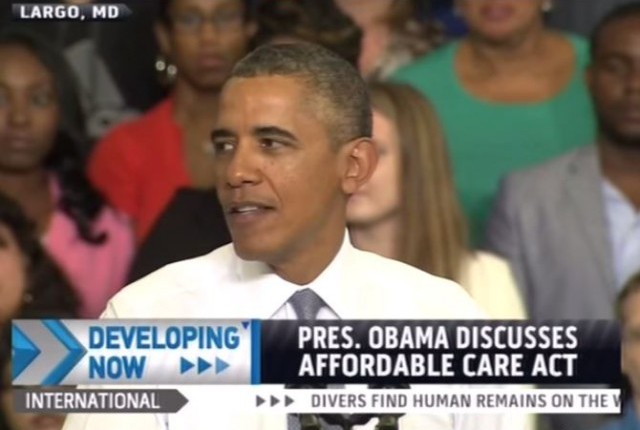
Again and again, during the congressional debate, Obamacare defenders promised: Obamacare subsidies won't subsidize abortion; customers will be able to choose insurance plans that don't cover abortion; Obamacare subsidies, if they want to pay for abortion coverage, will be billed separately. A new GAO report shows that Obamacare is failing on these counts. Warning of "bogus claims spread by those whose only agenda is to kill reform at any cost," for instance, President Obama told Congress in 2009: "And one more misunderstanding I want to clear up – under our plan, no federal dollars will be used to fund abortions, and federal conscience laws will remain in place."
The Examiner summarized the GAO report:
Customers in five states have no abortion-free plans available to them, and in many states, customers can't tell which plans cover abortion and which don't. In Washington State, for instance, the state's exchange bills customers on behalf of insurers--and the exchange covers abortion with federal tax dollars. The GAO found: "the exchange’s billing system was not assessing any premium to individuals whose premiums are fully subsidized under the law if these individuals are enrolled in QHPs that cover non-excepted abortion services."
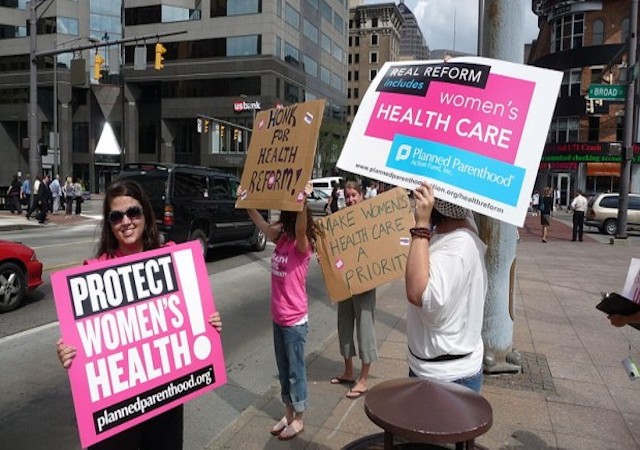
Last week, Planned Parenthood announced its opposition to Republican proposals to make contraceptives available as over-the-counter (OTC) drugs. Let me paraphrase Planned Parenthood's three points of opposition:

1) The expanded access to birth control is being offered by Republicans. Republicans hate women. Ergo, vote for Sen. Mark Udall (D-CO).

Planned Parenthood claims that GOP efforts to expand birth control access is "an empty gesture," because (get ready for non sequiturs) Republicans want to repeal Obamacare and support the First Amendment's guarantee of religious freedom. The Washington Examiner notes that "A number of Republican Senate candidates have backed over-the-counter birth control in races this year, including Cory Gardner in Colorado, Thom Tillis in North Carolina, Ed Gillespie in Virginia, Mike McFadden in Minnesota." What the leading abortion provider's press release does not mention is that OTC contraceptives would free many women from having to go to (and pay) its offices to get a prescription for the drugs. If birth control pills were easy to get over-the-counter, Planned Parenthood would lose a tremendous revenue stream. It benefits when the government forces women to go to its prescription-writing centers. It benefits by restricting a woman's access to birth control. By Planned Parenthood's own 2012 statistics, 34 percent of its revenue comes from "contraception" services, 37.9 percent of which are "oral" contraceptives. That's 13 percent of its annual take that could vanish if birth control pills were sold next to aspirin and antacids. Its 2013 annual report shows Planned Parenthood took in $1.2 billion dollars, so it stands to lose $156 million a year if GOP proposals gain ground.

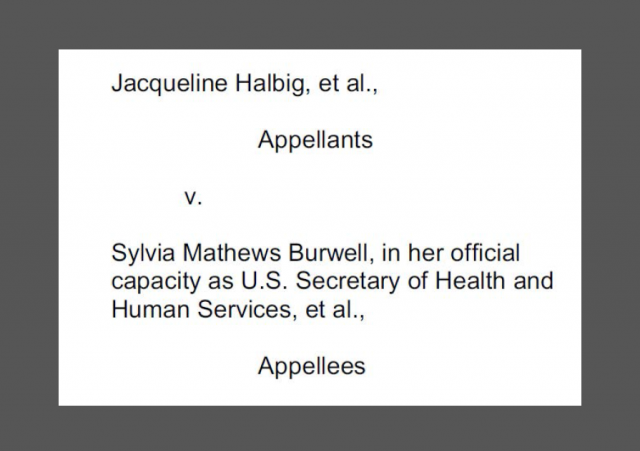
I don't know how I missed this yesterday. Actually, I do know. I was off the internets for most of the day, and the world kept turning without me. The D.C. Circuit Court of Appeals granted (Order embedded at bottom of post) en banc (full court) hearing in the Halbig case, in which an appeals court panel found that the IRS had no authority to grant people who signed up for Obamacare on the federal exchange tax subsidies which, under the statute, were only for those who signed up on state exchanges. The same day as the original Halbig decision was released, the 4th Circuit Court of Appeals reached a different conclusion. The split in Circuits convinced just about everyone that the case was on the fast track to the Supreme Court. But many speculated at the time that the D.C. Circuit, packed with Obama appointees, would take the case en banc, uphold the IRS regs, and avoid a Circuit split. I didn't think that would happen, but I was wrong. Via Prof. Jonathan Adler at Volokh Conspiracy:

The American Medical Association wants to jumpstart a health care discussion that died a political death almost five years ago: to "death panel," or not to "death panel?" Of course, we're not talking about actual panels making life-or-death decisions on behalf of patients, but mandated coverage for "end of life discussions" between patients and doctors. Back in 2009, Sarah Palin coined the divisive term, and woke America up to the possibility that yes, handing over our health care decisions to the government a little bit at a time could backfire in spectacular and inhumane ways. The New York Times reports that the AMA is putting pressure on the Center for Medicare and Medicaid Services to begin covering these end of life discussions. If the Center adopts the AMA's recommendations, Medicare patients could start receiving coverage for these conversations as early as next year. From the Times:
“We think it’s really important to incentivize this kind of care,” said Dr. Barbara Levy, chairwoman of the A.M.A. committee that submits reimbursement recommendations to Medicare. “The idea is to make sure patients and their families understand the consequences, the pros and cons and options so they can make the best decision for them.” Now, some doctors conduct such conversations for free or shoehorn them into other medical visits. Dr. Joseph Hinterberger, a family physician here in Dundee, wants to avoid situations in which he has had to decide for incapacitated patients who had no family or stated preferences.
Although the Affordable Care Act contains no coverage requirements for end of life conversations, many private insurance companies have made the choice on their own to cover these appointments.

Here's another item for the growing list of things we weren't told about Obamacare before it was passed. It seems the Affordable Care Act presents a direct threat to employer provided health insurance plans and could force up to 150 million people out of their current plans. Jim Angle of FOX News did a recent in-depth report on the subject:
Will ObamaCare mean the end of employer-provided insurance? President Obama's famous promise that “you can keep your plan and your doctor, no matter what” was not the only misleading argument he made for his health care plan. There is yet another controversy, with even bigger consequences, brewing for Americans who already have health care. Analysts predict that as ObamaCare takes hold, it will mean the end of employer-provided insurance, with former Obama adviser Zeke Emanuel predicting that80 percent of such plans will disappear within ten years.

The Obama Administration announced today that they're once again changing the rules governing health care plans provided by religiously-oriented nonprofit organizations. Via The Hill:
Under the rule, the government would step in and cover the law’s contraception requirements in instances where employers announce their religious objections in writing. The organizations would not have to play any direct role in providing for contraceptive coverage to which they object, according to sources familiar with the rule. The rule had not formally been issued as of Friday afternoon. The fix is in line with a suggestion put forth by Supreme Court Justice Anthony Kennedy in the high court ruling against the mandate in the case known as Hobby Lobby v. Burwell.
The new rule is posted in detail on the Centers for Medicare and Medicaid Services website:

Patient advocates are up in arms over allegations that insurance companies are violating Obamacare's anti-discrimination provisions. Groups like the AIDS Institute and the Leukemia and Lymphoma Society cite difficulties with getting coverage for expensive medications and finding quality in-network care as just two in a long list of grievances against the implementation of the new health care law. Via ABC News:
Kansas' commissioner, Sandy Praeger, a Republican, said the jury is out on whether some insurers are back to shunning the sick. Nonetheless, Praeger said the administration needs to take a strong stand. "They ought to make it very clear that if there is any kind of discrimination against people with chronic conditions, there will be enforcement action," Praeger said. "The whole goal here was to use the private insurance market to create a system that provides health insurance for all Americans."
Adding to patient difficulties is the fact that, although some of Obamacare's anti-discrimination provisions have been put into effect, many have been left pending for more than four years. This makes enforcement difficult when the people the law purports to protect have been told since 2010 that the Affordable Care Act is the immediate solution for those who previously were not able to secure coverage. What's troubling about the actions of patient advocates, however, is the obvious conflation of "discrimination" with "complications":
The advocates also say they are disappointed by how difficult it's proved for consumers to get a full picture of plans sold on the new insurance exchanges. Digging is often required to learn crucial details such as drugs covered, exact copayments and which doctors and hospitals are in the network.

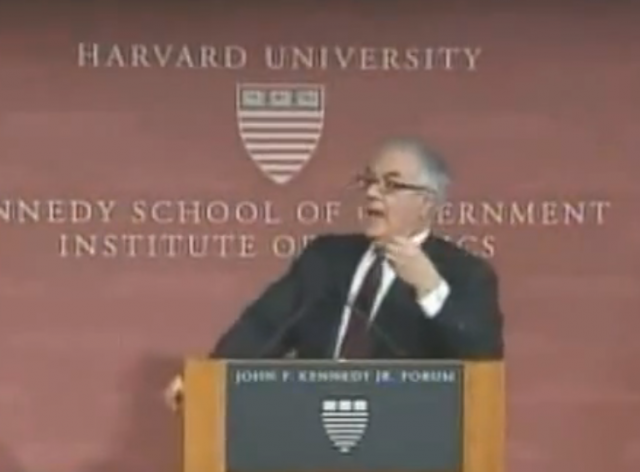
Former Democratic Congressman and outspoken liberal Barney Frank has some surprisingly harsh words for President Barack Obama. Frank was interviewed recently by The Huffington Post:
"The rollout was so bad, and I was appalled -- I don't understand how the president could have sat there and not been checking on that on a weekly basis," Frank told HuffPost during a July interview. "But frankly, he should never have said as much as he did, that if you like your current health care plan, you can keep it. That wasn't true. And you shouldn't lie to people. And they just lied to people." "He should have said, 'Look, in some cases the health care plans that you've got are really inadequate, and in your own interests, we're going to change them,'" Frank said. "But that's not what he said."
Frank was a 16th term Congressman from Massachusetts who retired from career politics in 2012. But he has always been an outspoken supporter of Obama and the Obamacare law itself. In fact, just four years ago, Frank equated Obamacare opponents to bullies that drive teenagers to suicide.:

UPDATE: Whipsaw: 4th Circuit upholds Obamacare federal exchange subsidy after D.C. Circuit rejects Full opinion and Judgment at bottom of post Decision just released in Halbig case. Here's the punchline:
Section 36B of the Internal Revenue Code, enacted as part of the Patient Protection and Affordable Care Act (ACA or the Act), makes tax credits available as a form of subsidy to individuals who purchase health insurance through marketplaces—known as “American Health Benefit Exchanges,” or “Exchanges” for short—that are “established by the State under section 1311” of the Act. 26 U.S.C. § 36B(c)(2)(A)(i). On its face, this provision authorizes tax credits for insurance purchased on an Exchange established by one of the fifty states or the District of Columbia. See 42 U.S.C. § 18024(d). But the Internal Revenue Service has interpreted section 36B broadly to authorize the subsidy also for insurance purchased on an Exchange established by the federal government under section 1321 of the Act. See 26 C.F.R. § 1.36B-2(a)(1) (hereinafter “IRS Rule”). Appellants are a group of individuals and employers residing in states that did not establish Exchanges. For reasons we explain more fully below, the IRS’s interpretation of section 36B makes them subject to certain penalties under the ACA that they would rather not face. Believing that the IRS’s interpretation is inconsistent with section 36B, appellants challenge the regulation under the Administrative Procedure Act (APA), alleging that it is not “in accordance with law.” 5 U.S.C. § 706(2)(A). ....Because we conclude that the ACA unambiguously restricts the section 36B subsidy to insurance purchased on Exchanges “established by the State,” we reverse the district court and vacate the IRS’s regulation.
What problems does this create? Massive. All the millions of people who signed up for Obamacare on the federal exchange -- and the true numbers were disputed -- expecting to get tax credits as subsidies now will not get those subsidies. A year-long effort to get people to sign up for Obamacare on the federal exchange will be in peril. Here's how The Washington Times summarized the effect prior to the decision, Five million Americans in for premium spikes if Obamacare challenge is successful:

The Obama administration has a habit of releasing new regulations at the beginning of holiday weekends and the 4th of July is no exception. While most Americans are planning outings with family and friends for picnics and fireworks, 1,300 pages of new Obamacare regulations were released. Larry O'Connor of Truth Revolt reported:
Holiday Document Dump: 1,300 Pages Of Obamacare Regs On July 4th Eve The Department of Health and Human Services released nearly 1,300 pages of new regulations related to the Affordable Care Act (Obamacare) at 4:15 Thursday, just as the nation was beginning their Independence Day holiday weekend. The regulations deal with payment rates to doctors and hospitals. How doctors get paid by HHS through the new, overreaching Obamacare guidelines has been an item of concern for the American Medical Association, a key supporter of the health care law.
Philip Klein of the Washington Examiner also noted the timing:

In light of the Hobby Lobby decision, the Supreme Court today granted an injunction pending appealy in favor of Wheaton College, which did not want to comply with certain Obamacare paperwork on religious grounds:
The application for an injunction having been submitted to JUSTICE KAGAN and by her referred to the Court, the Court orders: If the applicant informs the Secretary of Health and Human Services in writing that it is a nonprofit organization that holds itself out as religious and has religious objections to providing coverage for contraceptive services, the respondents are enjoined from enforcing against the applicant the challenged provisions of the Patient Protection and Affordable Care Act and related regulations pending final disposition of appellate review. To meet the condition for injunction pending appeal, the applicant need not use the form prescribed by the Government, EBSA Form 700, and need not send copies to health insurance issuers or third-party administrators.
Note that this really is not substantive, it's a matter of paperwork, as AP explains:
A divided Supreme Court on Thursday allowed, at least for now, an evangelical college in Illinois that objects to paying for contraceptives in its health plan to avoid filling out a government document that the college says would violate its religious beliefs. The justices said that Wheaton College does not have to fill out the contested form while its case is on appeal but can instead write the Department of Health and Human Services declaring that it is a religious nonprofit organization and making its objection to emergency contraception. The college does provide coverage for other birth control. Justices Ruth Bader Ginsburg, Elena Kagan and Sonia Sotomayor said they would have denied Wheaton's request and made the college fill out a form that enables their insurers or third-party administrators to take on the responsibility of paying for the birth control.
Yes, heads exploding: