

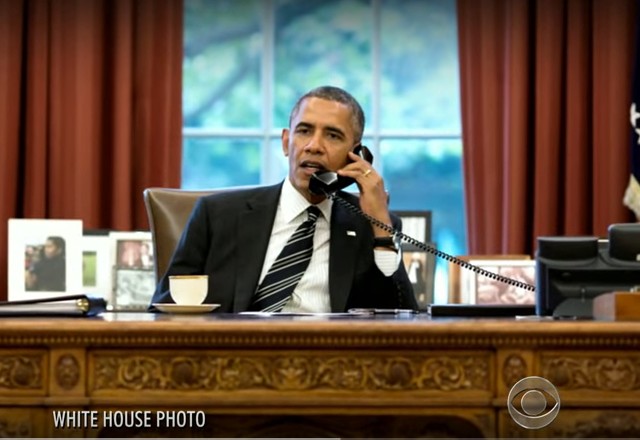
Today, the State Department sent the Obama Administration's now-infamous Iran nuclear deal to Congress for review. This means that starting now, Congress has 60 days to fully read, analyze, and pass judgment on the bill of goods Obama and Kerry are selling.
Will any of that work matter, though? Maybe not.
The other parties to the agreement with Iran are putting enormous pressure on the Obama Administration to push this deal through the UN before our Congress has the opportunity to either accept or reject its contents. The Administration, in turn, appears to have decided to take away all of the legitimacy of Congressional review by acquiescing to the demands of the international community---and Congress is not happy about it.
Via The Hill:
The battle is uniting Republicans, from conservative firebrand and presidential hopeful Sen. Ted Cruz (R-Texas) to GOP leadership and Foreign Relations Committee Chairman Sen. Bob Corker (R-Tenn.).
Sen. John Thune (R-S.D.), the chairman of the Senate Republican Conference, urged the administration to hold off on the U.N. Security Council vote.
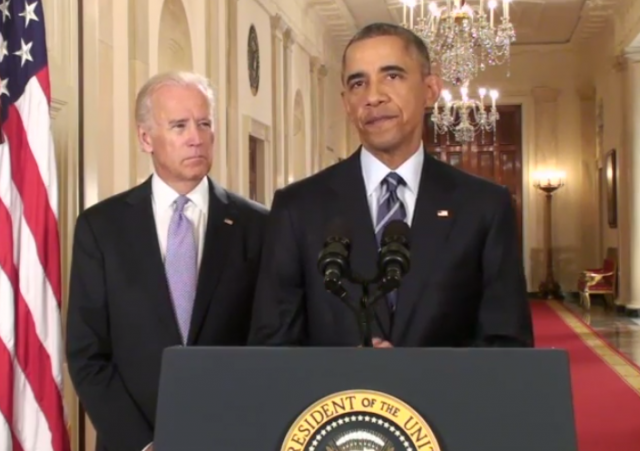
So to go back to Congress, I challenge those who are objecting to this agreement, number one, to read the agreement before they comment on it; number two, to explain specifically where it is that they think this agreement does not prevent Iran from getting a nuclear weapon, and why they’re right and people like Ernie Moniz, who is an MIT nuclear physicist and an expert in these issues, is wrong, why the rest of the world is wrong, and then present an alternative.
First off it's worth noting that Energy Secretary and MIT nuclear physicist Ernest Moniz said back in April that to be effective the deal would have to include "anytime, anywhere," inspections, so Obama's explanation about why 24 days notice is now good enough fails to convince me.
I want Moniz to explain why he changed his position on this AND why 24 days is now acceptable. I would like Deputy National Security Adviser Ben Rhodes to explain why he walked back his comments on requiring "anytime, anywhere" inspections.
And I want a more convincing explanation than negotiator Wendy Sherman's excuse that the term was just a "rhetorical flourish." (If that was a rhetorical flourish, I'm curious how many other administration comments about the nuclear deal were rhetorical flourishes.)
It is not often that I feel compelled to defend President Obama. But in this case I will. The recent nuclear deal with Iran reveals that he is not a poor negotiator but rather an excellent one.
The President has been mocked for his negotiation skills throughout his tenure by the Left and the Right - from people ranging from Paul Krugman to Bob Woodward to Donald Trump. And interestingly the reasons both sides give for their assessment are as similar as they are contrary.
To the Left, Obama is simply too good to be good negotiator. He’s no mere politician, after all. He’s an ideologue! Too filled with idealism, too pure, too above the taint of politics to be talented at negotiation.
The Atlantic for example wrote in its 2011 piece “Why Obama Is So Bad At Negotiations” that “The truth is, that while the president's idealism has made him a very poor negotiator, it is what attracted me and I suspect many others to him in the first place. His lack of cynicism and belief that we could tackle our problems together as one nation was unique, beautiful and stunning in our modern political system.”
Similarly, the Right argues that Obama is a poor negotiator because, again, he is an ideologue. As GOP presidential candidate Carly Fiorna said on a recent appearance on Hannity “[Obama] has spent a lifetime in politics and ideology. That’s it. That’s his life. If you have no experience in negotiating you don’t negotiate very well. If you have no experience in problem-solving you don’t solve problems very well. If you have no experience in compromising you don’t compromise very well. What’s he good at? Giving a speech and sticking to his ideology.”
This perception of Obama as a poor negotiator has been tested by the recently announced Iranian nuclear deal.
Posted by William A. Jacobson
on July 17, 201514 Comments
The Obama administration and its supporters try to paint opposition to the Iran nuke deal as a Bibi Netanyahu problem.
That's a convenient excuse, because it allows Obama to play the Democrat loyalty card among members still upset about Bibi's appearance in Congress. It also plays into "Israel Lobby" demonization, the bogeyman of the left.
The opposition to the Iran nuke deal, however, is bringing together usual political enemies. Jeffrey Goldberg at The Atlantic interviews Isaac Herzog, Bibi's primary domestic political opponent, Israeli Opposition Leader: Iran Deal Will Bring Chaos to the Middle East:
Last December, when I interviewed the leader of Israel’s left-leaning Labor Party, Isaac “Bougie” Herzog, at the Brookings Institution’s Saban Forum, he said, in reference to nuclear negotiations with Iran: “I trust the Obama administration to get a good deal.”
In a telephone call with me late last night, Herzog’s message was very different. The deal just finalized in Vienna, he said, “will unleash a lion from the cage, it will have a direct influence over the balance of power in our region, it’s going to affect our borders, and it will affect the safety of my children.”
Posted by Vijeta Uniyal
on July 16, 201510 Comments
Indian newspapers generally echoed Western sentiments by welcoming the Iran deal and India's Foreign Office also took a line similar to the one taken by the EU and other Western powers.
But behind the scenes, India is getting ready for the coming nuclear arms race in their Arab neighbourhood.
Far from buying President Obama's optimism over the 'peace dividend', Indian defence establishment is building up its nuclear defence capabilities.
In recent months, India has invested heavily in ramping up missile defences. With Israeli expertise, India will soon be able to detect and intercept missiles within the range of 5,000 km – double the aerial distance between New Delhi and Tehran.
As President Obama was announcing the Iran deal to the world, Indian government was busy clearing new defence deals worth billions. Indian News website Firstpost reports:
The Obama Administration is busy running a full court press on behalf of its terrible nuclear deal with Iran. Yesterday, the President sat down with Thomas Friedman of the New York Times for a softball interview, and today, he hosted a press conference to answer critics' concerns about the contents of the deal, and the Administration's posture toward Iran's overall behavior.
https://youtu.be/SzBlcd4n73g?t=1h8m1s
Via Fox news:
Posted by David Gerstman
on July 15, 201513 Comments
President Obama defended his deal to Iran to Thomas Friedman of The New York Times yesterday. It was a bad deal and it represented a retreat on nearly every single element of the deal.
In any case this is what Obama told Friedman:
“We are not measuring this deal by whether it is changing the regime inside of Iran,” said the president. “We’re not measuring this deal by whether we are solving every problem that can be traced back to Iran, whether we are eliminating all their nefarious activities around the globe. We are measuring this deal — and that was the original premise of this conversation, including by Prime Minister Netanyahu — Iran could not get a nuclear weapon. That was always the discussion. And what I’m going to be able to say, and I think we will be able to prove, is that this by a wide margin is the most definitive path by which Iran will not get a nuclear weapon, and we will be able to achieve that with the full cooperation of the world community and without having to engage in another war in the Middle East.”
Posted by William A. Jacobson
on July 14, 201529 Comments
I can't recall an event since I started this website in 2008 that has been as historically consequential as the nuclear deal the United States and five other countries just struck with Iran.
It is the sweep of history.
The deal is Obama's deal. He drove it, he crafted it with John Kerry as the scrivener, and he pulled the other powers along with it.
The defects in the Iran nuclear deal are being exposed in great detail. Those problems are serious and real.
But what has troubled me the most as I read through the varied technical analyses is the same thing that has bothered me since June 2009, when the Iranian people rose up against the Mullah regime after fraudulent elections.
Obama was silent for weeks in the face of brutal regime oppression and repression, and then structured a response designed to keep the Mullahs in power.
[Video of the Rooftop Revolution in Tehran, June 9, 2009]
I wrote about it at the time, Negotiations Preconditioned On Mullah Rule:
This morning, news broke confirming what conservatives have been dreading for weeks---Obama finally got his bad Iran deal, and is now threatening to veto any action by Congress that would derail it.
Iran is, of course, celebrating:
Posted by William A. Jacobson
on July 14, 201532 Comments
The Obama administration with the help of the so-called P5+1 has reached a nuclear deal with Iran.
Not all the details will be made public, but those that have been made public make a mockery of the promises of full, unfettered inspections, sanctions relief based on Iranian performance, and quick "snap back" of sanctions for violation.
WH needs to be careful not to over-sell #Iran deal. will not stop spread of nuclear weapons in the region & could come to make things worse
Posted by David Gerstman
on July 12, 201514 Comments
President Barack Obama has, at least since 2012, claimed that he has Israel's back regarding his engagement with Iran.
But as the Iran nuke negotiations move closer to an agreement, with reports it could happen by tomorrow, it is clear that Obama's words are empty rhetoric.
In May ahead of his talk at a Washington D.C. synagogue, Obama said it once again, telling Jeffrey Goldberg, "It’s because I think they recognize, having looked at my history and having seen the actions of my administration, that I’ve got Israel’s back..."
Events of this past week gives lie to Obama's contention. No this deal won't make Israel safer. But let's check what Iranians are saying.
Last week, for example, Iran's former president, Ali Akbar Hashemi Rafsanjani, someone often called a "moderate" and an ally of current president, Hassan Rouhani, threatened to "wipe Israel off the map."
In response to a question why the Zionist regime has done its best to prevent the path for reaching a nuclear agreement between Iran and the West, Ayatollah Rafsanjani said that even Tel Aviv knows well that Iran is not after acquiring nuclear weapons.
Posted by Mirabelle Ward
on July 07, 20152 Comments
Yesterday the Washington Free Beacon reported that that the Obama administration is willing to do whatever it takes to prevent a veto override when Congress votes on the Iran deal.
This morning, CNN hosted a veritable White House press conference about the subject. Former State Department Iran negotiator Hillary Mann Leverett and Obama shill and Haaretz contributor Peter Beinart were anchor Chris Cuomo's entire panel.
One point that Beinart made that deserves examination is his assertion that “Iranian dissidents want this deal to go through,” on the theory that opening up Iran will lessen the regime’s human rights abuses.
He’s made the same argument here, and we're likely to hear it again in the coming weeks.
It's worth asking, then, whether the human rights situation in Iran stands to improve.
To begin with, Beinart is being disingenuous when he says that dissidents support the deal. Eli Lake documented in 2013 that, while some support it, many others do not.
Another day, another deadline busted.
Officials attending nuclear policy talks in Vienna announced today that the deadline set by negotiators has been extended three days to July 10. This is the third time in a year that officials have blown past a deadline, but spokespeople from various parties blame this failure to agree on several "thorny" issues that appear to be hanging in the balance between total failure and...well, whatever level of "failure" will be represented by whatever terrible deal eventually emerges from this mess.
Via the Wall Street Journal:
EU foreign policy chief Federica Mogherini told reporters the two sides weren’t formally extending the deadline but would effectively stop the clock on the talks.
“The news is, we are continuing the negotiations in these hours. You might see some ministers leaving in the next hours and then ready to come back in the coming hours and days,” said Ms. Mogherini, who chairs the six-power group.
“We are continuing to negotiate for the next couple of days. That does not mean we are extending our deadlines,” she said, adding that “we are interpreting” the July 7 end-date “in a flexible way.”
Ms. Mogherini said the negotiations have hit the most difficult and sensitive final issues, but that sealing a nuclear agreement “is still possible.”
Posted by David Gerstman
on July 06, 20158 Comments
Adam Kredo of the Free Beacon obtained an e-mail threatening Democratic legislators who have doubts about the nuclear deal with Iran that the administration is negotiating.
“Democrats in Congress are the only remaining obstacle to finalizing today’s historic deal,” Zack Malitz, campaign manager for CREDO, said in a statement emailed to reporters on July 2, along with a note that details of the email were not to be published until a deal was actually announced. “Every Democrat should go on the record right now in support of the deal, and pledge to defend it from attacks in Congress.”
“Republicans will try to sabotage the deal and take us to war, but they can’t do it without Democratic votes,” Malitz wrote. “Progressives will hold accountable those Democrats who vote to help Republicans sabotage the deal and start a war.”
The Free Beacon cited a source who observed that this kind of political threat was consistent with the administration's mindset.
“This is exactly what you’d expect from the deal-at-any-cost lobby,” the source said. “The White House lied to Congress about what it would deliver and doesn’t have anything left than its raw political power.”
The Free Beacon report comes just after Bloomberg reported that an effort to promote a nuclear deal with Iran has been funded with millions since 2003.
Posted by David Gerstman
on July 03, 20154 Comments
Two recent articles document the multiple American capitulations to Iran in pursuit of a nuclear deal.
One is Friday's column by Charles Krauthammer, which showed the numerous retreats the administration has taken from ensuring that Iran will stick to an agreement. Another is by Lee Smith, who earlier this week covered a number of retreats the administration took in allowing Iran to maintain its nuclear infrastructure.
The administration's goal seems not to be preventing Iran from making a nuclear weapon but to making a deal.
Iranian TV is talking tough:
Krauthammer summarizes how the administration backed down from inspections, Iran's having to account for its past illicit nuclear research, as well as its generous application of sanctions relief. The matter of past nuclear work is necessary (and it's something that Ayatollah Ali Khamenei refuses discuss) in order to know the full extent of Iran's nuclear program. Here's what happened:
Posted by Kemberlee Kaye
on June 24, 201529 Comments
The arbitrary deadline to come to a nuclear agreement is less than a week away. Yet again, Iran's Supreme leader took to Twitter to make his demands -- demands not congruent with previous agreements.
The New York Times reported Tuesday:
In a speech broadcast live on Iran state television, the supreme leader, Ayatollah Ali Khamenei, demanded that most sanctions be lifted before Tehran has dismantled part of its nuclear infrastructure and before international inspectors verify that the country is beginning to meet its commitments. He also ruled out any freeze on Iran’s sensitive nuclear enrichment for as long as a decade, as a preliminary understanding announced in April stipulates, and he repeated his refusal to allow inspections of Iranian military sites.
American officials said they would not be baited into a public debate with the ayatollah, who has the final word on nuclear matters. But with Western foreign ministers already hinting that the negotiations may go past the June 30 deadline, both American and European officials have said in recent weeks that they are increasingly concerned about the possible effects of the ayatollah’s statements.