Image 01 Image 03

Obamacare Tag

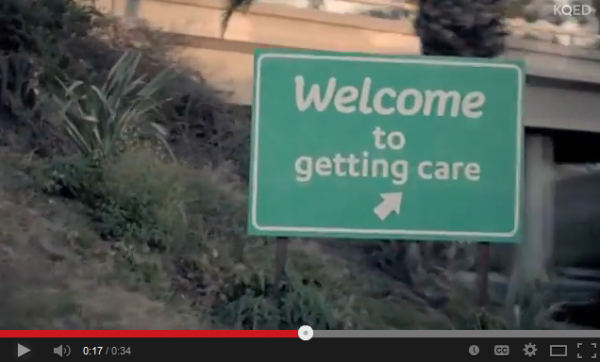
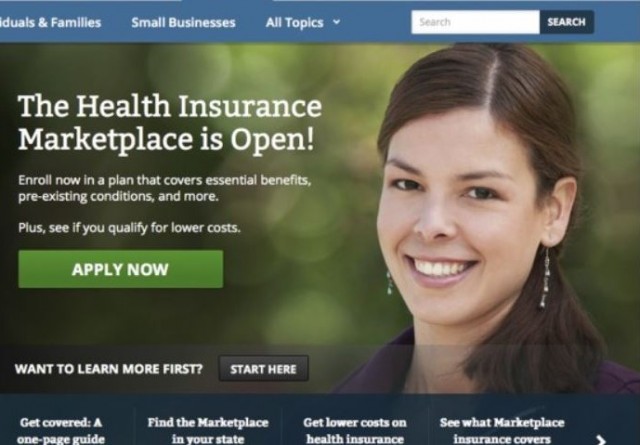
Now that I am back to my normal schedule after a week's worth of blazes in San Diego County, we seem to have another kind of wildfire breaking out in the state. Over the past few months, it looks like nearly 1,500 Californians have complained to state regulators about their Obamacare coverage purchased through California's insurance exchange (Covered California).
New data reveal the biggest category of complaints centers on getting confirmation of health plan enrollment and basic issues such as getting an identification card to obtain care. Many consumers have also encountered difficulty finding a doctor who accepts their new coverage, as well as frustration with inaccurate provider lists, according to the California Department of Managed Health Care. "If you have a medical condition and can't get care that is a very serious issue," said Marta Green, spokeswoman for the managed healthcare agency. "We are still working to resolve many of these cases." Health insurers and officials at the Covered California exchange say they are working hard too to address consumers' gripes. They say some problems are inevitable from such a massive overhaul and that the number of complaints is a small fraction of the more than 1 million Californians who signed up under the Affordable Care Act.
So, let me get this straight: The problems that the 1,500 people have reported are "inevitable" and because it is a "small fraction" we shouldn't worry. When should I start worrying, then? When someone in my family dies waiting for an appointment?

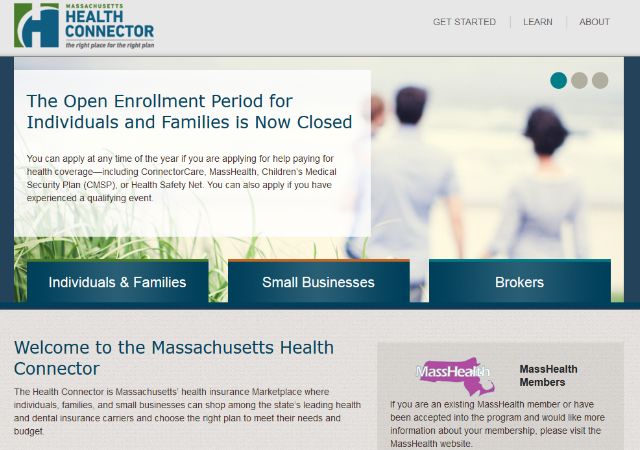
After months of technical problems, the state of Massachusetts will abandon much of its health insurance exchange website and replace it with new software, while simultaneously preparing to shift its exchange to the federal healthcare.gov system as part of a “dual track strategy.” From the NY Times:
Massachusetts will stop trying to fix its deeply flawed health insurance website and instead buy new software to help its residents enroll in coverage, officials there said Monday. But the state will also prepare to join the federal insurance marketplace by the next enrollment period, which starts in November, in case the new system is not working in time.

The decision follows months of problems with enrollment through the state website, which Massachusetts set up in 2006 under its landmark health insurance law. The site worked well until it was revamped last year to comply with the Affordable Care Act, President Obama’s health care law. The state had put CGI, the company that also helped design the initially problem-plagued federal exchange, in charge of the overhaul.

Massachusetts announced in March that it was dropping CGI, but it is still negotiating the terms of ending its $69 million contract, of which the state has paid $17 million. The state received $174 million from the federal government to overhaul its health insurance website and has spent about $57 million so far, including the amount paid to CGI, according to Glen Shor, the state’s secretary of administration and finance.

Sarah Iselin, a health insurance executive whom Gov. Deval Patrick appointed to oversee fixes to the website, said the new “dual-track” plan would cost a little more than $100 million through 2015. But she said it was too soon to know whether the state would seek more federal money; that will depend partly on whether the state ends up owing CGI more money.

It must be a difficult pill to swallow for the state, given that it had a functioning system prior to revamping its site to comply with the new federal law.  And that’s spurred some sharp criticism.

A press release from the House Energy and Commerce Committee (emphasis added):
Data provided to the committee by every insurance provider in the health care law’s Federally Facilitated Marketplace (FFM) shows that, as of April 15, 2014, only 67 percent of individuals and families that had selected a health plan in the federally facilitated marketplace had paid their first month’s premium and therefore completed the enrollment process. Nationwide, only 25 percent of paid enrollees are ages 18 to 34.... ...bThe committee has compiled the data that provides a snapshot of the true enrollment picture as of April 15, 2014, after the official end of the open enrollment period. Due to the administration’s repeated and unilateral extensions and changes, as well as the fact that many insurers have reported that individuals will still have time to pay their first month’s premium, the committee plans to ask the insurers in the federally facilitated marketplace to provide an enrollment update by May 20, 2014. On April 17, 2014, President Obama declared the success of his law, claiming that 8 million Americans had signed up for health insurance, but data from the insurance providers reveals that the president’s figure is largely misleading. As of April 15, 2014, insurers informed the committee that only 2.45 million had paid their first month’s premium for coverage obtained through the federally facilitated marketplace. While the administration has relied on questionable nationwide figures to boast the law’s success, the state-by-state breakdown compiled by the committee underscores the serious problems facing some states.

If there's one person in America who wants people to stop talking about Obamacare, it's Obama. In recent appearances, the president has gone out of his way to declare that the debate is over and the law is here to stay. Obama is obviously trying to cement that notion in the minds of Americans so they'll be less receptive to changes should the Republicans win the senate in 2014. What Obama doesn't seem to know or be willing to acknowledge is that the debate is continuing in spite of his wishes. George E. Condon Jr. recently wrote in National Journal...
The Debate Over Obamacare Is Hardly Over President Obama opened his press conference Thursday with a bold proclamation that "the repeal debate is and should be over." But his declaration of victory in the long-running war over his health care overhaul did not last long. Only five questions later, he was forced to offer a softer, almost wistful acknowledgement of the reality that there are many more battles to wage and the debate could go on for years.

Steve Lynch is a Democratic Rep. from Massachusetts who doesn't hesitate to buck the party line from a centrist point of view, and to speak openly about problems in the party and with party positions. Lynch ran for Senate to fill John Kerry's seat, but lost in the primary to now-Senator Ed Markey. Lynch recently was interviewed by The Boston Herald about upcoming Obamacare problems and how devastating they will be for Democrats. That runs contrary to cut current news cycle Democratic spin that (allegedly) meeting sign up goals means electoral problems related to Obamacare are over.
U.S. Rep. Stephen Lynch, the lone member of the Bay State delegation to vote against Obama­care four years ago, now predicts the law’s botched roll-out will not only cost Democrats valuable House seats but could even jeopardize their control of the Senate in this year’s hotly contested midterm elections. “We will lose seats in the House,” the plain-talking South Boston Democrat said in Boston Herald Radio’s studio yesterday, delivering a harsh diagnosis. “I am fairly certain of that based on the poll numbers that are coming out from the more experienced pollsters down there. And I think we may lose the Senate. I think that’s a possibility if things continue to go the way they have been ... primarily because of health care.”

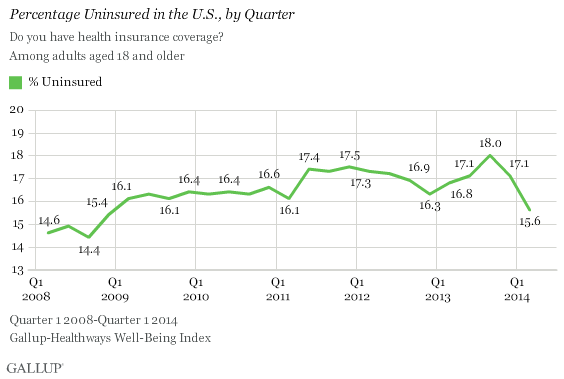
Stop the presses: the percentage of people without health insurance has dropped in the first quarter of 2014. But if a decline in the uninsured rate hadn't occurred when Obamacare began, now that would have been a shock. After all, if you give Medicaid to a whole new group of people, offer subsidies to a huge number of other lower-income people, and stick everyone else with penalties for not getting insurance, it could be expected that the rate of those without health insurance would go down. And I don't recall (although I could be missing something) that anyone on the right was suggesting that the total rate of the medically uninsured would fail to go down as a result of Obamacare. The real questions were and are (a) how much of a dent it would actually make in the uninsured (a figure that was probably somewhat elusive to begin with); (b) at what cost, both in money and disruption; (c) what quality of insurance would be the result; (d) what the effect on our health care system would be over time; and (e) the effect on our liberty. But anyway, here are the stats are from Gallup. Unfortunately, I can't find a link to the actual study, and I always prefer to look at the more complete picture, but let's look at the chart from the summary version: