

Image 01 Image 03

Media Bias Tag

Upon hearing the news of Eric Holder's resignation from the Department of Justice yesterday, NBC's Chuck Todd took to the airwaves and claimed that Holder is a very non-political person. Media bias is one thing. The utter dismissal of reality is another. Brendan Bordelon of National Review has the details:
NBC’s Chuck Todd: Self-Professed Activist Eric Holder ‘a Very Non-Political Person’ The host of NBC’s Meet the Press considers resigning attorney general Eric Holder — who once proudly declared himself an “activist attorney general,” called America a “nation of cowards” about race and took heat from his own White House for pursuing politically sensitive initiatives –  ”a very non-political person.” “He did a lot of the tough stuff that you would say, ‘Hey, the attorney general has to do tough stuff, this is not a forgiving job, you have to do tough stuff,’” Chuck Todd told MSNBC’s Tamron Hall on Thursday. “But, what’s interesting about him, he is a very non-political person. And I think people used to mistakenly think that this guy was this long-time political operative who happened to be an attorney general. That’s not him at all.”
Todd's declaration set off a firestorm on Twitter.

Remember when Katie Zavadski of NY Magazine, Sheera Frenkel of Buzzfeed and Jon Donnison of the BBC reported that Hamas was not behind the kidnapping and murder of three Israeli teens, Gil-ad Shaer, Naftali Fraenkel and Eyal Yifrach? That gave rise to the widespread false meme that Israeli invented the Hamas connection in order to start the Gaza war (never mind that the Gaza war actually was started and continued due to Hamas rocket fire on Israeli cities, not by Israeli reaction to the kidnapping). Since then, Hamas representatives repeatedly have admitted it was a Hamas operation. Indeed, they bragged about it, though Hamas denies that the most senior Hamas officials were involved. Israeli spokesmen not only identified the murderers, but also how they were funded and coordinated by Hamas operatives in Gaza and Turkey. Israel has been searching for the two murderers for several months. Israel finally found them last night in Hebron. After a firefight, the two were killed and Hamas, once again, admits they were Hamas operatives, as The Times of Israel reports:
Marwan Kawasme and Amer Abu Aysha were both killed during an early Tuesday arrest attempt in Hebron, the Israel Defense Forces said in a statement.... At around 3 a.m., the forces descended on the house where the suspects were believed to be hiding and began firing heavily on the home. Both were killed after refusing to surrender. “We opened fire, they returned fire and they were killed in the exchange,” IDF spokesperson Lt. Col. Peter Lerner told Reuters. “We have visual confirmation for one. The second one, we have no visual confirmation, but the assumption is he was killed.” Hamas confirmed in a statement the two were killed, Israeli media reported. “Two members of the Izz A-Din al-Qasam brigades, Marwan Kawasme and Amer Abu Aysha, were killed after a journey of sacrifice and giving,” Hamas spokesman Hussam Badran said in a statement. “This is the path of resistance and we walk it side by side.” An armed bulldozer was also used to destroy the home the two were in during the operation, Israel’s Channel 10 news reported.
The Jerusalem Post further reports:

It is nearly a year since Iran's President Hassan Rouhani spoke before the United Nations General Assembly. Later this week he is scheduled to speak again before the General Assembly, but the enthusiasm expressed last year is nowhere to be seen. In the run up to his speech there was much excitement among the chattering classes. Take, for example, a couple of paragraphs from an editorial in The New York Times from September 22, 2013, a year ago today:
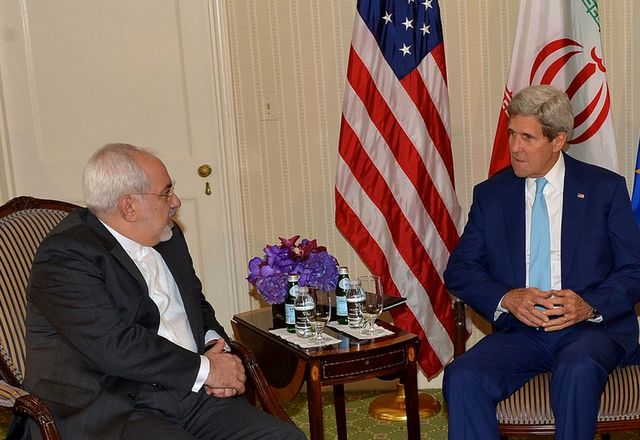
The next few weeks will be critical for capitalizing on a new sense of promise created by a recent flurry of remarkable gestures: Iran’s leadership has sent Rosh Hashana greetings to Jews worldwide via Twitter, released political prisoners, exchanged letters through the Swiss with President Obama, praised “flexibility” in negotiations and transferred responsibility for nuclear negotiations from conservatives in the military to the Foreign Ministry. Mr. Obama eased restraints on humanitarian and good-will activities, including athletic exchanges between the two countries. ... Mr. Rouhani has a sophisticated, Western-savvy team. His foreign minister, Mohammad Javad Zarif, received degrees from American universities and spent most of his adult life in the United States. Together they have raised expectations in a world eager to see Iran play a more constructive role, and the charm offensive is in full swing. Policy experts, journalists and business people are jockeying to attend a number of invitation-only breakfasts, dinners and meetings scheduled by Mr. Rouhani and Mr. Zarif while they are in New York. There’s a lot riding on their visit this week.
But the "remarkable gestures" that The New York Times cited were remarkable hollow.

The New York Times earlier this month published an expose of how foreign money influenced think tanks. One of the subjects of the article was the Brookings Institution, its vice president Indyk and $14.8 million grant that the government of Qatar had given Brookings. A former scholar at Brookings cautioned that because of Qatar's influence any report coming out of the institution is likely not to be the "full story." The New York Times didn't seem much concerned with the implication of its reporting but some people did notice. In Tablet this week Lee Smith pounced on the Times for not looking into the implications of what it reported.
Or maybe the editors decided that it was all on the level, and the money influenced neither Indyk’s government work on the peace process nor Brookings’ analysis of the Middle East. Or maybe journalists just don’t think it’s worth making a big fuss out of obvious conflicts of interest that may affect American foreign policy. Maybe Qatar’s $14.8 million doesn’t affect Brookings’ research projects or what the think tank’s scholars tell the media, including the New York Times, about subjects like Qatar, Hamas, Israel, Turkey, Saudi Arabia, and other related areas in which Qatar has key interests at stake. Maybe the think tank’s vaunted objectivity, and Indyk’s personal integrity and his pride in his career as a public servant, trump the large piles of vulgar Qatari natural gas money that keep the lights on and furnish the offices of Brookings scholars and pay their cell-phone bills and foreign travel.
Smith also observed that the Qatar connection made Indyk poorly suited as an interlocutor for both the Israelis and the Palestinians.

A new poll by Gallup shows that overall trust in the mass media has bottomed out at its previous all-time low of 40%. Via Gallup:
Prior to 2004, Americans placed more trust in mass media than they do now, with slim majorities saying they had a "great deal" or "fair amount" of trust. But over the course of former President George W. Bush's re-election season, the level of trust fell significantly, from 54% in 2003 to 44% in 2004. Although trust levels rebounded to 50% in 2005, they have failed to reach a full majority since. Americans' trust in the media in recent years has dropped slightly in election years, including 2008, 2010, 2012, and again this year -- only to edge its way back up again in the following odd-numbered years. Although the differences between the drops and the recoveries are not large, they suggest that something about national elections triggers skepticism about the accuracy of the news media's reporting.
The fact that trust in the MSM dips in election years isn't a surprise, and it says a lot about the media's place in America's electoral process. If only 40% of Americans trust what the media is saying, does the media play as big a role in swaying votes left as it once did? The midterms should be a good indicator of this, although I think "trust" has less to do with overall effect than does the constant bombardment (and and hero worship, in some cases) of one name over another.

Long time Palestinian affairs reporter Avi Issacharoff yesterday reported that the plot that led to the kidnapping and killing of Eyal Yifrach, Gil-ad Shaar and Naftali Fraenkel was done with the foreknowledge of Hamas's leadership. Issacharoff's report further buttresses Israel's long held claim that Hamas was responsible for the kidnappings and further undermines reports that Hamas's leadership was not connected. Palestinian security  officials told Issacharoff about another key member of the plot:
The officials said that although the Hamas leadership repeatedly denied involvement in the attack, the terror organization’s military and political wings knew about the plans in advance and had approved similar activities. Abed a-Rahman Ghaminat, one of the heads of a cell in Zurif (a village not far from Bethlehem) and a former resident of the village, was the Hamas military wing’s appointed leader over the Hebron area. Ghaminat was released from an Israeli prison in October 2011, and was deported to the Gaza Strip.
Based in Gaza, Ghaminat is part of Hamas' leadership and works with Saleh al-Arouri, who is based in Turkey, and is in charge of Hamas' operations in the West Bank. Ghanimat worked  with Mahmoud Kawasme in Gaza. Kawasme recruited his brother Hussam, who lives in the Hebron to mastermind the operation. Hussam Kawasme was indicted last week.

Central to the charge that Israel's conduct warrants an investigation by an "independent" commission to investigate whether it committed war crimes is the premise that Israel, in defending itself against rockets launched by Hamas into its territory, caused a disproportionate number of civilian deaths. Since a commission appointed by the anti-Israel United Nations Human Rights Council is looking to convict, a fair investigation into the violence is in order. Unfortunately, in an article from last week entitled "The U.N. says 7 in 10 Palestinians killed in Gaza were civilians. Israel disagrees," The Washington Post failed to provide the necessary context to allow a proper understanding of Operation Protective Edge.
The war in Gaza will now continue in a battle between databases to determine who was killed and why. The most contested number, the one that attracts the most stubborn insistence and ferocious rebuttal, is not the total fatalities on the Palestinian side, the more than 2,100 dead in the Gaza hostilities. The controversy centers instead on the ratio of civilians to combatants, or as the Israelis call them “terrorist operatives.”
In the second sentence the reporter, William Booth, mentions the "stubborn insistence and ferocious rebuttal," but doesn't acknowledge his own role in supporting the "stubborn insistence." Booth's articles on Operation Protective Edge have often contained similar language describing "mounting Palestinian civilian casualties." Furthermore, in other instances articles on which Booth was bylined listed casualty totals with no judgment as to their veracity. For example on July 19 a dispatch on which he had a byline reported:
The Palestinian death toll from the conflict rose Saturday to more than 330, including about 60 children, according to the Gaza Health Ministry. An additional 2,200 have been injured. The United Nations estimates that about 80 percent of the casualties are civilians, many of them children.

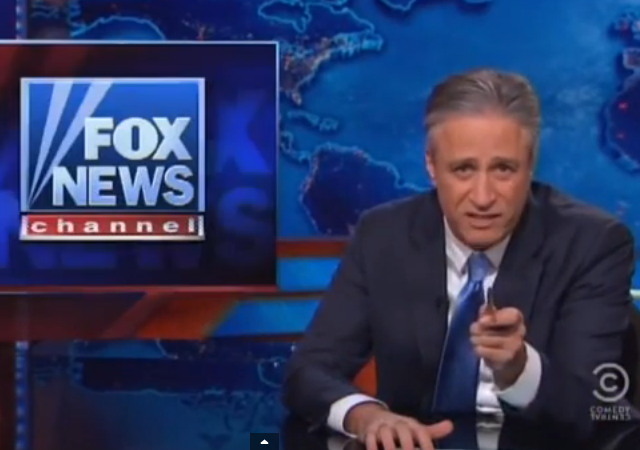
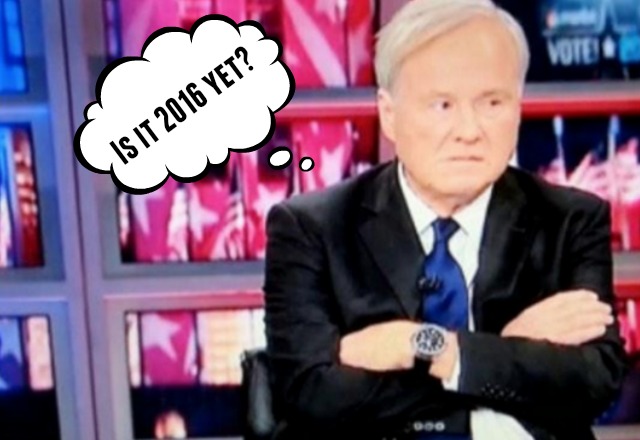
In case you missed it, I went off on a bit of a rant about comedy in the age of Obama at my site American Glob this week. Frankly, I'm sick to death of the left's inability to find anything funny about Obama while continuing to target the same tired subjects of Bush, FOX News and Republicans in general. Jon Stewart is a classic example of this and the left loves to point out how Stewart "destroys" his subjects. David Rutz of the Washington Free Beacon points out that Stewart can often induce laughter from his audience by simply staring at them after showcasing his chosen target, who is almost always someone on the right:
Comedy of Stares You know the drill if you watch The Daily Show. Host Jon Stewart plays a smashcut of television news clips, to help him destroy, eviscerate, demolish, devastate, torch, obliterate and disembowel a generally conservative straw man opinion, movement or Fox News host.

Three recent articles have critiqued the media's coverage of the Israeli-Palestinian conflict, especially in the context of Operation Protective Edge. Previously, I covered Richard Behar's takedown of reporting from Israel in Forbes and yesterday Prof. Jacobson highlighted Matti Friedman's expose from Tablet Magazine. Behar focused on what gets left out of reporting from the Middle East. Friedman concentrated on how the media's narrative shapes the reporting from the Middle East. To be sure, both covered other issues, but those were their respective focuses. Earlier this month, former correspondent Mark Lavie wrote Why Everything Reported from Gaza in Crazy, Twisted. Lavie explains "why you don’t get the whole story."
Besides the budgetary limitations, news organizations often hesitate to send reporters into Gaza at all because of the constant danger, and not from Israeli airstrikes. In 2007, BBC reporter Alan Johnston was kidnapped by Palestinian militants and held for more than three months. Many other foreign journalists were kidnapped there and held for a day or two around that time. There have been no kidnappings recently, but the message was clear—foreigners are fair game. The message was heard and understood. For lack of an alternative, news organizations began to rely more and more on local stringers, giving the regime considerable leverage through intimidation. It’s expected that news organizations will deny all this—it’s part of the dance.

I hate when people refer to a column as "important," because the reality is that few columns are important in the real world. But I consider the column at The Tablet written by former AP Middle East reporter Matti Friedman to be important. Readers have been emailing and tweeting the link at me at a somewhat furious pace. Friedman lays bare both the explicit and implicit biases of media coverage of Israel and how that bias is part of a larger narrative seeking Israel's destruction. Here are some excerpts from An Insider’s Guide to the Most Important Story on Earth, but of course, go and read the whole thing and share it widely:
The lasting importance of this summer’s war, I believe, doesn’t lie in the war itself. It lies instead in the way the war has been described and responded to abroad, and the way this has laid bare the resurgence of an old, twisted pattern of thought and its migration from the margins to the mainstream of Western discourse—namely, a hostile obsession with Jews. The key to understanding this resurgence is not to be found among jihadi webmasters, basement conspiracy theorists, or radical activists. It is instead to be found first among the educated and respectable people who populate the international news industry; decent people, many of them, and some of them my former colleagues....

On Saturday the WaPo featured a wordy piece devoted to Darren Wilson's dysfunctional family of origin, and the racial and other problems in the police force he used to work for, difficulties that seem to have had nothing whatsoever to do with him. As William A. Jacobson has written, it's an attempt at guilt by association. That effort seems even more biased when it is contrasted with a lengthy AP article published the very next day in the Sunday WaPo that tells us what a great guy Michael Brown was. From Saturday's article about Wilson, Darren Wilson’s first job was on a troubled police force disbanded by authorities:
...[E]veryone leaves a record, and Darren Dean Wilson is no exception. People who know him describe him as someone who grew up in a home marked by multiple divorces and tangles with the law... Wilson has had some recent personal turmoil: Last year, he petitioned the court seeking a divorce from his wife... His parents divorced in 1989, when he was 2 or 3 years old... In 2001, when Wilson was a freshman in high school, his mother pleaded guilty to forgery and stealing. She was sentenced to five years in prison, although records suggest the court agreed to let her serve her sentence on probation.

Slowly, we have seen numerous accounts of how Hamas intimidated foreign journalists into not covering Hamas' use of facilities such as Shifa Hospital and firing of rockets close to hospitals, apartment buildings, religious compounds and U.N. facilities. But it has come slowly, and mostly after reporters had left Gaza. And only after reporters were caught deleting tweets and pulling down stories that exposed the truth. Even Hamas admits to intimidating and controlling journalists -- and brags about it. The Foreign Press Association also admitted to the intimidation, after the fact. Now another report, via Elder of Ziyon, from a Dutch journalist (emphasis added):
Since the war started, one population group in Gaza has disappeared from the streets: people in uniform. Army green uniforms, blue-grey uniforms, black uniforms, they were all over the place. From one day to the next they are gone, the men and the few women (of the women police unit) with a weapon or a truncheon in their hands.

At his Muckraker column at Forbes, The Media Intifada: Bad Math, Ugly Truths About New York Times In Israel-Hamas War, investigative journalist Richard Behar exposes many of the problems - really scandals - with the MSM reporting on Gaza. Though he focuses a lot on The New York Times, he focuses on other news outlets too and how, through a combination of credulousness, bias and laziness, they have become in the words of his friend, and fellow investigative journalist, Gary Weiss, "part of the Hamas war machine.” In the wake of the Jayson Blair scandal The New York Times led the journalistic pack by hiring a "public editor" to handle complaints in the hopes of averting another similar scandal. But the problem with public editors or ombudsmen, as they are also called, is that they don't challenge the assumptions of the editors and reporters. Rather they seem to be explaining why the readers don't understand the high minded principles that professional journalists adhere to. What's important about Behar's takedown of the reporting is that he challenges the assumptions that news organizations accept. Behar looked at the media in general and specifically at The New York Times "because it is, without question, the most important media outlet in the world, in terms of setting the table each day for other outlets.". I can't cover the whole scope of Behar's critique as it is sweeping and comprehensive, but I'd like to focus on a few of his specific criticisms and then on a few of his observations. Richard Behar Media Intifada Behar's first critique of the Times is for its Gaza based reporter Fares Akram, and what he discovered when he visited Akram's Facebook page.

Israeli newspapers are reporting on the just disclosed coup attempt by Hamas to dislodge Fatah in the West Bank. The Times of Israel reported:
The Shin Bet said it arrested more than 90 Hamas operatives in May and June, confiscated dozens of weapons that had been smuggled into the West Bank, and seized more than $170,000 aimed at funding attacks. It produced photos of the confiscated weapons and cash and a flowchart of the Hamas operatives who had been questioned, and said they planned a series of massive attacks on Israeli targets, including the Temple Mount, in order to start a widespread conflagration. Indictments are expected to be filed against at least 70 of the suspects. Terror cells were set up in dozens of Palestinian West Bank towns and villages — including in and around Jenin, Nablus, eastern Jerusalem, Ramallah, and Hebron — the Shin Bet said.
There were other details at Ynet:
The plan called for using the intifada as cover to seize rule in Ramallah, which would have been led by the "Mohammed Deif of the West Bank" who currently operates out of Turkey. More than 70 indictments were served in recent days at military tribunals in the West Bank, and they expose the largest coordination effort Hamas has attempted in the area since Operation Defensive Shield more than a decade ago.
The "Mohammed Deif of the West Bank" is Saleh al-Arouri who was also implicated in the planning of the kidnappings and killings of Eyal Yifrach, Gil-ad Shaar and Naftali Fraenkel.

Israel and its supporters have argued for some time that the news media give a skewed view of Operation Protective Edge because reporters in Gaza are intimidated by Hamas. Perhaps one of the most blatant examples was the disappearing tweet of The Wall Street Journal's Nick Casey, showing a member of Hamas sitting for an interview in Shifa hospital. As Prof Jacobson noted, Casey was subjected to online threats. But the disappearing tweet was consistent Hamas' rules for social media (that also apparently applied to major media organizations), which included "[d]o not publish photos of military commanders." Apparently Casey was in violation of that. Last week the Foreign Press Association in Israel (and not an organization that shrinks from criticizing Israel) decried Hamas' "blatant, incessant, forceful and unorthodox methods" to intimidate journalists. There were still skeptics. Jodi Rudoren, the Jerusalem bureau chief of The New York Times, called the FPA's charge "nonsense." The left wing Israeli paper Ha'aretz also covered the story calling the press "divided" over the issue. Even in the Ha'aretz story, the term"divided" seems generous. The one reporter who spoke on the record to say he hadn't been intimidated, was forced to leave Gaza after he violated Hamas' press guidelines. If there was any remaining doubt about the intimidation, it was removed by an unlikely source, Hamas spokeswoman Yisra al-Mudallel. According to the MEMRI transcript, al-Mudallel said:
Moreover, the journalists who entered Gaza were fixated on the notion of peace and on the Israeli narrative. So when they were conducting interviewers, or when they went on location to report, they would focus on filming the places from where missiles were launched. Thus, they were collaborating with the occupation. These journalists were deported from the Gaza Strip. The security agencies would go and have a chat with these people. They would give them some time to change their message, one way or another. ... We suffered from this problem very much. Some of the journalists who entered the Gaza Strip were under security surveillance. Even under these difficult circumstances, we managed to reach them, and tell them that what they were doing was anything but professional journalism and that it was immoral.