

Image 01 Image 03

Iran Tag

Every headline today concerning Saudi Arabia and the conflict in Yemen contains the words "crunch time." Every. Single. One. It's an accurate assessment, of course, and it does a good job of describing the urgency that Saudi and western powers are finding themselves operating under. Saudi Arabia has now spent 11 weeks conducting airstrikes on key strategic targets in Yemen in an effort to drive back the Iranian-backed Houthi rebels and bolster local fighting forces loyal to deposed President Abd-Rabbu Mansour Hadi. The strikes have done their job, destroying heavy artillery and machinery, and creating a chaotic playing field for rebel ground forces. But:
Despite the destruction of much of their heavy weaponry, the Houthi militia and army forces loyal to former president Ali Abdullah Saleh control most of the country's populated west and still daily attack Saudi territory with mortar fire or missiles. The possibility of a ground operation in support of the ragtag local groups still fighting the Houthis in Aden, Taiz, Marib and al-Dhala appears to have been discounted by the Saudis and their allies in an Arab coalition from early on.

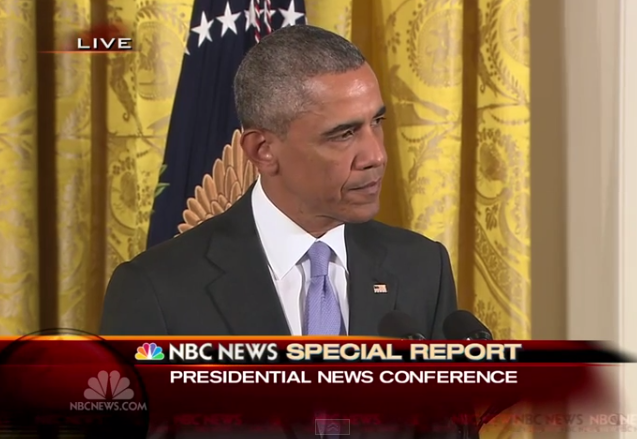
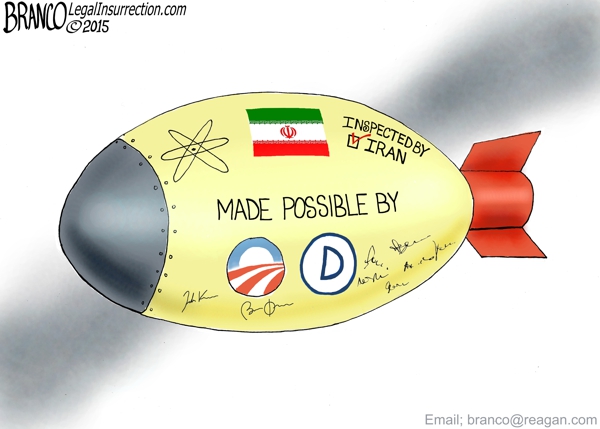
Last week President Obama finally stated openly what everyone, including the Iranians, has known all along – that he is simply not willing to use military force to stop Iran from attaining a nuclear weapon. Those of us with common sense and reason also know that his negotiations with Iran might delay, but will not stop, that country from attaining a nuclear weapon. We know this both because Obama himself told us so in an interview with NPR, and because once a military option is clearly off the table, Iran has no incentive to make concessions in a negotiation and no reason to comply with a negotiated agreement. With no US-sponsored military solution, at least for the remainder of Obama’s term, and no diplomatic solution, there are still two things left that the US can do. First, we can refrain from criminalizing the actions of other states for whom military action against Iran would be considered both reasonable and necessary. Second, we can, at the very, very, least, refrain from funding Iran’s pursuit of a nuclear bomb ourselves.

President Obama's speech a week and a half ago at Washington D.C. synagogue Adas Israel was alternatively promoted as both an opportunity to address the scourge of anti-semitism, and a chance to reach out to American Jews. The speech did nothing to advance either goal and was tone-deaf to any Jews, or Americans for that matter, who don't buy into the president's foreign policy. As far as his reaching out, the president simply rehashed all of his administration's arguments about closing off Iran's paths to a nuclear weapon. He offered nothing new. Of course, he said that the deal he's trying to make with Iran will make Israel safer. He made a point of saying that he shares the goal with Israel of preventing Iran from acquiring nuclear weapons; but he said it with no real conviction. He was just repeating a talking point. Repeating all of his talking points isn't going to convince someone who doesn't already agree with him. Notably, he repeated his 2012 line about having Israel's back. But with Israel's political establishment - Isaac Herzog is no less skeptical of the emerging deal than Benjamin Netanyahu is - doubting the efficacy of the ongoing diplomacy, that claim hardly seems credible. He says that he welcomes debate, but the night before Benjamin Netanyahu spoke to Congress, Obama gave an interview to Reuters attempting to undercut Netanyahu's arguments.

Finally---a hostage crisis that didn't end in bloodshed. (Yet.) Today Houthi rebels released the first of several American hostages currently being held in Yemen. Casey L. Coombs was held by the Iranian-backed group for two weeks in the capital city of Sanaa before his family was informed of his successful transfer out of the country and into neighboring Oman. From the New York Times:
Mr. Coombs, who lived in Sana, Yemen’s capital, was arrested by Houthi militiamen there in mid-May, and traveled to neighboring Oman on Monday. He was scheduled to undergo a medical evaluation there before flying home to Seattle, his mother, Jill Marie Hammill, said in a telephone interview. Ms. Hammill said she had received a call from the International Committee of the Red Cross early Monday saying that Mr. Coombs was at the Sana airport and was preparing to leave Yemen. She was able to speak to her son on Monday afternoon, after he arrived in Oman. “I cannot describe how happy I am,” she said. Mr. Coombs has written for publications including The Intercept, The American Prospect and Time magazine. The Obama administration has said a number of Americans have been detained by the Houthis, a Shiite rebel group that took control of Yemen’s capital and forced the United States-backed Yemeni government from power earlier this year.

If you were looking for a monument to supreme egotism, you would have to go far to beat Obama's statement in this interview with The Atlantic's Jeffrey Goldberg:
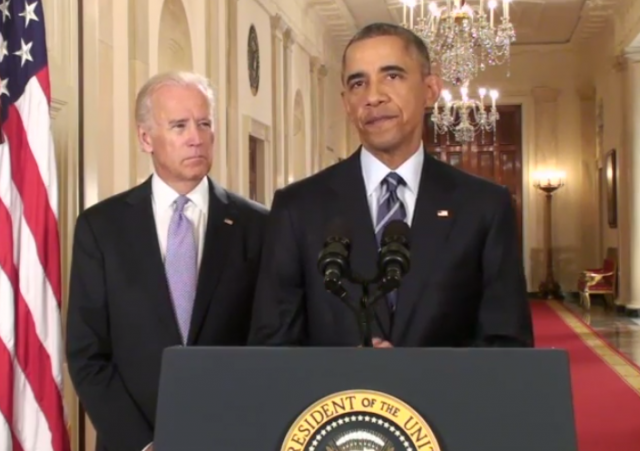
“Look, 20 years from now, I’m still going to be around, God willing. If Iran has a nuclear weapon, it’s my name on this,” he said, referring to the apparently almost-finished nuclear agreement between Iran and a group of world powers led by the United States. “I think it’s fair to say that in addition to our profound national-security interests, I have a personal interest in locking this down.”
I rack my brain to think of another president in our history---or another statesman or even another prominent politician---who would think to say "trust me, because my ego is riding on this." What on earth does ego have to do with judgment? In the calculus of what are the most important considerations about any Iran deal, the most important would be "our profound national-security interests" and those of the entire world. That's what's riding on it, that's the reason to "lock it down" (odd phrase for negotiations). The state of Obama's personal reputation ought to be so low on the list of things to think about that it shouldn't even be on his radar screen at this point, much less ours. Obama says he's got a special personal interest in "locking this down." But an agreement on nuclear weapons with Iran is not merely a question of applying oneself. Obama may think there's no limits to his powers, but sizing up Iran and negotiating with a country which is essentially an aggressive, repressive, fanatical enemy isn't just a matter of trying hard enough and thinking you're the smartest guy in the room. Even if it were true that Obama wanted and even needed to negotiate a good deal for the US in order to protect his precious reputation, that doesn't mean he has a clue how to get there from here, or that it's even possible to do so.

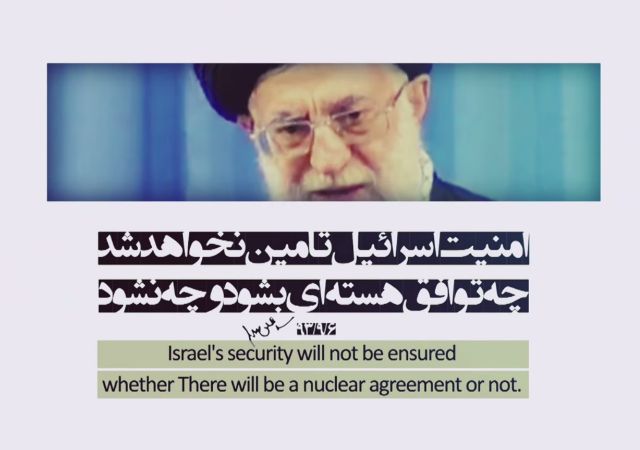
Leave it to the good ol' Ayatollah to tattle on U.S. officials. If Atatollah Khamenei's Twitter feed is any indicator, Iran is not too keen on the idea of nuclear inspections. Early this morning, Iran's Supreme Leader tweeted: The New York Times Ayatollah Khamenei, "ruled out inspections of Iranian military sites and interviews of Iranian nuclear scientists in any potential deal on its nuclear program," at a graduation speech Wednesday.

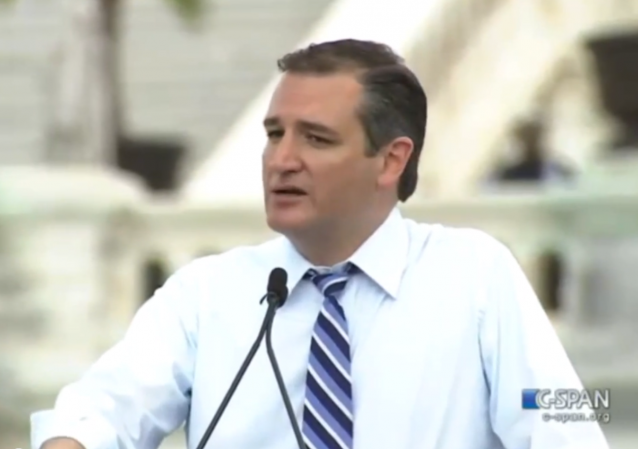
I appeared on Saturday, May 16, 2015, on The Craig Silverman Show on 710 KNUS in Aurora, Colorado. The conversation covered my background, what it means to be a conservative on campus, the anti-Israel boycott movement, the Pope on a Palestinian "state," the Pew Poll on Christians, and the fate of Christians in the Middle East. On Ted Cruz at Harvard Law School:
"When you're going to be political at a place like Harvard Law School, you have to be better than everybody else if you're a conservative. You have to be smarter, you have to be more well-read, you have to be better-prepared, because it's you against a lot of people. And certainly he wouldn't have been the only conservative at Harvard Law School, but he would have been in a severe minority. And when you're in that situation, you have to be better. And that's what I see with a lot of politically active conservative students on campus... [Cruz] had to sharpen his skills because he's basically arguing with everybody or almost everybody. Whereas if you're in a liberal position at a school most people agree with you, you don't need to sharpen your skills and you don't get tested the way you do if you're a conservative."
On the anti-Israel boycott movement:
"We're dealing with people who really are just outright liars. And I say that all the time because that's what they are. And they just make stuff up, they twist facts, they ignore facts."
On Israeli-Palestinian negotiations:

A bill ensuring Congressional oversight on any proposed nuclear deal with Iran is headed to the President's desk. The bill passed through the House 400-25 after a hard-fought battle in the Senate earlier this month. It imposes a 30 day buffer preventing the President from waiving any congressional sanctions against Iran while Congress reviews the deal; additionally, if Congress disapproves of the deal, the President will be unable to waive certain congressionally-imposed sanctions. Opponents of the bill maintained that its provisions were not strong enough to provide an adequate buffer between the Obama Administration and a nuclear Iran; its supporters, however, argued that the bill would be the best chance for the American people to weigh in on the controversial impending nuclear deal. The legislation eventually passed the Senate 98-1, with only Arkansas Senator Tom Cotton objecting. President Obama is expected to sign the bill, giving Congress the power of initial rejection but ushering in a new round of contentious negotiations over the nuclear deal itself. The House vote came as Obama met with the leadership (though not necessarily the figureheads) of leading Persian Gulf states in a series of meetings "designed to narrow differences" over the impending nuclear deal:

A couple of remarkable news reports have been broadcast in recent days about the care given Syrians wounded in the civil war across the border. One - the more dramatic one - was at the Israeli news site Ynet (affiliated with the daily Yedioth Ahronot); the other at CNN. The Ynet article written and narrated by one of the paper's top journalists, Ron Ben-Yishai told of an injured man -likely a jihadist - who was severely injured by a bullet to the stomach and shrapnel wounds. Israel has "trusted intermediaries," on the other side  of the border who communicate when there is an injured person who needs treatment in Israel. Most of the injured are woman, children and the elderly. However there are also younger men, such as the subject of the article. In this case the Israeli were told that without a hospital the man would die. Despite having contacts in Syria, the Israelis know who's on the other side of the border on the Golan Heights, so they have to take care:
At around 8 pm on the day the wounded Syrian was transferred, parties on the Syrian side announced they were approaching the fence. The Israeli ambulance and paramedics readied themselves, while Givati troops received a briefing and then headed out to the fence area. Their role is to make sure that those who sent the wounded citizens to the area had not laden them with explosives, as well as to ensure that the wounded person was not bait in a scheme designed to lure IDF troops into an ambush. Considering the information Israel has on its new neighbors across the border on the Golan Heights – these extra precautions are necessary. Half an hour later, the commander of the forces stationed near the border gave approval to send out the armored vehicle carrying the paramedics to collect the wounded citizen, who was already waiting on the Israeli side.

Brace yourselves for an international incident: John Kerry is going to Russia...and he wants to talk about Ukraine. And Iran. And Syria. I don't think I'm out of line for assuming that some sort of disaster will come of this, even if he does manage to make progress with the increasingly belligerent and wholly unaccountable Russian leadership. This will be Kerry's first visit to Russia since 2013, and only his second as Secretary of State. The 2013 visit fell just before Russian relations with Ukraine bottomed out amid the conflict that eventually led to the 2014 annexation of Crimea. Based on statements released by both Moscow and Washington, this trip is less of a diplomatic jaunt, and more of a salvage operation. From the AP:

Late Friday afternoon Reuters had a huge scoop. Inspectors found traces of prohibited chemical weapons at a previously undeclared site in Syria.
Samples taken by experts from the Organisation for the Prohibition and Chemical Weapons (OPCW) in December and January tested positive for chemical precursors needed to make the toxic agents, the sources told Reuters on the condition of anonymity because the information is confidential. "This is a pretty strong indication they have been lying about what they did with sarin," one diplomatic source said. "They have so far been unable to give a satisfactory explanation about this finding." ... The diplomatic sources said the sarin and VX nerve samples were taken from the Scientific Studies and Research Centre, a government agency where Western intelligence agencies say Syria developed biological and chemical weapons.
After it was established that Syria had used chemical weapons against civilians in a Damascus suburb, President Barack Obama said that he would seek Congressional authorization to use force. But in the end chose the path of diplomacy to deal with Syria's breach of international conventions by using chemical weapons. The deal, agreed to with Russia, a patron of Syria, called for Syria to declare all of its chemical weapons sites, destroy their chemical stores and destroy their means for making them. At the very least, Friday's news means that Syria did not fully comply with its obligations under the deal. At the worst it suggests that despite the hoopla about Syria destroying thousands of tons of chemical agents, Syria has an active chemical weapons program still remaining. (This is in addition to Syria's use of chlorine, which is prohibited for use as a weapon, even if chlorine is not prohibited to possess.) This wouldn't be the first time Syria has been caught cheating. In October of last year Syria admitted to having four chemical weapons facilities that it had not previously declared. Worse than that, The New York Times reported in January that the administration had informed Assad that the United States will train rebels to fight ISIS, not Syria.

Iran released the Maersk Tigris, the cargo ship it seized at sea last week. The New York Times reports:
The Maersk Line, the Danish shipping giant, confirmed in a statement that the vessel and its 24-member crew, forced to anchor near Iran’s southern port of Bandar Abbas since its seizure on April 28, were now free and en route to the port of Jebel Ali in the United Arab Emirates. ... The Maersk Tigris is registered in the Marshall Islands. It is managed and staffed by Rickmers Shipmanagement, a subsidiary of Germany’s Rickmers Group, a maritime services company, which reported that the crew was in good condition. ... The apparent stand-down reflected what political analysts called a wish by both Iran and the United States to avert an escalation of tensions that could sabotage the nuclear talks between Iran and a group of six powers that includes the United States.
From the language of the report it appears that Maersk agreed to a settlement of the claim an Iranian company had against it. CBS offered the judgment of one of its security analysts.
The Iranian decision to board the vessel was "a reflection of the fact that tensions are running very high, and these tensions don't really have borders," explained CBS News senior national security analyst Juan Zarate. "These are conflicts that are happening on the ground, they're happening in the shipping lanes, and there are places and points of vulnerability that could... serve as flashpoints for conflict."

Today the Senate passed a bill that would give Congress the authority to review the emerging nuclear deal with Iran. The bill---and the vote---was controversial, with many Republicans arguing against final passage; those who opposed sending the bill to the House argued that it was not strong enough, and would not provide a big enough buffer between the Obama Administration, and a nuclear Iran. Fox News explains why Senate leadership pushed so hard for the passage of the bill:
Senate Majority Leader Mitch McConnell, R-Ky., said the bill "offers the best chance for our constituents through the Congress they elect to weigh in on the White House negotiations with Iran." Added Sen. Bob Corker, R-Tenn., chairman of the Foreign Relations Committee: "No bill. No review." The legislation would bar Obama from waiving congressional sanctions for at least 30 days while lawmakers examine any final deal. The bill would stipulate that if senators disapprove of the deal, Obama would lose his current power to waive certain economic penalties Congress has imposed on Iran.

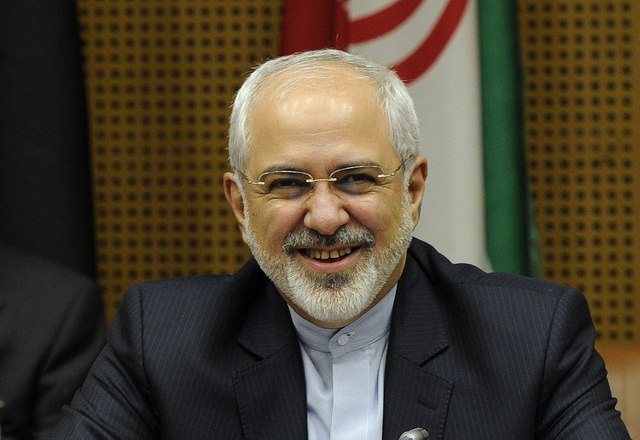
Last week Iran's foreign minister and chief nuclear negotiator Mohammad Javad Zarif appeared in "a conversation" with columnist David Ignatius of The Washington Post at NYU sponsored by the New America Foundation. There were those in the media who described Zarif as "suave" and "diplomatic," but not everyone was impressed with Zarif's performance. Matthew Continetti went after the supposed moderate in The Appalling Mr. Zarif.
What made Zarif’s appearance all the more nauseating was his pretense of moral standing. He has none. His lecture to the United States took place as his regime held a container ship it had seized in international waters, and as evidence emerged of Iranian violations of U.N. sanctions. It is the Iranian Revolutionary Guard Corps and its proxies such as Hezbollah and the Houthis and other Shiite militias that are fomenting and exploiting sectarian conflict in Lebanon, Syria, Yemen, and Iraq. Iran’s human rights record is abysmal. Since Zarif returned to government in the administration of Hassan Rouhani, there has been a “surge” in executions in Iran. “The authorities restricted freedoms of expression, association, and assembly, arresting, detaining, and prosecuting in unfair trials minority and women’s rights activists, journalists, human rights defenders, and others who voiced dissent” say the right-wing extremists at Amnesty International, whose most recent report catalogues the torture and cruel and unusual punishments of the Iranian regime. ... At NYU Zarif said America will have to lift sanctions on Iran “whether Senator Cotton likes it or not.” The “polite” and “respectful” audience broke into laughter—at Cotton. “I couldn’t resist,” Zarif said. No troll could.

When the Israeli elections were held in March, the result widely was seen as a huge win for Benjamin Netanyahu, because his Likud Party outperformed. But that was Part 1. The second part has taken several weeks to play out -- the formation of a governing coalition of at least 61 seats in the 120-seat Knesset (parliament). That took time, and almost didn't happen. Late last night Israel time Netanyahu put the final piece together, as reported in The Times of Israel:
Less than two hours before his deadline was set to expire on Wednesday night, Prime Minister Benjamin Netanyahu hammered out a deal with Jewish Home party leader Naftali Bennett, allowing him to inform President Reuven Rivlin that he had successfully cobbled together a 61-seat coalition — the narrowest of Knesset majorities.... In a meeting with Bennett in the Knesset Wednesday night, Netanyahu thanked the Jewish Home party leader for his “efforts during the negotiations and throughout these last weeks.” He also asserted that Israel would have a “strong, stable government,” which he hoped would exceed 61 seats by Wednesday. “’61 seats is a good number. 61-plus is a better number. But it starts with 61, and we will begin with that,” Netanyahu said. “We have a lot of work ahead of us. Good luck to us and to the Israeli nation.” “We support you,” Bennett told Netanyahu. “We will assist you with all of our strength for the sake of the country and the government, because we have no other land. This government can complete its term in office. We will work hard to make sure of that.” Bennett said that the two parties’ negotiating teams would “work all night” in order to finalize the fine points of the deal. Netanyahu was understood to have capitulated to the demands of the Orthodox-nationalist Jewish Home, the final recalcitrant coalition partner, and agreed to appoint Bennett as education minister, MK Ayelet Shaked as justice minister, and another Jewish Home member, Uri Ariel, as agriculture minister.
David Horvitz, Editor-in-Chief of The Times of Israel, notes the disappointment at such a thin margin:

Things just got real up in here. You might remember the hubbub surrounding Sen. Tom Cotton's so-called "47 Traitors" open letter addressed to Iranian officials. You know, the one where Cotton, et al. were proved right? Well earlier today, Iran's Foreign Minister Javad Zarif (the same dude who thought it would be cute to lecture the Senate about the U.S. Constitution), took a verbal swipe at Sen. Cotton. As U.S. News and World Report writes:
The Iranian foreign minister addressed the U.S. domestic political debate regarding the negotiations, referencing a letter sent by 47 Republican senators to leaders of the Islamic republic warning that any deal agreed to by President Barack Obama could be undone by a subsequent administration. The initiative was led by freshman Sen. Tom Cotton, R-Ark, whom Zarif called out by name Wednesday, saying with a chuckle that upon completion of a deal Iran expects sanctions to be dropped in the U.N. Security Council “whether Sen. Cotton likes it or not.” “We don’t want to get bogged down into the domestic procedures in the United States. I’ve studied and lived in the U.S.,” Zarif said. “I know enough about the U.S. Constitution and U.S. procedures, but as a foreign government I only deal with U.S. government. I do not deal with U.S. Congress.”
Shortly thereafter, Sen. Cotton released a statement urging Congressional approval of any Iran deal, and reiterating the need to oversee President Obama's efforts:

We are head-first through the looking glass, people. The Ayatollah of Iran is trolling us on Twitter:
Addressing the 20th annual General Congress of Law Enforcement Forces (LEF) Commanders and Staff on Sunday, Iran’s Supreme Leader criticized American police, saying their “authority is wrong and oppressive.” Khamenei took to Twitter to rail against U.S. law enforcement who he says utilize “power and tyranny” to “kill innocents” amid ongoing riots over the death of Freddie Gray in Baltimore. ... Khamenei, who is a Muslim Cleric, touted the religion of Islam for its balance of mercy and justice. “Power with cruelty isn’t favored by #Islam. #Police should embody justice and mercy while being potent,” he tweeted.
Behold, the power of the internet: