Image 01 Image 03

Gallup Poll Tag

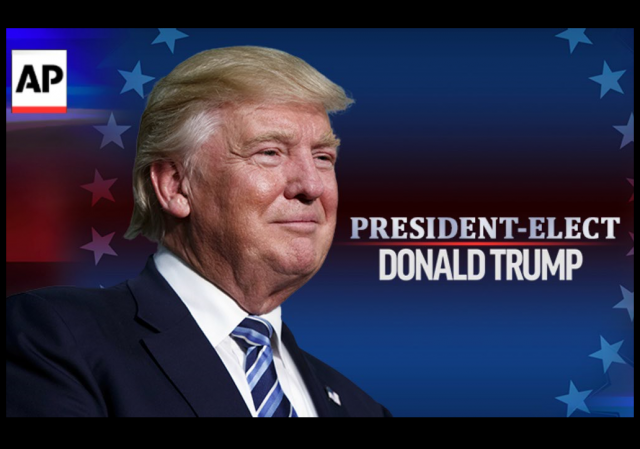
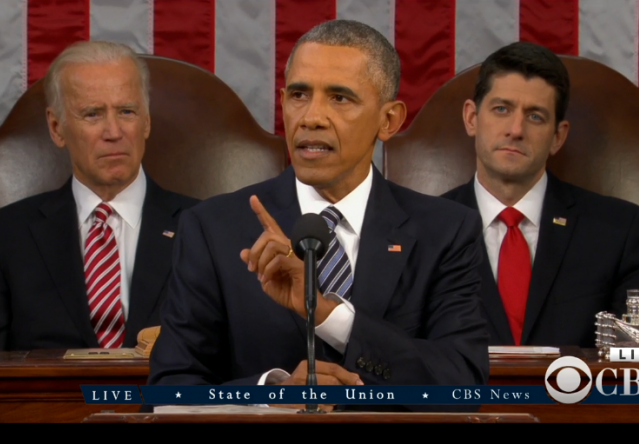
Gallup published its annual poll concerning America's most admired man and woman, and this year's results were pretty interesting. Despite three solid years of Democrats and their media cohorts relentlessly attacking and tearing down President Trump, he has climbed to the top spot, a position he shares with former president Obama.

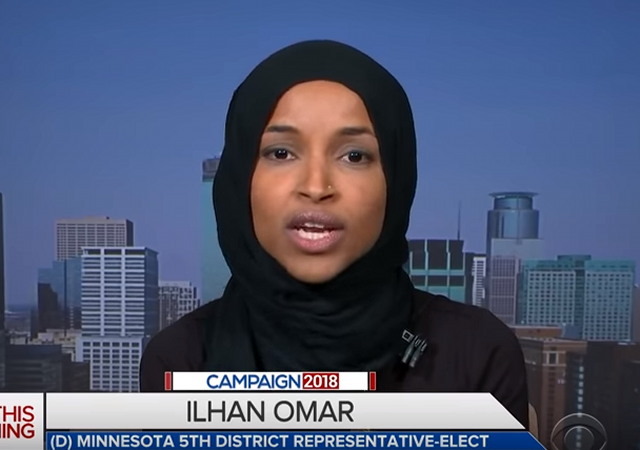
The Democrat Party is trying to come to grips with the antisemitic agitation by Minnesota Rep. Ihlan Omar, backed by Reps. Rashida Tlaib and Alexandria Ocasio-Cortez, that Americans who support Israel do so for money and have pledged allegiance to Israel. These dual-loyalty and disloyalty accusations are echoed by left-wing and Islamist Democrat activists.

A new poll by Gallup illustrates how public opinion on issues like Obamacare and immigration have changed since the midterm elections. One in 5 American surveyed now say that the federal government is the biggest problem with the country and were more likely to cite the government as problematic than any other issue. Even more interesting, guns sunk to the bottom of the list.

A Reuters/Ipsos poll shows a generic ballot lead for the 2018 congressional midterms ... in favor of Republicans. WUT?

Gallup and the Knight Foundation released a survey of college students on the issue of free speech. The full report (pdf.) is here. I discuss the highlights below. Liberal writers at Vox and elsewhere are furiously trying to preempt the fallout from the survey arguing that a majority of students say they support free speech. The results of the survey, however, show that generic support for free speech is not reflected in student willingness to let free speech happen.

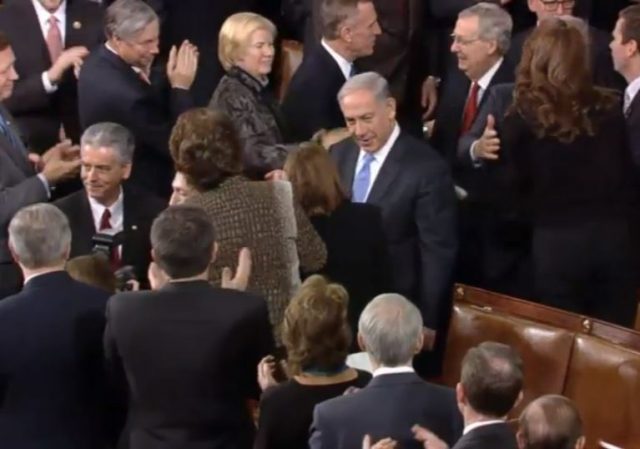
Isreali Prime Minister Benjamin Netanyahu is visiting the U.S. this week, and will meet President Trump. An important question is what is the status of the American popular opinion towards Israel. There is a misconception that American political support for Israel is a result of the "Israel Lobby" and "Israel Firsters." Those are terms frequently thrown around by regressive leftists and anti-Israel activists, a not too subtle play on the traditional antisemitic claim that Jews are disloyal to their home countries. Polling consistently shows, however, that Americans overwhelmingly support Israel, and that support has increased over the past decade, as we reported last year, Gallup: Americans still overwhelmingly support Israel. The "Israel Lobby" actually is the American people, and political support reflects popular opinion.

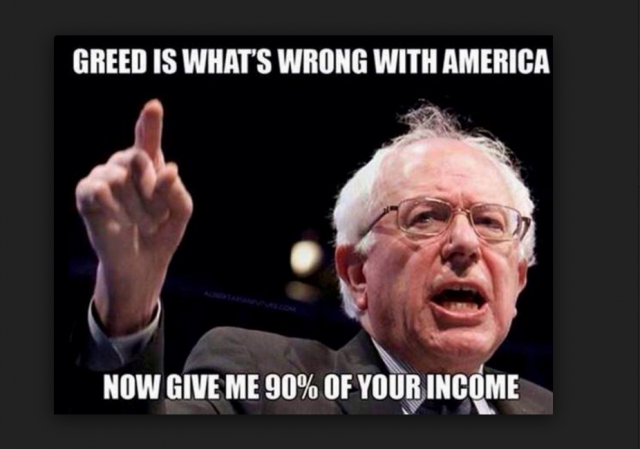
For several years we have been examining Gallup and Pew surveys of attitudes among Americans of the Israeli-Palestinian dispute. What we have seen is a trend of overall support for Israel reaching all-time or near-all-time highs. At the same time, there is a slice of the population in which the support has been slipping -- the left-wing of the Democratic Party. That makes sense based on a number of trends we post about unrelated to polling: The intensive global push, particularly on campuses, to demonize Israel; "intersectionality" theory which makes Israel the central antagonist in the racial and identity politics of the progressive movement; the identification of Israel with capitalism which increasingly itself is demonized among the socialist-friendly section of the Democratic Party that supported Bernie Sanders.

Gallup's post-election poll shows that the majority of Americans (76%) were surprised by Tuesday's results, and they found that Trump supporters feel "excited" and "relieved," while Hillary supporters feel "afraid." Gallup reports:
Americans on both sides of the 2016 presidential race are reacting strongly to Donald Trump's victory Tuesday: 80% of Trump voters say they are "excited," while 76% of Hillary Clinton voters say they are "afraid." A large majority (75%) share one reaction: surprise. . . . . [W]hen asked whether each of six adjectives describes how they are reacting to the election results, Americans do not overwhelmingly identify with the most negative terms. Almost as many say they are "relieved" (40%) as say they are "afraid" (42%). About the same percentages describe their reaction as "excited" (35%) and "devastated" (34%).

According to a recent Gallup poll, D. C. gridlock and "do nothing Congress" accusations seem to have taken its toll on Americans' preference for divided government.  Just 20% of Americans now prefer the presidency and Congress to be controlled by different parties...the lowest it's been in 15 years. Gallup reports:
One in five Americans believe it is best for the president to be from one political party and for Congress to be controlled by another, the lowest level of public support for divided government in Gallup's 15-year trend. The remainder are evenly divided between those who favor one party controlling both the presidency and Congress (36%) and those saying it makes no difference how political power is allocated (36%). Americans' current preference for one party controlling both the presidency and Congress is near the record high of 38% from four years ago. That fits with a pattern of heightened support for single-party control seen in the past two presidential election years. In 2004, the preferences were more evenly divided. These results are based on Gallup's annual Governance poll, conducted Sept. 7-11.

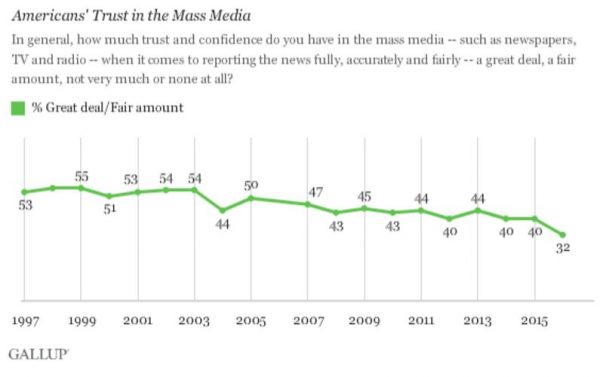
Gallup has released its survey of public trust in the media. The findings are confirmation of what we already knew: Democrats still mostly love the media, Republicans despise the media more than ever. First the top line number. Overall trust in the media is at a historical low and has fallen off a cliff: http://www.gallup.com/poll/195542/americans-trust-mass-media-sinks-new-low.aspx?utm_source=alert&utm_medium=email&utm_content=morelink&utm_campaign=syndication