

Image 01 Image 03

2nd Amendment Tag

This past Tuesday, the 9th Circuit held oral arguments en banc on two consolidated Second Amendment cases, Peruta v. County of San Diego and Richards v. County of Yolo. For a bit of background on this matter, please refer to yesterday’s post, “Full 9th Circuit hears 'Good Cause' 2A Ruling,” in which we provide this relevant background as well as a discussion of the pro-Second Amendment side of the argument as presented by Attorneys Paul Clement and Alan Gura. In this post we cover the gun control side of the argument as presented by Attorneys Edward Dumont, for the State of California and San Diego County, and John Whitesides, for Yolo County. We also include the three-minute rebuttals each by Clement and Gura, thus completing the entirety of the en banc hearing. Video of the full-length en banc hearing can be viewed in here, if you’ve the inclination. Also, a full-length rough transcript of the hearing is embedded at the bottom of this post.
This past Tuesday, the federal 9th Circuit held oral arguments on a re-hearing en banc on two consolidated gun control cases, Peruta v. County of San Diego and Richards v. County of Yolo. Both Peruta and Richards involve a provision of California gun control law that allows county Sheriffs to deny the issuance of a concealed carry permit unless the applicant can demonstrate “good cause” for the permit—typically a showing of some extraordinary risk of danger to the applicant, rather than a mere generalized interest in self-defense. Most California county Sheriffs define “good cause” broadly, such that a mere generalized interest in self-defense is sufficient to qualify an otherwise qualified applicant for a concealed carry permit. The Sheriffs for the Counties of San Diego and Yolo, however, define “good cause” so narrowly as to effectively preclude nearly all applicants from receiving a concealed carry license. The video of the entirety of the hearing, from gavel to gavel, below.  A rough transcript of the portion of the hearing in which the appellants attorneys, Paul Clement and Alan Gura, argue for their clients’ Second Amendment rights also is embedded below.  Both do an outstanding job, but I expect that won't help much before this Circuit.

For anybody who loves their civil rights, the dismantling of unconstitutional gun control schemes across the United States has been a marvel to behold. Today, only a handful of states continue to substantively restrict the ability of law-abiding residents to carry concealed handguns. One of those "states" still aggressively crushing fundamental civil rights is, ironically enough, the nation's capital, the District of Columbia. Pro-gun advocates suffered a modest and rare setback yesterday, according to Hotair.com and other sources, when a federal appeals court re-instated a gun control provision that that is used to effectively deny gun permits to almost all applicants. The District has long operated under some of the most oppressive gun control laws in the country, at one point even requiring the few guns legally owned to be dismantled while within the District. (These rules were upheld in spite of the fact that DC was also one of the "murder capitals" of the country, and practically awash in illegally owned guns used by criminals.) In recent years, however, the District's gun control scheme has come under assault in the form of a pro-2nd Amendment attack led by civil rights attorney Alan Gura. Last July, as part of a suit brought by Gura, Federal Judge Frederick Scullin ordered that the District begin issuing concealed carry permits to qualified persons.

A new Rassumussen poll released last week suggests Americans prefer living in neighborhoods with where they're allowed to arm themselves over gun-free locals. According to Rasmussen:
A new Rasmussen Reports national telephone survey finds that just 22% of Likely U.S. Voters would feel safer living in a neighborhood where nobody was allowed to own a gun over one where they could have a gun for their own protection. Sixty-eight percent (68%) would feel safer in a neighborhood where guns are allowed, while 10% are not sure.
The survey was conducted over a group of 977 likely voters. The results are consistent with other polling conducted by Rasmussen.

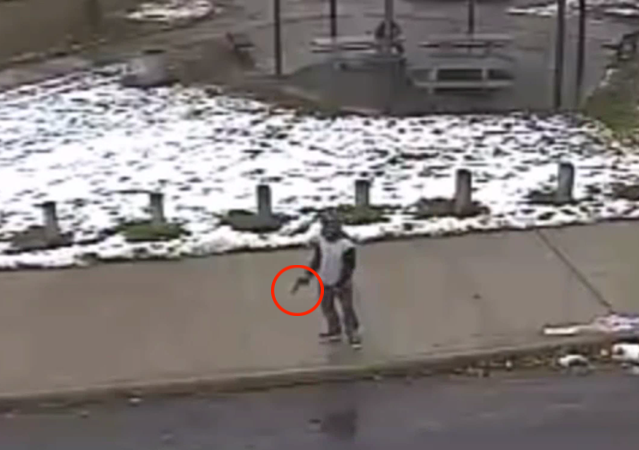
Last November Cleveland Officer Timothy Loehmann shot and killed 12-year-old Tamir Rice in a city park.  The investigation by law enforcement has now been completed, and the case is being handed over to prosecutors and a Grand Jury, reports CNN and other sources. The Cleveland police officers had been dispatched to the scene by 911 because of calls received that someone--ultimately determined to be Tamir Rice--was walking around the park pointing a gun at people. At least one call to 911 reported "a guy with a pistol" walking around the park. The same caller purportedly also told 911 that the gun was "probably" fake, but according to dispatch recordings released by law enforcement this additional information was not communicated to the responding officers.  Even if it had, no police officer could reasonably be expected to risk his life on the firearm identification skills of an anonymous caller to 911. Indeed, the surveillance video (below the fold, and annotated by the author) clearly shows Rice openly handling an apparent pistol (seemingly spinning it on his finger cowboy-style at the 1:20 mark), placing and removing it from his waistband (e.g., at 2:00 mark), and even apparently pointing the gun-like object at passersby. There are at least 10 occasions captured by the grainy footage of the surveillance video in which Rice is openly displaying the apparent gun in some fashion.  To an actual observer at the scene, the handling of the gun would have been far more apparent.

Obama has famously (infamously?) long been enamored of the idea of fundamentally transforming America, and one of the foundational aspects of American culture that he has in his sights is the Second Amendment and Americans' firmly held belief in their right to keep and bear arms. His former attorney general, Eric Holder, went so far as to proclaim—back in the 1990's—that "we really need to brainwash people into thinking about guns in a vastly different way." At least he understood that it's the American people who resist infringement of this right.  The administration has tried to pass gun control legislation, most notably in the wake of the Sandy Hook shootings, but such attempts fail. Completing missing the fact that Americans are strongly supportive of their right to bear arms, Obama and his assortment of anti-Second Amendment zealots blame the NRA:
“But the power of NRA and the gun lobby in Congress is formidable,” Obama said. “And you know, we’re going to keep chipping away at this, but until you get intense public demands for this, it’s probably not going to happen because some special interests and lobbyists in Washington are really, really strong and their membership feels very intensely about the issue. Whereas the general public is concerned about it, but doesn’t make it their top priority.”
He also recognizes that Congress—even when Democrats held supermajorities in both houses—is unable to pass the sort of sweeping gun control legislation he seeks.  In his 2014 State of the Union address, he promised gun control "with or without Congress," and it seems he's working on multiple fronts to make that happen. From taxing bullets, to gun locks, to gun recalls / buyback programs, to targeting children's pop-tarts and otherwise controlling the narrative about guns, Obama and other anti-Second Amendment advocates are working overtime in their frantic bid to disarm the American people.

As some of you may be aware, Attorney Alan Gura has been waging a legal battle against the District of Columbia (as well as other jurisdictions) based upon their unconstitutional infringement of the Second Amendment generally, and DC residents concealed carry rights in particular. Having already won a court decision compelling the District--and in particular, its Police Chief Cathy Lanier (pictured above)--to issue concealed carry permits to lawful, qualified residents, Gura naturally ran into the usual anti-gun rearguard position: "Sure, we'll issue permits--on terms of our own choosing. Terms that nobody except our rich friends and political comrades will ever be deemed to have satisfied." And those terms invariably require that the applicant have some special and unusual reason to be granted a concealed carry permit.  This is the kind of restriction still being employed in liberal states like New Jersey and New York, and which was being employed in California until the recent Peruta decision by the 9th Circuit. Gura responded to Lanier's demand that applications show some special reason--above and beyond simply being law-abiding Americans with civil rights--by filing a motion for an injunction with the US District Court for DC, to prohibit Lanier from imposing those special conditions. Today that Court handed down its decision on the requested motion--and Gura was the big winner, again:

Color the rest of the country shocked: Texas is one of the few states in the nation (six, to be exact) that hasn't yet approved the open carry of handguns in some form. That all could change this legislative session, though, if Republicans in the legislature have their way. Yesterday, members of the Texas House of Representatives voted 96-35 to approve House Bill 910 by Republican Larry Phillips. HB 910 would allow anyone holding a concealed carry license to also also openly carry a weapon in a hip or shoulder holster. (In Texas, it's already legal to openly carry a long gun.) According to the Houston Chronicle, lawmakers worked through almost 20 amendments before finally moving the measure on to the Senate, including one that would have allowed for campus carry. (That issue, unfortunately, is another blog post entirely.) The Senate has already passed its own version of the bill, which means that the two chambers will have to reconcile their differences before the bill is sent to Governor Greg Abbott for his signature.

As I continue my homeward travels from the NRA Annual Meeting--yesterday was seven hours of riding in hard rain from wester North Carolina to northern Virginia, and I'm still drying out--here's another post looking back at the Annual Firearms Law Seminar. A particularly interesting Seminar talk was entitled "Gun Rights Restoration: The Nuts & Bolts and Present Day Military Issues," presented by Attorney Derek A. DeBrosse, who specializes in this area. We all agree, of course, that to the extent it's feasible to do so society should deny bad people access to firearms. (As a practical matter, of course, the feasibility of enforcing such constraints is zero, at least against any bad actor who seriously wishes to obtain possession of a gun, but that's fodder for another day.) In the United States there are certain classes of individuals who the law requires be stripped of their gun rights for some period of time, and sometimes for the remainder of their lives.

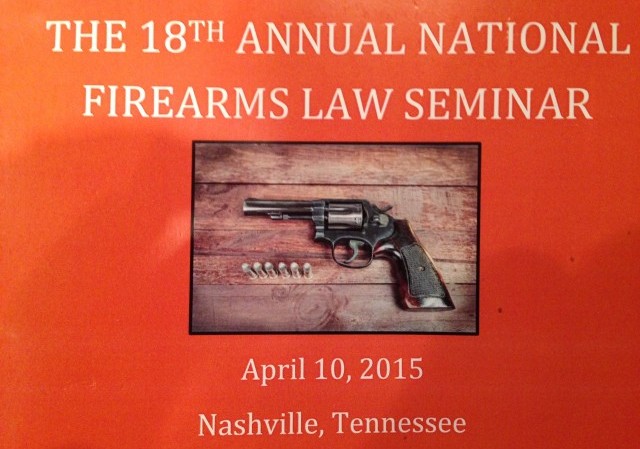
As I type this roughly 79,000 people are still happily recovering from their participation in the NRA Annual Meeting held this past weekend in Nashville, TN—your humble scribe among them. The massive scope of the event—three days of legal seminars, classroom instruction, political speeches, country music concert, and 9 acres (not a typo) of exhibits displaying an incredibly variety of firearms and related stuff and activities—is is obviously too great to cover in a single blog post. Accordingly, I’ll share my own view of the NRAAM 2015 through a series of relatively brief posts, focused largely within my particular area of expertise—the day-long Firearms Law Seminar held on Friday, April 10. (Full disclosure, I was a speaker at last year’s seminar, but merely an attendee at this one.) For those not familiar, the National Firearms Law Seminar is billed as providing “a unique opportunity for attorneys who represent firearms owners and firearms-related businesses to meet and discuss legal issues relevant to this expanding area of the law.” And I must say, they delivered, through a dozen talks on a variety of firearms-law related issues delivered by incredibly well-informed, experienced, and enjoyable speakers. I’ll do this first post on the talk given by Attorney Stephen Halbrook, who has for decades been a leading legal figure in gun rights legal actions, and is perhaps most commonly known for his ground-breaking book “That Every Man Be Armed: The Evolution of a Constitutional Right.”

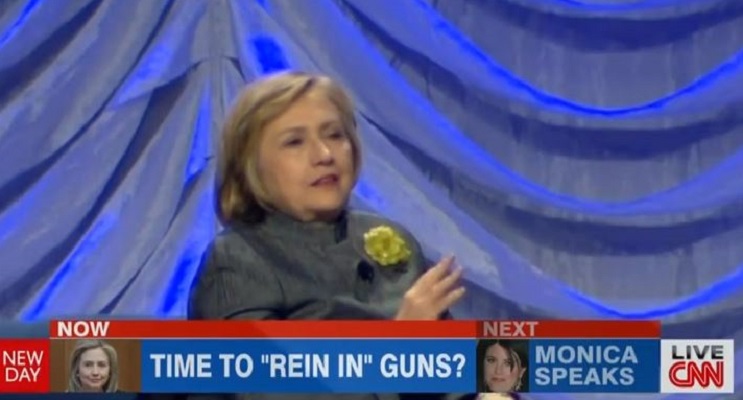
Hillary is set to announce her presidential run today. At the same time, former Mayor Michael Bloomberg is holding one of his anti-Second Amendment events and the NRA is holding its annual meeting.  Hot Air reports:
The well monied former New York mayor and head honcho of Everytown for Gun Safety is holding his own event in Tennessee to focus attention on politicians who aren’t willing to sign on to ever increasing restrictions of the rights of gun owners.
This is just the sort of attention that Democrats are not eager to bask in.  According to the Washington Times:
The near unity among Republicans on gun rights contrasts with the Democratic divide on the issue, underscoring how the politics appear to have swung in the GOP’s favor. “It is a loser for the Democrats and so they shy away from it — except in Washington, D.C., or New York, where they have a strong liberal constituency and where it is not going to cost them votingwise,” said Robert A. Levy, of the libertarian-leaning Cato Institute.

Members of the Legal Insurrection community will be familiar with the travails of Pennsylvania nurse and single-mom of two Shaneen Allen under the heel of New Jersey's unconscionable anti-Second Amendment laws, as we covered the matter here in some detail, including PA Nurse Arrested on Gun Charges Given Reprieve (9/24/14) and The Memo that let Shaneen Allen — and Chris Christie’s political future — off the hook (9/29/14). In brief, Ms. Allen was in possession of a PA-issued concealed carry permit and a handgun when she drove across the Delaware and into New Jersey.  Pulled over for a routine traffic stop, Allen volunteered to the officer that she was in possession of the handgun.  She mistakenly believed that her PA concealed carry permit, like her PA driver's license, was legally valid in both states. The New Jersey authorities quickly disabused her of that notion, charged her with illegal possession of a handgun, threatened the mother of two small children with a multiple-year mandatory jail sentence, and refused to allow her to enter a diversion program for non-violent first-time offenders (the same program into which football star and wife knock-out puncher Ray Rice would be readily admitted without hesitation just months later).

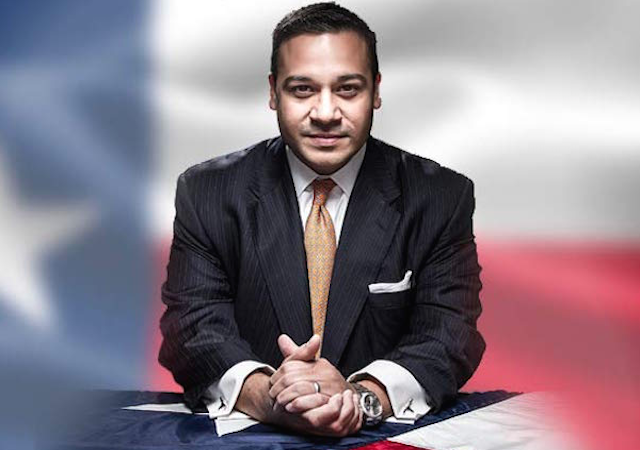
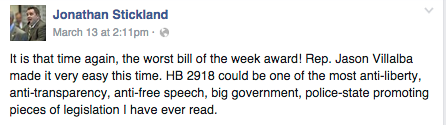
The Texas legislature has a reputation for creating headlines, and HB 2918, authored by Dallas-area state Representative Jason Villalba (R-HD 114), might just be the "lege" scandal that we've all been waiting for. Texans don't like it when you mess with their right to hold government accountable---especially when it comes to police action---and Villalba's HB 2918 appears to do just that. Citizens, advocates, and journalists alike are coming out in opposition to a bill that would restrict the rights of everyday citizens and bloggers to film the actions of police officers. The Dallas Republican is even taking heat from his own caucus, with colleagues speaking out publicly against the bill's filing: Screen Shot 2015-03-15 at 8.13.49 PM Villalba’s “cop watching” bill amends and adds to Section 38.15 of the Texas Penal Code, which applies a criminal negligence standard to civilian interference with police business. The problem is that the Villalba bill characterizes the filming or documenting of police action as "interference." Here’s the controversial language (emphasis mine):

"Is your 401k retirement plan invested in public gun companies?" The "Unload your 401k" campaign wants to know. Their website is full of scare stats: did you know that almost $2 billion of investor money is partially buried in three gun companies? That number is followed by statistics highlighting gunshot wounds, the cost of gun violence, and even a nod to Columbine. The Unload your 401k backers are ramping up the effort to get investor money out of the gun industry, and they're using celebrities to do it. Watch: From CNN Money:
Snoop Dogg might seem like an unusual choice as an anti-gun advocate. He once exalted gun violence through songs like "Bang Out" about gangsters. In 2006 he was charged with felony gun possession. And in the 1990s he was tried -- and acquitted -- of murder charges. But Snoop Dogg has changed his tune. Last year, he released a song called "No Guns Allowed," which he produced with Drake and his daughter Cori B. (The B stands for Broadus.) The song contained references to the massacres at Sandy Hook Elementary and Columbine High School.

I covered the federal court ruling in Mance v. Holder in some detail last month, and if you haven't yet had an opportunity to get up to speed on that decision it might be useful to take a moment to click over: Federal Court: Handgun Transfer Ban Unconstitutional. (That post includes the full-length ruling.) In brief, in Mance v. Holder US District Court Judge Reed O'Connor found that the federal interstate handgun transfer ban was unconstitutional on its face--specifically, the provision that requires an out-of-state handgun purchaser to transfer the handgun through several FFLs before taking possession. Most interestingly, Judge O'Connor found the requirement to be an unconstitutional infringement of the 2nd Amendment under both strict and intermediate scrutiny, as well as an unconstitutional infringement of the 5th Amendment under strict scrutiny. As observed in our earlier post on the subject:
Based on its conclusion that the federal handgun transfer ban was, both facially and as applied to the facts of this case, unconstitutional under both strict scrutiny and intermediate scrutiny, the Court granted the Plaintiff's motion for Summary Judgment (thus granting them victory without having to go to trial), and enjoined the Defendants (AG Holder and ATF(E) Director Jones) from enforcing those provisions of the federal handgun transfer ban.

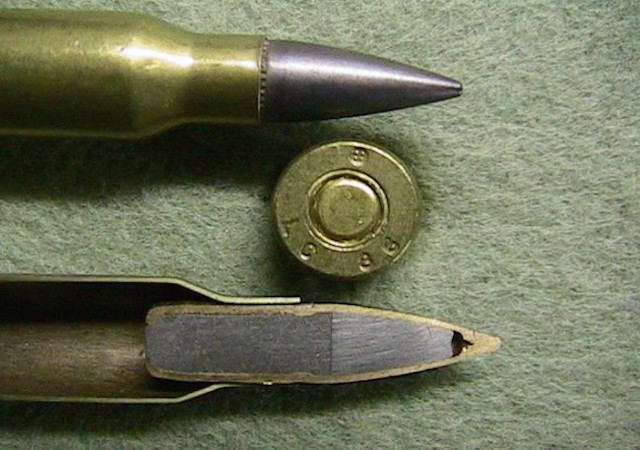
On Wednesday, February 11, the Department of Justice and the Bureau of Alcohol, Tobacco, Firearms & Explosives (BATFE) suffered a humiliating federal court defeat that struck at the very core of its power.  In response, it took the DOJ and the BATFE only two days to petulantly strike back at gun owners in the form of a late Friday order intended to ban a major type of ammunition for the single most commonly purchased rifle. (The BATFE's "framework notice" released Friday evening is embedded at the bottom of this post.) Last week's federal court summary judgment against the government in Mance v. Holder struck down a key provision of the Gun Control Act of 1968 (GCA) requiring all interstate handgun transfers to pass between FFLs in each state was struck down as an unconstitutional infringement of the 2nd Amendment under both strict and intermediate scrutiny, as well as on 5th Amendment Due Process grounds. (We covered that decision in detail right here at Legal Insurrection: Federal Court: Handgun Transfer Ban Unconstitutional, and the PDF of that court order can be found at that link.) Never before had the Gun Control Act of 1968 been so grievously wounded, and the BATFE's authority so profoundly shaken, and lawful American gun owners were appropriately ecstatic. Like any wounded beast, of course, the BATFE faced an existential imperative to reassert their authority, and late Friday afternoon (in a move that's long ago become standard operating procedure for the Obama administration) they did so with a vengeance.

When a 72-year-old retired school teacher faces a 10 year felony sentence (a likely life sentence) for possession of an unloaded 18th century flintlock pistol, one knows immediately that we can only be talking about a handful of states in which such a travesty can happen.  In this case, not surprisingly, it's the "Garden State" of New Jersey. (h/t Sebastian over at the Shall Not Be Questioned blog.) Gordon Van Gilder, who taught in the New Jersey school system for 34 years, is a collector of 18th century memorabilia.  He acquired a genuine antique flintlock pistol from that era, and had it unloaded and wrapped in a cloth in his glove compartment when he was pulled over for an alleged minor traffic violation.

Yesterday a federal district court in the 5th Circuit ordered summary judgment in favor of several plaintiffs who challenged existing restrictions on handgun transfers across state lines; the court found that the federal government’s existing handgun transfer ban was unconstitutional both on its face and applied to the facts of this case, under both strict scrutiny and intermediate scrutiny, and on 5th Amendment Due Process grounds. The order in the case of Mance v. Holder (PDF at bottom of post) is refreshingly clearly written, and I encourage even non-lawyers to “read the whole thing.” ™ In this post I’ll touch upon the high points of the decision, as well as some reasonably likely (and unlikely) practical consequences. First things first: a huge congratulations to Attorney Alan Gura for another tremendous win for the Second Amendment. While the immediate practical effects of this order are likely to be limited, it is yet another ratcheting of the law in the right direction. Everyone remembers, of course, that it was Alan who successfully litigated both of the groundbreaking Second Amendment cases Heller and McDonald before the US Supreme Court.