Image 01 Image 03

Le·gal In·sur·rec·tion

/var/www/vhosts/legalinsurrection.com/httpdocs/wp-content/themes/bridge-child/readFeeds.incFALSE

LATEST NEWS

Files paperwork to run for Congress...

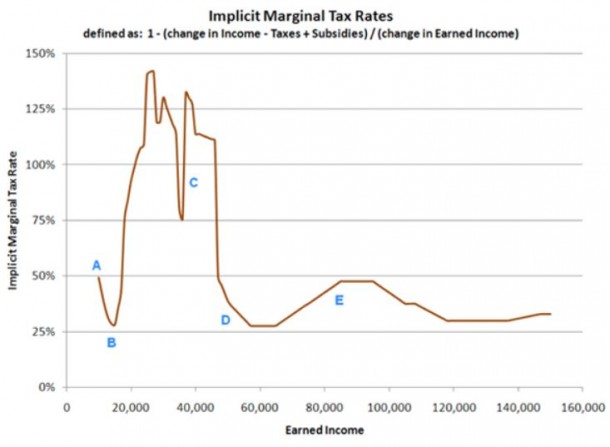
This all was predicted. Obamacare subsidies decrease the incentive to work harder because as one's income increases, the subsidies vanish. It's what we call the implicit marginal rate which takes into account not only tax marginal rates, but also loss of government benefits. In the key 30-50,000 range, the implicit marginal rate has exceeded 100% even before Obamacare (see Featured Image above) -- meaning that it is economically irrational to earn an extra dollar because you will lose more than one dollar through taxes and loss of benefits. Obamacare makes that problem even worse because of the high cost of Obamacare health insurance which depends on subsidies to render it even somewhat "affordable." Lose those subsidies and the cost of mandatory health insurance becomes onerous. The CBO is predicting a loss of 1-2% of employee hours because workers choose not to lose the subsidies, as reported by Reuters (h/t Bryan Preston)(full report embedded at bottom of post):
A historically high number of people will be locked out of the workforce by 2021, according to a report by the Congressional Budget Office released Tuesday. President Barack Obama's signature health-care law will contribute to this phenomenon, the CBO said, citing new estimates that the Affordable Care Act will cause a larger than-expected reduction in working hours—eliminating the equivalent of about 2.3 million workers in 2021 versus a previous estimate of an 800,000 decline. "CBO estimates that the ACA will reduce the total number of hours worked, on net, by about 1.5 to 2 percent during the period from 2017 to 2024, almost entirely because workers will choose to supply less labor—given the new taxes and other incentives they will face and the financial benefits some will receive," said the report.
The CBO Report states (in Appendix C):

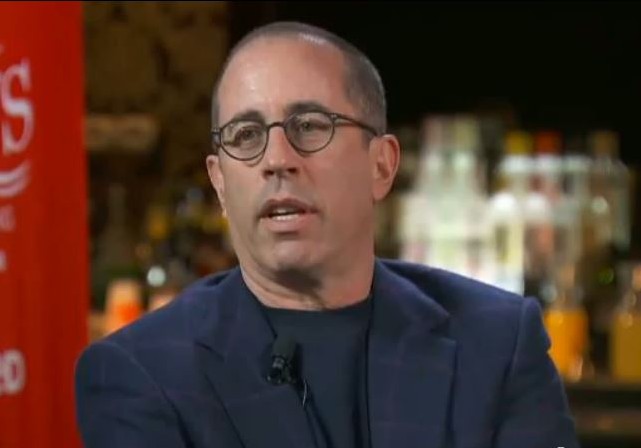
Jerry Seinfeld was interviewed for Buzzfeed Brew, and gave a perfectly sensible answer about "diversity" in comedy, namely that if you're funny, you're funny, and comedy is not a census designed to look like the pie chart of America. It's perfectly sensible, except to Gawker, which is trying to inspire 2-minutes of Seinfeld hate:

Jerry Seinfeld, the most successful comedian in the world and maker of comedy for and about white people, isn't interested in trying to include non-white anything in his work.

When asked why he featured so many white men in his web series Comedians in Cars Getting Coffee during a Buzzfeed interview on CBS This Morning, Seinfeld seemed offended by the very question. "It really pisses me off," he said. "People think [comedy] is the census or something, it's gotta represent the actual pie chart of America. Who cares?"

BuzzFeed Business Editor Peter Lauria seemed hesitant to pursue the frank answer, but the comedian continued on anyway. "Funny is the world that I live in. You're funny, I'm interested. You're not funny, I'm not interested," he said. "I have no interest in gender or race or anything like that." He seems to suggest that any comedian who is not a white male is also not funny, though he's also likely fed up with the amount of bad comedy he's been forced to sit through in his (waning) career.

Which is too bad, because Seinfeld is downplaying the work of everyone from Richard Pryor and Bill Cosby to Aziz Ansari, Mindy Kaling, and Eddie Huang, who are all in various stages of their own sitcoms that just might turn out to be the next Seinfeld....

In conclusion: Yes, comedy should represent the entire pie chart of America, and the glorious, multicolored diversity pie should be thrown directly at Jerry Seinfeld's face.

No, you fool, Seinfeld isn't denigrating anyone.  He's saying that we should judge comedians by the quality of their comedy, not the color of their skin.

Where did I hear something similar to that before?  Definitely not at Gawker.

Someone saw this coming from a mile away:

After an announcement just last week that he'd be taking an indefinite sick leave, the President of Ukraine returned on Monday, as the political crisis continues there. From Reuters:
Ukrainian President Viktor Yanukovich returned to work on Monday after four days of sick leave, issuing a warning about rising "radicalism" after more than two months of unrest on the streets but giving no word on a new prime minister. Yanukovich, caught in a tug of war between Russia and the West, is seeking a way out of a sometimes violent confrontation with protesters who have occupied city streets and public buildings following his decision in November to spurn a trade deal with the EU and accept financial aid from Moscow. As he returned to work, looking in fair health, a day before a new session of parliament, the political opposition took heart from fresh expressions of support from Western governments and pressed for more concessions to end protests. However, the European Union, whose foreign policy chief is due in Kiev late on Tuesday, played down suggestions it was working with the United States on a large-scale aid package aimed at nursing the economy through a political transition.
It remains an uncertain situation upon Yanukovich's return.

An interruption to a post-game interview. What was with that? ...

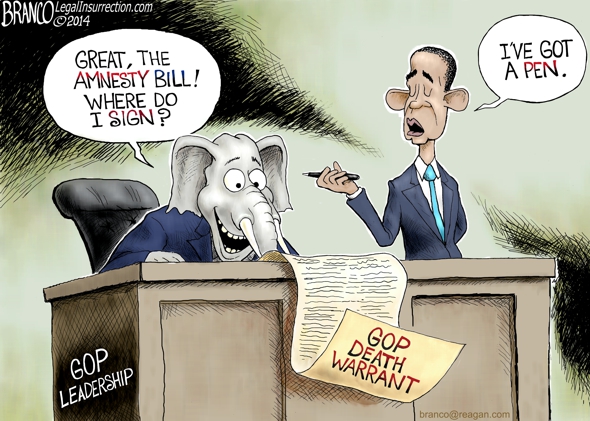
Ross Douthat, a columnist for the NY Times, is not someone people usually refer to as part of the Republican "base." Stephen Colbert describes him as the "conservative columnist at the NY Times, which also qualifies him to be the liberal columnist for the NY Post." But he's with the base when it comes to Republican immigration "principles" released on Friday:
THE debate over immigration reform, rekindled last week by House Republican leaders, bears a superficial resemblance to last fall’s debate over the government shutdown. Again, you have establishment Republicans transparently eager to cut a deal with the White House and a populist wing that doesn’t want to let them do it. Again, you have Republican business groups and donors wringing their hands over the intransigence of the base, while talk-radio hosts and right-wing bloggers warn against an imminent inside-the-Beltway sellout. Again, you have a bill that could pass the House tomorrow — but only if John Boehner was willing to live with having mostly Democrats voting for it. Except there’s one big difference: This time, the populists are right. They’re right about the policy, which remains a mess in every new compromise that’s floated — offering “solutions” that are unlikely to be permanent, enforcement provisions that probably won’t take effect, and favoring special interests, right and left, over the interests of the citizenry at large.
Among the many problems, any form of legalization prior to enforcement is folly. And therein lies the problem. Obama will not sign a meaningful "enforcement first" bill, so either Republicans repeat the mistakes of the past, or the "principles" go nowhere while disrupting Republicans focus for 2014. Greg Sargent of WaPo, reliable conduit of Democratic thinking, notes that Republicans don't trust Obama to enforce the law, so will impose preconditions that will be unacceptable to Obama:

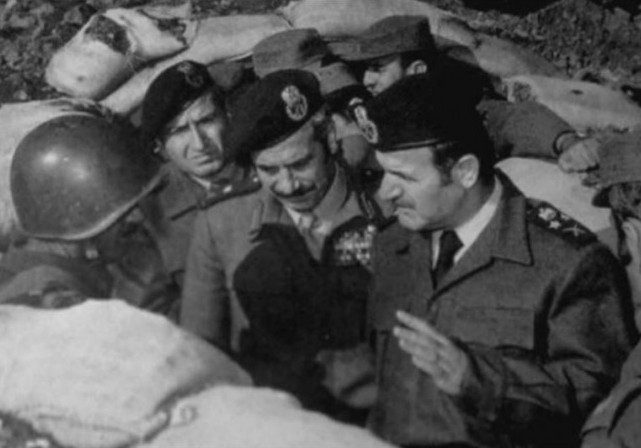
Thirty two years ago yesterday, February 2, 1982, Syrian President Bashar Assad's father, Hafez, began an assault on the city of Hama to put down a Muslim Brotherhood revolt against his regime. Two years ago NPR recounted:
The facts of that event are well-known, but the photographic evidence has been scant. Then, Syria's branch of the Muslim Brotherhood led an uprising centered in Hama, a central city of around 400,000. In response, President Hafez Assad, the father of the current president, ordered 12,000 troops to besiege the city. That force was led by Hafez Assad's brother Rifaat. He supervised the shelling that reduced parts of Hama to rubble. Those not killed in the tank and air assault were rounded up. Those not executed were jailed for years. To this day, the death toll is in dispute and is at best an estimate. Human rights groups, which were not present during the slaughter, have put the toll at around 10,000 dead or more. The Muslim Brotherhood claims 40,000 died in Hama, with 100,000 expelled and 15,000 who disappeared. The number of missing has never been acknowledged by the Syrian leadership.
As we know the lessons of the father have been well learned by the son. Kill enough people and no one will make you pay a price. Somehow the UN and Secretary of State John Kerry thought that they could get some sort of agreement to stop the killing in Syria. The latest round of talks ended on Friday, apparently in failure.
Secretary of State John Kerry and Foreign Minister Sergey V. Lavrov of Russia raised expectations in January at a joint news conference in Paris that a way would be found to open humanitarian aid corridors and possibly establish local cease-fires in Aleppo and other cities and towns. But to the dismay of the United Nations and other humanitarian organizations, even those basic steps proved elusive.

Note: You may reprint this cartoon provided you link back to this source.  To see more Legal Insurrection Branco cartoons, click here. Branco’s page is Cartoonist A.F.Branco...

Anyone who has read this blog the past months knows that I take the international boycott threat against Israel very seriously. It is a venomous movement conceived by propagandists that has had some success in Europe, but few victories in the U.S. Israel has lived all of its existence under boycott. The current boycott movement is a shadow of the Arab League boycott that started even before Israel was a nation and grew with great force as Arab oil wealth grew in the 1970s. Yet somehow Israel's economy survived and prospered nonetheless, helped in great part by U.S. anti-boycott legislation that mostly kept the boycott disease from our shores. The Israeli economy is more diverse, high tech, and privatized than it was in the 1970s. Israel also is less dependent on Europe, and a sought-after participant in the global economy, most of which wants no part of the boycott movement.  The leverage of Europeans who capitulate to anti-Israel groups is much less than in the past. The U.S. Congress also could significantly deflate the boycott movement once again by extending current legislation to cover the new form of boycott movement.  Congress should do so now, and in so doing will aid the peace process by letting the Palestinians know that they cannot achieve more through international boycotts than through negotiations. While it seems invincible because largely unchallenged, the boycott movement is susceptible not only to legislation, but the type of pushback academic boycotters in the U.S. are receiving. The boycott movement, while it should be taken seriously and combatted, should not be allowed to dictate Israel's strategic security needs as part of peace negotiations. Doing business with a few extra European banks will be a hollow achievement if the West Bank is turned into another Gaza-style Iranian missile base. Don't let the boycott tail wag the security dog. Yet John Kerry is playing the boycott card to pressure Israel, running around like chicken little screaming that the sky is falling.

Japan and India don't necessarily have the warmest relationship with their neighbor, China. China hasn't exactly lessened tensions by enforcing a no-fly zone over Japanese islands. And its rapidly expanding military efforts haven't brought comfort to India's government, especially with a long history of border tensions. Since it has become apparent that the Obama Administration is unreliable in handling complex international policy dynamics, what can Japan and India do? Go the tradition route: Form a strategic regional alliance. China downplays Japanese PM Shinzo Abe's visit to India
China on Monday downplayed Japanese Prime Minister Shinzo Abe's visit to India as a bilateral issue, even as the state-media termed the trip as a failure for not succeeding in pinning down Beijing. "The visit you mentioned is an issue between India and Japan," Chinese Foreign Ministry spokesman Qin Gang told a media briefing while responding to a question on Abe's just-concluded visit to India. The visit evoked considerable media attention in view of the China-Japan diplomatic stand off over the disputed islands in East China Sea.