Image 01 Image 03

Le·gal In·sur·rec·tion

/var/www/vhosts/legalinsurrection.com/httpdocs/wp-content/themes/bridge-child/readFeeds.incFALSE

LATEST NEWS

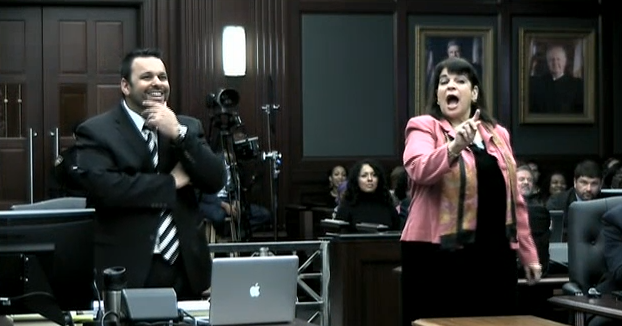
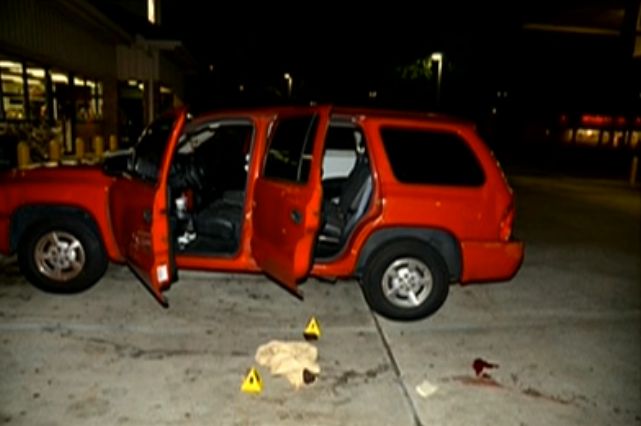
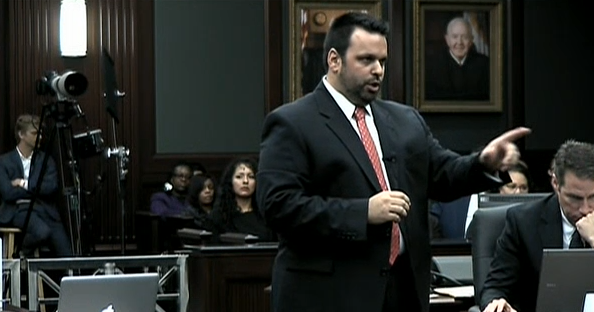
The court moved through three witnesses this morning, including two evidence technicians and the Deputy who executed the Jacksonville arrest warrant on Michael Dunn at his residence the day after the shooting. Before the trial proper started there was apparently an evidentiary issue that needed to be addressed. There existed a forensics photo that had a portion highlighted. Unfortunately, it was the wrong portion, so a second version was made. In confusion the first photo was admitted into evidence. It only took two highly educated lawyers and a presumably similarly well-educated judge 15 or 20 minutes to figure out how to resolve this difficult. They did manage to do so, however, in a cooperative spirit. [caption id="attachment_78069" align="alignnone" width="450"](Defense Counsel Cory Strolla and State Attorney Angela Corey.) (Defense Counsel Cory Strolla and State Attorney Angela Corey.)[/caption] State Attorney Angela Corey would take the lead on the two evidence technicians, before turning things over to Assistant State Attorney Erin Wolfson for direct of the Deputy. [caption id="attachment_78073" align="alignnone" width="450"](State Attorney Angela Corey.) (State Attorney Angela Corey.)[/caption] Ron Davis, father of Jordan Davis, was again present in the courtroom.


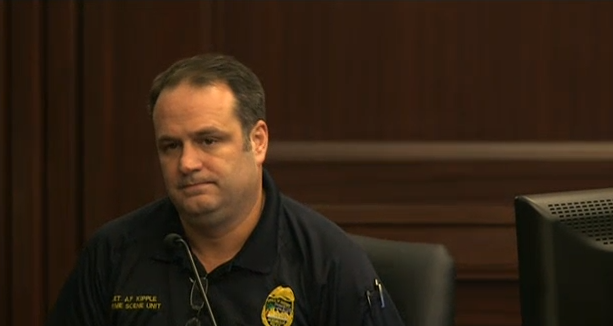
Detective Andrew Kipple, Lead Crime Scene Technician

[caption id="attachment_78072" align="alignnone" width="450"](Detective Andrew Kipple.) (Detective Andrew Kipple.)[/caption] The first State's witness was Detective Andrew Kipple, the senior evidence technician involved in processing the crime scene and evidence..  His testimony would consume the large majority of the morning.

UPDATE 2-11-2014 - Testimony over, here's the latest update: “Loud Music” Murder Trial Day 5: Dunn Testifies, Defense Rests. ---------------- Welcome to day three of our live coverage of the "loud music" 1st degree murder trial of Michael Dunn in real time. Here are a couple live video feeds, with the smaller, upper-most feed proving the most reliable yesterday. At the bottom of the post is a live Twitter feed with my live tweets and those of others reporting on the trial. We plan to do a brief mid-day summary when the court recesses for lunch, then our usual lengthier coverage/analysis after the court recesses that day's end.

The court moved through nine witnesses today, as they proceeded with the State's presentation of its case in the "loud music" first degree murder trial of Michael Dunn, for the shooting death of 17-year-old Jordan Davis. These witnesses consisted of several first-responders to the scene, the three young-men who were with Davis in the Durango SUV when Dunn opened fire, and two witnesses who observed the SUV for the brief period it had pulled away from the gas station. The first four witnesses were all first responders -- three police officers and a Fire & Rescue paramedic -- who arrived at the scene after the shooting had taken place. In order they were:

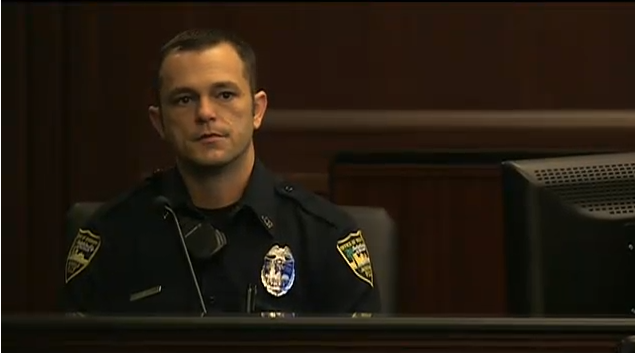
Robert Holmes, Patrol Officer, Jacksonville Sheriff's Office

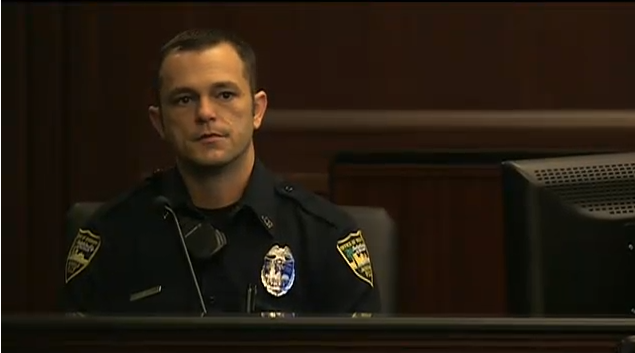
[caption id="attachment_77961" align="alignnone" width="450"](Patrol Officer Robert Holmes) (Patrol Officer Robert Holmes)[/caption] Assistant State Attorney handled the direct examination of Holmes. [caption id="attachment_77963" align="alignnone" width="450"](Assistant State Attorney Erin Wolfson) (Assistant State Attorney Erin Wolfson)[/caption] Holmes is a 7-year veteran of the police department, with prior Navy service.  Perhaps the most remarkable part of his testimony to me was how little first aid training he'd received either as a policeman or seamen.  Basically, his training was limited to CPR (last taught to him 7 years prior at the police academy) and how to use a tourniquet. Period. Holmes described receiving the call of shots fired, arriving at the scene to see Jordan Davis cradled in the arms of his friends.  Davis had no pulse.  There was no pool of blood (of course, given the deep internal nature of the wound and the fact that Davis' blood pressure would have been zero at that point, there wouldn't be much blood).  When Andrew Williams performed CPR compressions, however, Holmes observed blood coming from Davis' back.  He described Davis' friends as shocked, as he drove them collectively back to the police station to meet with detectives. On cross, Strolla asked why Holmes hadn't performed first aid himself, rather than let a "civilian" do it.  It was here Holmes explained the paucity of his first aid training, and indicated that he'd thought it best to defer to a civilian who purported to have greater skills. Strolla also explored the apparent fact that the interviews conducted at the police station by detectives were not recorded, despite the station having adequate capabilities to do so.  It seems he intends to argue that this allowed the statements of the Durango survivors to be altered and coordinated over time. One interesting point on direct arose when Corey asked Holmes where his notebook was from the night of the shooting, and Holmes casually indicated that the notebook was gone, destroyed.  This seemed as if it might have some import, but Strolla never touched upon it in cross. Offline, a Federal law enforcement officer contacted me to share that in his service notebooks were dated and destroyed by fire at pre-determined intervals, to ensure the confidentiality of their contents.  Perhaps a similar policy is being followed by the Jacksonville Sheriff's Office. Holmes came across as professional and objective, as is typical of police officers of any meaningful experience.

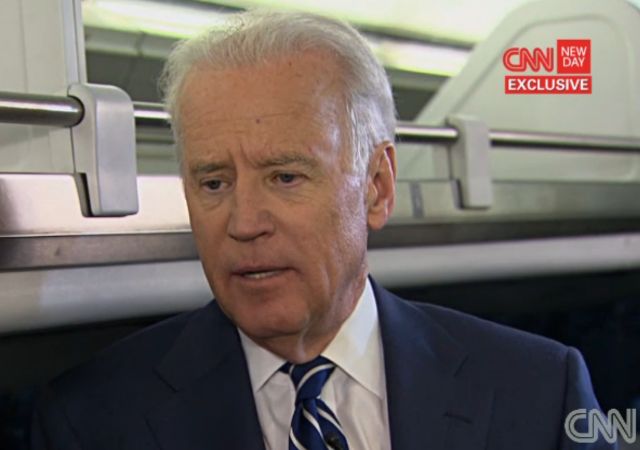
When asked to give a good reason (other than Corvettes) why he shouldn't run for President, Vice President Joe Biden told CNN "New Day's" Kate Bolduan in an interview, "I can't." “There may be reasons I don't run, but there's no obvious reason, for me, why...

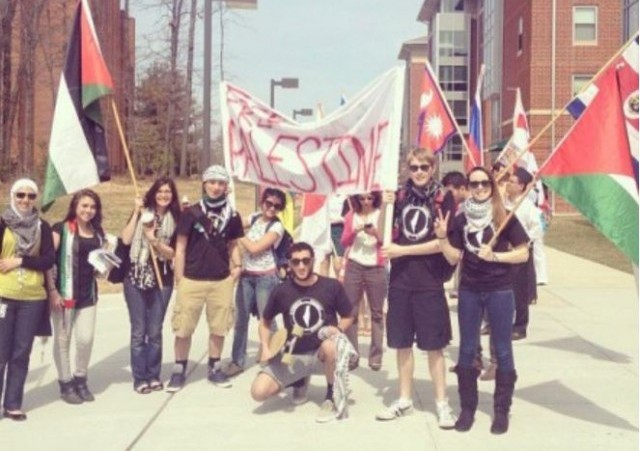
Over 225 University Presidents have issued statements condeming the anti-Israel academic boycott by the American Studies Association as a threat to academic freedom and education, as have several major academic organizations such as the American Association of University Professors and the Association of American Universities. Of the 80 ASA Institutional Members, at least 8 have dropped their membership and at least 11 have denied being Institutional Members in the first place. It is not an exaggeration to say that ASA has become a pariah in the academic community, and the boycott passed by a vote of less than 25% of the membership (because so few participated) has split the organization. There also has been legislative activity with regard to anti-boycott laws that is stalled because even critics of the ASA boycott are concerned with preserving university and individual academic autonomy. Nonetheless, even though stalled, the legislation does reflect a political backlash against the ASA. Canadian Prime Minister Stephen Harper publicly called the academic boycott part of “mutation of the old disease of anti-Semitism” From the earliest days, the ASA has played victim, mistaking harsh criticism of its boycott as an infringement of its academic freedom.  ASA's incoming President, NYU Prof. Lisa Duggan, also has accused one critic, an author at Forbes, of homophobia.  Others have accused Israel Lobby money of being behind the backlash. All the while, ASA as an organization has sought to put on a happy face, as if none of this troubles them and all is well. But there are significant signs that the backlash is being felt at ASA. First, the ASA activism caucus issued an urgent request to BDS supporters to join the organization to increase individual memberships. Next, ASA has increaed the activity of its non-profit legal advisers to speak out on the subject, defending ASA's boycott. Today I received an Open Letter to college and universities signed by the leftist National Lawyers Guild and other anti-Israel groups and individuals making inflammatory accusations that the Universities that have spoken out against the ASA boycott are engaged in "McCarthy" like witch hunts and are themselves abusing academic freedom by speaking out.

The court moved through five witnesses this morning, as they proceeded with the State's presentation of its case in the "loud music" first degree murder trial of Michael Dunn, for the shooting death of 17-year-old Jordan Davis. The first four witnesses were all first responders--three police officers and a Fire & Rescue paramedic--who arrived at the scene after the shooting had taken place. In order they were:

Robert Holmes, Patrol Officer, Jacksonville Sheriff's Office

[caption id="attachment_77961" align="alignnone" width="450"](Patrol Officer Robert Holmes) (Patrol Officer Robert Holmes)[/caption]

Assistant State Attorney handled the direct examination of Holmes.

[caption id="attachment_77963" align="alignnone" width="450"](Assistant State Attorney Erin Wolfson) (Assistant State Attorney Erin Wolfson)[/caption]

William Spicer, Engineer/Paramedic, Jacksonville Fire & Rescue

[caption id="attachment_77964" align="alignnone" width="450"](William Spicer, Paramedic) (William Spicer, Paramedic)[/caption]

Repeat "Blame Bush" ad infinitum -- it works!...

Welcome to day two of our live coverage of the "loud music" 1st degree murder trial of Michael Dunn in real time. Here are a couple live video feeds, with the smaller, upper-most feed proving the most reliable yesterday. At the bottom of the post is a live Twitter feed with my live tweets and those of others reporting on the trial:

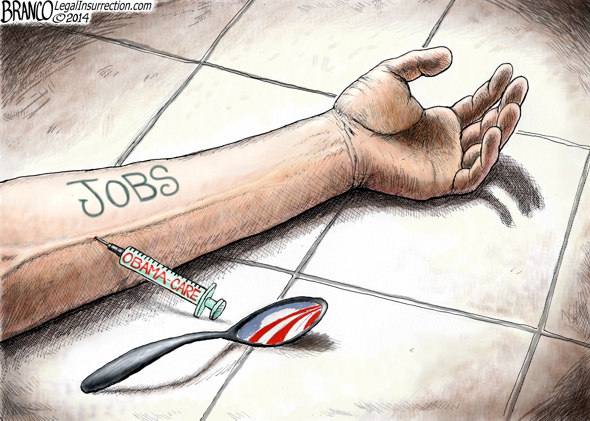
Note: You may reprint this cartoon provided you link back to this source.  To see more Legal Insurrection Branco cartoons, click here. Branco’s page is Cartoonist A.F.Branco...

The key legal narratives of both the State and defense began to emerge this afternoon as the Michael Dunn "loud music" murder trial kicked off with an afternoon launch. Dunn, 47-years-old, is charged with 1st degree murder for the shooting death of 17-year-old Jordan Davis. The State believes Dunn shot Jordan out of anger over Jordan's loud music, whereas Dunn claims he shot in lawful self-defense. Dunn is also charged with attempted murder for shooting the other three young men in the car, Leland Brunson, Tevin Thompson, and Tommie Storns. Finally, he is charged with the offense of firing a gun into an occupied vehicle. The trial started with Judge Russel Healey instructing the jury on their responsibilities in hearing the case, as well as various procedural facets common to any criminal trial.

Assistant State Attorney John Guy Delivers Opening for Prosecution

Following these introductory remarks, the State's opening was presented by Assistant State Attorney John Guy, and delivered in the emotive style so familiar from his performances during the Zimmerman trial. Alas, he chose to speak in such a soft voice that he was essentially inaudible. The use of headphones, however, makes it possible to hear his remarks. Consistent with the state going for 1st degree murder, and barring that 2nd degree murder, Guy emphasized the several concrete steps Dunn had to take in order to bring fire upon the Durango -- open glove compartment, remove pistol, chamber a round, grip the gun with both hands, fire, fire again, fire again, etc. -- all presumably to set the hook for premeditation and first degree murder. In addition, he emphasized Dunn's angry use of deadly force violence in response to being, as Guy put it, merely disrespected, to set the hook for malice necessary for second degree murder.

Attorney Cory Strolla Delivers Opening for the Defense

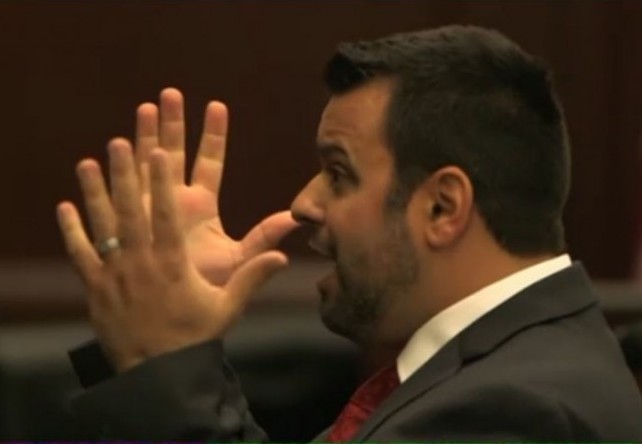
Defense Attorney Cory Strolla spent roughly twice as much time on his opening remarks, focusing on the three themes beloved by all defense counsel. First, the evidence is weak and contradictory and was collected and evaluated by police and prosecutors in an unprofessional and untrusthworthy manner. Second, if any one of the jurors has not been convinced beyond a reasonable doubt of Dunn's guilt, "stick to your guns" and do not allow yourself to be persuaded by the other jurors -- each of you is bound to make your own decision. And three, if you can hold off coming to a conclusion until we have a chance to present our side of things, you'll see that there are reasonable explanations for our client's conduct on every front.