



Image 01 Image 03

Le·gal In·sur·rec·tion

/var/www/vhosts/legalinsurrection.com/httpdocs/wp-content/themes/bridge-child/readFeeds.incFALSE

This video has been making the rounds on Reddit and stacking up tons of positive comments. The narrator takes you through Russian history explaining how geography helped define the nation politically. Zach Noble of The Blaze provides a description:
‘Russia in a Nutshell’: Learn the Real Reasons Why Russia Is So Big — And So Brutal Geography determines destiny — so goes the historian’s saying. Does Russia’s geography explain the nation’s history of bloodshed, overbearing government, secret police and poverty — and does it explain why Vladimir Putin is such a bellicose president? In a video published on YouTube earlier this year, geopolitical guru Caspian Report took a look at Russia’s history and geography and made the essential connections: Occupying a vast, flat land without significant mountains or seas to serve as natural barriers, the Russian people were forced to become brutal and bureaucratic in order to survive. After throwing off Mongol and Tatar domination in the first half of the last millennium, Russia’s rulers found themselves in a “conquer or be conquered” situation, Caspian Report noted. Seeking security, Russia’s czars led their people on a massive quest to expand, taking over lands to the south, west and especially east. They could not keep invaders from attacking, but by taking over huge swathes of territory, Russia’s rulers could ensure that Russia always had a “backup plan” to fall back on — and that plan proved invaluable when Napoleon and Hitler came rampaging through.
Anyone with an interest in history will find this entertaining and informative: The message in the video may explain some recent developments in Russia.
LATEST NEWS

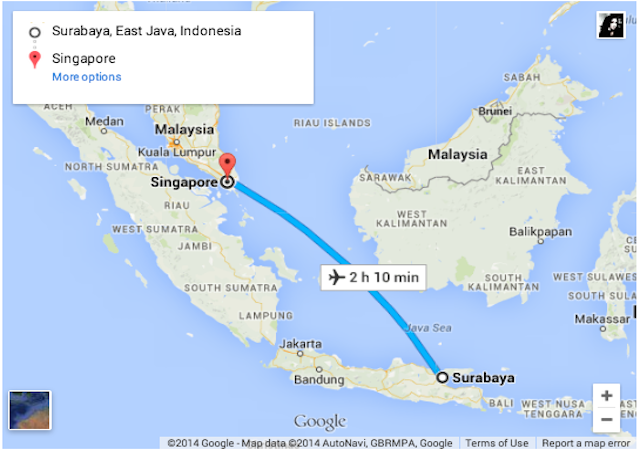
162 people have disappeared along with their plane somewhere over Indonesia, and no one knows what happened. Air Asia Flight 8501 disappeared last night as it approached stormy weather over the Java Sea. At 6:24 p.m. Eastern Standard Time, the plane lost contact with air traffic control, and hasn't been heard from since. According to NPR, the flight crew had requested a change in flight plan after encountering increasingly violent weather, and fell off the grid soon after. Indonesian officials have released what details they know about the plane's flight path and location, and Air Asia seems to be doing what it can to remain as transparent about the situation as possible.
AirAsia said in a statement that the plane has six Indonesian crew, a French crew member and 155 passengers, including 16 children and one infant. Among the passengers are three South Koreans, a Singaporean, a Malaysian and a Briton. The rest are Indonesians, the statement said. [Djoko Murjatmodjo, Indonesia's acting director general of transportation] said the plane is believed to have gone missing somewhere over the Java Sea between Tanjung Pandan on Belitung Island and Pontianak, on Indonesia's part of Borneo island. Contact was lost about 42 minutes after takeoff from Surabaya airport, authorities said. At Surabaya's Juanda International Airport, dozens of relatives sat in a room, many talking on mobile phones, crying and looking dazed as the hours dragged on without additional news. As word spread, more and more family members arrived at the crisis center to await word.
Of course, theorists and "experts" have come out of the woodwork in an attempt to explain what happened:

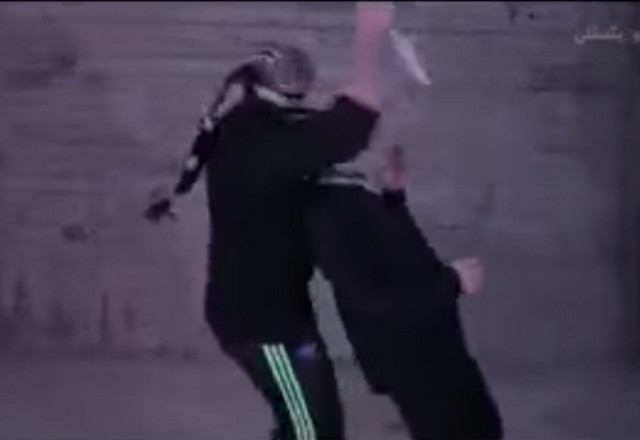
A new Hamas "How To" video is going viral in Palestinian social media circles. It isn't how to rebuild buildings. Or how to make peace with Israel. It's how to stab Jews. How do it properly and inflict maximum damage on the victim and increase the likelihood of killing him or her. The Jewish Press reports:
The “resisters of occupation in the occupied West Bank and Jerusalem” are spreading on Arab social media a frightening video demonstrating tactics on how to stab a Jew to death quickly and efficiently. The 1-minute and 13-second video, as seen below, shows the “teacher” calmly walking up to a “victim,” stabbing him, and walking away. One of the tactics appears to imitate the Islamic State of Iraq and Syria (ISIS) method of beheading. The guide to killing Jews teaches that after stabbing the victim, the knife should be twisted to maximize wounds and cause death.

Should teaching the law of sexual assault and rape be banned from law school classrooms because it could be a "triggering" event for some students? Apparently, there is a movement to do just such a thing. Earlier this month, Harvard Law professor Jeannie Suk wrote a wonderful article at the New Yorker discussing the risks of sheltering law students from the study of laws governing rape and sexual assault cases. In the article, she takes academia to task over its oft-cowardly approach to professor--student classroom relationships, and points out that current "culture signals" demanding less discussion of potentially "triggering" topics are actually harmful for the future of prosecuting sexual assault. In part:
Now more than ever, it is critical that law students develop the ability to engage productively and analytically in conversations about sexual assault. Instead, though, many students and teachers appear to be absorbing a cultural signal that real and challenging discussion of sexual misconduct is too risky to undertake—and that the risk is of a traumatic injury analogous to sexual assault itself. This is, to say the least, a perverse and unintended side effect of the intense public attention given to sexual violence in recent years. If the topic of sexual assault were to leave the law-school classroom, it would be a tremendous loss—above all to victims of sexual assault.
Because we can't have nice things in academia anymore, we have, of course, a response. Margaret Drew is a law professor at the University of Massachusetts, and she thinks that Jeannie Suk's article "misses the point":

Wherever there is....

As we wrap-up another eventful year, I wanted to share some favorite posts featuring the many diverse areas I cover as part of Professor Jacobson's wonderful team of authors.

Infectious Diseases: “Health and Safety Moms” Could Swing 2014 Elections

I was nothing if not optimistic about the election results this November, but the combination of the government's response to the Ebola epidemic combined with its ignoring a virus spreading among school children that looks as if it can cause paralysis angered mom's across the country.  The final results, especially with the US Senate, were even better than I had hoped.

Tea Party: Did Carl DeMaio have any choice but to run from Tea Party label in #CA52?

After losing to "filthy" Bob Filner in the San Diego mayor's race of 2012, Republican Carl DeMaio ran against a Democrat Scott Peters for the 52nd District house seat -- and lost.  It could be argued that DeMaio's distancing himself from grassroots conservatives cost him this close election.  However, it shows Tea Party activists still have some chops -- even after we have been declared "dead" on several different occasions.  Underestimate  us at your own peril, especially if you intend to run as a "conservative".

India: The Indian economy is shaking like a Bollywood dancer

India has the potential to be a real world power and a great regional counter-balance to China.  Perhaps the biggest story from that country in 2014 was the election of  Prime Minister Narendra Modi, who had  a pro-capitalism and  pro-Israel platform.  His appearance at a packed Madison Square Garden event in New York City was met with great enthusiasm -- the kind President Obama can now only dream of.

As 2014 comes to a close, it's expected for some writers to look back on the last twelve months and analyze the year that was. Two recent columns from well known outlets offer a very different view of where we are. Michael Grunwald of Politico is pretty sure everything is coming up roses:
Everything Is Awesome! Good news! The U.S. economy grew at a rollicking 5 percent rate in the third quarter. Oh, and it added 320,000 jobs in November, the best of its unprecedented 57 straight months of private-sector employment growth. Just in time for Christmas, the Dow just hit an all-time high and the uninsured rate is approaching an all-time low. Consumer confidence is soaring, inflation is low, gas prices are plunging, and the budget deficit is shrinking. You no longer hear much about the Ebola crisis that dominated the headlines in the fall, much less the border crisis that dominated the headlines over the summer. As Fox News host Andrea Tantaros proclaimed earlier this month: “The United States is awesome! We are awesome!” OK, she was talking about the Senate torture report, not the state of the union, but things in the U.S. do look rather awesome. Mitt Romney promised to bring unemployment down to 6 percent in his first term; it’s already down to 5.8 percent, half the struggling eurozone’s rate. Newt Gingrich promised $2.50 gas; it’s down to $2.38. Crime, abortion, teen pregnancy and oil imports are also way down, while renewable power is way up and the American auto industry is booming again. You don’t have to give credit to President Barack Obama for “America’s resurgence,” as he has started calling it, but there’s overwhelming evidence the resurgence is real.
Wow. Sounds great, huh? Not so fast.

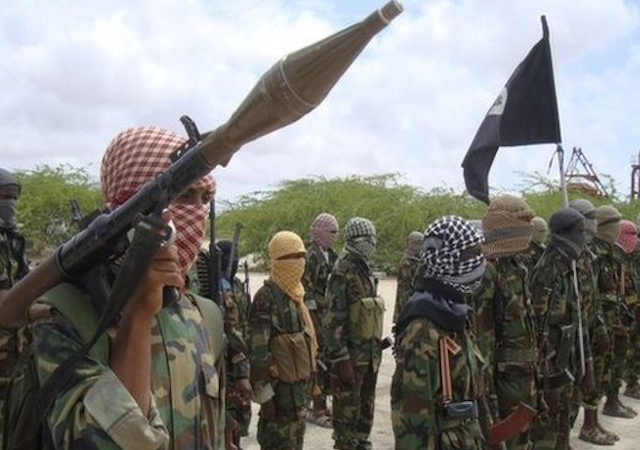
Just days after al-Shabaab insurgents attacked an African Union military base in Somalia, one of the group's leaders has been captured along the Somalia-Kenya border. From the AP:
A leader with the Islamic extremist group al-Shabab, who had a $3 million bounty on his head, surrendered in Somalia, a Somali intelligence official said Saturday. Zakariya Ismail Ahmed Hersi surrendered to Somali police in the Gedo region, said the intelligence officer, who insisted on anonymity because he is not authorized to speak to the press. Hersi may have surrendered because he fell out with those loyal to Ahmed Abdi Godane, al-Shabab's top leader who was killed in a U.S. airstrike earlier this year, the officer said. Hersi was one of seven top al-Shabab officials whom the Obama administration offered a total $33 million in rewards for information leading to their capture in 2012. It is not clear if the reward will be paid out for Hersi because he surrendered. Despite major setbacks in 2014, al-Shabab remains a threat in Somalia and the East African region. The group has carried out many terror attacks in Somalia and some in neighboring countries including Kenya, whose armies are part of the African Union troops bolstering Somalia's weak U.N.- backed government.
Reports out of Africa have confirmed that the Gashan (Somali special forces) have cleared out the last of the insurgents who attacked the AMISOM base in Mogadishu, but we still have very little information about why Hersi surrendered, or if his surrender had anything to do with Thursday's attack. Senior military official Col. Abas Ibrahim Gurey told CNN that "Zakariya has told us following his capture that he left Al-Shabaab a year and half ago and since then was looking for to surrender to the Somali government," but have otherwise been tight lipped about the man's motives.

Eugene Volokh has an interesting post over at his Volokh Conspiracy blog about a Washington-state Court of Appeals decision finding that there exists a Constitutional right of self-defense against attacking animals.  That decision, State v. Hull (Wash. Ct. App. Dec. 18, 2014),  is embedded at the bottom of this post. Professor Volokh's post on the matter is, as usual, insightful and worth reading, although it delves into considerable legal minutiae (as it must, given that the decision it discusses is based upon that minutiae).

"Bad Cases Make for Bad Law"

All the legalese aside, the decision could well be an interesting read even to non-lawyers for reasons unmentioned by Professor Volokh, and that is because it illustrates the truth of the adage, "Bad cases make for bad law." It seems inarguable that a person would have the legal right to defend himself against an unprovoked attack, regardless of the form--human aggressor, attacking animal, rampaging zombie, whatever. Yet at the trial the prosecution made precisely the argument that Washington state's self-defense laws applied only to a human attacker, and not to an animal attacker, and that therefore the defendant's request for a self-defense instruction should be denied.  Notably, this was an argument centered on what jury instructions were to be read, so it was made directly to the trial judge as a single individual, and not to the jury generally, so the prosecution needed to convince only one mind to agree.

2016 is still quite a way off but that hasn't stopped speculation about the chances for each of the major parties. Bill Barrow of the Associated Press looks back at the last few elections and raises an important question for the next one:
Can GOP shatter 'Obama coalition' in 2016? Republicans crowed in 2004 that freshly re-elected President George W. Bush had established a "permanent governing majority" for the GOP. Eight years later, Democrats were touting the enduring power of the "Obama coalition" to keep their party in the White House. But Democrats couldn't sustain that coalition for this year's midterm elections, leading to Republican gains in Congress, governorships and state legislatures nationwide. "The notion of demographics as destiny is overblown," said Republican pollster and media strategist Wes Anderson. "Just like (Bush aide Karl) Rove was wrong with that 'permanent majority' talk, Democrats have to remember that the pendulum is always swinging." So how will it swing in 2016? Is the path to 270 electoral votes so fixed that one side just can't win? Does Obama's unpopularity carry over into the next race for the White House? Or will an increasingly diverse electorate pick a Democrat for a third consecutive presidential election for the first time since Franklin Roosevelt and Harry Truman won five straight elections from 1932 to 1948?
Again, it's still early. Neither party has even begun the primary process. Still, when it comes to the so-called Obama coalition, Democrats are going to realize that their coalition and Obama's are two separate things.

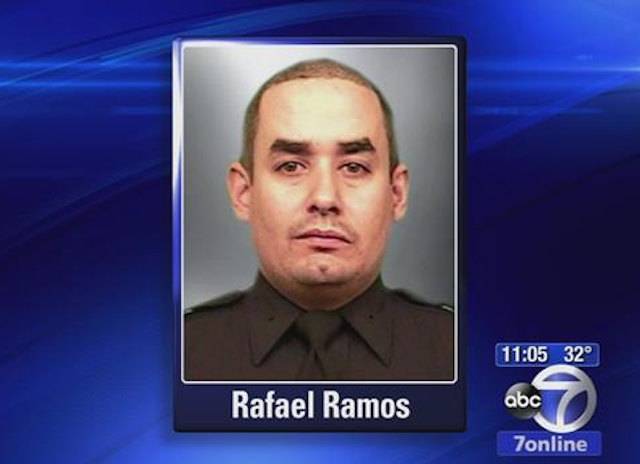
Today is the funeral for fallen New York Police Department Officer Rafael Ramos, executed along with officer Wenjian Liu. Live Video and Twitter feeds below, as well as our own select updates. [Funeral over, video feeds removed]

UPDATE: You can watch the funeral here. Today, New York City will lay to rest Officer Rafael Ramos, one of the victims of last week's brutal assassination that took the lives of Ramos and his partner, Officer Wenjian Liu. More than 20,000 officers from all over the country, along with Vice President Joe Biden, are expected to attend. Yesterday's wake drew thousands of people, some of whom waited hours outside the church to honor Ramos' life and sacrifice:
Throughout the day, mourners from all corners of New York City — friends and strangers alike — came to pay their respects to “a humble man” willing to help in any capacity, as a statement posted on the Christ Tabernacle website described him. “He had an infectious smile,” said the Rev. Ralph Castillo, one of the church’s 18 pastors. “When I think of Ralph [sic], I think of his smile and his consistency. He didn’t have to be there. This is something he chose to do. He was faithful and consistent.” A group of about 15 mourners, some carrying a single white rose, had already lined up by the church’s entrance before noon, waiting to go in for the viewing, which began at 2 p.m. A giant Christmas wreath with festive ornaments decorated the front of the brick building. “Today we weep with the Ramos family, the New York Police Department and the nation as we mourn the loss of our dear brother,” Mr. Castillo said. “He was a gift to our church.”
Outside of the church, however, tensions ran high, with protesters showing support for the family while calling for the resignation of New York City Mayor Bill di Blasio. Officers who attended took measures to protect themselves from the threat of violence.

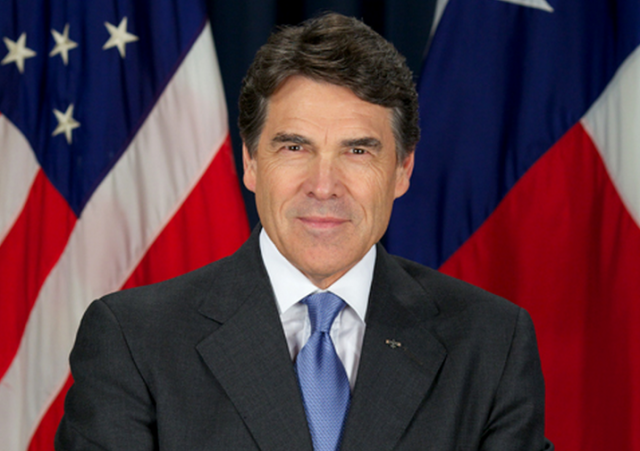
Greg Abbott won a decisive victory in Texas' recent gubernatorial election, but he'll have some big shoes to fill come January. Outgoing Governor Rick Perry may be stepping down from his post at the Texas capitol, but he's nowhere near close to making his exit from the national stage. In addition to forming a PAC, courting conservatives, and brushing up on his foreign policy credibility, he's taking time to detail the hard work and conservative policies that were passed under his watch that converged to create "The Texas Miracle." From Fox News:
"Governor Perry established in the national mind that Texas is the place for jobs and freedom where entrepreneurship thrives and the American dream is alive," said Cal Jillson, SMU political science professor and author of "Lone Star Tarnished." Indeed, Texas under Perry has outpaced any other state on the employment front, creating three out of 10 of all U.S. jobs. Forbes magazine recently named Texas as the leading state for economic climate and future job growth while Chief Executive Magazine readers have named Texas as the number one state to do business for 10 years running. Over 100 of America's top companies -- including AT&T, Fluor, Dell and ExxonMobil -- are based in Texas. Toyota, Apple, Charles Schwab and SpaceX are expanding operations in the state. Perry has crisscrossed the globe with missionary zeal, from Beijing to London, touting a flourishing Texas brand that looks a shade brighter against the national economy. Texas, in turn, is America's top exporting state averaging more than $1 billion in exports every working day. "I was always intrigued with economic development and an economic climate that frees people," Perry said. "It was innate, something I derived from watching people I admired like my father, and it wasn't something I read or studied in school."

I got the gift of karma last night, after returning home from a wonderful Christmas dinner with the in-laws. Why karma?  Because  one of the articles about infectious diseases I missed covering noted that this year's flu shot was ineffective against the most dominant strain of the virus:
The flu vaccine may not be very effective this winter, according to U.S. health officials who worry this may lead to more serious illnesses and deaths. Flu season has begun to ramp up, and officials say the vaccine does not protect well against the dominant strain seen most commonly so far this year. That strain tends to cause more deaths and hospitalizations, especially in the elderly. Though we cannot predict what will happen the rest of this flu season, it's possible we may have a season that's more severe than most," said Dr. Tom Frieden, director of the Centers for Disease Control and Prevention, at a news conference Thursday. CDC officials think the vaccine should provide some protection and still are urging people to get vaccinated. But it probably won't be as good as if the vaccine strain was a match.
So I came down with a case of that dominant strain last night, as I had received the 2014 vaccine in September. The nausea is so awful that it cannot be described with words -- it must be experienced. We spend millions of our taxpayer dollars for professionals to asses which strains to feature in the annual vaccine mixture. Yet, once again, the Centers for Disease Control and Prevention fail at its primary job task.

This story came across my Twitter feed the other day and my eyes might have leaked a little bit. And by a little bit, I mean I cried like a baby because this story is just that kind of story. Brandon Finnigan over at Ace of Spades shared this incredible story about a hardship he and his wife endured recently. Finnigan began:

Life is Beautiful

On Twitter a few nights back, I shared a very trying experience the wife and I endured this year. I want to share it here, expand on it, and direct it, a bit, at a very specific reader.