Image 01 Image 03

Author: William A. Jacobson

Profile photo

William A. Jacobson

William A. Jacobson is a Clinical Professor of Law and Director of the Securities Law Clinic at Cornell Law School.

He is a 1981 graduate of Hamilton College and a 1984 graduate of Harvard Law School. At Harvard he was Senior Editor of the Harvard International Law Journal and Director of Litigation for the Harvard Prison Legal Assistance Project.

Prior to joining the Cornell law faculty in 2007, Professor Jacobson had a highly successful civil litigation and arbitration practice in Providence, Rhode Island, concentrating in investment, employment, and business disputes in the securities industry, including many high profile cases reported in leading newspapers and magazines.

Professor Jacobson has argued cases in numerous federal and state courts, including the Courts of Appeal for the First, Fifth and Sixth Circuits, and the Rhode Island Supreme Court.

Professor Jacobson has a national reputation as a leading practitioner in securities arbitration. He was Treasurer, and is a former member of the Executive Committee and Board of Directors of the Public Investors Arbitration Bar Association, a professional organization of attorneys dedicated to protecting public investors. He frequently is quoted in national media on issues related to investment fraud and investor protection, and in the past has served as one of a small number of private practice attorneys who trained new arbitrators for the Financial Industry Regulatory Authority.

Professor Jacobson is co-author of the Securities Arbitration Desk Reference (Thomson-Reuters), updated annually.

Professor Jacobson is frequently quoted in the media on political and legal topics, has authored many Op-Eds in major publications, and appears on television and radio to discuss politics and the law.

A more complete listing of Professor Jacobson's professional background is available at the Cornell Law School website. The views expressed here are his own and not those of any employer or organization,

The best way to reach Prof. Jacobson is by e-mail here.

The Times of Israel, based on communications with unnamed Palestinian Authority officials, reports that the Palestinians have conveyed their rejection of John Kerry's draft "framework" proposal:
The Palestinian Authority has informed US Secretary of State John Kerry that it will not accept his framework peace proposal as it currently stands, PA officials told The Times of Israel.... Central clauses of the framework deal as presented by Kerry, and rejected by the PA, the Palestinian officials said, are as follows: Borders: The peace agreement is to be based on pre-1967 lines, but will take into consideration changes on the ground in the decades since. Settlements: There will be no massive evacuation of “residents.” Refugees: Palestinian refugees will be able to return to Palestine or remain where they currently live. In addition, it is possible that a limited number of refugees could be allowed into pre-1967 Israel as a humanitarian gesture, and only with Israeli acquiescence. Nowhere is it written that Israel bears responsibility for suffering caused to the refugees. Capital: The Palestinian capital will be in Jerusalem. Security: Israel has the right to defend itself, by itself. The Jordan Valley: The IDF will retain a presence in the Jordan Valley. The length of time the IDF will remain will depend on the abilities of the Palestinian security forces. Border crossings: Israel will continue to control border crossings into Jordan. Definition of the countries: Two states will result, “a national state of the Jewish people and a national state of the Palestinian people.”
So what's the problem?  Some of these issues probably are surmountable. But one issue probably is not, the recognition of Israel as the Jewish homeland, as further reported by the Times:

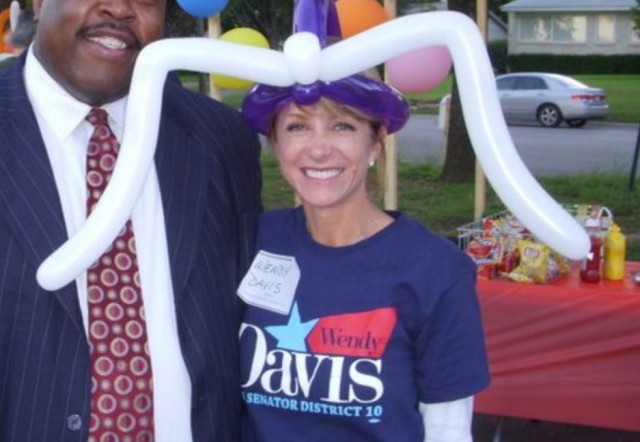
Erick Erickson called Wendy Davis “Abortion Barbie” because of her cluelessness about the Gosnell shop of horrors at the same time she was fighting a proposed requirement that abortion clinics meet normal surgical center standards and abortion doctors have admitting privileges at local hostpitals. When Davis stepped back from that position the other day and declared that she could support a ban on late-term abortions if there were sufficient "deference" given to the doctor-patient relationship, I suggested the proper analogy was Gumby not Barbie because "infinitely flexible positions now are the hallmark of Wendy Davis’ campaign." For that change in position on late term abortion, Davis was accused of "betrayal" by abortion advocates. Davis, however, has changed her stance again, and now is back to opposing any ban on late-term abortions, because there is no amount of "deference" that could satisfy her, after all. Via San Antonio Express, Wendy Davis says it would be 'impossible' for Legislature to devise appropriate 20-week ban on abortion:


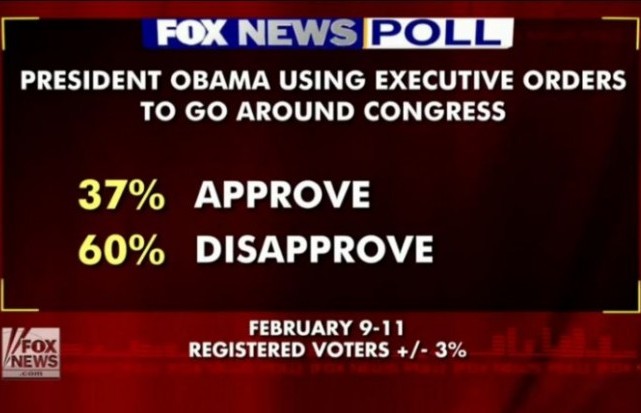
who like Obama using executive orders to go around Congress? "The Enablers"...

The reaction to Wendy Davis' statement that she could support a ban on late-term abortion if there were more deference given to patients and physicians has caused angst in a Democratic base already upset over Davis' support of Open Carry laws. Amanda Marcotte at Slate.com called it a betrayal (emphasis added):
Texas state Sen. Wendy Davis made her name and kick-started her campaign for governor by filibustering an anti-abortion omnibus bill, standing and talking for 11 hours straight in support of abortion rights. So it comes as a surprise — and frankly, a betrayal — to learn that Davis told the Dallas Morning News on Tuesday that she could support a ban on abortions after 20 weeks, if it gave "enough deference between a woman and her doctor" to make the decision to abort after that point for medical reasons.... You may have bought her sneakers, but when it comes down to it, Wendy Davis is a politician.
Irin Carmon at MSNBC writes, Wendy Davis falls into abortion question trap:
This week, Texas gubernatorial candidate Wendy Davis delighted her detractors and confounded her pro-choice supporters when she appeared to support the very same 20-week ban she spent 11 hours filibustering..... It’s far too late for Davis to shy away from abortion rights, including the more politically uncomfortable parts, after confronting them head-on in her filibuster. Regardless of what she was trying to say, a political campaign isn’t a great place for complex or nuanced moral conversations. On the campaign trail, Davis would likely be better off if she stuck to the broader point she made in her filibuster: “The alleged reason for the bill is to enhance patient safety. But what [the provisions] really do is create provisions that treat women as though they are not capable of making their own medical decisions.”
Tata Culp-Ressler at Think Progress (yes, that Think Progress) wrote, Why Wendy Davis’ Position On 20-Week Abortion Bans Doesn’t Make Any Sense:

Huge British Mammogram study finds no benefit to routine screenings....

More peeks through a historical window into her soul, this time from CNN:
Shortly before Hillary Clinton’s effort to pass health care reform died in the summer of 1994, the first lady asked a close friend and confidant for advice on “how best to preserve her general memories of the administration and of health care in particular.” When asked why, according to the friend’s June 20, 1994, diary entry, Clinton said, “Revenge.” That exchange is among thousands of pages of notes, letters, and diary entries penned by Diane Blair, a political science professor and longtime Clinton friend whose papers were donated to the University of Arkansas after her death in 2000. Blair worked on Bill Clinton’s two presidential campaigns and advised the president and first lady throughout their eight years in the White House. In particular, she was very close with Hillary Clinton, who called Blair her “closest friend” in her 2003 memoir “Living History.” Blair’s notes from 1994 and 1995 shed light on Clinton as first lady, especially her persistent interest in recording her and her closest advisers’ accounts of their time at the White House in order to both tell her own story as well as document what she saw as the truth.
Meanwhile, it will be hard for Hillary supporters to blame this latest disclosure on a "right wing" website, the way the media tried to denegrate the Washington Free Beacon's release of some of The Hillary Papers:

I recall someone saying that you could judge societies based upon how they treat their Jews. I don't recall who said it. I think that's still true in large part, but less of a global issue because most of the world -- and certainly the Muslim world -- has been depopulated of its Jews. In Europe, the maxim still holds, as the virulent demonization of Israel by the BDS movement alliance of Islamists and leftists is driving out the Jews who are left, and driving others into virtual hiding. Globally, however, it is Christians who are under pressure and persecution. Hearings were held in Congress today on the issue: Qanta Ahmed, writing in The Jerusalem Post, recently noted the dire situation of Christians in the Muslim world, Persecution of Christians in the Muslim world: We are what we tolerate:

I wonder who he thinks they will vote for? Let me think about that a while, ahem, tough call....

Alana Goodman at The Washington Free Beacon has published The Hillary Papers (embed at bottom of this post). Here's Alana's summary:
The papers of Diane Blair, a political science professor Hillary Clinton described as her “closest friend” before Blair’s death in 2000, record years of candid conversations with the Clintons on issues ranging from single-payer health care to Monica Lewinsky. The archive includes correspondence, diaries, interviews, strategy memos, and contemporaneous accounts of conversations with the Clintons ranging from the mid-1970s to the turn of the millennium. Diane Blair’s husband, Jim Blair, a former chief counsel at Tyson Foods Inc. who was at the center of “Cattlegate,” a 1994 controversy involving the unusually large returns Hillary Clinton made while trading cattle futures contracts in the 1970s, donated his wife’s papers to the University of Arkansas Special Collections library in Fayetteville after her death. The full contents of the archive, which before 2010 was closed to the public, have not previously been reported on and shed new light on Clinton’s three decades in public life. The records paint a complex portrait of Hillary Clinton, revealing her to be a loyal friend, devoted mother, and a cutthroat strategist who relished revenge against her adversaries and complained in private that nobody in the White House was “tough and mean enough.”
Much of the portrayal is of the bitter, brutal, belligerent Hillary we all know. But her early support for single-payer, despite later denials, is directly relevant to the Obamacare debacle that will be an issue in the 2016 election. Again Alana summarizes: