

Image 01 Image 03

October 2014

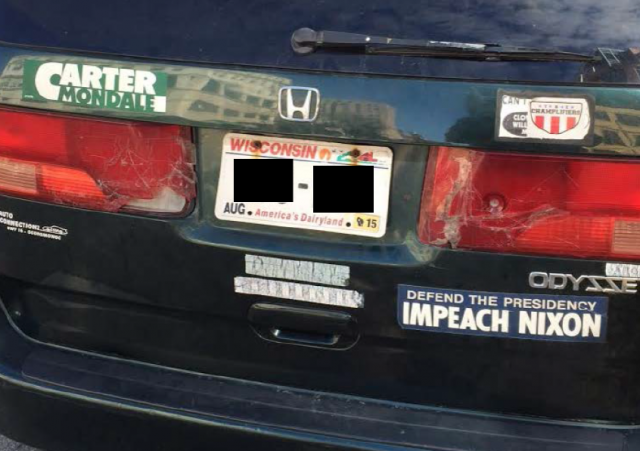
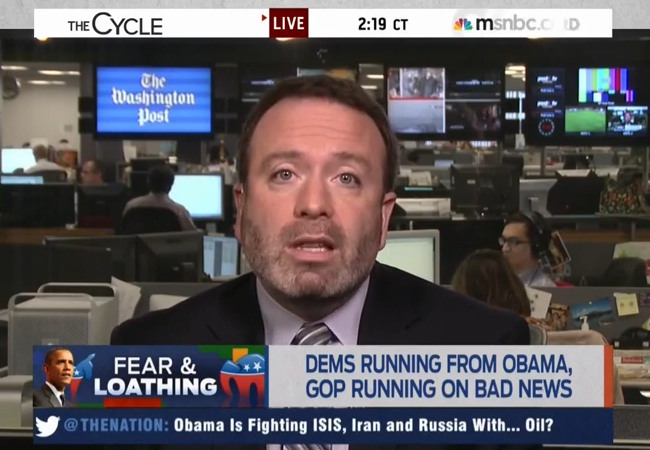
In a recent appearance on MSNBC, the Washington Post's Dana Milbank suggested an inconsistency between Republican desires to remove Obama from office, and Republican complaints that the Secret Service was not adequately protecting Obama from harm. Why is that inconsistent? Can't we both oppose a president and want to protect the President? The Presidency is greater than the man or his policies. Noah Rothman of Hot Air reported:
Milbank: Why would GOP want Secret Service to protect Obama? Among the fears Milbank suggests the GOP is aggravating for political gain are concerns that the Secret Service is underperforming. “They’re even making a campaign issue of the Secret Service,” The Post columnist said, “saying things are so bad that even the President of the United States, the President of the United States we would like to remove from office by the way, is not being adequately protected by the Secret Service.” First, what a shocking and offensive insinuation to make. Yes, Republicans (and Democrats, I’d venture) can oppose a president of the opposite party and also not want any harm to come to them. Second, the suggestion that voicing concerns about the increasingly apparent incompetence in the Secret Service amounts to fear mongering is just as insulting.
Here's a video of the exchange: Of course, this could be a classic case of media projection.
In the wake of news that my future congressional representative may be someone with sound fiscal awareness, and since I am nothing if not optimistic, I took a glace at the status of the California governor's race today. This race pits our state's longest serving governor, Jerry Brown, against the Republican Neel Kashkari, who served as Assistant U.S. Secretary of the Treasury for Financial Stability. Kashkari is one of those rare candidates I like more as the campaign season progresses. In part, it is because he has been innovative on the campaign trail. Cal Watchdog's James Poulos has this assessment.
... Rather than offering the media a retread of tales of California Republicans’ past, Kashkari has presented a surprising spectacle. Wealthy political novices from business backgrounds, such as Carly Fiorina and Meg Whitman, have tried to unseat top-tier Democrats before. They failed — leading national political journalists to question why the state GOP was willing to tolerate such a bad investment. Kashkari, who is not personally short on cash, has raised a far more modest campaign chest. But his small budget has become a buzz-building advantage. Not only has it fueled the kind of stunt-driven campaigning that grabs headlines, it has given state Republicans a feeling that neither donors nor the party have thrown good money after bad. And it has changed the media narrative, differentiating Kashkari from the political losers who have come before him.
Unhappily for the rest of the country, most of my fellow citizens are not as impressed. Real Clear Politics has the snapshot of the race I provided above, indicating the polls have budged little since I last covered the topic: LI #11 Governor's Race

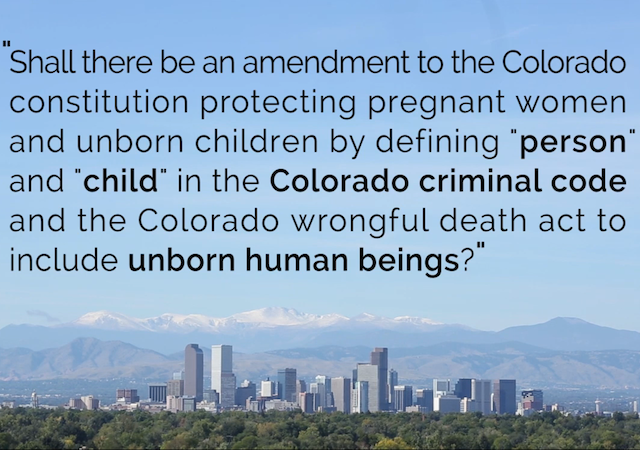
On November 4, Colorado residents will have to decide whether or not to change their criminal code to include an "unborn human being" in the definition of a "person." Proponents of the measure, dubbed "Amendment 67," say that the goal of the initiative is to protect pregnant women, but opponents say it's nothing more than a veiled attempt to ban abortion in Colorado. This isn't Colorado conservatives' first attempt at adding personhood protections for the unborn to state law; similar initiatives have failed twice before. However, this amendment works differently in that it changes its approach in defining the amendment's scope of protection. colorado personhood Via the Washington Post:
Earlier versions defined a fetus as a person from the moment of fertilization, or from the moment of biological development. In both cases, abortion rights activists convinced voters to reject the measures, which they said would have limited a woman’s right to choose.

Marissa Alexander was back in the news, as her lawyers try to preclude state prosecutors from getting truthful but damaging evidence against her before the jury (details on this below). With her trial now only about 6 weeks away, the misinformation machinery will be spinning up to top speed. As a reality-based counterweight I thought it might be useful (and fun) to refresh our recollection on the truth behind Marissa Alexander and her (self-acquired) legal travails. Without further ado, here are three big lies about the Marissa Alexander case that you--or, if not you, too many others--believe to be true.

1. Marissa Alexander Merely Fired a Warning Shot Into the Air

I’ll start with the best one first: the notion that Alexander merely fired “into the air” as a warning shot. Literally speaking, of course, any time one fires a gun one is firing it “into the air”—unless, I suppose, one is firing the gun under water. Substantively, however, this statement is an outright and deliberate lie, and proven to be a lie by both the further misleading characterization of the shot as being “fired into the ceiling” and the forensics evidence shared by the prosecutor’s office with the media and public. The term “warning shot” is, of course, intended to convey the firing of a shot in a “harmless” direction, or at least not deliberately near any particular person. The purpose is to forcefully communicate the will to fire more accurately and with greater effect if necessary to stop the other person’s offensive conduct.

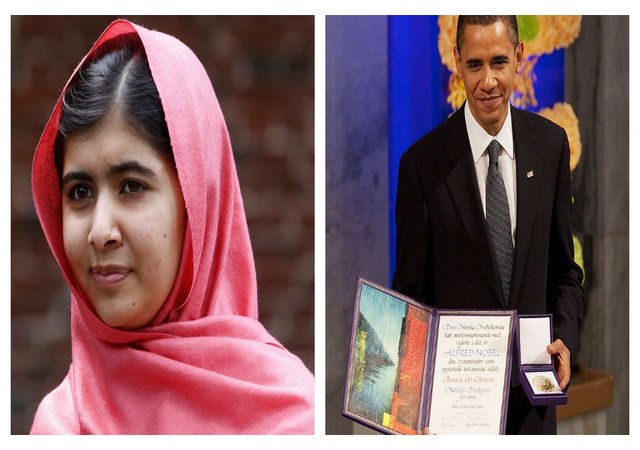
This year, we have two deserving Nobel Peace Prize winners, each of whom has an inspiring story of fighting against great odds for the humanity of others, and suffering great pain in the process. They are the people we imagine when we think of the Nobel Peace Prize in our mind's eye. Even if that mind's eye doesn't always meet reality. Amy Davidson in The New Yorker has brief backgrounds on this year's winners:
Malala Yousafzai, who is seventeen years old, and Kailash Satyarthi, who is sixty, were awarded the Nobel Peace Prize on Friday morning—for, in the committee’s words, “their struggle against the suppression of children and young people and for the right of all children to education.” Satyarthi, who is Indian, is a man who has fought for children for decades; Malala, who is Pakistani, is a child, and a fighter herself. There was some thought, ahead of the announcement, that Malala, as she is known, would be awarded the prize alone. She is more famous than Satyarthi. Two years ago, gunmen from the Taliban got on her school bus and shot her in the head, shattering her skull—an attack she answered by becoming one of the world’s clearest voices for girls’ education. Satyarthi has survived physical attacks, too, and has led raids on factories that hold small children as bonded laborers.... ccording to press reports, he has worked directly with more than eighty thousand children, and has fought to change the conditions and chances of hundreds of thousands more.
And then there's this:

This thing speaks for itself. Remember when Battleground Texas supporters of Wendy Davis laughed at Greg Abbott being in wheelchair? The line of attack by the Battleground Texas people was exactly the line of attack in Davis' current video -- that Abbott is in a wheelchair but has not sympathy for others, as if being a Judge means cases should be decided on sympathy:

It all started when an 8th grader decided to wear his mother's wig to school as a joke. What could go wrong? Apparently, a great deal. By the end of the day that awesome judgment call had cost the wig wearer an eye, within weeks leading to a juvenile hate crime conviction on the 7th grader responsible for the injury, and as of this week led the Appellate Division of the Supreme Court of the State of New York to reverse that conviction on self-defense grounds (PDF of the decision and order to reverse is embedded below). (Note: New York is one of a small number of states in which "Supreme Court" does NOT refer to the highest court in the state.  In New York that highest court is instead referred to as the Court of Appeals--a term that in most states refers to the court of intermediate jurisdiction.) On June 5, 2012, the (then) 8th grade complainant, as mentioned, decided to wear mom's wig to Junior High.  Shockingly, other students began to taunt him over this, among them a group of 7th graders that included Mondy E., the appellant.  Also shockingly, their taunts included anti-homosexual/transgender epithets, thus opening up the "hate crimes" can of worms. The complainant asked the taunters to stop, which had the efficacy one might expect under the circumstances.

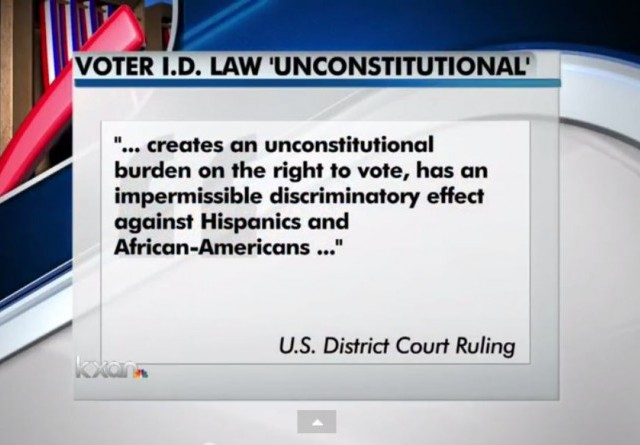
A federal District Court judge has ruled that Texas' embattled voter ID law is unconstitutional. This news came just hours after the Supreme Court granted a request from civil rights activists to block similar requirements in Wisconsin. In a 147 page opinion, U.S. District Court Judge for the Southern District of Texas Nelva Gonzales Ramos held "that SB 14 creates an unconstitutional burden on the right to vote, has an impermissible discriminatory effect against Hispanics and African-Americans, and was imposed with an unconstitutional discriminatory purpose." Judge Ramos also held that SB 14 constitutes an unconstitutional poll tax. Although the Supreme Court last year freed Texas from onerous federal pre-clearance requirements, much of Ramos's opinion focuses on Texas' (admittedly) dark history of discrimination and racial tension. Additionally, the opinion appears to accept arguments made by Justice Department attorneys that voter fraud is "extraordinarily rare" and that SB 14 amounts to nothing more than “a solution in search of a problem.”
This history describes not only a penchant for discrimination in Texas with respect to voting, but it exhibits a recalcitrance that has persisted over generations despite the repeated intervention of the federal government and its courts on behalf of minority citizens. In each instance, the Texas Legislature relied on the justification that its discriminatory measures were necessary to combat voter fraud. In some instances, there were admissions that the legislature did not want minorities voting. In other instances, the laws that the courts deemed discriminatory appeared neutral on their face. There has been a clear and disturbing pattern of discrimination in the name of combatting voter fraud in Texas. In this case, the Texas Legislature’s primary justification for passing SB 14 was to combat voter fraud. The only voter fraud addressed by SB 14 is voter impersonation fraud, which the evidence demonstrates is very rare (discussed below). This history of discrimination has permeated all aspects of life in Texas...

While reporting on the San Diego area's extremely competitive congressional race in CA-52 between Democrat Scott Peters and Republican Carl DeMaio, my colleague Casey Breznick noted that "DeMaio recently took further steps to distance himself from the Tea Party by releasing a new campaign ad where he says:
“As a proud gay American, I’ve been called a lot of things in my life, but a Tea Party extremist? Nothing could be farther from the truth."
I assert that the internal polls for Peters must be worse than those Casey officially reported, because the Democrat ads are referencing Tea Party so often that one could confuse DeMaio for the president of Lipton Tea Company. And, as I noted previously, DeMaio has never truly been "Tea Party". However, I am now concerned that the ad may have been too demeaning of the area's Tea Party groups, who are among the most active grassroots supporters of DeMaio. Dawn Wildman, co-founder of the SoCalTax Revolt Coalition and the organizer of the area's first Tea Party finds the approach disturbing. She says:

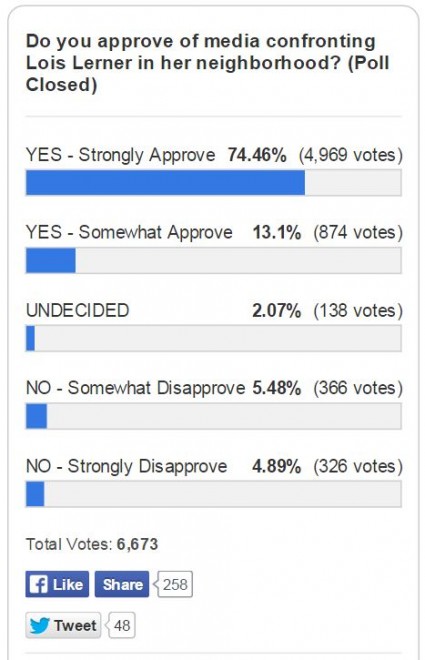
Our reader poll turned up strong support for Jason Mattera confronting Lois Lerner in her neighborhood, including following her to a neighbor's door. Based on the comments to that post, I think the general reasoning in favor was that Lerner deserves to have to answer questions, they do it to us (60 Minutes ambush interviews anyone? SEIU?), and we lose when we don't fight back and hold them to their own standards. The general reasoning against was that we are not like the other side, we need to be better, and it was creepy to follow her onto a neighbors' lawn and to the front door. Asking her questions on the street might be one thing, but running after her is too much. Poll Results Lois Lerner Jason Mattera But Greg Gutfeld on The Fives was not impressed with Mattera's performance, viewing it as counterproductive. Bob Beckel went further (surprise!) and challenged Mattera to a fight. TPM reports:
Conservative author Jason Mattera's ambush of former IRS official Lois Lerner has earned plaudits from certain conservative circles, but it was too much for the gang on Fox News Channel's "The Five." Co-host Greg Gutfeld said Wednesday that the video — in which Mattera chased Lerner around a suburban Washington, D.C. neighborhood as she walked her dogs — pulled off the impossible. "Seriously, that even made me feel bad for Lerner, and I can't stand her," Gutfeld said.... In fact, Beckel was so incensed that he's apparently willing to throw down with Mattera.