Image 01 Image 03

US Supreme Court Tag

The Supreme Court has issued an unsigned order blocking key provisions of sweeping new health care regulations from being enforced against Texas abortion providers. Via Fox News:
In an unsigned order, the justices sided with abortion rights advocates and health care providers in suspending an Oct. 2 ruling by a panel of the New Orleans-based U.S. 5th Circuit Court of Appeals that Texas could immediately apply a rule making abortion clinics statewide spend millions of dollars on hospital-level upgrades. The court also put on hold a separate provision of the law only as it applies to clinics in McAllen and El Paso that requires doctors at the facilities to have admitting privileges at nearby hospitals. The admitting privileges remains in effect elsewhere in Texas. Justices Samuel Alito, Antonin Scalia and Clarence Thomas said they would have ruled against the clinics in all respects.
This decision temporarily set aside provisions that require abortion clinics to follow the same health and safety standards as ambulatory surgical centers; this means thirteen abortion clinics that closed after the law took effect will be allowed to reopen. It also exempted practitioners operating clinics in El Paso and McAllen (larger cities in the Rio Grande Valley) from having to gain admitting privileges at nearby hospitals. Pro-choice organizations are, of course, gloating; but keep in mind that this was an emergency ruling. Advocates for abortion providers asked for the Supreme Court's ruling because the Fifth Circuit allowed the restrictive new laws to be enforced during the appeals process.

A federal District Court judge has ruled that Texas' embattled voter ID law is unconstitutional. This news came just hours after the Supreme Court granted a request from civil rights activists to block similar requirements in Wisconsin. In a 147 page opinion, U.S. District Court Judge for the Southern District of Texas Nelva Gonzales Ramos held "that SB 14 creates an unconstitutional burden on the right to vote, has an impermissible discriminatory effect against Hispanics and African-Americans, and was imposed with an unconstitutional discriminatory purpose." Judge Ramos also held that SB 14 constitutes an unconstitutional poll tax. Although the Supreme Court last year freed Texas from onerous federal pre-clearance requirements, much of Ramos's opinion focuses on Texas' (admittedly) dark history of discrimination and racial tension. Additionally, the opinion appears to accept arguments made by Justice Department attorneys that voter fraud is "extraordinarily rare" and that SB 14 amounts to nothing more than “a solution in search of a problem.”
This history describes not only a penchant for discrimination in Texas with respect to voting, but it exhibits a recalcitrance that has persisted over generations despite the repeated intervention of the federal government and its courts on behalf of minority citizens. In each instance, the Texas Legislature relied on the justification that its discriminatory measures were necessary to combat voter fraud. In some instances, there were admissions that the legislature did not want minorities voting. In other instances, the laws that the courts deemed discriminatory appeared neutral on their face. There has been a clear and disturbing pattern of discrimination in the name of combatting voter fraud in Texas. In this case, the Texas Legislature’s primary justification for passing SB 14 was to combat voter fraud. The only voter fraud addressed by SB 14 is voter impersonation fraud, which the evidence demonstrates is very rare (discussed below). This history of discrimination has permeated all aspects of life in Texas...

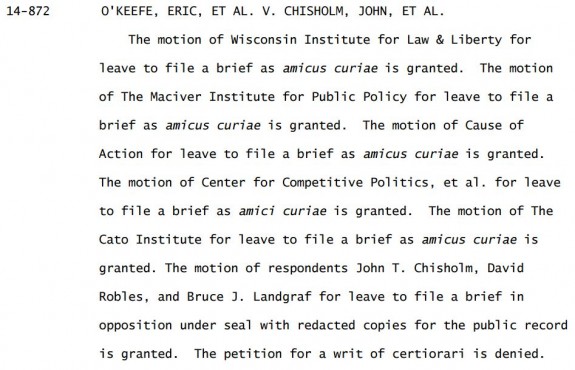
Many if not most observers expected the Supreme Court to take at least one of the cases for which review was sought in which the issue of whether same-sex marriage bans were constitutional was squarely presented. None of the Supreme Court's decisions in DOMA or the Prop. 8 litigation decided that issue. But the Supreme Court did not take any of the cases, leaving in place Court of Appeals decisions that seem to clear the way for same-sex marriages in numerous states. ScotusBlog reports:
The Supreme Court had issued the first round of orders from the September 29 Conference last Thursday, adding eleven new cases to its docket for the new Term.  Many people had anticipated that one or more of the same-sex marriage petitions might be on that list, but the Court did not act on any of them at the time.  Last month Justice Ruth Bader Ginsburg had suggested that the Court might not step into the controversy at this point, because there was no disagreement among the lower courts on that issue.  Today her prediction proved true, with the Court denying review (without any comment) of the seven petitions:  Bogan v. Baskin (Indiana); Walker v. Wolf (Wisconsin); Herbert v. Kitchen (Utah); McQuigg v. Bostic (Virginia); Rainey v. Bostic (Virginia); Schaefer v. Bostic(Virginia); and Smith v. Bishop (Oklahoma).
The NY Times explains the impact:

A new poll from Harris Interactive suggests that 70% of Americans are uncomfortable with using a system of lifetime appointments to fill vacancies on our nation's highest Court. This shouldn't come as a shock, and neither should that fact that millennials are far less likely to object to the idea of lifetime appointments (only 63% object) as compared to baby boomers (73%), "matures" (76%), and---perhaps most interestingly---Gen Xers (71%.) A generational gap isn't surprising because, for all intents and purposes, the Court is generally painted as some sort of next-level legislative body, expected to respond to the ever-fluid world views of pundits, protesters, and various voting demographics. (Don't believe me? Review the news coverage from the Court's rejection of DOMA.) As a card-carrying member of the bizarro generation tucked neatly between "GenX" and "Millennial," I can testify to the fact that as we grow, so grows our exposure to various ideas about how government should respond to a diversifying society, and vice versa. The problem with this viewpoint isn't that it's likely to change the system overnight---this would require a Constitutional amendment---but that it comes from a bloc of people who harbor a fundamental misunderstanding of the point and purpose of a Supreme Court.
The Harris Poll asked Americans to deliberate on the nation's highest court, and found that despite two-thirds of Americans (68%) feeling it's a crucial governing body for the success of the United States, nearly half of Americans (47%, up from 42% in 2010) say they are not knowledgeable about the Supreme Court confirmation process. Just over half of Americans (53%, down from 58% in 2010) indicate being that they're knowledgeable about the process, with one in ten (11%) saying specifically that they are very knowledgeable about it and just over four in ten (42%) saying they're somewhat knowledgeable.
Less than half of those who have an opinion about how the court should be run know how we currently choose justices. Excellent. Then there's this gem:

The Supreme Court will sit for their first long conference of the October session on Monday, and SCOTUS watchers are anxious to find out whether or not the Court will decide to wade once more into the murky waters of the marriage equality battle. There are seven gay marriage cases set to be discussed during the Monday conference, and each of them offers a slightly different variation on the argument that has been raging since before this writer even began to think about the possibility of attending law school. Via U.S. News and World Report:
The Supreme Court will not only be considering the matter of timing. What case or cases it ultimately hears will help determine the scope of its eventual ruling, both as it pertains to marriage itself – will its ruling apply to the ability of gay couples to get married in all states or just whether states have to recognize the same-sex marriages of other states – and the decision’s implications outside the issues of marriage. “The court is going to have to decide how much it is going to put on its plate,” said Gregory Garre, a former U.S. solicitor general and now the chairman of the Supreme Court and Appellate practice at Latham & Watkins, at a panel sponsored by the American Constitution Society for Law and Policy. Bans in Utah and Oklahoma, both overturned in separate decisions by the 10th Circuit, were decided on the basis of due process, meaning that denying gay couples the ability to wed deprives them of their fundamental right to marry. The 7th Circuit decision finding Indiana’s and Wisconsin’s same-sex marriage bans unconstitutional did so on the grounds of the equal protection clause of the 14th Amendment, with the unanimous panel arguing that same-sex marriage bans discriminate against one’s sexual orientation. If the Supreme Court decides on a case that invokes the equal protection clause, how it interprets the 14th Amendment could affect judicial rulings on other questions of LGBT rights and discrimination. Those on both sides of the argument say they can win on either grounds.

I don't know how I missed this yesterday. Actually, I do know. I was off the internets for most of the day, and the world kept turning without me. The D.C. Circuit Court of Appeals granted (Order embedded at bottom of post) en banc (full court) hearing in the Halbig case, in which an appeals court panel found that the IRS had no authority to grant people who signed up for Obamacare on the federal exchange tax subsidies which, under the statute, were only for those who signed up on state exchanges. The same day as the original Halbig decision was released, the 4th Circuit Court of Appeals reached a different conclusion. The split in Circuits convinced just about everyone that the case was on the fast track to the Supreme Court. But many speculated at the time that the D.C. Circuit, packed with Obama appointees, would take the case en banc, uphold the IRS regs, and avoid a Circuit split. I didn't think that would happen, but I was wrong. Via Prof. Jonathan Adler at Volokh Conspiracy:

Last month, the Fourth Circuit Court of Appeals struck down as unconstitutional Virginia's same sex marriage ban. This week, however, the Supreme Court put a hold on that ruling, meaning that for the time being gay marriages are blocked in Virginia:
While nearly all federal and state courts have ruled in favor of same-sex marriage since the high court issued two landmark decisions in June 2013, judges have blocked nearly all such marriages while the cases are appealed. The justices had stepped in once before, in Utah, to do just that. If the court declines to hear the Virginia appeal, the stay would be lifted and couples could begin getting married. Otherwise, those marriages would have to wait until the case is ultimately decided. "The Supreme Court is making clear, as it already did in the Utah marriage case, that it believes a dignified process is better than disorder," said Byron Babione, senior counsel at Alliance Defending Freedom, which represents the Virginia court clerk opposed to same-sex marriage.
Virginia Attorney General Mike Herring, who has decided not to support the new ban, actually asked the Supreme Court to issue a stay on the Fourth Circuit's ruling, citing concerns over the impact an eventual negative ruling could have on families and businesses.

Bloomberg reports that the executives of Aereo, Inc., are exploring ways to continue offering their streaming service by operating more like a cable TV provider. The startup's owners say that, by behaving more like a Comcast or a Time Warner, they will be able to reinstate their service. There is, of course, a catch to any plan aimed at reviving Aereo--the cost:
To operate as a cable company, Aereo would have to get and pay fees for a compulsory copyright license, which gives permission to transmit broadcast channels. Then the startup would have to negotiate with broadcast companies over retransmission fees, which are paid to broadcasters for the right to air their content. This would almost guarantee that Aereo would have to charge customers more to gain access to programming, said Neil Begley, an analyst at Moody’s Investors Service. For one, Aereo would most likely have to buy entire channel bundles to gain access to broadcast channels, he said. Content companies haven’t been keen on selling the rights to transmit individual channels to cable companies, instead favoring bundling offerings like Walt Disney Co. (DIS)’s ABC broadcast network with ESPN. Companies like Apple Inc. (AAPL) have tried and failed to persuade cable networks to let it sell their channels a la carte.
The beauty of Aereo is that its streaming service provided basic channels at an extremely low cost--$8 per month, versus $70-$80 per month with a mainstream subscription service like those offered by major cable companies. Aereo's selection was limited, but at under $10 per month, it was a good option for subscribers who weren't interested in scrolling through 300 channels. Last month, the Supreme Court ruled that Aereo's streaming service violated copyright law because the near-real time delivery of the television show amounted to a public performance of private material. (Aereo had previously claimed that they were merely "equipment providers," and were thus exempt from paying for copyright licenses and retransmission of the copyrighted material.) Now, lawyers on both sides are scrambling to respond to the Supreme Court's ruling:

Hillary Clinton is a lawyer, and a smart one at that. So she knows better than this statement she made about the Hobby Lobby SCOTUS decision:
It’s very troubling that a salesclerk at Hobby Lobby who needs contraception, which is pretty expensive, is not going to get that service through her employer’s health care plan because her employer doesn’t think she should be using contraception.
Politifact rates Clinton's statement as Mostly False. The WaPo's fact-checker gave it 2 Pinocchios. But although both articles say Clinton is dissembling to a certain extent, they both give Clinton's statement a more generous interpretation than it deserves, with the WaPo even insinuating that her error might have been inadvertent. Absurd; as I said, Clinton is a razor-sharp lawyer when she wants to be. She should have gotten the maximum number of Pinocchios and then some.

In his new column at the Washington Post, George Will examines the recent rulings of the Supreme Court on Hobby Lobby and unions. As usual, Will has the facts on his side:
The Supreme Court reins in government bullies

Two 5 to 4 decisions this week, on the final decision day of the Supreme Court’s term, dealt with issues that illustrate the legal consequences of political tactics by today’s progressives. One case demonstrated how progressivism’s achievement, the regulatory state, manufactures social strife and can do so in ways politically useful to progressives. The other case arose from government coercion used to conscript unwilling citizens into funding the progressives’ party.

Under the 1993 Religious Freedom Restoration Act (RFRA), any government action that substantially burdens religious practices will be subject to strict judicial scrutiny to determine if it, rather than some less intrusive measure, is necessary to achieve a compelling government interest. The Affordable Care Act, as supplemented by regulations, requires for-profit employers to provide health-care coverage that includes all 20 Food and Drug Administration-approved birth control methods.

These include four that prevent a fertilized egg from being implanted in the uterus. Some persons consider this tantamount to abortion and oppose these abortifacients for religious reasons. Why did Congress, having enacted RFRA, write this clearly incompatible birth control mandate? Congress didn’t.

Read the entire column here.

Meanwhile, the Obama administration is scrambling to find a way to work around the Hobby Lobby ruling.

In light of the Hobby Lobby decision, the Supreme Court today granted an injunction pending appealy in favor of Wheaton College, which did not want to comply with certain Obamacare paperwork on religious grounds:
The application for an injunction having been submitted to JUSTICE KAGAN and by her referred to the Court, the Court orders: If the applicant informs the Secretary of Health and Human Services in writing that it is a nonprofit organization that holds itself out as religious and has religious objections to providing coverage for contraceptive services, the respondents are enjoined from enforcing against the applicant the challenged provisions of the Patient Protection and Affordable Care Act and related regulations pending final disposition of appellate review. To meet the condition for injunction pending appeal, the applicant need not use the form prescribed by the Government, EBSA Form 700, and need not send copies to health insurance issuers or third-party administrators.
Note that this really is not substantive, it's a matter of paperwork, as AP explains:
A divided Supreme Court on Thursday allowed, at least for now, an evangelical college in Illinois that objects to paying for contraceptives in its health plan to avoid filling out a government document that the college says would violate its religious beliefs. The justices said that Wheaton College does not have to fill out the contested form while its case is on appeal but can instead write the Department of Health and Human Services declaring that it is a religious nonprofit organization and making its objection to emergency contraception. The college does provide coverage for other birth control. Justices Ruth Bader Ginsburg, Elena Kagan and Sonia Sotomayor said they would have denied Wheaton's request and made the college fill out a form that enables their insurers or third-party administrators to take on the responsibility of paying for the birth control.
Yes, heads exploding:

Ruth Marcus thinks that the female SCOTUS justices do. And she thinks it's a good thing:
How did the Supreme Court manage to agree unanimously that police must obtain a warrant before searching cellphones, yet split on whether employers must offer contraception as part of their health care plans? My explanation, slightly crude but perhaps compelling: All the justices, presumably, have cellphones. Only three have uteruses, and you know which way they voted.
This is hardly an isolated idea. It was inherent in Sotomayor's statements about the superior judgment of a "wise Latina":
And [Sotomayor] often said that she hoped those experiences would help her reach better judicial conclusions than someone without such a varied background might reach. The line was almost identical every time: "I would hope that a wise Latina woman with the richness of her experiences would, more often than not, reach a better conclusion." That sentence, or a similar one, has appeared in speeches Sotomayor delivered in 1994, 1999, 2002, 2004 and 2001. In that speech, she included the phrase "than a white male who hasn't lived that life" at the end, which sparked cries of racism from some Republicans.
A similar notion about the superiority and importance of membership in a minority or other group officially designated as oppressed was strongly suggested in an execrable comment by Harry Reid (is there any other kind?) in connection with Hobby Lobby, about which I wrote:

By now you've seen Monday's Supreme Court decisions here and here, which - quite predictably - set off a nuclear reaction on Twitter. Some of that outrage was misguidedly directed at SCOTUSblog by angry tweeters who thought they were surely tweeting the actual Supreme Court Justices. But as many of us know, and others have also pointed out, SCOTUSblog Is Not the Supreme Court. I never realized that the serious minds at SCOTUSblog had such a sense of humor, which was on full display in how they handled the barrage of hate wrongly dumped into their timeline. You must go visit SCOTUSblog's Twitter timeline to see all of their responses, but a handful of them are featured below. Well played SCOTUSblog, well played. scotusblog-tweet6 scotusblog-tweet5

The Supreme Court just handed down its decision in Harris v. Quinn, where the issues were (via ScotusBlog):
(1) Whether a state may, consistent with the First and Fourteenth Amendments to the United States Constitution, compel personal care providers to accept and financially support a private organization as their exclusive representative to petition the state for greater reimbursements from its Medicaid programs; and (2) whether the lower court erred in holding that the claims of providers in the Home Based Support Services Program are not ripe for judicial review.
The ruling was 5-4, with the majority authored by Justice Alito, as tweeted by ScotusBlog: TPM elaborated on the fear from the left, Unions Fear This SCOTUS Case Could Bring Their 'Final Destruction' From the Majority Opinion:
This case presents the question whether the First Amendment permits a State to compel personal care providers to subsidize speech on matters of public concern by a union that they do not wish to join or support. We hold that it does not, and we therefore reverse the judg­ment of the Court of Appeals.