Image 01 Image 03

Immigration Tag

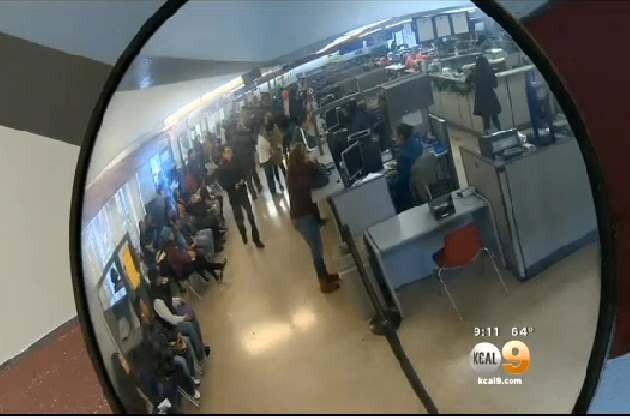
Do you enjoy long wait times at the Department of Motor Vehicles? If you live in California, you're in luck. So many illegal immigrants are now applying for driver's licences that wait times are absurd. CBS News in Los Angeles reported (h/t Weasel Zippers):
Some Motorists Wait Months For DMV Appointments After Immigrants Law Goes Into Effect The Department of Motor Vehicles is so overwhelmed with requests for new driver’s licenses and vehicle registrations that it can take up to three months to get an appointment or a half-day wait in the lobby. A DMV spokesman told KCAL9 Political Reporter Dave Bryan there has been a crush of applications for new licenses for undocumented immigrants, a program that began earlier this month. The spokesman said the DMV is working to address the problems, but some people are having to take a day off of work to handle a 15-minute transaction. At the Hollywood DMV office, where they handle drivers license issues, the long lines outside and packed waiting areas inside are testimony to the long, grueling process that California drivers have to endure before getting service. For example, Jose Quiroz’s DMV ordeal spanned two days of waiting patiently with his family to have his license renewed. “Yesterday, I was here for four hours standing outside, and when I got to the front line they said that they were not taking us in no more,” Quiroz told Bryan. “And now I am back here again, because I am here to fix my license, and I have been here five or six hours.”
Here's the video report:

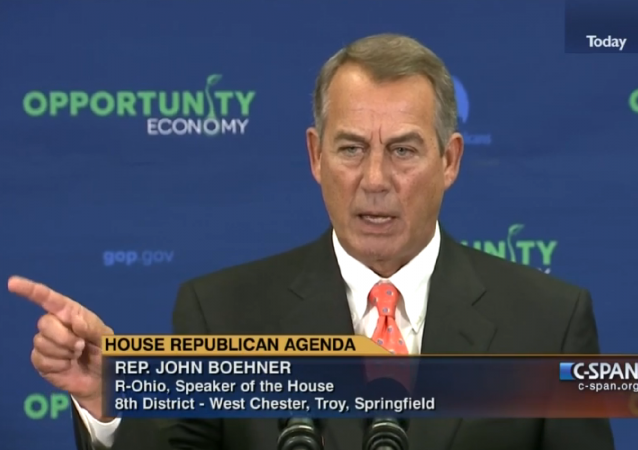
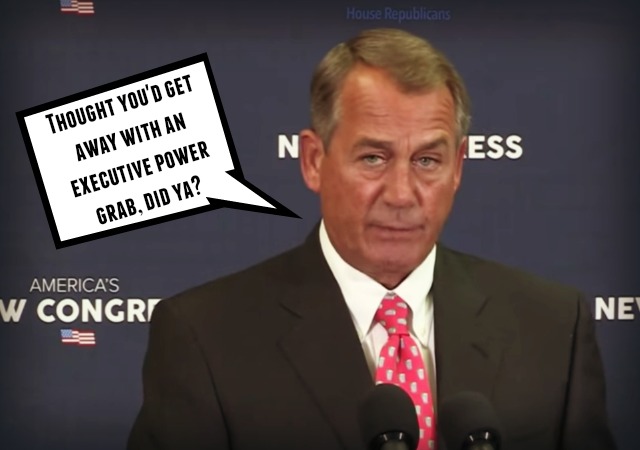
This morning, Speaker Boehner announced he's working with House members to finalize a plan authorizing legal action against the President for his immigration executive overreach. This latest effort is in addition to the work the House has already done to rein in immigration. The House tried to limit the president's executive overreach with the Department of Homeland Security appropriations bill. The bill diverted funds to beef up immigration enforcement. Additionally, the House Department of Homeland Security Committee recently released the Secure Our Borders First Act, one of, if not the toughest border security bill considered by Congress. Yet as Boehner pointed out this morning, much of the latest executive sidestep falls outside of the jurisdiction of the House Homeland Security Committee.

Earlier this month, twelve states joined forces to file an amicus curiae in support of President Obama's immigration executive overreach. Now, a group of mayors are organizing their own campaign to support the president's executive overreach. New York City Mayor Bill de Blasio and Los Angeles's Eric Garcetti are leading a group of more than 30 big city mayors, the National League of Cities, and the U.S. Conference of Mayors, who plan to file a similar amicus brief on behalf of the president. Like the states supporting the president via amici in Texas v. United States, the mayoral amicus brief states that, "public interest across the country is served clearly and overwhelmingly by implementing immigration reform by executive action," according to a statement released from de Blasio's office. “Our mission is urgent. Delaying implementation of the President’s executive action will further hurt our families, negatively impact our economies, and create unnecessary insecurity in our communities,” said Mayor Bill de Blasio. “Cities are where immigrants live, and cities are where the President’s executive action will be successfully executed. We are organized, and we will fight for the changes this nation needs and deserves, and fight those who oppose immigration reform, be it in the courtroom, in Congress, or in our communities. Our voices will be heard.” Participating mayors include those from Atlanta, Baltimore, Buffalo, Chicago, Denver, Newark, Philadelphia, and Houston. Houston's Annise Parker is the only Texas mayor currently supporting the initiative.

Congress now under Republican control is working on immigration reforms one bill at a time. Their latest endeavor is the Secure Our Borders First Act. The bill was released from the House Homeland Security Committee this week and has sister legislation being considered in the Senate. Rep. Michael McCaul of Texas is the Chairman of the House Homeland Security Committee. Some reports indicate the bill actually removes border fencing. We reached out to Chairman McCaul's office who indicated reports of fence removal were, "simply wrong." Further, we read the bill and also found no indication of fence removal. So what does the border security bill do about fencing? The bill does not require the building of a wall or fence along the entirety of America's southern border. Rather, it mixed security measures depending on the location. The southern border (for the purposes of implementing security) have been divvied up into multiple sectors. Security in each sector vary depending on severity of threat and include areal surveillance, tower watch, manned patrols, and other tactics. The bill requires regular assessment of each sector in order to shift tactics as needed.

The House Homeland Security Committee passed the Secure Our Borders First Act of 2015 yesterday. The Act will be introduced in the House today. "This is probably the strongest border security bill ever presented to the Congress," Homeland Security Committee Chairman, Rep. Michael McCaul, told Fox News yesterday. The bill's stated purpose is, "to require the Secretary of Homeland Security to gain and maintain operational control of the international borders of the United States." The Homeland Security Committee released the following to promote the bill: "It's the fundamental responsibility of the government to ensure the territory of this nation is secure against any illicit entry and concealed threats, and on that account the government has failed consistently. Despite billions of dollars and decades of policy debates, the border is not secure," McCaul said in a statement.

Holding DHS Accountable

Facing numerous roadblocks to thwarting President Obama's executive immigration overreach by tightening the purse strings, the Secure Our Borders First Act seems to have found a way to force accountability, at least on the border. The bill seeks to hold the Department of Homeland Security accountable by imposing penalties for noncompliance.

Just when you may have given up entirely on the Golden State, news comes about a newspaper in one of the deepest blue enclaves fighting political correctness.
A California newspaper will continue to use the term "illegals" to describe people who enter the U.S. without permission, despite an attack on its building by vandals believed to object to the term. The Santa Barbara News-Press's front entrance was sprayed with the message "The border is illegal, not the people who cross it" in red paint, sometime either Wednesday night or early Thursday, according to the newspaper's director of operations, Donald Katich. The attack came amid wider objections to a News-Press headline that used the word "illegals" alongside a story on California granting driver's licenses to people in the country illegally. ....In addition to the writing on the building, graffiti espousing a no-borders mentality was scribbled on the walkway through Storke Placita and the sidewalk near Santa Barbara City Hall. Police were braced for a protest in front of the paper later this week. Jan said hundreds could show up, and the Police Department is aware of the call for a protest.
Here's the offending paper: You may recall that another of California's newspapers, the Los Angeles Times, jettisoned the phrases “illegal immigrant,” “illegal immigration” and even "undocumented immigrant."

Have you been struggling to talk to your kids about immigration? Worried they might not understand our immigration policy? Have you been pacing back and forth at night wondering how to explain that America is a nation of immigrants; and oh god, what about this whole "melting pot" thing or is it a "salad bowl" these days? Worry no more. TIME has you covered.
News stories about the debate over the DREAM act, the tens of thousands of children who arrive unaccompanied in the U.S. each year and even the backlash against immigrants in Europe after the Charlie Hedbo killings can raise all kinds of questions and stir up all kinds of emotions for kids. This is especially true when they involve children being separated from their parents.
I distinctly remember laying in bed after an arduous day at German kindergarten, wondering how the President's immigration policy, and Euro-Arab relations would affect me. Not really, but if I had, this article would've undoubtedly improved my entire childhood. To bring clarification to the matter of immigration, children, and communication, TIME chatted with what appears to be a completely and totally unbiased, objective, and nonpartisan source, Professor of Education at Claremont Graduate University and author of Americans By Heart: Undocumented Latino Students and the Promise of Higher Education, William Perez who made the following suggestions:

The ink hasn't even dried on the House bill on immigration reform, and already there is a significant new challenge to address, one which seems designed to help implement Obama's new immigration status plan. The development hasn't come from the White House, but from Mexico, which has just started issuing birth certificates to its citizens at consulates throughout this country.
The Mexican government on Thursday will start issuing birth certificates to its citizens at consulates in the United States, seeking to make it easier for them to apply for US work permits, driver’s licenses and protection from deportation. Until now, Mexico has required citizens to get birth certificates at government offices in Mexico. Many of those living in the US ask friends and relatives back home to retrieve them, which can delay their applications for immigration or other programs.
The reason for the new policy? It makes it more convenient for Mexico to deal with poverty and unemployment in its own country.
Mexico is trying to help millions of immigrants living illegally in the U.S. apply for programs that would allow them to remain temporarily in the country and continue sending money to relatives across the border, despite Republicans in Congress trying to quash President Obama's immigration reform plan. "It is a huge help. It helps individuals really begin to formulate their formal identity in this country," said Angelica Salas, executive director of the Coalition for Humane Immigrant Rights of Los Angeles. About half of the 11 million immigrants living in the United States illegally are from Mexico, and immigration experts estimate that roughly 3 million Mexicans could be eligible to apply for work permits and protection from deportation under the administration's plan.
KATV - Breaking News, Weather and Razorback Sports

As Congress struggles to fight Obama's executive immigration overreach, Speaker Boehner compiled a list of 22 times Obama said he couldn't create his own immigration law. March 31, 2008: “I take the Constitution very seriously. The biggest problems that we’re facing right now have to do with [the president] trying to … not go through Congress at all. And that’s what I intend to reverse when I’m President...” May 19, 2008: “I believe in the Constitution and I will obey the Constitution of the United States.”

Last year 17 states took a stand against President Obama and his plans to use an executive order to remove nearly 5 million illegal immigrants from the bounds of existing immigration law. The coalition, now made up of 25 states and led by Texas' new Governor Greg Abbott, will present oral arguments today advocating both to suspend implementation of Obama's immigration plan, and for the life of the lawsuit crafted to stop it. This type of lawsuit is unprecedented in scope. We know that the President holds certain powers of prosecutorial discretion; but do those powers extend so far as to allow a blanket amnesty without any sort of Congressional approval or legislatively-based change to existing law? And if it does, how should the law account for disparate financial impact to the various states? All novel questions that the court will have to consider. Via the San Antonio Express-News:
Legal scholars say the issues of deferred action and executive discretion on matters of immigration have been upheld in court many times before, and yet predicting the outcome of this lawsuit is difficult because of its unprecedented scale. “Under current case law, there is no basis to find this action illegal,” Chishti said. “But there has never been a case of 5 million, and therefore one might argue that prior cases don’t apply.” Abbott has said Texas shouldered the financial brunt of Obama's 2012 executive action on deferred action, costing taxpayers tens of millions of dollars for an increased police presence on the border, along with health care and education costs.

John Boehner gave a speech today that I could have written for him about Obama's lawless immigration actions. The speech hit all the right notes in connection with passage of a House funding bill for the Department of Homeland Security which blocks using funds for Obama's executive immigration plan. That plan, devised by the White House, unilaterally creates a new class of people effectively exempt from being penalized for immigration violations by inventing a process to obtain legal status found nowhere in the immigration laws. It is not executive or prosecutorial discretion as to better implementing current law---it is a rejection of current law.

In December, 4 governors and 14 states filed suit, requesting a preliminary injunction from President Obama's executive overreach. Lead by then Texas AG (now Governor) Abbott, the complaint stated, "This lawsuit is not about immigration. It is about the rule of law, presidential power, and the structural limits of the U.S. Constitution." The Abbott lead complaint cited numerous damning examples of the President's insistence on circumventing Congress, beginning with the his most recent venture in bypassing Congress to unilaterally implement immigration reform:
"On November 20, 2014, the President of the United States announced that he would unilaterally suspend the immigration laws as applied to 4 million of the 11 million undocumented immigrants in the United States. The President candidly admitted that, in so doing, he unilaterally rewrote the law: “What you’re not paying attention to is, I just took an action to change the law.”
Equipped with reinforcements, House Republicans will debate a Department of Homeland Security (the agency responsible for immigration) appropriation bill Wednesday that if passed with the current amendments, would obliterate Obama's immigration executive overreach. Disarming the President's immigration action through funding was the brain child of Rep. Price.

Here's what's planned on immigration by Republicans in the new Congress:
The House plans to vote next week on legislation that would defund President Obama's executive action on immigration. Republicans also plan to include language rolling back a 2012 order from the Obama administration that gave legal status to illegal immigrants brought to the United States as children. The two measures would be considered as part of a bill funding the Department of Homeland Security through September. An earlier government-funding measure approved last month only funded that agency through February... Mulvaney said Republicans debated in their closed-door meeting whether to focus solely on Obama's move to shield illegal immigrants from deportation, or whether to attack the president's policies on multiple fronts. Some more moderate, swing-district Republicans "wanted the rifle shot, ... maybe didn't want to muddy the waters," Mulvaney said. "But there were other voices in the room who said they wanted a chance to get at DACA, to get at the Morton memos" that relaxed some immigration laws in 2011.
Apparently the latter group won---for now. However, there's always the Senate:

Yesterday, the House Appropriation's Committee released their plan to fund the Department of Homeland Security, making it the last federal agency to receive funding for this fiscal year. The appropriation bill provides additional funding and reallocates resources to strengthen border security and significantly enhance immigration enforcement. The House will debate the appropriation bill next week. Several amendments to the House appropriation bill have already been submitted. In order to prevent implementation of President Obama's immigration overreach, amendments to the appropriation bill further restrict where and how DHS funds will be spent. This was by design. As we've reported, at the center of this debate lies United States Immigration and Citizenship Services (USCIS); the department responsible for processing immigration petitions. USCIS does not receive federal funding from appropriations as it sustains itself on fees collected from petitions. The vast majority of petitions filed with USCIS are filed by immigrants in the United States legally. Whether they are applying for an extension of their green card, changing their visa type, extending lawful status, or applying for naturalization, these petitions (and many, many others) are all processed by USCIS.

In last year's budget battle, Rep. Tom Price, incoming House Budget Committee Chairman, proposed funding the Department of Homeland Security through the end of February. (DHS oversees immigration by way of United States Citizenship and Immigration Services (USCIS).) The idea was that if funding for DHS and subsequent entities were held until the Republicans had a majority in both houses, Republicans would be in a strategically advantageous position to enact substantive reforms and direct more resources to our national borders. Today, the House Appropriations Committee released the DHS appropriations bill. Next week, the bill will be considered on the House floor, making it the last of the annual appropriations bills for this fiscal year. Overall, DHS is slated to receive an increase of $400 million from last fiscal year, giving the agency a budget of $39.7 billion. As the bill currently reads, the surge in funding and substantial reallocations will be poured into enforcement agencies like Customs and Border Patrol (CBP) who are responsible for border protection and confiscating contraband, and Immigrations and Customs Enforcement (ICE) who are the "round 'em up and detain 'em while they await trial" folks. CBP will receive an extra $118 million with the aim of providing more support than the agency has ever received since it's creation in 2003. Almost $400 million is allocated to border security fencing, infrastructure, and technology. Funding has been allocated to add more than 2,000 additional CBP officers to it's current force of 21,370. CBP's total budget in this bill clocks in at $10.7 billion.

In a move to "make lives easier," California has initiated a driver's license program for immigrants who are in the country illegally. The program went into effect today, and has doubled the number of applications for licenses submitted to the state. From the AP:
California has begun accepting driver's license applications from immigrants who are in the country illegally. Despite near-freezing temperatures, hundreds of immigrants lined up as early as 2 a.m. Friday at a temporary Department of Motor Vehicles office in the city of Stanton to begin the process of obtaining licenses. The DMV expects 1.4 million people will seek a license in the first three years of a program aimed at boosting road safety and making immigrants' lives easier. Some applicants may receive licenses Friday if they previously had one. First-time applicants will receive permits if they pass a written test. They will have to return for a driving test at a later date.
This move reverses previous state policy which required "proof of legal presence" in the state of California before an applicant could successfully obtain a driver's license. According to the AP report, while illegals will be able to obtain a license to drive, the license will not count as official federal identification. Additionally, applicants are being cautioned to seek legal advice before applying if they are under a pending deportation order or have a criminal record.