

Image 01 Image 03

Le·gal In·sur·rec·tion

/var/www/vhosts/legalinsurrection.com/httpdocs/wp-content/themes/bridge-child/readFeeds.incFALSE

The truce announced yesterday didn't last long.  CNN reports:
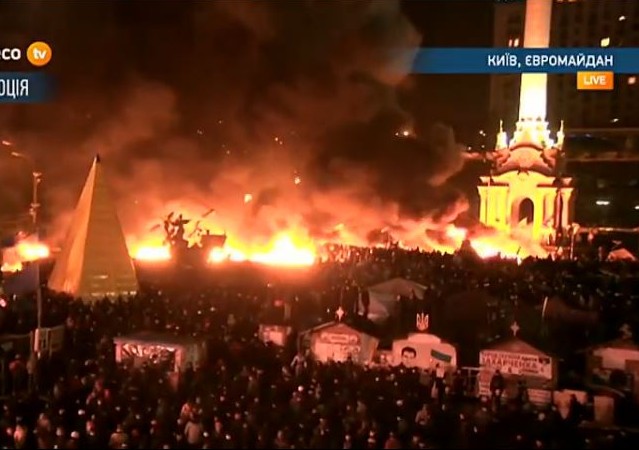
A shaky truce crumbled in Kiev Thursday morning, when gunfire erupted at the city's Maidan, or Independence Square, which has been ground zero for anti-government protesters. At least 20 protesters died, said Oleg Musiy, head of the protesters' medical service. A police officer also was killed, the interior ministry said. It's unclear what prompted the gunfire. But CNN crews at the scene reported that as security forces were moving away from the area, a group of protesters pursued them, throwing rocks and Molotov cocktails. "Protesters broke the truce," said a statement from President Viktor Yanukovych's office."The opposition used the negotiation period to buy time, to mobilize and get weapons to protesters." When the bullets flew, several demonstrators fell to the ground.
Live feeds and other video footage show clashes between protesters and police forces and footage of the scenes on the ground.

LATEST NEWS

President of Ukraine Viktor Yanukovych said late Wednesday in a statement on his website that he and opposition leaders had agreed to a truce and will start negotiations in an effort to try and stabilize the situation in the country amid recent unrest. From NBC News:
The president of Ukraine and the leader of the anti-government movement have agreed to a “truce” and “negotiations” aimed at bringing an end to the violence that has torn the country apart. In a statement on his official website, President Viktor Yanukovych said his government and the opposition have agreed to “negotiations aimed at cessation of bloodshed and stabilization of the situation in the country for the sake of civil peace.” Opposition leader Vitali Klitschko said in a statement on his website that both sides reached an agreement on the negotiations and that the next round of talks will be held tomorrow (Thursday). The website quoted Klitschko as saying, "We have received assurances from Yanukovych that there would be no assault on Maidan (Independence Square). Literally, it means a truce. Today a key goal is to stop the bloodshed that authorities have provoked and unleashed. Now we will see how Yanukovych will stick to his word after promised sanctions from the West." The announcements — the first significant sign of progress since the anti-government protests began nearly three months ago — came just one day after brutal clashes between demonstrators and police left at least 26 people dead and nearly 250 injured.
Earlier Wednesday, President Obama had weighed in on the situation in Ukraine, urging for an end to the violence and warning all sides that “there will be consequences if people step over the line.”

A recent report released by the National Science Foundation has garnered quite a bit of media attention after revealing a survey that found 25% of Americans couldn't correctly answer the question, "does the Earth go around the Sun or does the Sun go around the Earth?" The results of the survey prompted a slew of snark from national media outlets such as Time and Yahoo!. Even the tech site c|net felt the survey warranted some coverage. But after the snark had settled, people began to seriously question how so many individuals in a country like the United States could be so wrong about a seemingly basic question. The popular but incorrect conclusion often arrived at was that it must be those “anti-science, bible-toting righties.” A CNN Opinion piece by Sheril Kirshenbaum draws attention to my point. To be sure, I don’t think Kirshenbaum intentionally penned a hit piece on the Republican faithful. Indeed, the bulk of her article appropriately addresses the general need for improvement of science literacy. She also properly lauds the days when science was “cool,” recalling the public fascination with the Cold War space race.

What's in a name?...

The United States is not Ukraine, so, I hope, we don't find ourselves living in interesting times. 1.  Somewhat educated young people with no opportunities are a revolutionary class.  Between 1990 and 2006, as Ukraine's population declined, the number of students entering colleges shot up an unbelievable 60%.  According to another source, " The number of students enrolled in Ukrainian universities grew from 1.5 million in 2001, to 2.5 million in 2009-2011."  Towards the end of this period the student population consisted primarily of those born in the 1990's when fertility went through the floor. At the same time, the quality of education continued to decline.  Ukrainian universities are not highly ranked, and that grades and diplomas are bought and sold is an open secret.  In 2006, 32% of recent college graduates were unemployed.  Overall youth unemployment (ages 15-24) is 18.6%.  That the students and young people in general and are very active in protests is not surprising, but it helps to know their circumstances. [caption id="" align="aligncenter" width="450"] (Ever wonder why Ukrainian women are so eager to bare their chests for the joy of media outlets across the world? Femen protest against sexual harassment in universities.)[/caption]

What's in a name?...

Violence again erupted in Ukraine on Tuesday. From the NY Times:
Mayhem gripped the center of the Ukrainian capital on Tuesday evening as riot police officers tried to drive two armored personnel carriers through stone-reinforced barriers in Independence Square, the focal point of more than two months of protests against President Viktor F. Yanukovych.

Pelted by rocks and fireworks, the vehicles became stuck in the massive barricades outside the Khreschatyk Hotel and burst into flames, apparently trapping the security officers inside, prompting desperate rescue efforts from their colleagues.

In the course of wild day of parries and thrusts by the protesters and the police, the authorities in Kiev reported nine people killed, including two police officers. It was the bloodiest day of violence since President Yanukovych spurned a trade deal with Europe in November and set of protests that began peacefully but have since involved occasional spasms of deadly violence.

Live feeds and other video footage show clashes between protesters and police forces and footage of the scenes on the ground.

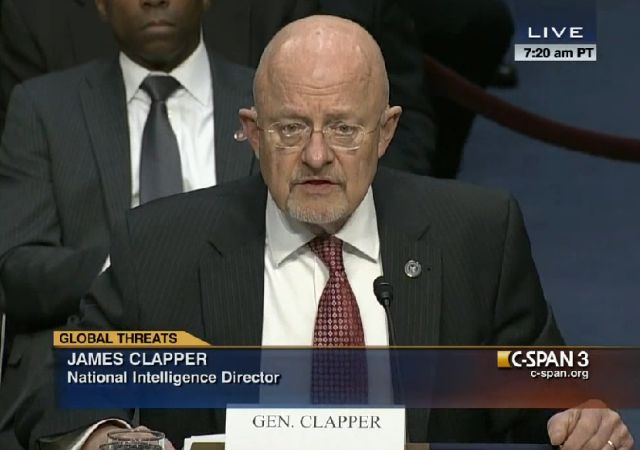
The Director of National Intelligence indicated Monday that the federal government probably should have been more transparent in the first place about its collection of phone records. In an interview with the Daily Beast’s Eli Lake, James Clapper reflected on how the program may have been received differently had general information about it been shared with the public from the outset. From the Daily Beast, Spy Chief: We Should’ve Told You We Track Your Calls:
In an exclusive interview with The Daily Beast, Clapper said the problems facing the U.S. intelligence community over its collection of phone records could have been avoided. “I probably shouldn’t say this, but I will. Had we been transparent about this from the outset right after 9/11—which is the genesis of the 215 program—and said both to the American people and to their elected representatives, we need to cover this gap, we need to make sure this never happens to us again, so here is what we are going to set up, here is how it’s going to work, and why we have to do it, and here are the safeguards… We wouldn’t have had the problem we had,” Clapper said. “What did us in here, what worked against us was this shocking revelation,” he said, referring to the first disclosures from Snowden. If the program had been publicly introduced in the wake of the 9/11 attacks, most Americans would probably have supported it. “I don’t think it would be of any greater concern to most Americans than fingerprints. Well people kind of accept that because they know about it. But had we been transparent about it and say here’s one more thing we have to do as citizens for the common good, just like we have to go to airports two hours early and take our shoes off, all the other things we do for the common good, this is one more thing.”
It's difficult to know whether or not the American public would have accepted the program as another security necessity.  But I'd agree that a more extensive public debate about the general nature of the program probably would have been more productive at the outset.