

Poll finding Cuban-Americans favor ending embargo called into question
on June 19, 2014
1 Comment
A poll released this week suggests that a majority of Cuban-Americans living in Miami favor ending the Cuban trade embargo. A finer reading calls those results into question.
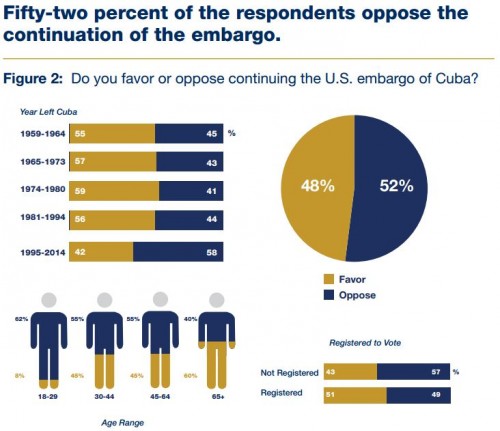
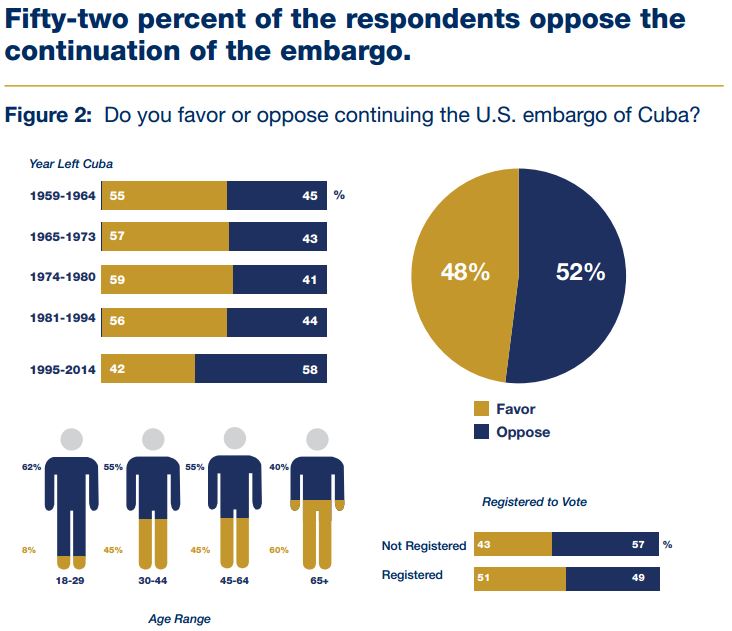
The poll, conducted by Florida International University (FIU) professors Guillermo J. Grenier and Hugh Gladwin for the Cuban Research Initiative, finds that 52% of all Cuban-Americans and 51% of Cuban-Americans registered to vote favor ending the 54-year long embargo that restricts all imports of Cuban goods and most exports to the communist island.
 Though, since the study has a margin of error of 3.12 points, a 52-to-48 spread is a virtual tie.
Professors Grenier and Gladwin have conducted the FIU Cuba Poll every year since 1991. Its respondents are 1,000 randomly selected Cuban-Americans above age 18 living throughout Miami-Dade County.
Though, since the study has a margin of error of 3.12 points, a 52-to-48 spread is a virtual tie.
Professors Grenier and Gladwin have conducted the FIU Cuba Poll every year since 1991. Its respondents are 1,000 randomly selected Cuban-Americans above age 18 living throughout Miami-Dade County.
 Though, since the study has a margin of error of 3.12 points, a 52-to-48 spread is a virtual tie.
Professors Grenier and Gladwin have conducted the FIU Cuba Poll every year since 1991. Its respondents are 1,000 randomly selected Cuban-Americans above age 18 living throughout Miami-Dade County.
Though, since the study has a margin of error of 3.12 points, a 52-to-48 spread is a virtual tie.
Professors Grenier and Gladwin have conducted the FIU Cuba Poll every year since 1991. Its respondents are 1,000 randomly selected Cuban-Americans above age 18 living throughout Miami-Dade County.