

Image 01 Image 03

May 2015

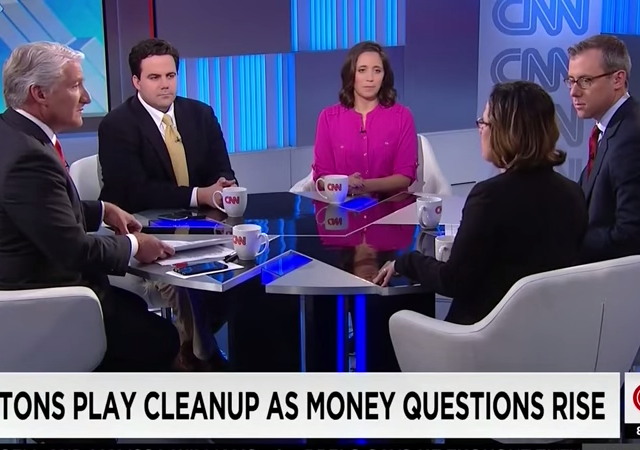
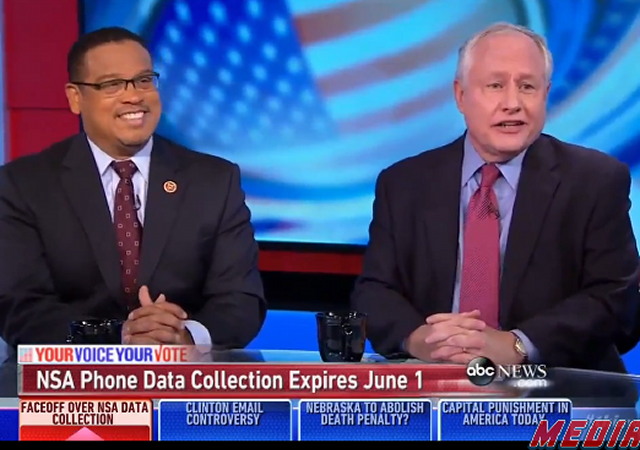
Rand Paul inhabits a unique position in the Republican Party. While he's conservative on some issues, his Libertarian views on others put him at odds with the establishment. His recent filibuster on the Patriot Act is a prime example. Bill Kristol of the Weekly Standard voiced his thoughts on the issue in an appearance on ABC News Sunday. I'm not sure this is a fair line of attack. Evan McMurry of Mediaite has the story:
Kristol: Liberal Democrats Had Rand Paul’s Policies Before He Did A This Week panel noted that Representative Keith Ellison (D-MN) #standswithRand (sigh) over the NSA’s bulk collection of communications data and criminal justice reform, causing Weekly Standard editor Bill Kristol to call for a point of clarification. “That’s not fair to Keith,” Kristol said. “Rand stands with Keith. Seriously. They had these positions first. Rand Paul has decided that he wants to be a liberal Democrat, undercut necessary intelligence collection and weaken law enforcement services, and Rand Paul thinks that’s going to sell in the Republican primary.
Here's the video:

Yesterday I reported on the Haifa Bus 37 suicide bombing in 2003, and how I stumbled on the Memorial during my first full day in Haifa. Today was a travel day that took us even further north, to the Lebanese border. I'll have a report in the next couple of days on the extraordinary story of a child survivor of another bus bombing, and the unexpected recent twist in his life some 45 years later. Now I report on a different aspect of terror, and the extraordinary Israeli humanitarian effort. I traveled to the Ziv Medical Center in Safed (Zefat), Israel. Ziv is the major trauma center serving the northestern part of the country from the Upper Gallile to the Golan Heights. Safed Rivka Ziv Medical Center Regional Map Because Ziv is only 11 kilometers from Lebanon, Ziv was targeted by Hezbollah rockets during the 2006 Lebanon War. It has undergone, and still is undergoing, a process of creating reinforced operating room theaters and patient facilities to protect against future rocket attacks.

The story "The Man Without a Country" used to be standard reading matter for seventh graders. In fact, it was the first "real" book---as opposed to those tedious Dick and Jane readers---that I was assigned in school. It was exciting compared to Dick and Jane and the rest, since it dealt with an actual story that had some actual drama to it. It struck me as terribly sad---and unfair, too---that Philip Nolan was forced to wander the world, exiled, for one moment of cursing the United States. "The Man Without a Country" was the sort of paean to patriotism that I would guess is rarely or never assigned nowadays to students. Patriotism has gotten a bad name during the last few decades. This trend seems to have taken root (at least in this country) with the 60s, the Vietnam era, and the rise in influence of the left. But patriotism and nationalism were rejected by a significant segment of Europeans even earlier, as a result of the devastation both sentiments wrought on that continent during World War II. (Of course, WWII in Europe was a result mainly of German nationalism run amok, but it seems to have given nationalism as a whole a very bad name, a trend that began after the carnage of World War I.)

Legal Insurrection has been filled with touching Memorial Day pieces, especially Professor Jacobson's on Roslyn Schulte, Johnny “Mike” Spann and Jonathan Porto. My contribution, and one I intend to carry forward on future Memorial Days, will feature American scientists and engineers whose discoveries and innovations have helped our military men and women return to their families. However, I would like to begin with a woman who was not a scientist, but whose World War II innovation still impacts our lives today and allows our service men and women to stay connected to home while they are on duty. Lamarr-Stars-and-Stripes-300x243 Hedy Lamarr was born Hedwig Eva Maria Kiesler in Vienna, Austria. After ending an unhappy marriage in 1937, to a wealthy Austrian munitions manufacturer who sold arms to the Nazis, the actress fled to the United States and signed a contract with the Metro-Goldwyn-Mayer studio in Hollywood under the name Hedy Lamarr. She became a big star upon the release of her first American film, Algiers, co-starring Charles Boyer.

Ronald Reagan could deliver a speech almost like no other President. 31 years ago, Reagan delivered an address to commemorate an unknown serviceman in the Vietnam War. Never one to make such moments about himself, the speech is a brief 9 minutes long. The text of the speech follows: --- My fellow Americans: Memorial Day is a day of ceremonies and speeches. Throughout America today, we honor the dead of our wars. We recall their valor and their sacrifices. We remember they gave their lives so that others might live. We're also gathered here for a special event -- the national funeral for an unknown soldier who will today join the heroes of three other wars.

While we remember our service men and women who paid the ultimate price so that we can enjoy freedom, it's fitting to reflect on a few of our finest virtues.

1. We're back to back World War champions

captain america i've knocked over adolf hitler over 200 times

2. Old Glory is a beaut

american flag

Memorial Day is always a bittersweet holiday for me. I enjoy having a day to partake in BBQ and beer (Texas BBQ though, not what Yanks call "BBQ"), while wearing my favorite, ratty, American flag t-shirt and watching war movies. As much as I love reflecting on this brilliant country a bunch of old dudes created a couple hundred years ago, there is a weight that lies heavy on my heart on days like Memorial Day. It's the simple reminder that freedom is never free. Our freedom comes at inestimable price. More often than not, that debt is only satisfied with blood. When I was in high school "Saving Private Ryan" made its silver screen debut. Always a sucker for war movies, I went to see it on opening weekend. Completely unaware that what I was about to see would have a lasting impact, I sprung for cherry sours, a Coke slushy and found a seat. The first thirty minutes of the film were unlike anything I'd ever seen on screen and easily the most intense. At the time I was only vaguely familiar with the D-Day invasion. What I knew of D-Day I'd learned from 60s flicks like "The Longest Day." Unlike the older World War II films where a bullet to the heart resulted in a theatrical fall sometimes accompanied by a bit of obviously fake blood and famous last words, "Saving Private Ryan" was the goriest movie I’d ever seen. A soldier reached down to pick up his arm that had been blown off and another lay on the ground, his guts strewn across the sand. The water was red with blood and soldier after soldier fell in similarly violent fashion, some never making it off the landing craft.

What happens when the money backing a war memorial dries up? The doors shut, tourists and veterans are turned away, and the memorabilia and plaques inside languish under a layer of dust. This is exactly what has happened to the Brooklyn War Memorial. The Memorial, built 64 years ago, has never been accessible to the general public, which means that only a few people have ever been able to stand before the 11,000 names etched into its inside walls, representing Brooklynites who died fighting in World War II. According to a GoFundMe page set up by the Cadman Park Conservancy, the memorial is in need of a serious overhaul; new stone work, new roof, new electric, new plumbing, new glass, insulation, and a handicapped accessible ramp, bathrooms, and elevator are all needed before the site can be completely opened to visitors. Getting the site up to speed is going to be an enormous undertaking---but a devoted group of veterans and supporters are determined to make that dream a reality. Yesterday, the surrounding community rallied at the memorial to honor the fallen and kick off the restoration effort:

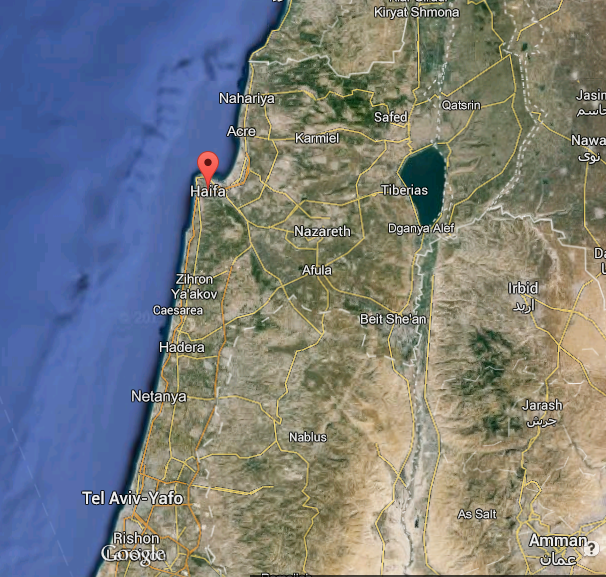
In Israel, you are never far away from terror or the memory of terror. I learned that by chance tonight. We arrived in Israel late afternoon yesterday, May 23, 2015.  Today was planned as a rest day to try to adjust to the 7-hour time difference. From the airport we headed directly for Haifa, the northernmost big city in Israel, with a population just under 300,000.  It is a very mixed city, both ethnically and religiously. Haifa Country Satellite Map We started the day with the classic Israeli Shakshuka breakfast at the Villa Carmel, where we are staying:

An Israeli civil servant committed suicide on Saturday after a Facebook post accusing him of racism went viral. Ariel Ronis, 47, managed the Population, Immigration and Border Crossing Authority (PIBA) offices in Tel Aviv. Last week, a black Israeli woman posted a note on Facebook about her experiences in the office, accusing various staff---including Ronis---of treating her unfairly because of the color of her skin. She says that she was denied services by a clerk, and then told by Ronis to "get out of his face" when she complained about it. She claims the incident made her cry, and caused her a considerable amount of distress. Her post caught the attention of the online community and the media, and went viral. Ronis was officially smeared, and judging by a note he posted to his own Facebook page, the incident pushed him over the edge. Screen Shot 2015-05-24 at 4.26.58 PM The Times of Israel translated his post:

Department of Justice official Vanita Gupta has come under fire for suggesting the riots in Baltimore and Ferguson should be blamed in part on slavery and Jim Crow laws. J. Christian Adams of PJ Media recently wrote:
DOJ Official: Slavery to Blame for Riots in Ferguson and Baltimore Vanita Gupta, head of the Department of Justice Civil Rights Division, has told a lawyers group in Colorado that slavery and Jim Crow helped fuel the Ferguson and Baltimore riots. The last few days have seen a number of fanciful stories with the Obama administration seemingly questioning the authority of local police. I’ve long maintained that the administration is nakedly seeking to federalize policing standards — but get rid of local police? No way, that sounds like something broadcast from a shortwave station in Austin, Texas. But then up steps Vanita Gupta to lend some credibility to the idea that some want to disband local police and replace police powers with the federal government. Speaking to a group of left-wing lawyers in Colorado, Gupta had this to say:
The conversation in these rooms, however, is not about whether to have police or not but about what kind of policing communities want and deserve. There is no question that we need police in our communities.
The conversation? What conversation is Gupta hearing that needs to be corrected? Who brought up the idea we might not need police? Nobody sane, for sure.
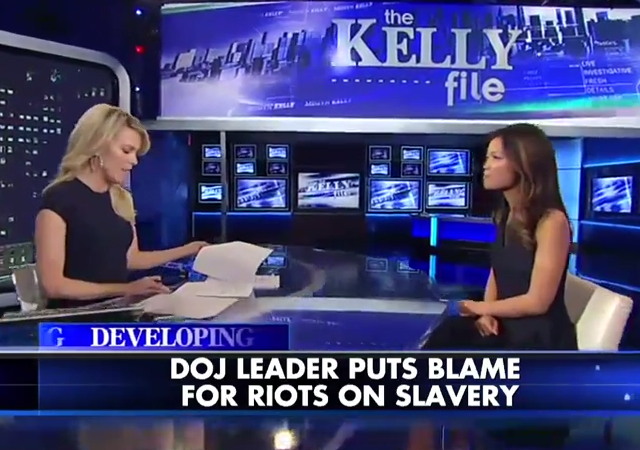
Megyn Kelly recently discussed the subject with conservative author Michelle Malkin, who analyzed the issue in a political context.

A couple of interesting polls came out this week that raise some equally interesting questions about conservatism, American values, and American culture and society.  One Gallup poll states that Americans greatly overestimate the percentage of Americans who are lesbian, gay, bisexual, or transgender.
The American public estimates on average that 23% of Americans are gay or lesbian, little changed from Americans' 25% estimate in 2011, and only slightly higher than separate 2002 estimates of the gay and lesbian population. These estimates are many times higher than the 3.8% of the adult population who identified themselves as lesbian, gay, bisexual or transgender in Gallup Daily tracking in the first four months of this year. The stability of these estimates over time contrasts with the major shifts in Americans' attitudes about the morality and legality of gay and lesbian relations in the past two decades. Whereas 38% of Americans said gay and lesbian relations were morally acceptable in 2002, that number has risen to 63% today. And while 35% of Americans favored legalized same-sex marriage in 1999, 60% favor it today.
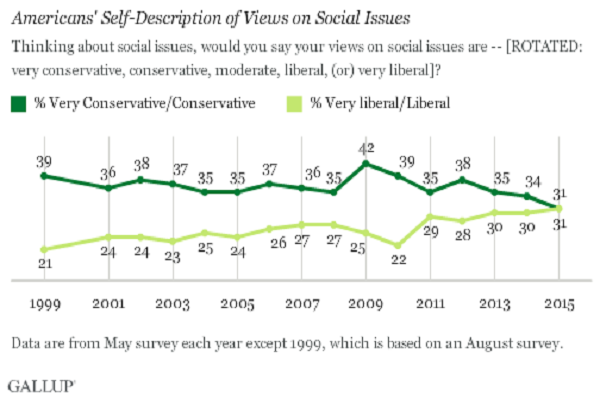
It might come as a surprise that only 3.8% of the American population identify as LGBT.  It did to me.  We are inundated with news stories and manufactured outrage from the left to such a degree that it really seemed that we were transforming our laws, interpretation of our Constitution, and our religious beliefs for a significant portion of the population.  But no. Not that the tiny percentage makes any real difference in our own beliefs about states' rights, gay "marriage," and the assault on Judeo-Christian values, but the difference between our perception and reality speaks volumes about the effectiveness of the progressive far left. They are so effective at both creating false impressions and pushing their ideology, in fact, that the results are measurable.  According to another Gallup poll, the number of people identifying their social values as liberal matches those who identify their social values as conservative for the first time.

If you were looking for a monument to supreme egotism, you would have to go far to beat Obama's statement in this interview with The Atlantic's Jeffrey Goldberg:
“Look, 20 years from now, I’m still going to be around, God willing. If Iran has a nuclear weapon, it’s my name on this,” he said, referring to the apparently almost-finished nuclear agreement between Iran and a group of world powers led by the United States. “I think it’s fair to say that in addition to our profound national-security interests, I have a personal interest in locking this down.”
I rack my brain to think of another president in our history---or another statesman or even another prominent politician---who would think to say "trust me, because my ego is riding on this." What on earth does ego have to do with judgment? In the calculus of what are the most important considerations about any Iran deal, the most important would be "our profound national-security interests" and those of the entire world. That's what's riding on it, that's the reason to "lock it down" (odd phrase for negotiations). The state of Obama's personal reputation ought to be so low on the list of things to think about that it shouldn't even be on his radar screen at this point, much less ours. Obama says he's got a special personal interest in "locking this down." But an agreement on nuclear weapons with Iran is not merely a question of applying oneself. Obama may think there's no limits to his powers, but sizing up Iran and negotiating with a country which is essentially an aggressive, repressive, fanatical enemy isn't just a matter of trying hard enough and thinking you're the smartest guy in the room. Even if it were true that Obama wanted and even needed to negotiate a good deal for the US in order to protect his precious reputation, that doesn't mean he has a clue how to get there from here, or that it's even possible to do so.

As the GOP field of candidates gets larger and more ideologically diverse, conservatives work toward a defining message about their brand of conservatism.  The latest incarnation is an apparent rebranding of the "compassionate conservatism" most closely associated with President George W. Bush. Not only is the term itself objectionable in its implication that conservatism is not compassionate, but it is equally objectionable in practice.  From compassionate conservatism we notably got No Child Left Behind and (then and still unfunded) Medicare Part D.  Expanding government and increasing spending to provide, expand, and otherwise "reform" an ever-growing number of federal programs seems to undermine fundamental principles of conservatism. Rather than working to significantly shrink or even eradicate giant social welfare programs, "compassionate" conservatism worked to "reform" them at huge cost to the American tax payer. And therein lies the problem for many conservatives who might agree that a safety net is viable, even necessary, but who draw the line at a welfare state that goes well beyond being a temporary safety net for those in need to a generational morass from which few ever escape. Compassionate conservatism was, in essence, an attempt to apply conservative principles to social engineering goals, a means of reforming the welfare state and "helping the poor" via central planning.  The central planning itself, however, was supposed to be rooted in fiscally conservative principles, but the underlying precept was that big government is the answer . . . no matter the question.

According to a new report from Jeremy W. Peters of the New York Times, there's one Republican candidate that Democrats fear in a 2016 match-up with Hillary Clinton:
A Hillary Clinton Match-Up With Marco Rubio Is a Scary Thought for Democrats WASHINGTON — They use words like “historic” and “charismatic,” phrases like “great potential” and “million-dollar smile.” They notice audience members moved to tears by an American-dream-come-true success story. When they look at the cold, hard political math, they get uneasy. An incipient sense of anxiety is tugging at some Democrats — a feeling tersely captured in four words from a blog post written recently by a seasoned party strategist in Florida: “Marco Rubio scares me.” What is so unnerving to them at this early phase of the 2016 presidential campaign still seems, at worst, a distant danger: the prospect of a head-to-head general-election contest between Mr. Rubio, the Republican senator from Florida, and Hillary Rodham Clinton.
The KOS kids don't seem as concerned:
I think it has some merit. I personally am not "scared" of Hillary facing Rubio in the general, but I do think that he would far and away be the Republicans strongest candidate. That does not mean that I find him impressive in any way - I do not. But I do believe that he could put a dent in the Hispanic advantage that the Democratic part has, and I also think that he could win Florida. Yes, I know, I know - his immigration stance will probably hurt him with both the Hispanic voting block and the RWNJ voting block - but I do believe that Democrats - and the Clinton campaign - should take Rubio very seriously.
Rubio represents the younger, new crop of Republicans who came up in the mid term elections of 2010 and 2014. Whether he represents a danger to Clinton in 2016 or not, he's certainly a reminder of a big problem Democrats currently face.