

Image 01 Image 03

Terrorism Tag

A video discovered by the Middle East Media Research Institute (MEMRI) contains a direct threat against the life of President Barack Obama, as well as promises to kill more hostages if Jordan does not release extremist and prisoner Sajida al-Rishawi. Fox News has the details:
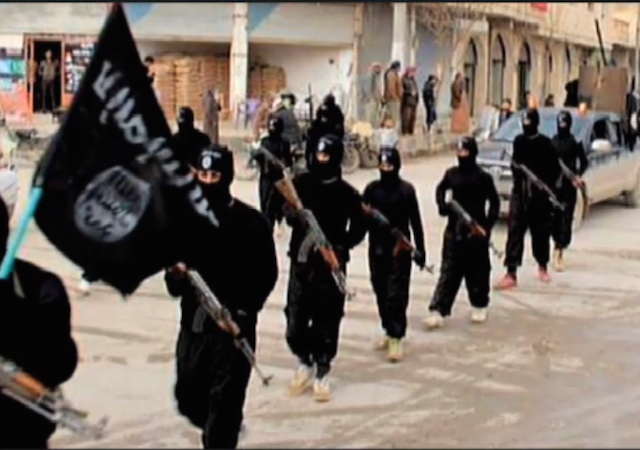
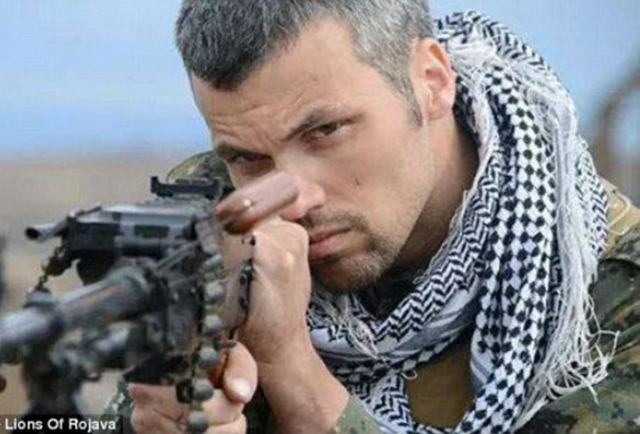
In a new online video discovered by the Middle East Media Research Institute (MEMRI) on Tuesday, three Islamic State fighters stand behind a kneeling Kurdish fighter as one of the extremists launches into a diatribe against the U.S. and other Western nations. “Know, oh Obama, that will reach America,” says one of the fighters, clad in black and wearing a balaclava, in a translation from Arabic provided by MEMRI. “Know also that we will cut off your head in the White House, and transform America into a Muslim Province.” The extremist also issued warnings to European nations. “And this is my message to France and to its sister, Belgium,” he said. “We advise you that we will come to you with car bombs and explosive charges, and will cut off your heads.” The video fades to black as one Islamic State fighter brings a knife up to the unidentified Kurdish fighter’s throat.
Like another message released this weekend, this video did not bear the Islamic State's media logo; but officials have not released any statements offering a credible denial of the video's authenticity. The White House has not commented on the threats to President Obama's life.

Today, Islamic extremist group Boko Haram launched a three-front assault on northeast Nigeria's largest city, Maidguri, and also raided villages in Adamawa state, burning homes and abducting women and children. Via Fox News:
In Maiduguri, troops blocked roads into the city, which also prevented civilians from escaping. "Coordinated air and land operations are being conducted now," Defense Ministry spokesman Brig. Gen. Chris Olukolade posted on Twitter. He said the 12-hour curfew in place in Maiduguri for more than a year is extended to 24 hours. "We believe hundreds of thousands of civilians are now at grave risk," Amnesty International said. More than 200 combatants have been killed, mainly insurgents, according to soldiers and civilian self-defense fighters who counted bodies. They spoke on condition of anonymity because they are not allowed to speak to reporters.
Although forces in Maiduguri were able to fight back the wave of insurgents, the army at Monguno, just north of Maiduguri, was overwhelmed and Boko Haram was able to seize control of the city.

A man named Ahmad Rashidi was interviewed on Meet the Press today and provided an alarming look into the goals of ISIS. He claims they want to be "better" than al-Qaeda and orchestrate an attack "more brutal" than the 9/11 attack on the World Trade Center. Andrew Johnson of National Review has more:
Man Who Escaped ISIS: They Want to Plan an Attack ‘More Brutal’ than 9/11 The Islamic State is “happy” about the air strikes by the United States because it validates their efforts in emerging as a global threat, says a man who escaped after a month with the group. Ahmad Rashidi was captured by the Islamic State when he went to Syria from London to retrieve the two daughters of a family friend; the teenage girls had fled England to marry Islamic State fighters. When Rashidi found one of the girls, her husband accused him of being a spy and he was taken prisoner and tortured. He later won the favor of his capturers by telling them he was a doctor; Rashidi is, in fact, a first-year medical student. While embedded with the Islamic State for a month, Rashidi gained access to their computers and communications. He told NBC News’s Richard Engel that the group communicates with its contacts “every day” and is not worried about the West’s response to its attacks. In fact, the Islamic State was “happy” about the American military’s response of air strikes because it proved to the group’s leaders that they were considered as important a threat as al-Qaeda. “They want to be more . . . better than al-Qaeda,” he told Engel. “This is why they need to do something more brutal than the World Trade Center.”
Here's the video: Speaking of Syria, there are new developments in American policy.

Yesterday, the Islamic State released a video they claim contains an image of the decapitated body of Japanese hostage Haruna Yukawa. A second hostage, journalist Kenji Goto, appears in the video holding a photo of what ISIS claims is the remains of Yukawa, and in accompanying audio relays a proposed hostage trade. Via the New York Times:
In the three-minute audio recording released Saturday, the voice of a man who claimed to be Mr. Goto said Mr. Yukawa had been “slaughtered” and blamed Mr. Abe’s failure to pay the ransom. (In the audio, the voice says he is Kenji Goto Jogo; it remained unclear late Saturday why that was different from the name given by the Japanese government and his own website.) The audio is addressed to Mr. Goto’s wife, telling her that the Islamic State was now demanding the release of the woman imprisoned in Jordan, Sajida Mubarak al-Rishawi. “They no longer want money,” the voice says in accented English. “You bring them their sister from the Jordanian regime, and I will be released immediately. Me for her. Don’t let these be my last words you ever hear. Don’t let Abe also kill me.”
Although officials are hesitant to deny the authenticity of the video, it did significantly differ from previous messages from the Islamic State. Fox explains:

Four years ago, many of us were glued to the TV and social media streams following the dawn of "Arab Spring". One of the most dramatic moments of that era was the start of massive pro-democracy demonstrations in Egypt's Tahrir Square. After ousting the reviled Hosni Mubarak, the Egyptians used their vote to elect a Muslim Brotherhood "community organizer"; and the ensuing meltdown led to his ouster and the nation declaring the group illegal. In April 2014, I noted the country had sentenced over 600 alleged supporters of the country’s ousted Islamist president to death, including the Muslim Brotherhood’s spiritual leader -- the aptly named Mohammed Badie. Those sentences have now been revoked.
Egypt’s top appeals court Saturday revoked death and life sentences against more than 500 backers of deposed Islamist president Mohammad Mursi and ordered a retrial for them in a case that has raised international concerns over the operation of the justice system in the country. The Court of Cassation delivered the ruling at a hearing in which prosecution and defence lawyers alike demanded the cancellation of the verdicts delivered by a lower court last year, citing legal flaws. ...On Saturday, lawyer Mohammad Toson argued in a brief hearing that the Criminal Court issued the rulings without listening defense lawyers and witnesses. No date has been set yet for the start of the retrial.
The ruling also included Badie's sentence.

A three-day long controversy broke out recently over the use of the term "No-Go Zones" with regard to certain European cities in light of the Charlie Hebdo and HyperCasher supermarket attacks by Islamic radicals. Steve Emerson of The Investigative Project, a longtime expert on terrorism and its connection to Islamist radicals, made a misstep when he overstated the case while appearing on Fox News.  That created a near-perfect storm of groups just waiting to jump all over him: Fox News haters like the NY Times (even though it previously used the term) and the liberal entertainment media; British and European politicians who prefer not to deal with the sources and implications of domestic terror; and groups that have made professions of tarring people with the Islamophobia epithet. Emerson handed it all to them on a silver platter, as Theodore Dalrymple at City Journal explains:
Steven Emerson, the expert on terrorism, has caused a sigh of relief among the bien pensants of the Western world. By making inaccurate and false claims on Fox News, he has enabled them to pour righteous scorn on him and thereby avoid thinking about uncomfortable social realities.
A defense of Emerson's basic point, if not his specific description, is provided by the Gatestone Institute, European 'No-Go' Zones: Fact or Fiction? Part 1, France. (added) See also, Jonathan Tobin, ‘No-Go Zones’ Are Not a Conservative Meme. Regardless of whether "No-Go Zone" is a proper term in a general way, there is no doubt that there are cities and sections of many cities in Europe which are no-go zones for those publicly identifying as Jewish by dress (e.g., wearing a kippah/yarmulke) or symbols (e.g. wearing a Star of David) or appearance (e.g., long beard in combination with dress and symbols). We have explored the problem of Walking While Jewish repeatedly over the years, including recently regarding "Kippah Walks" in placed like Copenhagen to protest harassment of Jews on the street, frequently by groups of Muslim young men. Though it's not only men, as this woman in Copenhagen demonstrated with her Heil Hitler shout when she spotted Jews at a restaurant:

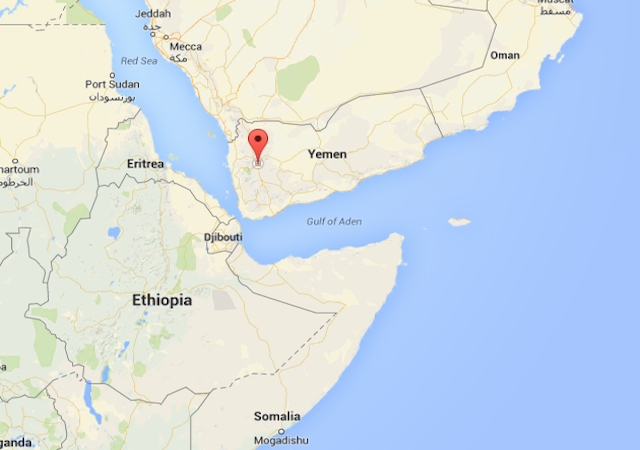
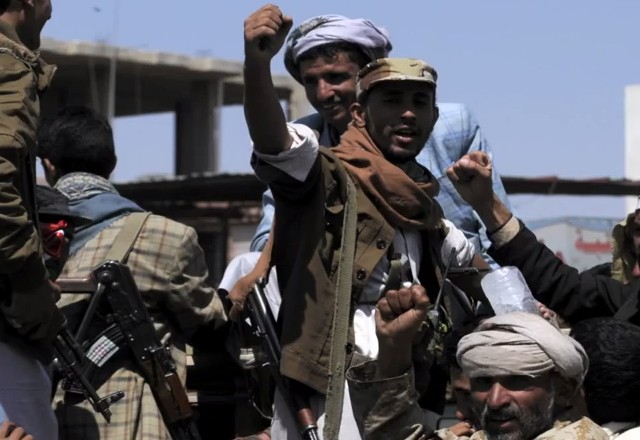
Earlier today, Yemeni President Abed Rabbo Mansour Hadi and his government resigned under pressure from Houthi rebels who gained control over the Presidential palace and residence this week. According to Presidential adviser Sultan al-Atawani, contrary to what previous sources touted as the beginnings of a compromise, Houthi rebels refused to withdraw from key parts of the city---including the presidential palace, and the presidential and prime minister's palaces---and refused to release government officials taken hostage during the attack. Via the AP:
"We reached a deadlock," Hadi said, according to a copy of his letter of resignation obtained by The Associated Press. "We found out that we are unable to achieve the goal, for which we bear a lot of pain and disappointment," he said. ... Military officials close to the president said Hadi resigned after the Houthis pressured him to give a televised speech to calm the streets. They said the Houthis also requested appointments in his own office, the Defense Ministry and provincial capitals, demands Hadi rejected.
The fallout from this could go in one of two directions---although in this region, unrest and faction splits don't generally lead to either peace, or collaboration against growing terror operations. On one hand, some analysts believe that the resignations will lead to backlash and popular uprising, further isolating the Houthi (and diminishing Iranian influence.)

Yesterday, State Department officials in Yemen were preparing for the possibility of evacuation. Houthi rebels had laid siege to the presidential palace, and later held President Hadi captive in his own home. The United States Embassy was fired upon, and the Navy was on alert. Earlier today, however, the Houthi reached a compromise with the U.S.-backed leadership that would give the rebel group more of a say in government, bringing an end to the immediate violence. (It is unclear whether or not Hadi remains a prisoner in his own home.) Via the AP:
SABA [news agency] said the agreement included a clause that would answer the rebels' demands to amend the constitution and expand their representation in the parliament and in state institutions. It also included promises to ensure better representation for Yemen's southerners as well, the deal said. The agreement also calls on Hadi to shake up a commission tasked with writing a draft constitution to ensure bigger representation for the Houthis. The draft constitution has proposed a federation of six regions, something the Houthis reject. The agreement reached Wednesday night also ensures that Yemen would be a federal state, but doesn't mention the six region proposal, saying controversial issues will be further discussed. The agreement, while addressing the immediate Houthi takeover and security concerns in the capital, leaves the contentious political issues unresolved.
The Houthi reign of terror began last year, when the Iran-backed rebels took partial control of the capital city of Sana'a, and attempted to block the the President from taking power.

We are seeing a growing volume of knife attacks on Jews in Israel as the new Palestinian terror tactic. The murder of four Jews praying in a synagogue in Jerusalem with knives and machetes received a lot of attention, but there are almost daily knife attacks on Jews, primarily but not exclusively in Jerusalem. That terror tactic is necessitated, in part, by Israel's security barrier, checkpoints and raids which make it much more difficult to infiltrate weapons and explosives into Israel for use in terror attacks. But knives are more readily available, and knife attacks seem to be promoted as a tactic. Hamas-affliated Palestinian students at Al Quds University produced a video celebrating the murder of the four Jews in Synagogue: Hamas even produced a video on how to stab a Jew:

Sometimes, more can be learned from what a world leader fails to say. One of the topics President Obama failed to cover in his State of the Union address is the situation in Yemen, a country that has descended so far into chaos that two U.S. Navy warships now stand ready to evacuate Americans from the Embassy. Just prior to the President's speech, California Senator Dianne Feinstein urged that the embassy be closed immediately and the personnel evacuated.
The U.S. government should immediately close and evacuate the U.S. Embassy in Sana'a, Yemen, according to Senator Dianne Feinstein, the Democratic vice-chairman of the Senate Select Committee on Intelligence. I asked her today whether the embassy, which remains open despite raging violence throughout the Yemeni capital, should be closed. She responded: “Based on what I know so far, yes.” “I’m very concerned about our embassy there, who is still there, who isn’t still there, and what the plans are,” Feinstein added.
Contrast this to what the President said of Yemen just last September:

Yemen is in chaos. For the past two days, Shiite Houthi rebels have laid siege to the presidential palace. Now, reports claim that the rebels have seized the palace; and the status of President Abed Rabbo Mansour Hadi remains unknown. Although the Houthi rebels are not targeting Americans---at least for the time being---U.S. officials are preparing for the possibility of a "non permissive environment," meaning that the city of Sana'a will have descended into combat-like conditions. Unfortunately for Americans in Yemen, evacuation isn't simply a matter of driving to the airport and hopping a flight. CNN explains:
If an evacuation is ordered, the first option would be to have embassy personnel drive to the commercial airport in Sanaa and fly out, the official said. But in the wake of an embassy car being fired Tuesday, the safety of the roads in the capital is now being constantly evaluated, the official said. If embassy workers did drive to the airport it is likely some sort of air cover would be provided, under the current plan. Other detailed military planning for various options has been finalized, the official said. Those options would be used if a request for military assistance were made. If helicopters and V-22 aircraft from the ships are sent to Sanaa, it would be a complex operation that could last for several days to fully evacuate "several hundred Americans" from the embassy, the official cautioned. "Nobody should think this would be easy."
The Houthi rebels claim that they're working for a more democratic Yemen, but analysts are skeptical of the group's claims, and worry that a successful coup could lead to further radicalization.

On January 21, U.S. Assistant Secretary of State Roberta Jacobson will be the first diplomat since the Carter administration to set foot on Cuban soil with the goal of restoring diplomatic relations that haven't existed since the height of the Cold War. From Bloomberg:
Jacobson’s arrival will kickstart negotiations that could eventually expand to include everything from demands for compensation by Cuban-American exiles and U.S. companies to improved human rights. While the U.S. and Cuba have met for years to discuss lower-level issues such as counter-narcotics and migration, her visit is the first to test Obama and Castro’s pledges to bolster relations. The U.S. will review Cuba’s designation as a state sponsor of terror and make a decision within six months of the Dec. 17 announcement that relations would be normalized, an administration official said in advance of the trip, speaking on the condition of not being identified because of diplomatic protocol. The State Department will review evidence and intelligence to determine if Cuba is sponsoring terrorism, though the determination won’t impede normalization, regardless of the outcome, the official said.
Although formal ties were severed in 1961, the U.S. maintained its old embassy as a way of maintaining communications with the Castro regime. President Obama has plans to reopen the embassy, but will have to secure funding from Congress to do so. Cuba's status as a state sponsor of terrorism tops the list of concerns for American lawmakers who oppose the normalization plan. State Department officials have said that determinations regarding Cuba's terror listing "will have no impact" on the administration's efforts to reestablish diplomatic relations, and that the two issues "are proceeding on separate tracks."

Alberto Nisman, the Argentinian prosecutor who investigated the 1994 bombing of the AMIA Jewish center in Buenos Aires and documented Iran's extensive terror ties in the western hemisphere, was found dead at his home Sunday night of a bullet wound to the head. Nisman was slated to testify today on his latest explosive accusations that the current government of Argentina, specifically President Cristina Fernández de Kirchner, purposely covered up Iran's involvement in the bombing in order to preserve a grain-for-oil deal with the Islamic Republic. The New York Times reports:
The body of the prosecutor, Alberto Nisman, 51, who had been heavily protected by police sentries because of threats, was discovered Sunday night. He had been scheduled to testify on Monday at a congressional inquiry about his accusations. The security minister, Sergio Berni, said evidence at the scene, including a .22-caliber pistol and spent cartridge found near Mr. Nisman’s body, indicated suicide. An autopsy announced later said he had died of a bullet wound to the head. But the news immediately provoked shock and outrage from the political opposition and leaders of Argentina’s Jewish population, Latin America’s largest, who demanded a transparent inquiry into his death. The timing appeared to put a skulduggerous international shadow over his accusations.

The wake of the attacks on French satirical magazine Charlie Hebdo have drawn all of Europe into the debate over how to best collaborate to prevent similar terror attacks in what is becoming a more culturally divided Europe. Responses by the various countries to the terror threat have ranged from rolling back anti-free speech laws, to cracking down on free speech, to tracking and eliminating terror threats. In France, prosecutors have been ordered to prosecute "hate speech"; meanwhile, the UK Parliament finds itself in a gridlock over whether or not to pass new, restrictive "anti-terror" legislation. Belgium has already tracked down one terror cell, and is on the ready should another rear its head. If this leaves you thinking, "something's gotta give," then you're of the same mind as some European Union officials who are pushing for a new alliance with Muslim countries. They believe that if the two regions cooperate and share information, they'll be able to prevent terrorist attacks before the occur. Via the AP:
EU foreign policy chief Federica Mogherini said Monday that "we need an alliance. We need to strengthen our way of cooperating together." Mogherini later met with Arab League Secretary General Nabil Elaraby. She also attended a meeting of the EU foreign ministers who are preparing for a summit of EU leaders in February focused on terrorism. Some ministers emphasized the importance of working with Muslim countries, rather than blaming them for the problem. "They will continue to be in the front line, and we have to work closely with them to protect both those countries and the European Union countries," British Foreign Secretary Philip Hammond said. Belgian Foreign Minister Didier Reynders said the police raids launched in his country last week to break up a suspected network of foreign fighters demonstrate that information-sharing is the key to success. "We have to exchange information in Europe and outside Europe to really follow what is going on and to prevent any acts that could be launched on our territory," he said.

At least 20 hostages of the 80 hostages taken after this weekend's raid by Boko Haram on villages in Cameroon have been set free. Officials don't yet know how it is that those 20 people managed to escape their captors. The raid was typical of Boko Haram in every way---except that they crossed the border from Nigeria into Cameroon to carry it out. Via Reuters:
"According to our initial information, around 30 adults, most of them herders, and 50 young girls and boys aged between 10 and 15 years were abducted," a senior army officer deployed to northern Cameroon told Reuters. He said the early-morning attack had targeted the village of Mabass and other villages along the porous border. Soldiers intervened and exchanged fire with the raiders for around two hours, he added. Government spokesman Issa Tchiroma confirmed the attack, in which he said three people had been killed, as well as the kidnappings. He was not able to say with certainty how many people had been taken in the raid. “There was a Boko Haram attack on several localities in the Far North region. The assailants burnt down about 80 homes and kidnapped several inhabitants including women and very young children,” he said.
Boko Haram is increasing the scope of its operations, which comes as a major concern for security forces tasked with dealing with the group. Late last year, we covered the evolution of the group from regional threat to cross-border terror organization; things have only gotten worse for the people of Nigeria and the surrounding areas.

The Obama administration has engaged in absurd linguistic gymnastics to pretend that the terrorists who shot up Charlie Hebdo and the HyperCasher supermarket merely were individuals who happened to adopt radical Islamic extremism almost by chance.  Could have been any extremism, we're told. Generic "extremism" is the problem, as if it lived out of body. By playing these word games, the administration does no favor to those in the Muslim world who recognize the reality and want it to stop.  To the contrary, the administration's word games constitute an abandonment. The President of Egypt is one of those voices, calling for a revolution within the Muslim world against the extremism. Another voice is Hisham Melhem, the Washington bureau chief of Al-Arabiya In late September 2014, I wrote about an article by Melhem, The Barbarians Within Our Gates. Melhem made points as a Muslim examining the Muslim world that would get him labeled "Islamophobic" and "racist" by groups like CAIR and the Southern Poverty Law Center:
Arab civilization, such as we knew it, is all but gone. The Arab world today is more violent, unstable, fragmented and driven by extremism—the extremism of the rulers and those in opposition—than at any time since the collapse of the Ottoman Empire a century ago. Every hope of modern Arab history has been betrayed.... And let’s face the grim truth: There is no evidence whatever that Islam in its various political forms is compatible with modern democracy. From Afghanistan under the Taliban to Pakistan and Saudi Arabia, and from Iran to Sudan, there is no Islamist entity that can be said to be democratic, just or a practitioner of good governance. The short rule of the Muslim Brotherhood in Egypt under the presidency of Mohamed Morsi was no exception. The Brotherhood tried to monopolize power, hound and intimidate the opposition and was driving the country toward a dangerous impasse before a violent military coup ended the brief experimentation with Islamist rule....