

Image 01 Image 03

Author: William A. Jacobson

Profile photo

William A. Jacobson

William A. Jacobson is a Clinical Professor of Law and Director of the Securities Law Clinic at Cornell Law School.

He is a 1981 graduate of Hamilton College and a 1984 graduate of Harvard Law School. At Harvard he was Senior Editor of the Harvard International Law Journal and Director of Litigation for the Harvard Prison Legal Assistance Project.

Prior to joining the Cornell law faculty in 2007, Professor Jacobson had a highly successful civil litigation and arbitration practice in Providence, Rhode Island, concentrating in investment, employment, and business disputes in the securities industry, including many high profile cases reported in leading newspapers and magazines.

Professor Jacobson has argued cases in numerous federal and state courts, including the Courts of Appeal for the First, Fifth and Sixth Circuits, and the Rhode Island Supreme Court.

Professor Jacobson has a national reputation as a leading practitioner in securities arbitration. He was Treasurer, and is a former member of the Executive Committee and Board of Directors of the Public Investors Arbitration Bar Association, a professional organization of attorneys dedicated to protecting public investors. He frequently is quoted in national media on issues related to investment fraud and investor protection, and in the past has served as one of a small number of private practice attorneys who trained new arbitrators for the Financial Industry Regulatory Authority.

Professor Jacobson is co-author of the Securities Arbitration Desk Reference (Thomson-Reuters), updated annually.

Professor Jacobson is frequently quoted in the media on political and legal topics, has authored many Op-Eds in major publications, and appears on television and radio to discuss politics and the law.

A more complete listing of Professor Jacobson's professional background is available at the Cornell Law School website. The views expressed here are his own and not those of any employer or organization,

The best way to reach Prof. Jacobson is by e-mail here.

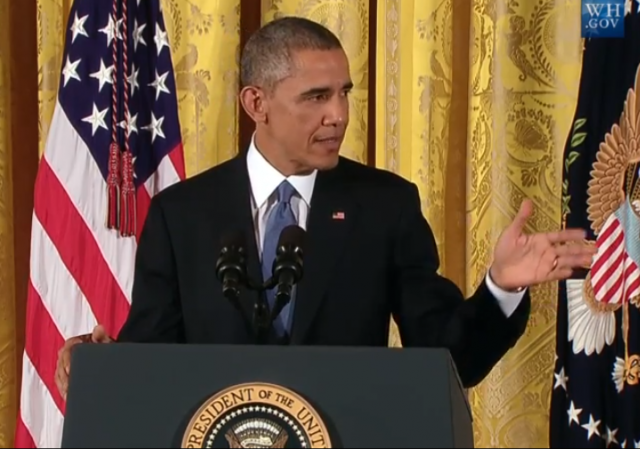
Byron York remarks on one of the more remarkable aspects of Obama's post-election press conference, the notion that those who did not vote have given him a mandate:
President Obama did something extraordinary, perhaps unprecedented, in his post-election news conference Wednesday: He claimed a mandate on behalf of voters who didn't vote. "To everyone who voted, I want you to know that I hear you," the president said. "To the two-thirds of voters who chose not to participate in the process yesterday, I hear you, too." What did that mean? What did those non-voters say? It would probably be more useful to ask what the president heard. And apparently Obama heard expressions of support from non-voters across the land. The president explained that many more voters turned out when he was elected, and then re-elected, than in Tuesday's midterms that left Republicans firmly in control of House and Senate. "One of the things that I'm very proud of in 2008 and 2012, when I ran for office, was we got people involved who hadn't been involved before," Obama said. "Part of what I also think we've got to look at is that two-thirds of people who were eligible to vote just didn't vote."
http://youtu.be/VMIWgaPd_1w?t=26s York continues:

The American Studies Association annual meeting, which started yesterday, had a panel of faculty opposed to the ASA's anti-Israel academic boycott. That panel came against the backdrop of ASA being forced to abandon its previous written policy of excluding representatives of Israeli academic institutions under threat of legal action against the hosting hotel. Apparently, the anti-BDS panel's mere existence was upsetting to some boycott supporters, including Micki McGee of Fordham, who was in the spotlight when she filed a university religious discrimination complaint against a fellow professor who objected to the boycott. Fordham rejected the charge. Inside Higher Ed reports:
It was just the first day of the American Studies Association’s annual meeting here Thursday, but tensions surrounding the organization’s year-old academic boycott of Israel were already flaring. The flashpoint was an anti-boycott panel that sought to explore such questions as the role of political ideology in academic debate, whether the Israel-Palestine conflict is within the purview of the ASA, and whether academic boycotts are a legitimate means to political ends. But while some attendees said they appreciated the panelists' thoughts, others accused them of perpetuating a “for” or “against” line of thinking they said has done irreparable damage to the discipline.

The issue of subsidies on the federal exchange has been accepted by the Supreme Court. Scotusblog reports:
The Supreme Court, moving back into the abiding controversy over the new health care law, agreed early Friday afternoon to decide how far the federal government can extend its program of subsidies to buyers of health insurance. At issue is whether the program of tax credits applies only in the consumer marketplaces set up by 16 states, and not at federally-run sites in 34 states. Rather than waiting until Monday to announce its action, which would be the usual mode at this time in the Court year, the Justices released the order granting review of King v. Burwell not long after finishing their closed-door private Conference. By adding the case to its decision docket at this point, without waiting for further action in lower federal courts, as the Obama administration had asked, the Court assured that it would rule on the case during the current Term. If it confines the subsidies to the state-run “exchanges,” it is widely understood that this would crash the Affordable Care Act’s carefully balanced economic arrangements.
We previously wrote about the King case, Whipsaw: 4th Circuit upholds Obamacare federal exchange subsidy after D.C. Circuit rejects:

There have been few electoral races in which Legal Insurrection played a more decisive role than in the congressional race in my home district NY-23 this cycle. Martha Robertson was challenging incumbent Republican Tom Reed, who won the district in 2012 by about 4 points. Reed was considered vulnerable. Robertson was the promising star in the Democratic Congressional Campaign Committee candidate roster slated to take Reed out. Robertson earned the coveted "Red-to-Blue" designation, meaning that she was one of a small number of Democratic prospects to flip a Republican seat. Robertson was an Emily's List favorite. Money poured in to support Robertson. But Robertson's campaign never really got off the ground as she geared up in the fall of 2013. Our accurate and in depth reporting was a part of that failure. We exposed a false campaign fundraising solicitation that claimed GOP operatives tried to take down Robertson's website during a key fundraising period. That report, which Robertson struggled to deal with, haunted the Robertson campaign for the rest of the campaign. We exposed Robertson's history of supporting single-payer and plan to use Obamacare as the stepping stone. That is not a popular view in this district.

Update 7 p.m.: It's official: In a second trail-blazing pick for the nation's top law enforcement officer, President Barack Obama intends to nominate the federal prosecutor in Brooklyn, New York, to become the next attorney general and the first black woman to lead the Justice Department. Obama's spokesman said Friday that he will announce his selection of Loretta Lynch from the White House on Saturday. If confirmed by the Senate, she would replace Eric Holder, who announced his resignation in September after serving as the nation's first black attorney general. --------------- I admit, I'm prejudiced in favor of Loretta Lynch, my law school classmate and then good acquaintance. Other than a brief encounter at a reunion, I have not had contact with her since 1984, but I've followed her career.  While there certainly is more research to be done, I never viewed her as politicized in her conduct as U.S. Attorney for the Eastern District of New York. It is reported she will be nominated to replace Eric Holder:

snookered...

Rasmieh (Rasmea) Odeh is a convicted Palestinian terrorist on trial in Detroit for falsely stating on her 1994 visa application that she had not been arrested or convicted of a crime or served time in prison. (Indictment here.) Odeh became a naturalized citizen in 2004, and now faces up to 10 years in prison (she rejected a plea deal that likely would have kept her out of prison) and deportation. Odeh was convicted in Israel in the late 1960s of being a member of a terrorist organization and participating in the planting a bomb in a supermarket and at the British consulate. Odeh served 10 years in prison before being released in a prisoner exchange where 76 prisoners in Israeli jails were exchanged for an Israeli soldier captured in Lebanon. Odeh claims she was tortured into confessing to the crimes leading to her conviction, but there is substantial independent evidence that -- at a minimum -- she was one of the planners of the supermarket bombing. Needless to say, the Palestinian activist community, particularly in Chicago, has turned Odeh into a hero and victim of the long arm of Zionism.

Last night's Republican wave drew some strong and funny reactions. Here are some tweets we gathered, and some of our own in no particular order.

We will be covering the main contested Senate elections (all poll closing times in Eastern time): By popular demand (WARNING -- Flashing lights) And Yes, for those of you late to the game, we did set off the Fireworks and Music: Fireworks November 2014 Election Night