

Image 01 Image 03

Somalia Tag

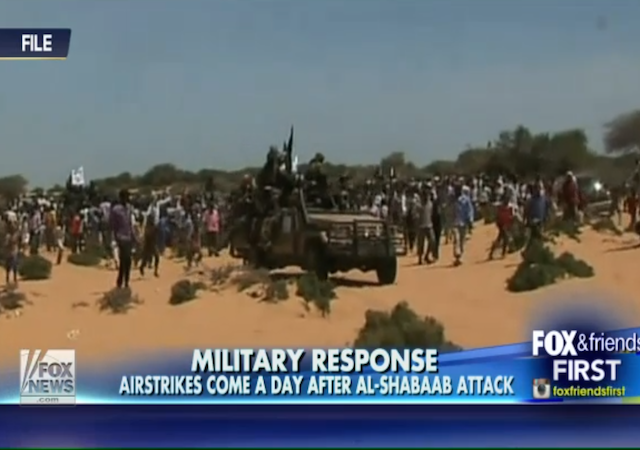
Yesterday, the United States Military launched targeted airstrikes against the insurgent group al-Shabaab in Somalia. From the Washington Post:
“The target of the strike was a senior al-Shabab leader,” Kirby said in a statement. “At this time, we do not assess there to be any civilian or bystander casualties.” A U.S. defense official, speaking on the condition of anonymity to discuss the ongoing analysis of the strike, said officials were not fully certain whether the strike had hit the militant. But he added: “We think the targeting was done precisely and accurately.” The official said that Monday’s attack on al-Shabab did not include any U.S. operations on the ground against the militant leader, whom he declined to name.
Multiple news outlets are reporting that the target was a "senior leader" of the al-Qaida affiliate, but American officials have not yet confirmed a name, or if the strike was successful. This is familiar territory for the U.S. Military, whose targeted drone strikes in southern Somalia this past September deposed former al-Shabaab front man and spiritual leader Ahmed Abdi Godane. After those strikes, Abu Ubeid Ahmed Omar rose to power within the organization, and although officials' lips are sealed (for now) about who this latest target was, it would make sense for the U.S. to target Omar.

Just days after al-Shabaab insurgents attacked an African Union military base in Somalia, one of the group's leaders has been captured along the Somalia-Kenya border. From the AP:
A leader with the Islamic extremist group al-Shabab, who had a $3 million bounty on his head, surrendered in Somalia, a Somali intelligence official said Saturday. Zakariya Ismail Ahmed Hersi surrendered to Somali police in the Gedo region, said the intelligence officer, who insisted on anonymity because he is not authorized to speak to the press. Hersi may have surrendered because he fell out with those loyal to Ahmed Abdi Godane, al-Shabab's top leader who was killed in a U.S. airstrike earlier this year, the officer said. Hersi was one of seven top al-Shabab officials whom the Obama administration offered a total $33 million in rewards for information leading to their capture in 2012. It is not clear if the reward will be paid out for Hersi because he surrendered. Despite major setbacks in 2014, al-Shabab remains a threat in Somalia and the East African region. The group has carried out many terror attacks in Somalia and some in neighboring countries including Kenya, whose armies are part of the African Union troops bolstering Somalia's weak U.N.- backed government.
Reports out of Africa have confirmed that the Gashan (Somali special forces) have cleared out the last of the insurgents who attacked the AMISOM base in Mogadishu, but we still have very little information about why Hersi surrendered, or if his surrender had anything to do with Thursday's attack. Senior military official Col. Abas Ibrahim Gurey told CNN that "Zakariya has told us following his capture that he left Al-Shabaab a year and half ago and since then was looking for to surrender to the Somali government," but have otherwise been tight lipped about the man's motives.

Members of the Islamic terrorist group al-Shabaab have named new leader Abu Ubeid Ahmed Omar to replace Ahmed Abdi Godane, the organization's former spiritual leader who was killed last week in a U.S.-led drone strike in southern Somalia. Ubeyd has some big shoes to fill. The late Godane was instrumental in transforming al-Shabaab from a fractured regional threat into a well-organized machine whose membership orchestrated attacks in Kenya and Uganda as well as in Somalia. In a statement released yesterday, an al-Shabaab spokesman stated that the group intends to maintain its well-cultivated relationship with al-Qaeda. Somali national security minister Gen. Khalif Ahmed Ereg, as well as others in the region, have expressed gratitude for the United States military's part in shaking the foundations Godane worked for years to cultivate:
The killing of Godane was a "delightful victory", said Ereg. He called on militants still fighting for al-Shabaab to surrender to get a "brighter" life from the government. Uhuru Kenyatta, the Kenyan president, thanked the US for killing Godane, saying his death provides "a small measure of closure" for victims of the Westgate Mall attack. Kenyatta's nephew and his fiancée died in that attack. Godane, who used a number of other aliases, led the planning and was responsible for the perpetration of the attack on Westgate, Kenyatta said.

Defense Department officials have confirmed that a weekend drone strike in the Sablale district of southern Somalia has lead to the death of Al-Shabaab co-founder Ahmed Abdi Godane. From the White House Office of the Press Secretary:
Today, the Department of Defense confirmed that Ahmed Godane, the leader of al-Shabaab, is dead as a result of a U.S. military targeted airstrike in Somalia undertaken over the weekend. Godane’s removal is a major symbolic and operational loss to the largest al-Qaida affiliate in Africa and reflects years of painstaking work by our intelligence, military and law enforcement professionals. Even as this is an important step forward in the fight against al-Shabaab, the United States will continue to use the tools at our disposal – financial, diplomatic, intelligence and military –to address the threat that al-Shabaab and other terrorist groups pose to the United States and the American people. We will also continue to support our international partners, particularly the African Union Mission in Somalia, that are working to support the Federal Government of Somalia build a secure and stable future for the Somali people.
The strike took out five other members of the Islamic militant group who recently took responsibility for an attack on a Mogadishu prison that occurred just prior to the drone strikes. The prison is believed to house some of the region's most dangerous militants. According to analysts, Godane was the glue holding the al-Shabaab together. Acting as al-Shabaab's spiritual leader, he was instrumental in forging the group's relationship with al Qaeda, and played a large part in helping the group focus its efforts via a better organized secret police force. Although experts disagree as to whether or not the death of Godane will mean the end of a well-organized movement, the evolution and dynamics of al-Shabaab are proving to be a sobering reminder of just how difficult it is to oust entrenched paramilitary movements, and how long it may take to control and eliminate the influence of ISIS in the Middle East: