


We Have a “Truthy”-ness Problem
on October 19, 2014
19 Comments
When it comes to quantifiably productive debate about politics, Twitter is the abyss. Those who choose to wade into its murky depths accept the fact that they're jumping into the deep end with the hackers, the trolls, and the most enthusiastic dregs of internet society.
The government recognizes this, and they're here to help.
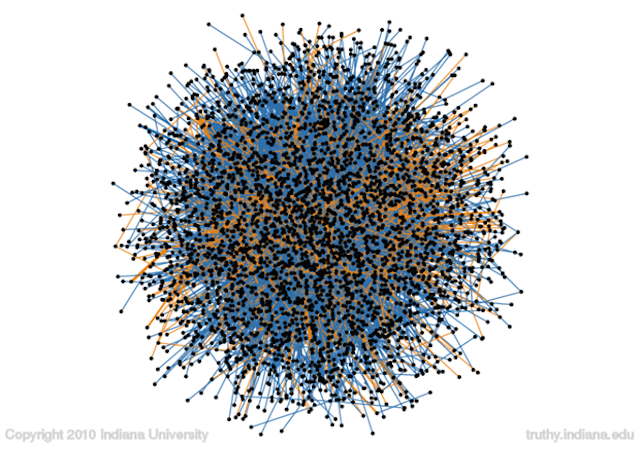
A new project out of Indiana University, dubbed "Truthy," is fully funded by the federal government and seeks to harvest and analyze your Twitter data. The project's developers claim that they've developed a system that "evaluates thousands of tweets an hour to identify new and emerging bursts of activity around memes of various flavors."
Here comes the science, courtesy of Indiana University's Truthy homepage:
We also plan to use Truthy to detect political smears, astroturfing, misinformation, and other social pollution. While the vast majority of memes arise in a perfectly organic manner, driven by the complex mechanisms of life on the Web, some are engineered by the shady machinery of high-profile congressional campaigns. Truthy uses a sophisticated combination of text and data mining, social network analysis, and complex networks models. To train our algorithms, we leverage crowdsourcing: we rely on users like you to flag injections of forged grass-roots activity. Therefore, click on the Truthy button when you see a suspicious meme!Here's a flow chart, which contains even more science: