

Image 01 Image 03

Iran Nuclear Deal Tag

Armin Rosen of Business Insider had a bombshell report on Monday about the Obama administration's diplomatic malpractice with Iran in the context of the nuclear deal announced earlier this summer. Citing a recently obtained State Department document, Rosen reported that the administration has no intention of ensuring that Iran provide the International Atomic Energy Agency (IAEA) with all the details of its past nuclear research. Though "extensive evidence" exists that Iran had a nuclear weapons program until at least 2003, the United States has so watered down Iran's requirements for answering questions about its past nuclear work, that the IAEA  will not have a complete picture of the extent of Iran's military nuclear program. As IAEA Director General Yukiya Amano made clear earlier this week, Iran is still stonewalling. The problem is that the United States is okay with that. Rosen reported:

Last week saw a very important piece of news about the nuclear deal with Iran. And it was covered by neither The New York Times nor The Washington Post. International Atomic Energy Agency Director-General Yukiya Amano said that Iran, instead of coming clean about its past nuclear work, has continued to stonewall. Amano, too much the bureaucrat to use those actual words, said that his agency's report will not be "black and white." But Iran was obligated to come clean by the interim Joint Plan of Action (JPOA) from two years ago "to facilitate resolution of past and present issues of concern." That obligation to come clean also was required by this summer's Joint Comprehensive Plan of Action (JCPOA) to "fully implement the 'Roadmap for Clarification of Past and Present Outstanding Issues' agreed with the IAEA, containing arrangements to address past and present issues of concern relating to its nuclear programme." Since Amano did not say that Iran "fully" addressed questions about its past nuclear work, he's acknowledging that Iran did not comply with its obligations.

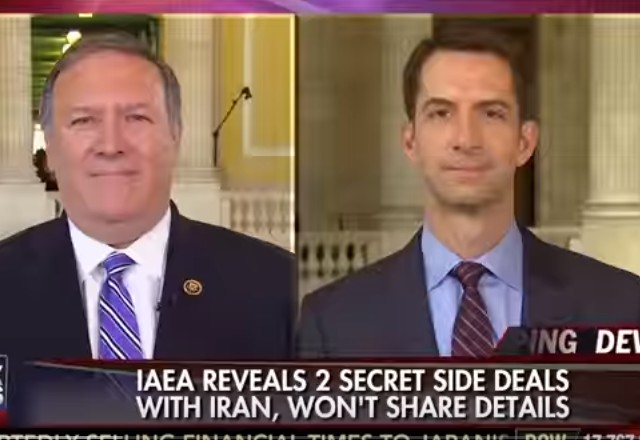
Rep. Mike Pompeo (R - Kan.) and Sen. Tom Cotton (R - Ark.) have a lot in common. Both are army veterans and both are graduates of Harvard Law School. And both have been doing a great job of exposing aspects of the nuclear deal with Iran that the administration would rather keep quiet. This week it was reported that an inquiry from Pompeo got the State Department to admit that the nuclear deal was never signed and is not "legally binding." Julia Frifield, the Assistant Secretary of State for Legislative Affairs, wrote in response to Pompeo's inquiry if he could see the signed agreement, in a letter reproduced at the congressman's website, that the nuclear deal was not binding and that it was not signed by any party. The key parts of the letter read:
The Joint Comprehensive Plan of Action (JCPOA) is not a treaty or an executive agreement, and is not a signed document ...

In a look at the history of the tensions between President Barack Obama and Israeli Prime Minister Benjamin Netanyahu, The New York Times several days ago started with an interesting anecdote.
For President Obama, it was a day of celebration. He had just signed the most important domestic measure of his presidency, his health care program. So when Prime Minister Benjamin Netanyahu of Israel arrived at the White House for a hastily arranged visit, it was likely not the main thing on his mind. To White House officials, it was a show of respect to make time for Mr. Netanyahu on that day back in March 2010. But Mr. Netanyahu did not see it that way. He felt squeezed in, not accorded the rituals of such a visit. No photographers were invited to record the moment. "That wasn't a good way to treat me," he complained to an American afterward. The tortured relationship between Barack and Bibi, as they call each other, has been a story of crossed signals, misunderstandings, slights perceived and real. Burdened by mistrust, divided by ideology, the leaders of the United States and Israel talked past each other for years until the rupture over Mr. Obama's push for a nuclear agreement with Iran led to the spectacle of Mr. Netanyahu denouncing the president's efforts before a joint meeting of Congress.
It's interesting because this is not at all how I remembered it. I remember that the lack of attention to the meeting was perceived as an intentional slight of Netanyahu. A quick check of the contemporaneous reporting confirmed this.

Iranian President Hassan Rouhani confirmed what we all, ahem, knew, that when hundreds of thousands of Iranians led by the Iranian leadership chant "Death to America," they don't really mean it. He didn't say "I’d really like to visit Disneyland," but he did downplay the significance. What they mean is, well, here's the explanation, on 60 Minutes:
Steve Kroft: I'm sure you realize that it is difficult for many Americans to get past the fact that President Obama has signed an agreement with a country that says, "Death to America, Death to Israel." How do you explain this? What are they to make of it? Are they to take it literally? Is this for domestic, internal Iranian political consumption? What are Americans to make of it, the language? President Rouhani: This slogan that is chanted is not a slogan against the American people. Our people respect the American people. The Iranian people are not looking for war with any country. But at the same time the policies of the United States have been against the national interests of Iranian people. It's understandable that people will demonstrate sensitivity to this issue. When the people rose up against the shah, the United States aggressively supported the shah until the last moments. In the eight-year war with Iraq, the Americans supported Saddam. People will not forget these things. We cannot forget the past, but at the same time our gaze must be towards the future.

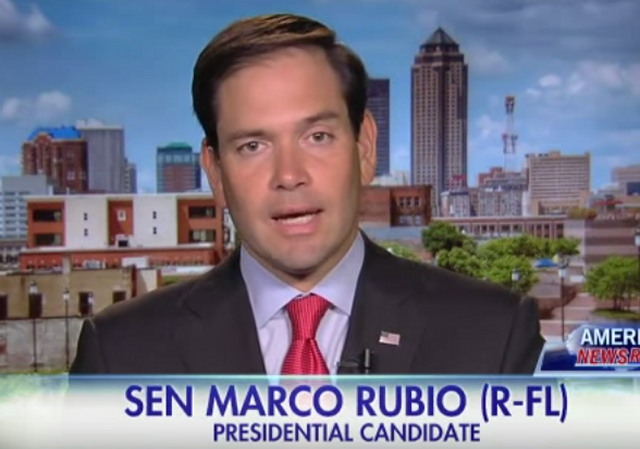
Marco Rubio is not a fan of the Iran deal and had plenty of criticism for Democrats and his own party in a recent interview on FOX News. Al Weaver of the Washington Examiner reported:
Rubio pans Dems for 'walking the plank' on Iran deal Sen. Marco Rubio lit into Democrats supporting the Iran nuclear deal Friday after 42 of them blocked a resolution that rejected the deal on Thursday. During an interview with Fox News' Martha MacCallum, the 2016 hopeful called out Democrats for "walking the plank" by supporting the deal after seeing how Sen. Charles Schumer was treated by the administration after he came out against the agreement in August. Rubio also argued that Democrats who backed the agreement have "become captive to a radical element in their party." "They know it's a bad deal. The Democrats know it's a bad deal," Rubio said. "That's why they all couched their terms in the sense of 'I don't think it's perfect, I don't think it's ideal.'"

On Tuesday I wrote about National Review contributing editor Andrew C. McCarthy and Representative Mike Pompeo's clearly accurate assertions that President Obama has failed to comply with the requirements of the Iran Nuclear Agreement Review Act of 2015. Both McCarthy and Pompeo further asserted that this non-compliance meant that the Congressional review period for the proposed nuclear deal with Iran had not started, and therefore that the time within which Congress must vote on it had not yet started. I also wrote that that McCarthy and Pompeo disagreed about the consequences of this non-compliance, with Pompeo claiming that “the president remains unable lawfully to waive or lift statutory Iran-related sanctions” and McCarthy arguing that Obama still had "authority to waive the existing sanctions — although not to lift them permanently." By Wednesday, however, McCarthy had basically -- and quite happily, it seems -- admitted that his interpretation was wrong. Senator Ted Cruz, he says, explained that,
Under Corker [i.e., the Iran Nuclear Agreement Review Act of 2015] section (b)(3), "prior to and during the period for transmission of an agreement … and during the period for congressional review … the President may not waive, suspend, reduce, provide relief from, or otherwise limit the application of statutory sanctions with respect to Iran[.]" Further, under other provisions of the Corker law, the prohibition against Obama’s taking actions to lift sanctions is extended to ten days after the date that he vetoes a “resolution of disapproval” (assuming one is passed by both houses of Congress). Get it? From the time Obama reached the deal with Iran, through the time for congressional review, and for up to ten more days after Obama’s veto of a disapproval resolution, the sanctions against Iran’s nuclear program must remain in place.

Well, that didn't last long. Chuck Schumer's breakaway from the Democratic Party and obedience to Obama, by coming out against the Iran nuke deal, lasted about as long as the inmates who escaped from Dannemora prison in upstate NY in June. John McCormack at The Weekly Standard reports, Schumer Praises Obama on Iran, Hits Republicans as Hostage-Takers:
Senator Chuck Schumer of New York is the highest-ranking Democrat to oppose President Obama's executive agreement with Iran over the Islamic republic's nuclear program. But during the Senate Democratic leadership's final press conference prior to a vote on the deal, Schumer didn't say anything about it. Instead, he chose to attack Republicans. "Everywhere Republican leaders look this fall, there's potential disaster lurking thanks to their hard right members determined to hold the government hostage unless they get everything they want," Schumer said on Wednesday, referring to budget negotiations.

As expected, the Iran deal disapproval measure failed to win the requisite 60+ votes to invoke cloture in the Senate and allow a vote on the merits. The linked article describes the Congressional Democrats as: "overcoming ferocious Republican opposition and delivering President Barack Obama a legacy-making victory on his top foreign policy priority." But the reality is that Obama's side not only did not get a single Republican vote, it failed to get all the Democratic votes, either. So this was another bipartisan vote---but as usual with Obama, the bipartisanship was all on the side of the opposition to the president. This "victory" of Obama's, so "legacy-making," therefore consisted of Obama getting just enough Democrats on his side to block a vote on the merits (that vote to invoke cloture failed by a margin of two). Even had cloture gotten the necessary 60+, and the disapproval bill come to a vote and been passed, Obama would have vetoed it and there would not have been enough votes to override that veto.

Just in case you were wondering, no, this is not from The Onion. I know it's hard to tell these days, but this is an actual thing that happened. According to Adam Kredo at the Washington Free Beacon, the New York Times has provided a nifty new tool, a Congressional 'Jew Tracker.'
The New York Times has come under fire from Jewish organizations for launching a website aimed at tracking how Jewish lawmakers are voting on the Iran nuclear agreement. The online chart, which tracks whether lawmakers who opposes the accord are Jewish, is being criticized as anti-Semitic in nature and an attempt to publicly count where Jews fall on the issue, which some have sought to turn into a debate about dual loyalty to Israel. The feature, titled “Lawmakers Against the Iran Nuclear Deal,” includes a list of legislators currently opposing the deal.
On the outset, the NYT article seems harmless enough, "Lawmakers Against the Iran Nuclear Deal," it's called. But then there are the charts...

It started yesterday, when conservative Republicans in the House expressed strong disagreement with the GOP leadership over whether to proceed with the vote of disapproval on the Iran deal. The conservative wing aimed to force Obama to first live up to the terms of Corker-Menendez and disclose the still-secret side deals with Iran that (which are an enormously important part of the big picture.) They claimed that the clock on the Congressional review period would not start until Obama complied, and thus the disapproval vote should be delayed. The movement had the support of Ted Cruz in the Senate, and many conservatives in the House (Roskam of Illinois; Pompeo of Kansas and the rest of the House Freedom Caucus). The House doesn't have a cloture or filibuster rule, so it is much easier to bring something to a vote there over minority Democratic opposition than it is in the Senate. Later, it was leaked that Boehner had given in to House conservatives on this issue, agreeing to postpone the vote and substituting a series of votes on three other resolutions in the House:

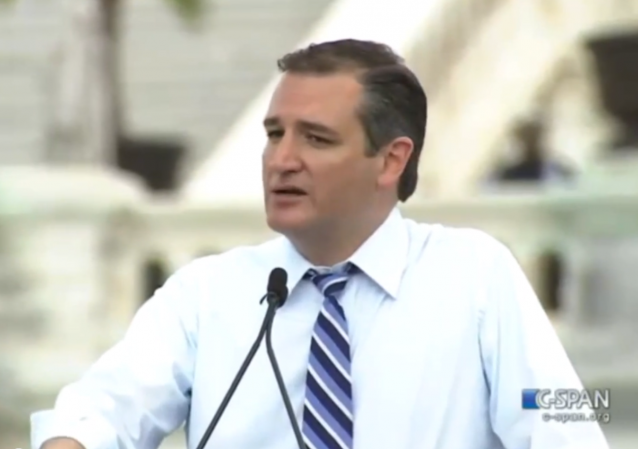
Wednesday afternoon, Senator Cruz joined the Tea Party Patriots rally to Stop the Iran Deal. Cruz's fiery speech outlined the consequences of the passage of the Iran Nuclear Deal. The Obama administration would be, "quite literally the world's biggest financier of Islamic terrorism," said Cruz. His full speech from the rally is here:

Two recent news analysis pieces highlight President Obama's lawlessness in the case of his proposed nuclear deal with Iran. Recall that about one week after the administration’s announcement that it had reached an agreement with Iran, Congressman Mike Pompeo revealed that the IAEA had told him and Senator Tom Cotton that:
Two side deals made between the Islamic Republic of Iran and the IAEA as part of the Joint Comprehensive Plan of Action (JCPOA) will remain secret and will not be shared with other nations, with Congress, or with the public. One agreement covers the inspection of the Parchin military complex, and the second details how the IAEA and Iran will resolve outstanding issues on possible military dimensions of Iran’s nuclear program.
A draft that was said to the same as the final text of one of these side deals was leaked to, and published by, the Associated Press. The second of the two still remains secret. Asking Congress to approve an agreement, the complete terms of which it has not even seen, is of course absurd on its face. Even more absurd is that a sufficient number of Senators to sustain a Presidential veto of Congressional disapproval have agreed to do so.

The United States Ambassador to the United Nations, Samantha Power recently wrote a piece for Politico arguing the Congress not reject the nuclear deal with Iran. In short she argued that rejecting the deal would leave the United States, not Iran isolated and the ability of the United States would be greatly compromised in its ability to influence outcomes globally. Towards the end she summed up her argument:
The Iran nuclear deal has been championed by the president of the United States, every one of America’s European friends and countless other countries around the world. If Congress rejects the deal, we will project globally an America that is internally divided, unreliable and dismissive of the views of those with whom we built Iran’s sanctions architecture in the first place. Although it is hard to measure the precise impact of these perceptions, I and other American diplomats around the world draw every day on our nation’s soft power, which greatly enhances our ability to mobilize other countries to our side. While that soft power is built in many ways, two of its most important sources are the belief among other countries’ leaders and publics that we share similar values, and that America delivers on its commitments. Of course, there is no substitute for the essential deterrent and coercive effects rooted in the hard power of America’s unmatched military arsenal. But we should not underestimate the political capital we will lose—political capital that we draw upon for influence—if we walk away from this deal.
What makes Power's plea so inexplicable is her record. As Claudia Rosett explained back in July:

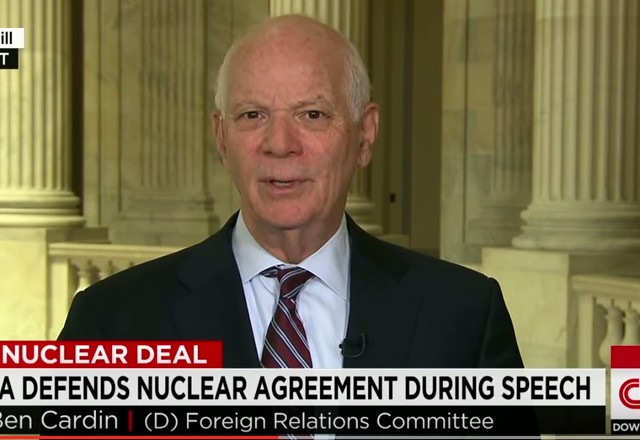
Sen. Ben Cardin (D - Md.) today announced his opposition to the nuclear deal with Iran (AKA Joint Comprehensive Plan of Action or JCPOA) in an op-ed published in The Washington Post. With Sen. Chuck Schumer (D - N.Y.) and Sen. Robert Menendez (D - N.J.) Cardin becomes the third Democrat to break ranks with President Barack Obama and oppose the deal. But Democrats already have enough votes to override a veto. Cardin's main points of disagreement with the deal is that it would legitimize Iran's nuclear program and boost its economy making the imposition of sanctions difficult if not impossible.
The JCPOA would provide this legal path to a country that remains a rogue state and has violated its international nonproliferation obligations for years. It would provide Iran with international endorsement of an industrial-scale nuclear program. Worse, Iran would be economically strengthened by frighteningly quick relief from sanctions and international economic engagement. If Iran violates the agreement, building international support for new sanctions would take too long to be effective. A military response in this scenario would be more likely, although disastrous.

As if biting off a big chunk off Ukraine in Crimea wasn’t enough, Putin is now putting Russian troops on the ground in Syria. Counting on President Obama’s continuing Foreign Policy paralysis on Syria, Russian army is reinforcing Dictator Bashar al-Assad’s air and ground forces. Neither Russia nor Assad’s Syria have any real intentions of destroying the Islamic State (ISIS) in the region. Their primary aim is to restore and maintain territorial control. Emboldened by America’s retreat under President Obama’s reign and the recent rise of its regional ally Iran in the Middle East, Russia feels confident opening up a new front in the Arab heartland. A story by Michael Weiss in The Daily Beast confirms that Russian troops are playing combat role in Syria. Previous reports from the Syrian frontlines dating back to 2013 had indicated Russian presence amidst the ranks of Assad’s Syrian Arab Army (SAA). Michael Weiss writes:
Russian pilots are gearing up to fly missions alongside the Syrian air force, dropping bombs not just on ISIS but on anti-Assad rebels who may or may not be aligned with the United States or its regional allies. Several sources consulted for this story said the Pentagon is being unusually cagey about Russia’s reinvigorated role in Syria. A former U.S. military officer told The Daily Beast, “I’m being told things like, ‘We really can’t talk about this.’ That indicates to me that there’s some truth to these allegations.”
After Iran gets access to over $100 billion of frozen reserves as a signing amount for the nuclear deal, Regime in Tehran is setting about carving out a new map of the Middle East -- tightening its hold on Syria, Iraq, Lebanon and Yemen. Russian want to play a bigger role in this scramble for the Middle East.

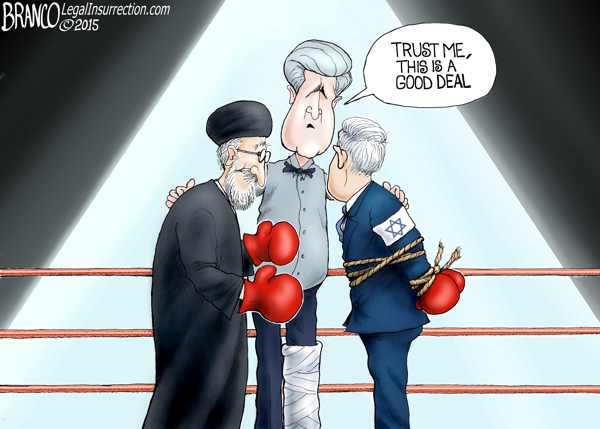
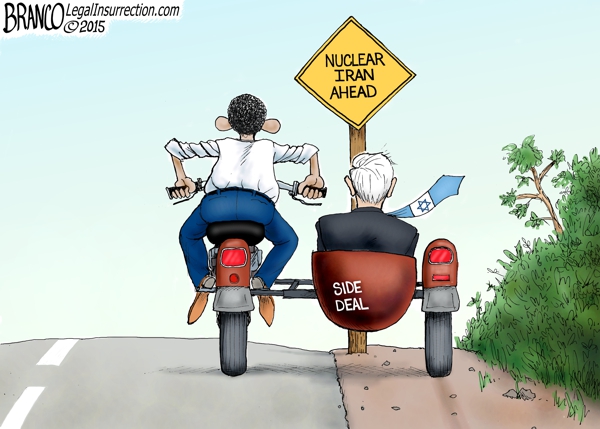
The Iran nuclear deal, which is so bad in so many ways explained here so many times, is a done deal. Democrats now have enough votes in the Senate to prevent an override of an Obama veto of a resolution of disapproval, if it even gets to a vote given Democrats are close to the votes needed to filibuster. Partial blame belongs to Republicans in the Senate for agreeing to a procedure that required passage of a resolution of disapproval by a supermajority, rather than approval by a supermajority, or even a majority. But at least Republicans opposed the deal, which means that majorities in each house of Congress are against it. Whatever procedural mistakes Republicans made are dwarfed by the substantive embrace of the deal by most Democrats in Congress. That despite the fact that the deal is hugely unpopular overall, and is at best a split decision even among Democrats not in Congress. It is not an exaggeration to say that loyalty to Obama was the overriding factor. Democrats in Congress were the main targets of Obama's demagoguery -- be with Obama or be for war; be with Obama or be for the monied lobbyists. The message was clear: Be with Obama or be a traitor. So the deal will not fail. To say that it "passes" is inaccurate. There will be calls once the votes are taken to heal. To make Israel, once again, a matter of bipartisan consensus.