


Image 01 Image 03

Economy Tag

The economic crisis in Venezuela canaptly be described as a centralized control crisis, a crisis socialist and communist states know and for some reason insist on repeating.  Over and over.  We've seen the reports on shortages ranging from toilet paper to food, and rather than risk a revolution that would topple government, the Venezuelan government has decided that it will ease up on price controls on food and other essentials (like toilet paper). NPR, in October of last year, wrote about the problems with Venezuela's price controls and the firm grip the government had its citizens access to food.
For Caracas housewife Anny Valero, today is grocery day — whether she likes it or not. Here's why: It's Monday, and if Valero doesn't go now, she'll have to wait four more days to buy food. In Venezuela, government supermarkets sell price-controlled food, making them far cheaper than private stores. But Valero explains that people are allowed in state-run supermarkets just two days per week, based on their ID card numbers. The system is designed to prevent shoppers from buying more than they need and then reselling goods on the black market at a huge markup.

It looks like putting the left wing Syriza Party in control of Greece hasn't changed much. The country is still broke, still struggling to make cuts and there is still unrest. In fact, recent pension cuts nearly led to rioting. The Telegraph UK reports:
Greek police pepper spray protesting pensioners Greek police on Monday fired pepper spray at pensioners protesting against cuts in their state income. Thousands of pensioners responded to a protest call by the communist opposition and tensions increased as their protest march approached the prime minister's residence.

There is another disturbing report related to the spread of the Zika virus; however, this one doesn't involve birth defects or neurological problems. Millions of honey bees were killed after areas of South Carolina were sprayed to kill the mosquitoes that transmit the pathogen.
"On Saturday, it was total energy, millions of bees foraging, pollinating, making honey for winter," beekeeper Juanita Stanley said. "Today, it stinks of death. Maggots and other insects are feeding on the honey and the baby bees who are still in the hives. It's heartbreaking." Stanley, co-owner of Flowertown Bee Farm and Supply in Summerville, South Carolina, said she lost 46 beehives -- more than 3 million bees -- in mere minutes after the spraying began Sunday morning. "Those that didn't die immediately were poisoned trying to drag out the dead," Stanley said. "Now, I'm going to have to destroy my hives, the honey, all my equipment. It's all contaminated."
Truly, the images of the bee-keepers assessing the loss of both their bees and their livelihoods are heartbreaking:

Brexit has caused quite the kerfuffle among the countries of the European Union (EU), and amid the dire warnings of lasting DOOOM!, the Polish Finance Minister notes that Brexit shows that the EU is not the only option for the nations of Europe. CNBC reports:
The U.K.'s Brexit vote may have changed attitudes to the European Union across the continent, Polish Finance Minister Pawel Szalamacha told CNBC Friday, adding that the decision showed that the EU is "no longer the only choice for the nations of Europe." Szalamacha suggested that more countries could be prompted to leave the 28-nation bloc, such as those "with a strong sense of identity, some of the Nordic countries," or even some countries who may "feel that their destiny … is no longer within their hands." He added, "I don't think it's a sensible policy just to rely on the decisions of the major international players," not least because "some policy mistakes were committed."
Szalamacha goes on to say he supports decentralizing the EU's power base in Brussels so that countries can have more control over their own economies and markets.

In a move that is being hailed as cementing his conservation legacy, Obama has, with the stroke of his pen, expanded a national marine monument off the coast of Hawaii to over 582,578 square miles.  This move will, however, destroy commercial fishing and potential drilling and mineral collection in a vast expanse of our waters. The Hill reports:
President Obama on Friday morning created a massive national monument off the coast of his native Hawaii, the world’s largest protected area. The declaration expands more than threefold the size of the Papahānaumokuāke Marine National Monument, surrounding the outlying northwestern Hawaiian islands. The move in Obama’s final months further cements his legacy of using unilateral executive authority to protect far more land and water as national monuments than any other president.

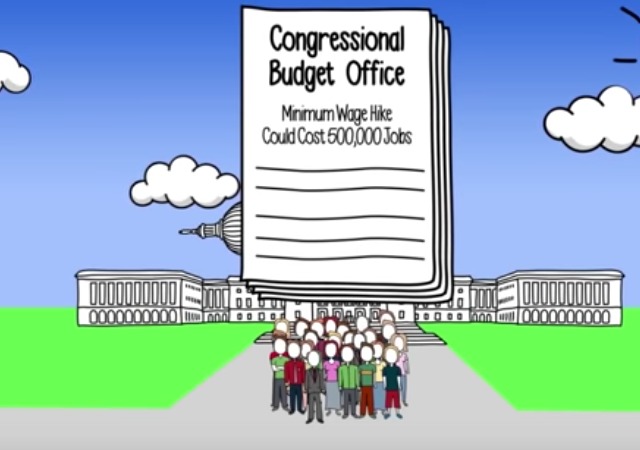
Minimum wage hikes sound great on the surface, but as we've been reporting here at LI, such hikes tend to do the opposite of their proponents' stated intention.  From forcing businesses to fire employees, cut hours, and find technological replacements for workers, minimum wage hikes are counter-productive, even destructive to low-income workers. For example, a new study from Seattle shows that "there was almost no effect on workers' average total earnings" due to a combination of factors including fewer hours and a more difficult time finding a second job to make up those lost hours. The Washington Post reports:
[T]he actual benefits to workers might have been minimal, according to a group of economists whom the city commissioned to study the minimum wage and who presented their initial findings last week.

We've been hearing a lot about the movement toward a cashless world, and Sweden now appears to be leading the race to become completely cashless. The Guardian reports:
“I don’t use cash any more, for anything,” said Louise Henriksson, 26, a teaching assistant. “You just don’t need it. Shops don’t want it; lots of banks don’t even have it. Even for a candy bar or a paper, you use a card or phone.” Swedish buses have not taken cash for years, it is impossible to buy a ticket on the Stockholm metro with cash, retailers are legally entitled to refuse coins and notes, and street vendors – and even churches – increasingly prefer card or phone payments. According to central bank the Riksbank, cash transactions made up barely 2% of the value of all payments made in Sweden last year – a figure some see dropping to 0.5% by 2020. In shops, cash is now used for barely 20% of transactions, half the number five years ago, and way below the global average of 75%.

I am taking a few moments from my "Crazy California" and science coverage today to hit a topic that will be critically important in November: Jobs. Yesterday, the media coverage I followed was focused on San Jose. Interestingly, for those of us who have been following the Facebook trending news saga, San Jose completely failed to appear in the trending items. In fact, here is today's list: LI #53 Facebook Tredning And while I am grateful to see news about the Great Pyramid, I also noticed that another critical story is also absent:

Most people can do without certain luxuries and conveniences for a significant amount of time. Temporary power and internet outages due to storms are common in many parts of America and people get through it. Food on the other hand, is a different story. As any student of history can tell you, when people can't find food things get ugly pretty fast. Venezuela is quickly entering that danger zone. Reuters reports:
'We want food!', Venezuelans cry at protest near presidency Venezuelan security forces fired teargas at protesters chanting "We want food!" near Caracas' presidential palace on Thursday, the latest street violence in the crisis-hit OPEC nation.

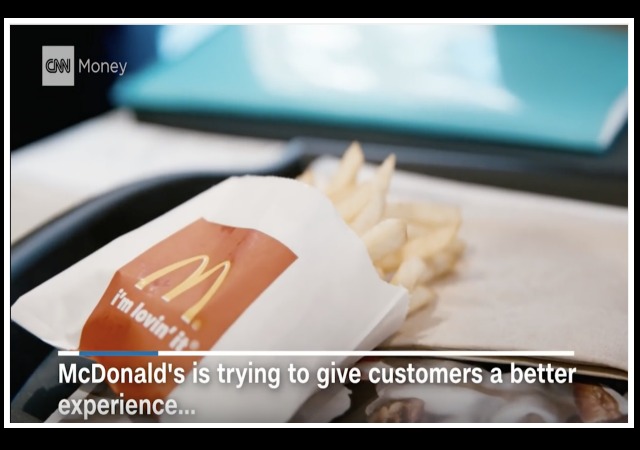
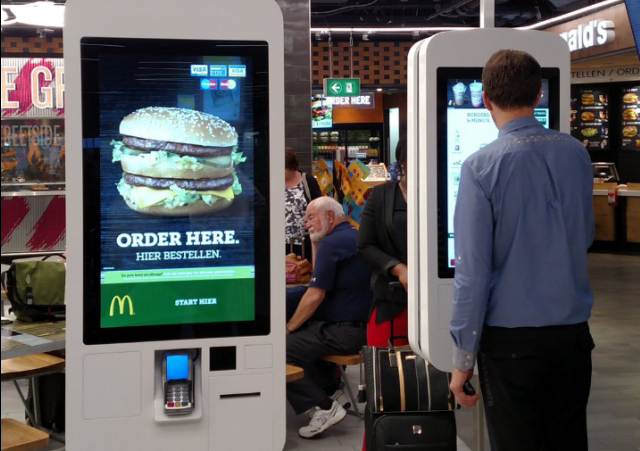
Being replaced by machines is probably not what the Raise the Wage! crowd had in mind, but here we are. Again. For almost two years, McDonald's has been flirting with automated ordering machines, and has introduced the new mechanical overlords to some of its locations. I blogged about this back in 2014:

The American economy is off to a horrible start in 2016. GDP grew a measly 0.5 percent in the first quarter of this year. No wonder Democrats want to talk about transgender people and bathrooms. Bloomberg reports:
U.S. Economy Expands to 0.5% Pace, Weakest in Two Years The U.S. economy expanded in the first quarter at the slowest pace in two years as American consumers reined in spending and companies tightened their belts in response to weak global financial conditions and a plunge in oil prices.

New York's new minimum wage is being cited as the main reason that a popular Albany restaurant is closing its doors after serving the community for decades. Mental Recession reports:
Beloved Upstate Restaurant Closes, Cites Minimum Wage Hike As Major Reason An Albany area fish fry restaurant is closing its doors after nearly 70 years in business, and the owner is pointing to New York’s $15 minimum wage as a major reason for his establishment’s downfall. Bob and Ron’s Fish Fry, described by New York Upstate as an “Albany institution” featuring “the best fish fry in the Capital Region,” announced they’d be closing their doors in less than two weeks.

Obama signed an Executive Order (EO) on Friday that affects American businesses and the free market (what's left of it, anyway). Obama has ordered the FCC to open up set-top cable boxes to competition, and he more broadly ordered executive agencies to search for ways that they can ensure competition among free market businesses and corporations. The set-top box order centers on the way that cable companies lease these boxes to consumers, charging a monthly fee for their use.  Harkening back to the days when people had to rent phones from the telephone company, the order intends to correct the problem as was done in telephone case. The White House writes:
That’s why today the President announced that his Administration is calling on the FCC to open up set-top cable boxes to competition. This will allow for companies to create new, innovative, higher-quality, lower-cost products. Instead of spending nearly $1,000 over four years to lease a set of behind-the-times boxes, American families will have options to own a device for much less money that will integrate everything they want — including their cable or satellite content, as well as online streaming apps — in one, easier-to-use gadget.
On its face, this doesn't seem to be a problem and may even be a good idea for those still using cable, but this is just the tip of the iceberg.

Last week, CBS aired a special report on the missing or redacted 28 pages of the 9/11 Commission's report that might implicate Saudi Arabia in the 9/11 attacks.  In the CBS report, former Senator and former Florida Governor Bob Graham (D-FL) restated his long-held view that these 28 pages should be declassified. From the transcript of the CBS report entitled "28 Pages":
. . . [T]he White House and intelligence officials are reviewing whether to declassify one of the country's most sensitive documents -- known as the "28 pages." They have to do with 9/11 and the possible existence of a Saudi support network for the hijackers while they were in the U.S. For 13 years, the 28 pages have been locked away in a secret vault. Only a small group of people have ever seen them. Tonight, you will hear from some of the people who have read them and believe, along with the families of 9/11 victims that they should be declassified. Bob Graham: I think it is implausible to believe that 19 people, most of whom didn't speak English, most of whom had never been in the United States before, many of whom didn't have a high school education-- could've carried out such a complicated task without some support from within the United States.
Graham, who has seen the 28 pages and has been trying to get the pages declassified since 2003, has to be careful about what he says, but he is confident that there is connection.

The State of New York just passed two significant measures. One is a new family leave policy and the other is a new minimum wage of $15 an hour. Liberals are pretty stoked about both items. Smaller businesses, particularly in hard-hit upstate NY, not so much. Expect the people intended to benefit -- lower wage workers in marginal industries -- to be hardest hit because there will be fewer jobs. Entry level positions, where many people get their start, will be harder to come by. New York Mag reports:
New York Just Created a Revolutionary New Family-Leave Policy You say you want a revolution? A political, social, economic policy upheaval that will dramatically alter the playing field for millions of Americans by significantly reducing economic and gender inequality?

Early this week, while most people were focusing on the Nevada GOP caucus, CNN held another Democratic Party town hall event. When Bernie Sanders was confronted about the viability of his proposals, he got a little cranky. Jack Heretik reports at the Washington Free Beacon:
Bernie Sanders Tries To Defend Viability Of His Socialist Proposals Sen. Bernie Sanders (I., Vt.) dismissed criticism of his socialist economic proposals as coming from Hillary Clinton’s campaign during CNN’s Democratic Town Hall Tuesday night.

We've become accustomed to hearing from the increasingly shrill fringe left about the greedy evils of the top 1%.  However, it's important not to lose sight of the fact that Americans are a generous and charitable people . . . including the most wealthy among us. The Washington Examiner reports that of the world's charitable donations an entire third comes from America's top 1%.
Americans are a charitable group, in fact the most generous in the world, according to the new Almanac of American Philanthropy. In a first of its kind survey, the Almanac found that Americans out-donate Britain and Canada two-to-one and nations like Italy and Germany 20-to-one. What's more, more than half of every single income class except those earning less than $25,000 donate to charity. The much maligned top 1 percent in the U.S. economy fork over one third of all donations made. Even in death.