


Image 01 Image 03

US Supreme Court Tag

Today, the Supreme Court handed down a ruling that stands to drastically change the relationship farmers have with the federal government. The order in Horne, et al. v. Department of Agriculture turned on its head the idea that the government can seize an entire "bundle" of property rights, yet avoid classifying that seizure as a taking as long as they allow the original owners to retain some manner of interest in the property. In 2001, Marvin and Laura Horne challenged that very premise when they decided to withhold portions of their raisin crop that the government mandated be relinquished to the Raisin Administrative Committee (which is indeed a real thing); the Hornes were fined almost a million dollars for their transgressions, but they fought back, arguing that the Committee's seizure of even a portion of an individual farmer's crop as a condition of participating in the market constituted an unconstitutional taking.

Think tanks, policy wonks, legislative staffers, and politijunkies are eagerly awaiting the Supreme Court's ruling on King v. Burwell. As for the rest of the country, most have clue why this case is so crucial. John David Danielson of The Federalist addressed this issue Thursday:
According to a new poll by the Kaiser Family Foundation, 7 in 10 Americans have heard little or nothing about King v. Burwell, the U.S. Supreme Court case that will, any day now, decide the fate of Obamacare’s health insurance subsidies for millions of Americans. Yet 63 percent of those surveyed also say that if the court rules against the government, Congress should act to keep those subsidies in place. Got that? The vast majority of Americans know almost nothing about this case, but 63 percent have an opinion about what Congress should do in response to a ruling that carries certain policy implications.
Thanks for nothing, Media. But what about those enrolled in Obamacare? The Foundation for Government Accountability surveyed voters enrolled in a federal exchange heath care plan. Obamacare customers do think Congress should act to change the law, but not for the same reasons as the general respondents surveyed in the Kaiser Family Foundation poll.

There has been a lot of speculation, including by me, about what the Republican-controlled Congress will do should the Supreme Court rule against Obama in King v. Burwell.  Should the Court strike down federal subsidies, Republicans will need to have a plan in place to address this decision as it impacts those who are currently receiving subsidies for ObamaCare from the federal exchange because their state did not set up a state exchange. Republicans are still talking about a "fix" but are now stressing that it is to be "transitional" rather than permanent.  According to Bloomberg:
[Representative Dennis Ross of Florida] added, “There’s a strong consensus in that room” that the subsidies must be continued in some form “until Republicans can substantively change the law.” Participants at Wednesday’s closed-door meeting said key aspects of a transition plan were presented to lawmakers by Ryan, Energy and Commerce Committee Chairman Fred Upton, Budget Committee Chairman Tom Price of Georgia and Education and Workforce Committee Chairman John Kline of Minnesota. Along with immediate repeal of the law’s individual and employer mandates, the plan would give states the option to build their own insurance exchanges and offer subsidies, using federal money. Alternatively, people in states affected by the ruling would receive a subsidy to purchase an insurance plan either from healthcare.gov or on the open market.

Atlantic writer Russell Berman wonders:
...[Obama's] decision to champion his signature achievement in such pointed terms just weeks before the high court’s ruling is due raised the question of whether Obama was trying to jawbone the justices at the 11th hour. ...“It seems so cynical,” he said, “to want to take coverage away from millions of people; to take care away from people who need it the most; to punish millions with higher costs of care and unravel what’s now been woven into the fabric of America.”... The speech came a day after the president, in response to a reporter’s question, commented directly on the case before the justices..."Under well-established precedent, there is no reason why the existing exchanges should be overturned through a court case," Obama said. "This should be an easy case. Frankly, it probably shouldn't even have been taken up," he added... [In 2012, Obama had] sharply warned the Court not to rule against his healthcare law the first time around. “I'm confident that the Supreme Court will not take what would be an unprecedented, extraordinary step of overturning a law that was passed by a strong majority of a democratically elected Congress,” Obama said then.

I was a guest Tuesday morning on The Tony Katz Show on WICB Indianapolis. The topic was the Zivotofsky case discussed earlier this week, Supreme Court Overturns Congress on Jerusalem Passport Law. I made the point that while the majority decision purported to make the decision very narrow, it's likely that the decision would be used to try to limit Congressional legislation more broadly as relates to foreign policy: Professor Eugene Kontorovich expresses a similar view, writing at ScotusBlog (via Volokh Conspiracy):

The Supreme Court decided the much-anticipated Zivotofsky case, involving a congressional law which permitted American citizens born in Jerusalem to choose to list "Israel" as their place of birth, rather than just "Jerusalem," as the State Department mandated.  (Full Opinion here.) Needless to say, the case had enormous political implications, even if the legal issue itself was not particularly political.  The Executive Branch refuses to recognize Jerusalem as the capital of Israel, or even though Israel has declared Jerusalem to be its capital both when it was divided prior to 1967, and after it was reunited in 1967.  Worse still, for passport purposes it does not even recognize Jerusalem as part of Israel at all. The political gloss is that the Executive Branch claims the issue should be subject to negotiations, but the reality is that the State Department fears backlash from the Palestinians and Israel-hating nations (i.e., most of the United Nations) should it side with Israel's claim to Jerusalem as its capital. Congress, on the other hand, is in sync with American domestic public opinion, which is overwhelmingly pro-Israel, so in 2002 Congress passed a law to force the State Department's hand on the issue.

Republicans are in a pickle, and have been since the moment Obamacare was passed. You might think they're in a good position, because the Supreme Court is considering overturning the state Obamacare exchanges and subsidies because of wording in the statute, and this would throw the entire Obamacare system into turmoil. The case in question is King v. Burwell, and it could be decided any day now. But there's one catch, and it's a biggee: if the ruling goes against Obamacare, the press and the left will rail at the Republicans for being the big bad meanies who took away a lot of people's subsidies. That was part of the beauty of Obamacare for the left, and one of the many many reasons they were so extraordinarily eager to pass it and pass it as quickly as possible: they wanted to create a dependence and an expectation, otherwise known as an entitlement, that would be tremendously hard to reverse. But what do the American people actually want if SCOTUS throws out the state exchanges and therefore the state subsidies? A substantial majority appear to want Congress to fix Obamacare rather than re-establish the state exchanges, according to this poll. But what would that actually look like?

Yesterday, fledgling retailer Abercrombie & Fitch lost their anti-hijab case in the Supreme Court. Amy provided background when SCOTUS heard oral arguments in February:
Back in 2008, Samantha Elauf, an observant Muslim, applied and was interviewed for a job at teen-friendly retailer Abercrombie & Fitch. She impressed the hiring manager, but when the time came to make a decision, the manager decided not to hire Samantha because she had concerns about whether or not Samantha would insist on wearing her headscarf to work. This would have been a violation of Abercrombie’s “Look Policy,” which dictates that employees conform to a strict set of style guidelines that specifically prohibit head coverings and black clothing.
Abercrombie's "Look Policy" was summarized as, "classic East Coast collegiate style."

Remember Anthony Elonis? He was sentenced to four years in federal prison after he posted original rap lyrics and other content concerning his wife, co-workers, a kindergarten class, and even a federal agent. A lower court held that Elonis' posts constituted a "true threat" against those mentioned in his rants, and he served more than three years of his sentence before being released. At controversy in the ensuing lawsuit was the prosecutor's use of a low-hanging, "reasonable person" standard in his instructions to the jury. The Court had never specifically ruled on whether or not a prosecutor must show intent to carry out verbal or written threats in order to get a conviction; lower courts are split, with most requiring enough evidence to show that a reasonable person would see or hear the speech and believe that it is “a serious expression of an intention to inflict bodily injury or take the life of an individual.” In today's ruling, the Supreme Court held that requiring only negligence with respect to the communication of a threat, is not sufficient to support a conviction under the statute that governed Elonis' alleged crimes.

It's time to define what the meaning of the word "population" is---and how it applies to the drawing of electoral districts. In 1964, the Supreme Court ruled in Reynolds v. Sims that, under the Equal Protection Clause of the 14th Amendment, state legislative districts have to be about equal in population. The Court also held that population must always be the "controlling consideration" in state redistricting. Seem straightforward? Not so fast, say two voters from Texas. A few years ago, Sue Evenwel and Edward Pfenninger, together with the Austin-based Project on Fair Representation, sued the State of Texas over an implemented redistricting plan that redrew state senate districts based on total population, as opposed to voting population. They argue that such a standard dilutes the voting power of registered voters living in areas heavily populated with nonvoters and illegal immigrants, thus violating the principle of "one person, one vote." The Texas Tribune explains:

The U.S. Supreme Court issued an Order this morning denying the Petition for Writ of Certiorari in the Wisconsin John Doe case. For background, see our prior posts, including Will Supreme Court take blockbuster “John Doe” campaign case?:
The case is O’Keefe v. Chisholm.... The issue on which review was sought had little to do — on the surface — with the substance of the abuses in the John Doe case, but rather, focuses on a technical legal point as to whether and when federal courts can or should stop state investigations.... But, the nature of the case necessarily involves the underlying ability of states to regulate campaign coordination and how that ability interacts with First Amendment rights.
While the Court will not hear the case, the underlying investigation currently is on hold anyway because of a separate federal court order not involved in the Supreme Court petition, and a state court order putting the investigation on hold. Here is the Supreme Court Order: http://www.supremecourt.gov/orders/courtorders/051815zor_a86c.pdf

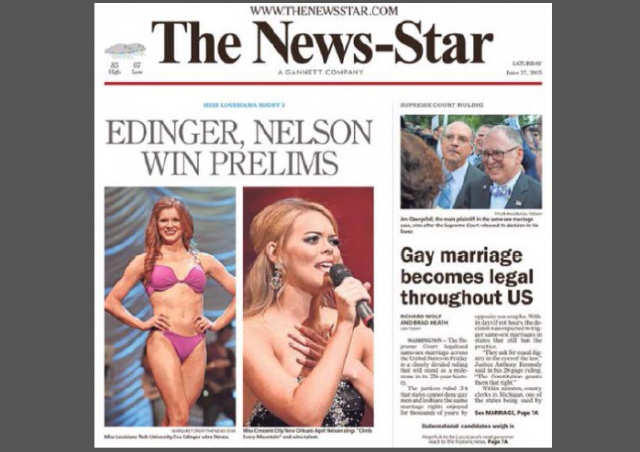
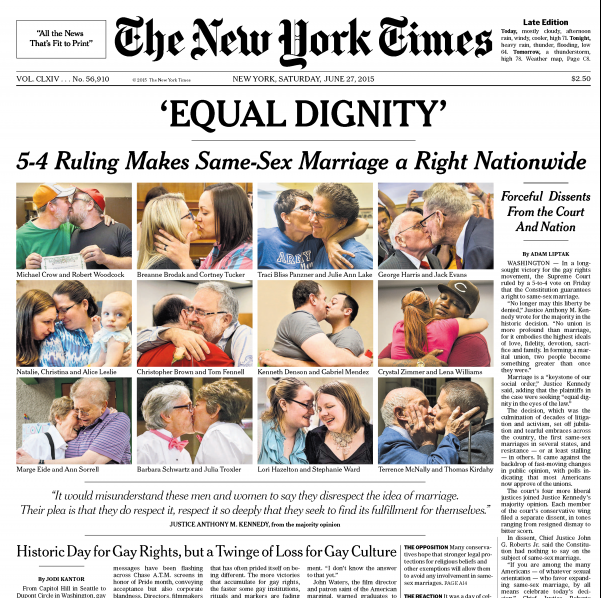
No matter which way you come down on the issue of gay marriage, today was a big day at the Supreme Court. Those who wished to sit in the courtroom (and who weren't lucky enough to hold membership in the Supreme Court Bar, or the media) camped for several nights outside the courthouse, and today, protesters (both hopeful and defiant) gathered on the steps to make their voices heard. Obergefell v. Hodges is consolidated with three other cases, and the issues at hand are pretty simple compared to those contained in other cases we've covered:
1) Does the Fourteenth Amendment require a state to license a marriage between two people of the same sex? 2) Does the Fourteenth Amendment require a state to recognize a marriage between two people of the same sex when their marriage was lawfully licensed and performed out-of-state?
So, here we are. "Finally," some would say. Is gay marriage an idea whose time has come, or an idea that should be left untouched by the government? Both parties had their day in court today, and the ebb and flow of oral arguments revealed a divide in the Court that has left many SCOTUS watchers hesitant to make a prediction.

The U.S. Supreme court has not yet decided whether to grant a petition for writ of certiorari to review a decision by the 7th Circuit Court of Appeals that ruled the federal courts should not have issued an injunction halting the "John Doe" investigation targeting conservative groups in Wisconsin. The case was on the Supreme Court conference list for Friday, April 24, 2015, and a decision was expected to be part of Orders issued today, but there was no order. Andrew Grossman, one of the counsel for the petitioners, tweeted this morning: The case is O’Keefe v. Chisholm. You can find all the pleadings here. Since the vast majority of cases are not accepted by the Supreme Court, it's hard to know what, if anything, the delay means. The issue on which review was sought had little to do -- on the surface -- with the substance of the abuses in the John Doe case, but rather, focuses on a technical legal point as to whether and when federal courts can or should stop state investigations. Here's how ScotusBlog summarized the issues:

In 2015 America, government overreach isn't exactly headline news anymore. From the IRS to the VA to the EPA, it seems like every agency in the country is managing to find new and exciting ways to rob from the middle class to feed the bureaucracy; not only is the "system" growing, it's getting harder and harder for the average citizen to fight The Man and come out standing. Not headline news, and nothing new; many of the programs giving Americans hell were developed decades back. One program targeting raisin farmers, however, is currently under fire from business owners looking to protect their property rights. In the wake of World War II, the US government developed a series of programs aimed at stabilizing the agricultural industry. They wanted to drive up market prices, and decided the best way to do so was to confiscate a portion of each farmer's raisin crop without compensation. (Yes, really.) In 2001, farmers Marvin and Laura Horne decided they had had enough with regulations, and developed their own packaging and distribution system.

In 2012, the Supreme Court ruled that states have the right to refuse the ObamaCare Medicaid expansion without penalty to other, existing, federal Medicaid funding.  Following is the summary from SCOTUSblog:
The Court’s decision on the constitutionality of the Medicaid expansion is divided and complicated.  The bottom line is that: (1) Congress acted constitutionally in offering states funds to expand coverage to millions of new individuals; (2) So states can agree to expand coverage in exchange for those new funds; (3) If the state accepts the expansion funds, it must obey by the new rules and expand coverage; (4) but a state can refuse to participate in the expansion without losing all of its Medicaid funds; instead the state will have the option of continue the its current, unexpanded plan as is. [emphasis added]
It is quite surprising, then, that the Obama administration is trying to use federal low-income pool (LIP) funding to, according to Governor Scott, "coerce" Florida into accepting the short-term federal funding of the ObamaCare Medicaid expansion. There are a number of good reasons for refusing the Medicaid expansion: Not only are health outcomes under Medicaid substantially less than those under any other health care or health insurance program, but this federal funding effectively runs out in only three years, leaving states to foot the hugely-expanded Medicaid bill. Governor Scott has said that he is unwilling to pile such crushing debt on the backs of Florida taxpayers:

Obama's big government health care takeover has taken another hit---albeit a small one---to its provisions mandating the coverage of contraception. Notre Dame v. Burwell seemed dead last year, when the Seventh Circuit threw out a lawsuit laying out the University of Notre Dame's religious objections to Obamacare's contraception mandate. Notre Dame brought their objection in the wake of the Religious Freedom Restoration Act, which allowed religious organizations to opt out of the mandate and pass responsibility for paying the costs of contraception to insurance companies. The institution argued that this still placed a burden on exempt religious institutions, because even when opting out, those institutions still have to authorize the coverage. The last time the Seventh Circuit considered this case, SCOTUS had not yet ruled in the landmark Hobby Lobby case, which authorized closely held corporations to seek religious exemptions from the contraception mandate. The Seventh Circuit ruled that Notre Dame failed to show a sufficient burden against the rights of religious institutions; but SCOTUS has now tossed out that ruling completely, and have ordered the appeals court to review the case in light of the Hobby Lobby ruling. Reuters has more background:

Arguments in the case of King v. Burwell helped serve to shine light on just how big of a mess implementing, changing, scuttling, or rebuilding the ACA will be. From Bloomberg:
It wasn’t immediately clear where the court leaned, as Chief Justice John Roberts -- who voted in 2012 to uphold the law as constitutional -- asked few questions during the hearing Wednesday. A ruling is expected by late June. Alito’s suggestion that the court might set an end-of-the-year termination date for subsidies in healthcare.gov states was greeted somewhat favorably by solicitor general Donald Verilli, who represented the Obama administration. “That would reduce the disruption,” he told Alito. Still, he said it was “completely unrealistic” to expect that states that lack their own exchange could build one by the end of the year. Under current regulations, for example, states must win approval from the health department by May for an exchange that would open for business in October. Justice Antonin Scalia, another Republican appointee, said that Congress could act to solve the problem. Republicans in both the Senate and House have said that they would respond to a court ruling against the government with legislation to preserve insurance coverage, but they don’t agree on a solution. “Well, this Congress, your honor?” Verilli said, to laughter. “Theoretically, they could.”
One does not joke before the Supreme Court unless one is absolutely positive that the bench will join in the fun. Everyone laughed.